
The awkward part of buying a supply chain control tower is that three vendors can show three convincing demos and still be selling three different operating models. One screen highlights late shipments and carrier ETAs. Another lets planners test demand, inventory, and capacity scenarios across a future horizon. A third changes routes, sequences stops, and pushes new instructions into same-day execution. All three may call the product a control tower. Only one may fit the bottleneck that is actually costing the operation money.
That distinction matters more in 2026 because buying intent is running ahead of operating readiness. Current market summaries project the global control tower market at USD 8.75 billion in 2026, with North America holding 37.2% share, while Blue Yonder-cited survey data says 37% of supply chain organizations prioritize control towers and only 66% of leaders feel ready for the future, down from 73% in 2025.[1] Those numbers are best read as pressure signals, not victory laps. More companies are budgeting for control towers at the same time their teams are less confident they can absorb what the systems expose.

Start With the Failure Mode, Not the Vendor Category
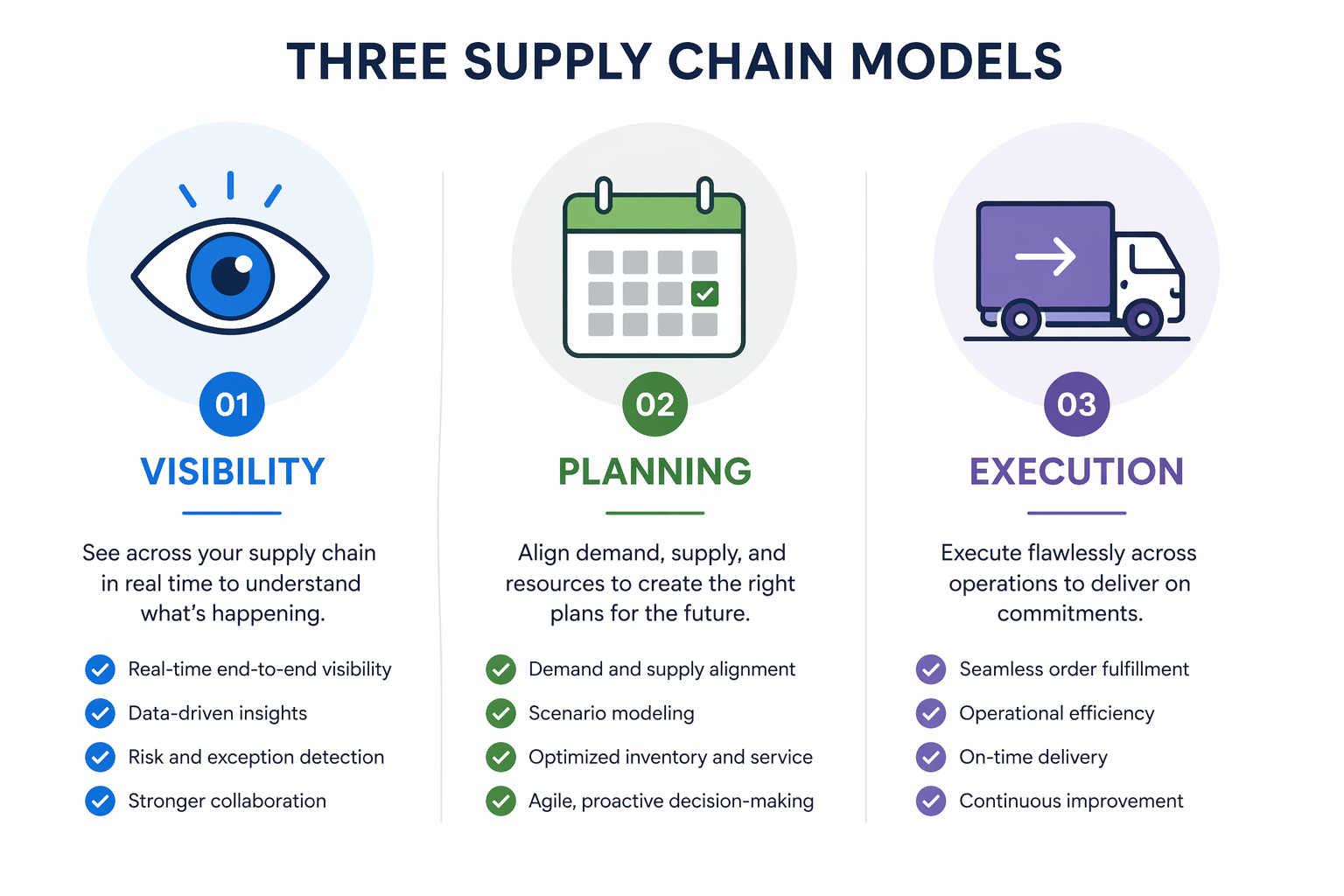
A cleaner way to compare control tower vendors is to ask where the operation loses the most money because a decision is late, missing, or impossible. In practice, the answer usually falls into one of three failure modes: failing to see, failing to plan, or failing to react in time. The three-model framework published in Locus’s 2026 control tower guide maps these differences as visibility-led, planning-led, and execution-led control towers, with different vendor examples and operating assumptions attached to each model.[1]
| Bottleneck | Best-fit model | What the system mainly changes | Where it can fail |
|---|---|---|---|
| The team cannot reliably see where inventory, shipments, or exceptions are | Visibility-led | Signal quality, event monitoring, exception awareness | Alerts pile up if no team has capacity or authority to act |
| The team sees problems but cannot make better forward decisions fast enough | Planning-led | Scenario modeling, supply-demand tradeoffs, planning horizons | Strategic insight arrives too far from daily execution |
| The team sees the exception but reacts too slowly to protect service or cost | Execution-led | Routing, dispatch, task assignment, exception handling | Automation is wasted if the real problem is network design or policy |
This table is deliberately operational rather than taxonomic. The useful question is not whether a platform has a dashboard, an AI label, or a broad partner ecosystem. The useful question is which decision changes after the system goes live, who makes that decision, and whether the software reduces the constraint around that person or team.
Visibility-Led Towers: Useful Signal, Human Bottleneck
Visibility-led control towers are the model many buyers picture first: shipment tracking, supplier or carrier events, exception alerts, ETA updates, and heat maps that make network disruption visible. Project44, FourKites, E2open, and SAP are common examples in this visibility-led category in the Locus framework.[1] For SAP-specific buyers, a deeper vendor profile of SAP Supply Chain Control Tower is useful because the value proposition often depends on how standardized the surrounding SAP environment already is.
The best case for this model is simple: the organization is making bad decisions because it is operating from stale, fragmented, or unreliable signals. Transportation does not know which loads are at risk. Customer service finds out after the customer does. Procurement cannot distinguish a supplier delay from a carrier delay. Inventory planners are working from updates that arrive after the decision window has closed.
A visibility-led tower can improve that operating environment. It gives the team a shared event layer and a faster way to identify exceptions. The hard part starts immediately after the alert. If a system flags 200 at-risk shipments and the transportation desk has authority to intervene in only 20 of them, the control tower has not solved the bottleneck. It has measured it more attractively.
This is where many demos overperform. A red lane on a map is visually persuasive. A ranked exception queue looks like progress. But unless the buyer has defined who reviews the alert, which decisions they can make, what data they need to make them, and what downstream team must accept the new instruction, the tower depends on manual response capacity. That may be acceptable. It just needs to be priced and staffed honestly.
Visibility-led systems fit best when the most expensive failure is lack of reliable signal. They fit poorly when the team already sees the problem but cannot resolve it before the service or cost damage is done.
Planning-Led Towers: Better Decisions Before the Exception Exists
Planning-led control towers live in a different decision horizon. They are less concerned with today’s dispatcher trying to save a delivery window and more concerned with whether the network, inventory position, production plan, or supply allocation will hold up under changing assumptions. Blue Yonder, Kinaxis, o9 Solutions, and Coupa are commonly discussed in this planning-led group.[1]
The planning-led buyer’s pain is not usually that no one knew a truck was late. It is that the organization could not evaluate alternatives early enough: shift production, reallocate inventory, change sourcing, prioritize customers, or rebalance capacity. The decision is forward-looking. The consequence may show up in service, margin, working capital, or expediting cost weeks later.
That is why planning-led systems tend to involve bigger enterprise programs. Altexsoft’s vendor comparison, citing Nucleus Research, places typical planning-led platform deal sizes in the USD 300,000 to USD 1 million-plus annual range.[2] That number should not be treated as a universal quote, but it does reflect the scope difference: these platforms often sit close to integrated business planning, demand-supply balancing, and cross-functional scenario work rather than only shipment monitoring.
The risk is buying a planning-led tower to solve an execution bottleneck. A quarterly or monthly scenario engine may improve the quality of network and allocation decisions, but it will not necessarily help a dispatcher at 2:40 p.m. decide which driver should take an urgent reassignment. The platform may correctly identify a better plan while the daily operation still bleeds through missed handoffs, manual routing work, or slow exception escalation.
Planning-led systems fit best when the costly failure is poor forward decision quality. They fit poorly when the company already has reasonable plans but cannot execute today’s exceptions with enough speed and consistency. Buyers comparing planning vendors may also want to read the focused comparison of Blue Yonder vs. Kinaxis after they have confirmed that planning, rather than response latency, is the constraint.
Execution-Led Towers: When the Clock Is the Constraint
Execution-led control towers address a more immediate operating problem: the exception is known, the decision window is short, and the team needs the system to help change what happens next. That may mean rerouting vehicles, resequencing stops, reassigning tasks, updating dispatch instructions, or handling delivery exceptions without waiting for a planner or supervisor to manually work through every option.
This model is especially relevant in last-mile, field service, store replenishment, and dense transportation environments where many small decisions accumulate into service failure or cost leakage. The operating question is not only “What happened?” It is “Can the system help the team respond before the delivery window, route plan, or customer promise is lost?”
Locus reports customer outcomes for execution-led control tower deployments including 25% efficiency gains, 45% more deliveries per vehicle, and 8% SLA improvement.[1] Those figures are useful as examples of the kind of execution metric this model targets, but they should stay in their proper box: they are vendor-published, customer-reported outcomes, not independent benchmarks or guaranteed results.
The attraction of execution-led systems is that they reduce the gap between detection and action. The danger is assuming every operation is ready for that. If dispatch rules are unclear, master data is weak, labor agreements limit reassignment, or customer promise policies are inconsistent, automation can expose governance problems rather than remove them. Execution-led software works best when the organization can define which decisions can be automated, which require approval, and which should stay with a human operator.
This is also where newer AI-native and agentic approaches become relevant, though the category is still unevenly documented. The practical dividing line is whether the system merely recommends or actually orchestrates bounded actions. For readers exploring that shift, the analysis of agentic AI in logistics control towers is a useful next layer, provided the evaluation stays tied to real operating authority rather than autonomy language.
The Expensive Mistake Is a Model Mismatch
The wrong control tower does not always fail dramatically. More often, it becomes an expensive layer of partial truth. People log in, admire the visibility, export reports, and then continue resolving the same constraints through email, spreadsheets, phone calls, and tribal knowledge.
A visibility-led system bought for an execution problem creates alert fatigue. Transportation sees more late-risk loads but still lacks routing authority, carrier options, or automated dispatch support. Customer service gets better explanations but not better outcomes. Leadership sees the exception count and may mistake measurement for control.
A planning-led system bought for a signal problem can create a different failure. Planners model scenarios against incomplete or delayed operating data. The platform may be sophisticated, but the inputs do not reflect what is happening quickly enough. The organization then spends enterprise-planning money while still arguing about basic event truth.
An execution-led system bought for a planning problem can automate local decisions inside a network that was poorly designed in the first place. The routes may improve, the dispatch queue may move faster, and the same structural constraints may remain: inventory in the wrong nodes, unrealistic delivery promises, weak capacity planning, or supplier risk that should have been addressed upstream.
This is why broad top-10 lists and market maps should be used carefully. Supply Chain Digital’s ranking is helpful for seeing how prominent vendors position themselves, but a ranked list cannot answer which decision bottleneck belongs to a specific operation.[3] Vendor landscape research is useful after the buyer has named the constraint; before that, it can make unlike products look more comparable than they are.
How to Diagnose the Bottleneck Before Shortlisting
The best diagnostic work happens before the RFP language hardens. Pick a costly recurring exception and follow it from first signal to final consequence. A late inbound container, a missed store delivery, an out-of-stock caused by allocation conflict, or a same-day delivery failure can all work. The specific example matters less than the discipline of tracing the decision path.
- When did the organization first have a usable signal that something was wrong?
- Who saw the signal, and did they trust it enough to act?
- Which alternative decisions were available at that moment?
- Who had authority to choose among those alternatives?
- How much time passed between detection, decision, and execution?
- What cost or service damage occurred because that chain was too slow or incomplete?
If the first usable signal arrived too late or no one trusted it, the organization is likely failing to see. If the signal was available but the team could not evaluate tradeoffs across inventory, capacity, sourcing, or demand, it is likely failing to plan. If the right answer was obvious but action still moved too slowly, it is failing to react in time.
That diagnosis should shape demo scripts. A visibility-led demo should prove event coverage, data freshness, exception prioritization, and workflow handoff. A planning-led demo should prove scenario speed, constraint modeling, cross-functional assumptions, and decision traceability. An execution-led demo should prove how the system changes dispatch, routing, task assignment, or exception resolution within the operational time window.
For a complementary way to separate capabilities from model type, the framework on the four functional clusters of a supply chain control tower can help buyers avoid turning every requirement into a generic visibility, analytics, collaboration, or automation checkbox.
Combining Models Is Possible, but It Raises the Maturity Bar
The three models are not mutually exclusive in mature enterprises. A company may use a planning-led platform for quarterly or monthly supply-demand decisions, a visibility layer for shipment and event intelligence, and an execution-led system for daily dispatch and exception response. In that pattern, visibility becomes connective tissue rather than the whole tower.
The maturity requirement is easy to underestimate. Combining models means the organization must define which system owns which decision, how exceptions move between planning and execution, and how feedback from daily operations changes future plans. Without that design, a multi-platform architecture can create a second control tower problem: more dashboards, more alerts, and more meetings to reconcile what each system says.
Hybrid and AI-native products may reduce some of this fragmentation over time, but the buyer’s test should stay grounded. Does the platform improve signal reliability, forward decision quality, or response latency? If it claims to do all three, ask which one it improves first in your environment, using your data, with your people responsible for the next action.
The Matching Rule
Choose a visibility-led control tower when the expensive bottleneck is lack of reliable signal. Choose a planning-led control tower when the expensive bottleneck is poor forward decision quality. Choose an execution-led control tower when the expensive bottleneck is response latency. Combine them only when the organization is ready to connect strategic planning, operational visibility, and daily execution without creating another layer of noise.
References
- Best Supply Chain Control Tower Providers, Locus, 2026, https://locus.sh/blogs/best-supply-chain-control-tower-providers/
- Supply Chain Control Tower Visibility: Software Comparison, Altexsoft, https://www.altexsoft.com/blog/supply-chain-control-tower-visibility/
- Top 10 Supply Chain Control Towers, Supply Chain Digital, https://supplychaindigital.com/top10/top-10-supply-chain-control-towers
Comments
Join the discussion with an anonymous comment.