
The most useful Samsung factory number is also the one that should make supply chain leaders slow down before they celebrate it. In a reported backend automation pilot at Samsung’s Cheonan and Onyang sites, manpower demand fell by 85% while equipment failure rates fell by 90%. The figures, reported by Digitimes in March 2024 citing South Korean outlet Dealsite and industry insiders, refer to work completed around June 2023 rather than to a Samsung-published performance dashboard.[1]
Even with that caveat, the pairing matters. Labor demand went down sharply, and quality-related disruption appeared to improve at the same time. That is the uncomfortable promise of Samsung’s AI factory transition: automation can remove work and stabilize operations in the same move. The management problem begins once both things are true.
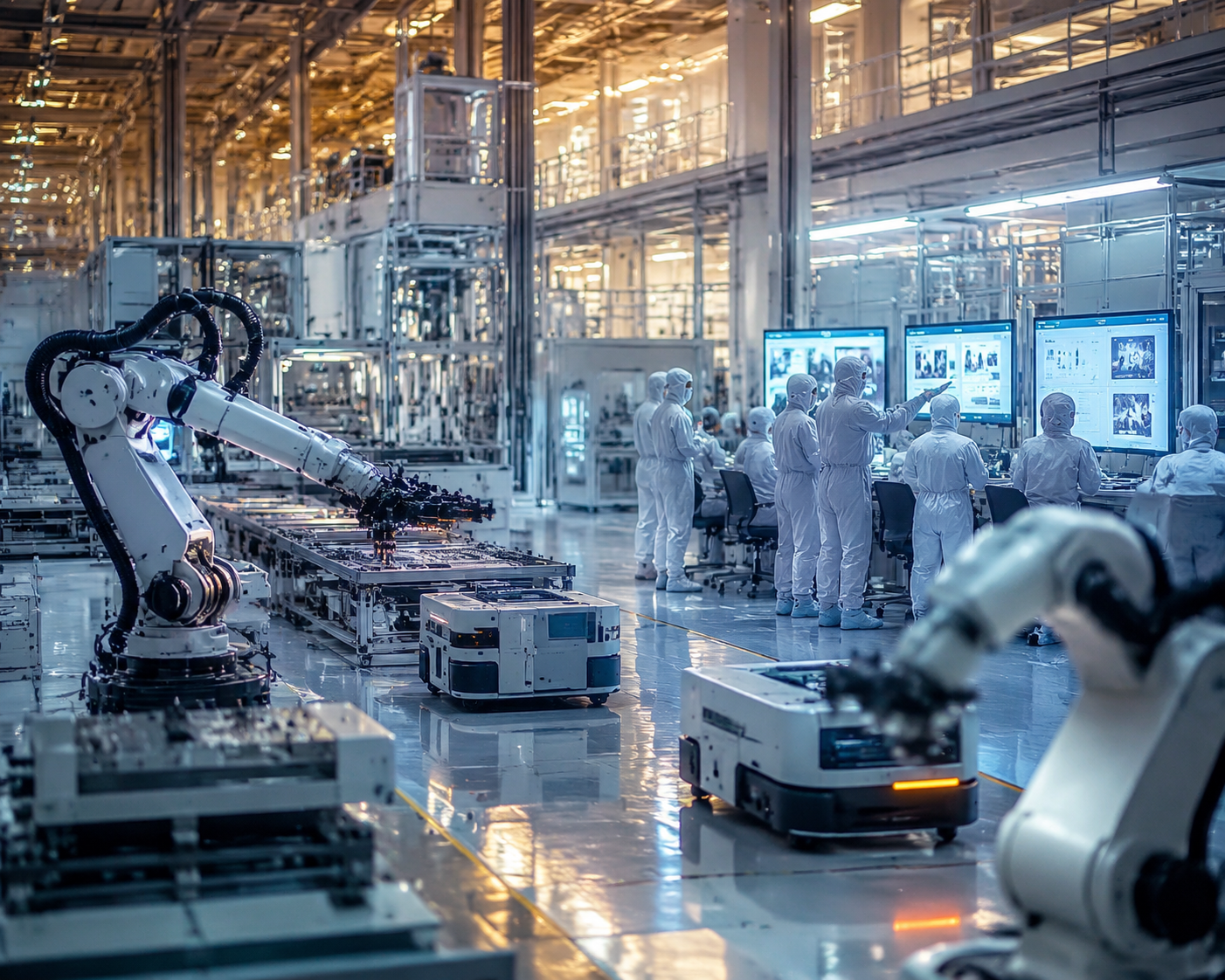
For Samsung, the Cheonan and Onyang case is not an isolated efficiency anecdote. In March 2026, Samsung Electronics announced a company-wide plan to transition its global manufacturing network into AI-driven factories by 2030. The official roadmap includes operating robots, logistics robots, assembly robots, environmental safety robots, agentic AI, and digital twins.[2] The language is broad, but the workforce implications are more specific: some jobs become unnecessary, some become supervision and exception-management roles, and some sites become more valuable than others inside the same corporate system.
The real fault line is backend manufacturing
Semiconductor automation is not starting from zero. The frontend side of chip manufacturing is already highly automated. Digitimes reported that Samsung’s frontend semiconductor manufacturing exceeds 90% automation, while backend operations remain at only 20% to 30% automation.[1] That gap explains why the Cheonan and Onyang numbers are so important. The biggest labor impact is likely to concentrate where work has remained more manual, variable, and inspection-heavy.
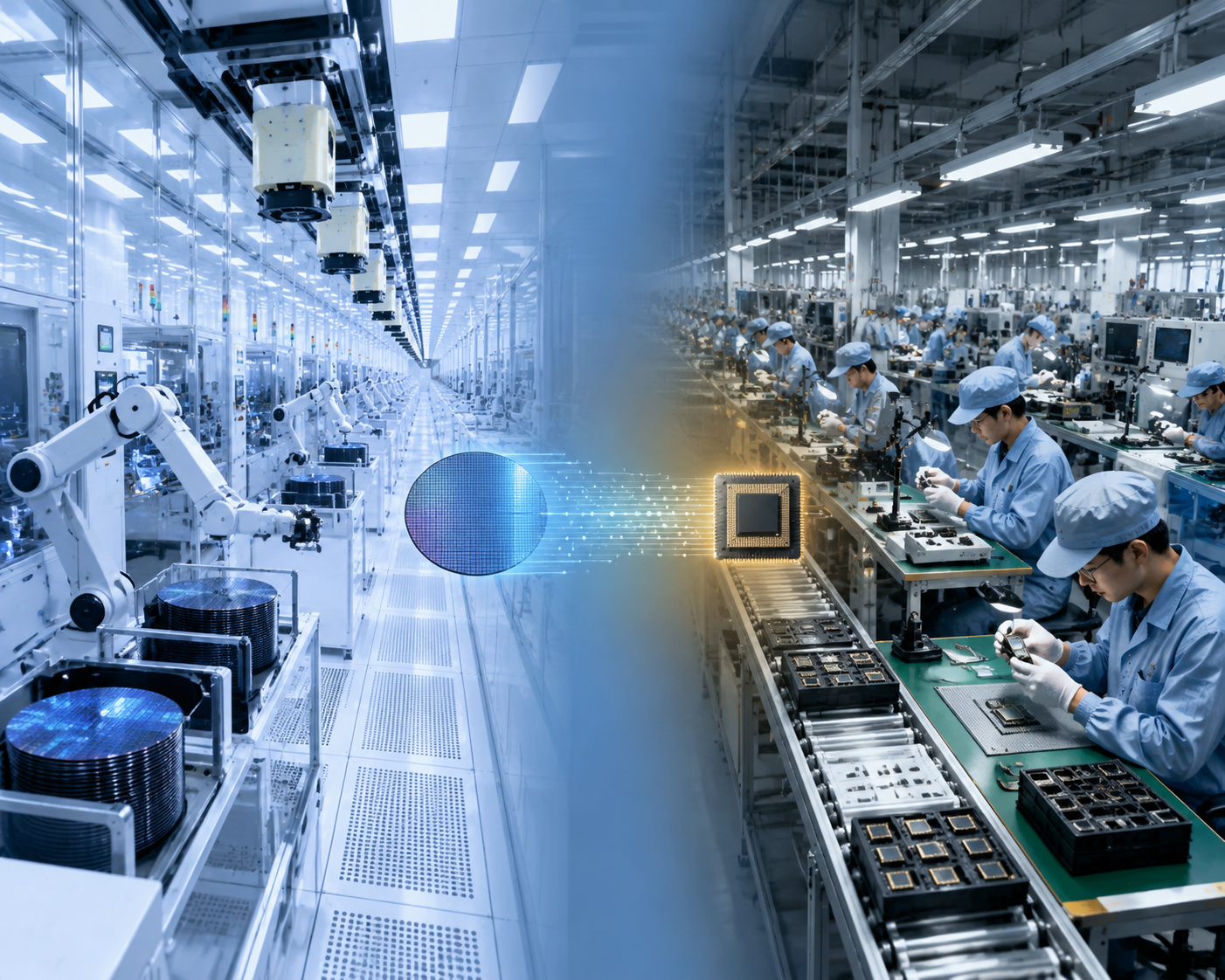
Frontend fabs have spent decades pushing human intervention out of the most sensitive parts of the process. Backend operations are different. Packaging, assembly, testing, inspection, internal logistics, material handling, and exception recovery can contain more fragmented work. They are also closer to the parts of a supply chain where automation has to deal with physical variation, line balancing, equipment downtime, and human know-how that may never have been fully documented.
That is why an 85% reduction in manpower demand cannot be read as a generic automation benchmark. It is more useful as a signal about where AI, robotics, and digital-twin systems may produce the steepest organizational shock. If backend labor has been absorbing complexity that frontend automation already eliminated, then backend automation shifts that complexity into system design, maintenance, data quality, process engineering, and escalation workflows.
| Factory Area | Reported Automation Position | Workforce Implication |
|---|---|---|
| Frontend semiconductor manufacturing | More than 90% automated, according to Digitimes citing industry sources | Fewer direct manual roles remain; workforce pressure centers on engineering, monitoring, process control, and uptime |
| Backend operations | Reported at 20% to 30% automation before Samsung’s 2030 push | Higher exposure to headcount reduction, role redesign, and skills displacement |
| AI-driven factory roadmap | Samsung’s official 2030 plan covers robots, agentic AI, digital twins, and environmental safety automation | Workforce planning must move beyond operator counts to include system supervision, exception handling, and technical retraining |
Samsung’s Digital Twin Task Force, formed in 2023, was reported as part of the effort to close the frontend/backend automation gap by 2030.[1] Digital twins are often described as planning tools, but in this context they are also labor-allocation tools. Once a process can be modeled, simulated, monitored, and optimized through software, the human role changes from performing each step to maintaining the conditions that let the system perform.
Samsung’s 2030 plan is broader than robotics
The visible machinery in Samsung’s roadmap matters, but it is not the center of the workforce story. Samsung’s official announcement describes operating robots, logistics robots, assembly robots, and environmental safety robots working alongside agentic AI and digital twin technology.[2] A later report also pointed to the Rainbow Robotics RB-Y1 humanoid robot as part of Samsung’s manufacturing automation direction.[3]
The humanoid detail is useful mainly because it shows how far Samsung is willing to extend physical automation. It does not answer the harder question: which human roles remain valuable when robots can move materials, support assembly, monitor environmental safety, and feed operational data into AI systems that can recommend or execute next actions?
For a supply chain leader, the relevant unit of analysis is not the robot. It is the workflow. A logistics robot reduces walking time and transport variability. An assembly robot changes takt-time assumptions and line staffing. Environmental safety robots can alter inspection routines and risk response. Agentic AI may reduce the number of routine decisions that supervisors and planners make directly. Digital twins can move process changes from live trial-and-error into simulation. Each change can look operationally sensible on its own, while the combined effect rewrites the workforce map.
Reskilling is not a side program
Samsung has at least one visible answer to the skills problem. Its Smart Factory Support Program trained 4,752 small and midsize enterprise professionals in 2025 alone, and the program had reached 3,625 SMEs cumulatively since 2015, according to Samsung’s sustainability materials.[4] The program is not the same thing as a complete internal transition plan for Samsung’s own workforce. Still, it is evidence that Samsung understands a basic constraint: autonomous factories need a skills pipeline outside the factory walls as well as inside them.
That distinction matters. A company can buy robots faster than it can produce experienced technicians, automation engineers, maintenance specialists, data-literate supervisors, and frontline workers who know when an AI recommendation is wrong. Supplier capability also becomes part of the labor strategy. If Samsung automates its own sites faster than smaller suppliers can adapt, bottlenecks do not disappear; they move upstream or downstream.
The Smart Factory Support Program should not be treated as a moral offset for headcount reduction. Training thousands of SME professionals does not automatically protect workers in lower-growth divisions, nor does it guarantee that displaced backend workers move into higher-paid technical roles. It does show, however, that AI manufacturing scale requires institutional training capacity. Without that, an autonomous factory roadmap becomes a procurement plan with a labor shortage attached.
- Map roles by task exposure, not by job title, because backend jobs often combine manual handling, judgment, inspection, and informal troubleshooting.
- Separate roles likely to be displaced from roles likely to be upgraded, because the training path and compensation logic are different.
- Train suppliers and internal teams together where process changes cross organizational boundaries.
- Measure whether trained workers actually move into growth roles, not only how many people complete programs.
AI gains are not landing evenly inside Samsung
The workforce picture becomes sharper when Samsung’s semiconductor momentum is placed beside job cuts elsewhere in the company. Reuters reported that Samsung Electronics America would cut 739 jobs in New Jersey under a July 2026 WARN notice.[5] Reports have also described possible cuts of up to 30% in some overseas consumer electronics divisions, but those figures have not been confirmed by Samsung and should be treated as less certain than the WARN-notice layoffs.[5]
At the same time, Samsung’s chip business has been pulled upward by the AI cycle. CNN reported in May 2026 that Samsung had reached a $1 trillion valuation and that first-quarter profit had jumped 48-fold.[6] Those numbers do not prove that every automation gain caused every profit gain. They do show how strongly AI-era demand can concentrate value in the divisions closest to advanced semiconductors while other parts of the same company face cost pressure.
That split is the part many automation business cases understate. AI can raise demand for certain products, increase the strategic value of certain fabs, and reduce labor demand in selected workflows at the same time. The result is not a clean story of company-wide prosperity or company-wide displacement. It is a redistribution of bargaining power, training opportunity, bonus pools, and career security.
For supply chain executives, this is where the Samsung example becomes more than a technology case. If semiconductor teams see growth, bonuses, and strategic investment while consumer electronics or backend workers see cuts, the organization is asking different groups to accept very different versions of the AI transition. That difference can become an operational issue long before it becomes a reputational one.
Labor tension is a supply continuity risk
Samsung’s labor disputes show why workforce inequality cannot be parked in HR while operations leaders focus on yield and throughput. Reuters reported that a one-day April 2026 labor action caused foundry output to drop 58% and memory fab output to fall 18%.[7] Supply Chain Digital reported that 48,000 workers, equal to 38% of Samsung’s domestic workforce, threatened an 18-day strike, while JPMorgan estimated a potential operating profit impact of 21 trillion to 31 trillion won, or roughly $14 billion to $21 billion.[8]
Those are not soft consequences. A foundry output drop affects customers waiting on capacity. A memory fab slowdown matters in an AI hardware cycle where availability can shape downstream production schedules. A strike threat becomes part of supply risk modeling, especially when the affected company is central to memory, foundry, and consumer electronics supply chains.
The lesson is not that automation causes strikes. The available evidence does not support that kind of simple causal claim. The narrower and more useful lesson is that uneven gains from an AI boom can intensify labor disputes, and those disputes can interrupt production. Once that happens, workforce strategy becomes a supply chain control point.
What supply chain leaders should take from Samsung
Samsung’s AI factory roadmap gives supply chain leaders a useful but demanding model. The Cheonan and Onyang pilot figures suggest that headcount reduction and quality improvement can coincide in backend automation. Samsung’s 2030 plan shows that the company is not treating that result as a small local optimization. Its skills programs show that automation at this scale requires training capacity. Its labor disputes show that productivity gains can still become supply risk when the benefits and burdens land unevenly.
The first practical move is to stop treating headcount impact as a late-stage finance adjustment. If a workflow is being redesigned around robotics, agentic AI, or digital twins, the workforce model should be redesigned at the same time. That means identifying which tasks disappear, which tasks move to exception handling, which tasks require higher technical judgment, and which groups have realistic access to the new roles being created.
The second move is to treat backend operations as a transition zone, not as a residual labor pool. If backend automation is where the largest gap remains, then backend workers should not be the last group invited into reskilling. They are often the people who understand the failure modes, inspection habits, workaround logic, and informal process knowledge that automation teams need to encode or redesign.
The third move is to put workforce inequality into supply chain risk reviews. A company can have a strong automation return on investment and still create resentment if gains concentrate in one division while cuts fall in another. Samsung’s 2026 labor tensions show that this is not only an internal communications problem. It can become a capacity problem.
Samsung’s example does not offer a clean formula for every manufacturer. The useful lesson is narrower: when AI reduces labor demand and improves quality, leaders still have to decide who learns the new system, who is moved into higher-value work, who is left exposed, and how quickly those choices turn into supply continuity risk.
References
- Samsung aims to automate chip backend process by 2030, Digitimes
- Samsung Electronics Announces Strategy to Transition Global Manufacturing into AI-Driven Factories by 2030, Samsung Newsroom, March 2026
- Samsung to use humanoid robots and agentic AI to reshape its global factories by 2030, Notebookcheck
- Samsung Sustainability Smart Factory Support Program document, Samsung Sustainability
- Samsung Electronics America to reduce workforce by 739 in New Jersey, US WARN notice, Reuters, July 18, 2026
- Samsung’s AI boom masks deepening labor divide, CNN, May 21, 2026
- Samsung global AI boom spurred looming strike, deep divisions, Reuters, May 15, 2026
- Samsung strike: AI memory shortage supply chain impacts, Supply Chain Digital
Comments
Join the discussion with an anonymous comment.