
Oracle’s 2026 supply chain AI strategy is easiest to understand if the usual product language is separated into three capability tiers. This is an analytical framework, not Oracle’s official packaging: embedded machine learning inside planning and execution screens; single-task AI agents that recommend or handle bounded exceptions; and coordinated agentic applications that manage multi-step outcomes across functions. The distinction matters because each tier moves judgment to a different place in the operating model.
| Capability tier | What Oracle has put into the market | Where judgment sits | Main supply chain implication |
|---|---|---|---|
| Tier 1: Embedded ML | Forecasting, optimization, demand sensing, recommendations, and other AI features embedded in SCM workflows | Mostly with the planner, who reviews better system outputs | Less manual analysis, but the same core planning role |
| Tier 2: Single-task agents | AI agents across planning, PLM, procurement, maintenance, manufacturing, inventory, logistics, and order management | Shared between agent and human validator | Planners and analysts spend less time finding exceptions and more time approving, rejecting, or tuning recommended actions |
| Tier 3: Coordinated agentic applications | Fusion Agentic Applications such as Logistics Execution Command Center, Warehouse Operations Workspace, Production Shift Operations Workspace, and Design-to-Source Workspace | Distributed across multi-agent workflows, business rules, escalation paths, and supervisors | The organization must define decision rights, guardrails, escalation ownership, and accountability before autonomy becomes operationally safe |
That progression is the practical center of Oracle’s AI strategy and its supply chain implications. The question is no longer whether Oracle can put AI into supply chain software. Oracle’s SCM AI catalog already presents more than 100 AI capabilities across supply chain planning, procurement, manufacturing, maintenance, logistics, order management, and product lifecycle management.[1] The harder question is which decisions Oracle’s AI is now being asked to influence, coordinate, or execute.

Tier 1 keeps AI inside the familiar planning workflow
The first tier is the least dramatic and still the most familiar to most supply chain teams: AI and machine learning embedded inside existing SCM processes. Oracle’s SCM AI page groups these capabilities around use cases such as improving forecast accuracy, optimizing inventory, automating procurement, improving logistics performance, and helping teams make better operational decisions.[1]
The SCM 26A release shows that Oracle is continuing this embedded-AI cadence rather than treating AI as a separate sidecar. Oracle described 26A as part of Fusion Cloud SCM’s quarterly innovation stream, with built-in AI aimed at resilient supply chains.[2] That release-cadence point is not glamorous, but it matters. Enterprise supply chain adoption usually happens when capability arrives inside the screens and approvals people already use, not when a separate innovation team builds a demo outside the planning cycle.
At this tier, the planner’s work changes by degree rather than by category. A demand planner may receive a better forecast signal. A supply planner may see improved optimization output. A procurement analyst may see ranked supplier suggestions. But the human still performs the same basic loop: review the system output, compare it with business context, adjust where needed, and move the plan forward.
That is useful, but it is not yet a new operating model. Embedded ML can reduce manual data preparation and improve the quality of the first answer. It does not, by itself, decide who owns a cross-functional exception, who can override a policy, or what happens when an optimization recommendation is financially correct but commercially unacceptable.
For teams using AI to support scenario-heavy planning, including network shifts and sourcing changes, this tier connects naturally to adjacent planning use cases such as AI-enabled nearshoring supply chain planning. The important distinction is that embedded ML improves the planning conversation; it does not automatically redesign the decision meeting.
Tier 2 changes the planner from exception finder to exception validator
The second tier is where the labor implications become more concrete. On February 10, 2026, Oracle announced AI agents for supply chain management across planning, product lifecycle management, procurement, maintenance, manufacturing, inventory, logistics, and order management. The announcement named agents including the Planning Cycle Agent, Autonomous Sourcing Agent, Inventory Aging Advisor, and others intended to help users act on specific supply chain tasks and exceptions.[3]
This is a different design pattern from embedded forecasting or optimization. A single-task agent does not merely improve an input. It watches a bounded area of work, interprets a condition, and recommends or initiates an action inside a defined process. The operational handoff moves from “here is a better number” to “here is the exception and the recommended next step.”
That handoff is where spreadsheet work either declines or quietly mutates. If the agent reliably finds aging inventory, drafts a sourcing recommendation, or prepares a planning-cycle action, the analyst no longer spends the same amount of time scanning for the issue. But someone still has to decide whether the recommendation fits current policy, customer priority, supplier reality, and financial exposure.
Oracle’s April 2026 announcement included a statement from Vikash Goyal, group vice president of product strategy for Oracle Cloud SCM, that embedded AI helps organizations “improve forecast accuracy, optimize supply and production decisions, and respond to change in real-time.”[4] That phrasing is directionally right, but the role-level implication is more specific: the planner becomes less of an exception detector and more of an exception validator.
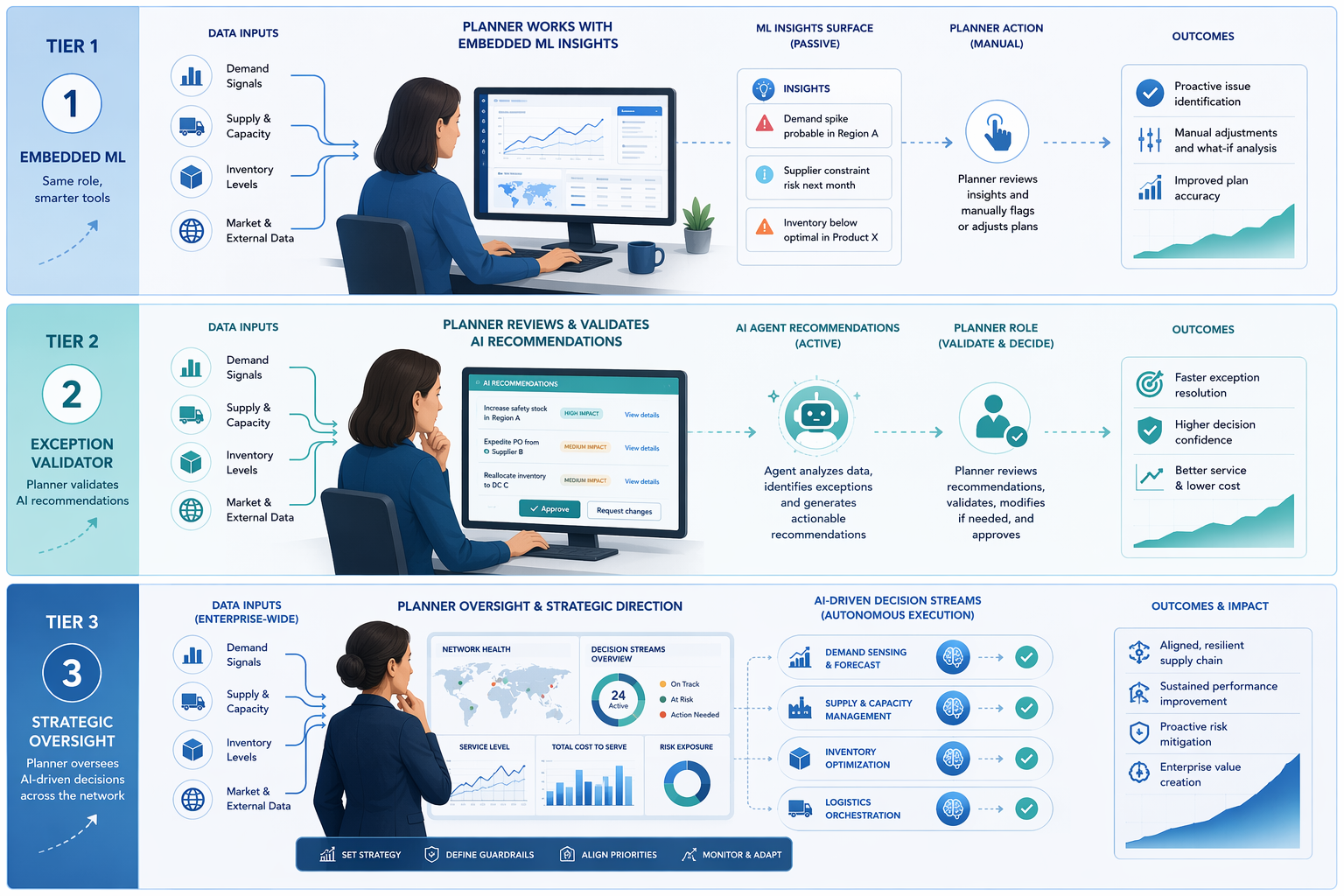
That shift changes the skill profile. The old workload rewarded people who could reconcile data, spot mismatches, maintain side files, and remember which master-data fields were unreliable. Those skills do not disappear, especially during implementation and exception analysis. But the day-to-day value moves toward knowing when to trust a recommendation, when to challenge it, and how to explain the decision to procurement, manufacturing, logistics, finance, or sales.
A Planning Cycle Agent may reduce the manual assembly work around a planning review. An Autonomous Sourcing Agent may help prepare a sourcing action. An Inventory Aging Advisor may surface stock that deserves attention before it becomes a write-off. None of those examples eliminates accountability. They compress the time between signal and decision, which means the human review step has to become sharper, not looser.
The practical design question for Tier 2 is therefore not “Which agent is impressive?” It is “Who is authorized to accept the agent’s recommendation, under what threshold, and with what audit trail?” A planner may validate a constrained recommendation. A procurement manager may approve supplier action. An inventory analyst may decide whether aging stock should be reallocated, discounted, consumed, or escalated. If those boundaries are not explicit, the agent simply accelerates ambiguity.
Third-party coverage has largely reinforced that Oracle is packaging these tools as operational AI, not just analytics. Supply Chain Dive covered Oracle’s AI-powered supply chain features, including supplier recommendation capabilities, while AI Magazine described Oracle’s agents as a way to streamline supply chain operations.[5][6] Those reports are useful signals of market reception, but they do not answer the operating-model question. Buyers still have to map each agent to a real decision owner.
Tier 3 makes coordination the product, and governance the constraint
The third tier arrived more clearly with Oracle’s April 9, 2026 announcement of 12 Fusion Agentic Applications for finance and supply chain. For SCM, Oracle named applications including Logistics Execution Command Center, Warehouse Operations Workspace, Production Shift Operations Workspace, and Design-to-Source Workspace.[4] These are not positioned as isolated assistants. They are intended to coordinate work across processes.
Oracle’s June 2026 SCM blog sharpened the language further by describing five agentic applications for supply chain execution and a shift from “monitoring operations to actively managing outcomes.”[7] That phrase is the clearest marker of the upper tier. Monitoring is a dashboard activity. Managing outcomes implies that the application interprets signals, coordinates actions, and moves work forward inside guardrails.
This is where Oracle’s embedded position across SCM, ERP, and execution workflows becomes strategically important. A logistics exception is rarely just a logistics exception. It can affect inventory availability, order promises, warehouse labor, transportation cost, customer service, and revenue timing. A production shift decision can touch materials, maintenance, labor, quality, and shipment commitments. Coordinated agentic applications are credible only if they can see enough of that process fabric to recommend action without creating a new reconciliation burden somewhere else.
That does not make autonomy free. It makes the governance work more visible. A Logistics Execution Command Center can help coordinate shipment exceptions, but the business still has to decide when service level beats transportation cost. A Warehouse Operations Workspace can help prioritize work, but someone must define how labor constraints, order priority, dock capacity, and inventory accuracy interact. A Production Shift Operations Workspace can help manage operational disruption, but escalation rules must say when a production decision becomes a customer, finance, or executive decision.
The supervisor role also changes. In a traditional control-tower model, the team watches alerts, opens tickets, chases owners, and pushes updates through email, chat, or spreadsheets. In a coordinated agentic model, the system may propose the sequence of actions and route work to the people or systems that need to act. The human supervisor is then evaluating whether the coordination logic reflects actual business policy.
| Workflow question | Why it matters at Tier 3 |
|---|---|
| Which decisions can be executed automatically? | Automation needs thresholds, business rules, and exception classes that are clear enough to survive real operating pressure. |
| Which decisions require human validation? | The value of agents depends on fast review, but high-impact tradeoffs still need named owners. |
| Which decisions require cross-functional escalation? | Supply chain exceptions often move from planning to procurement, logistics, manufacturing, finance, or sales. |
| Which policies can the system tune or recommend changing? | Outcome management can expose outdated rules, but policy changes need governance beyond the immediate transaction. |
| Who is accountable when the workflow follows the rule but creates the wrong result? | Agentic coordination can make accountability less obvious unless ownership is designed into the process. |
This is the point at which broad agent-count claims become less useful. A suite-wide number may sound impressive, especially when repeated in partner or ecosystem material, but it does not prove that a supply chain decision is safer, faster, or better governed. For SCM buyers, the more relevant evidence is whether the agentic application can coordinate a named workflow, operate inside visible guardrails, produce an auditable rationale, and escalate to the right human role.
The workforce implication is decision redesign, not headcount arithmetic
It is tempting to translate Oracle’s AI strategy into a simple productivity story: fewer manual tasks, faster decisions, better resilience. Some of that may be true for specific workflows. But supply chain leaders will get into trouble if they treat the 2026 announcements as a labor-reduction switch. The real implication is decision redesign.
At Tier 1, the team needs people who understand model outputs well enough to challenge them. At Tier 2, the team needs validators who can approve or reject recommendations quickly and consistently. At Tier 3, the team needs supervisors who can manage policies, exceptions, escalation paths, and cross-functional tradeoffs. Those are related skills, but they are not identical.
In this model, the planner is not removed from the process. The planner is moved closer to the point where business judgment matters. Less time should go into building the exception list. More time goes into deciding whether the exception has been classified correctly, whether the recommended action fits the current operating context, and whether the policy itself is still valid.
That is a better use of experienced planners, but it is not automatically easier work. Exception validation requires confidence with data lineage, scenario reasoning, business rules, and organizational consequences. If the system recommends changing a source of supply, reallocating inventory, expediting a shipment, or resequencing warehouse work, the reviewer needs to understand both the local action and the downstream effects.
The same issue applies to managers. A procurement manager cannot simply ask whether an autonomous sourcing recommendation found a cheaper option. The manager has to know whether the supplier meets risk, compliance, capacity, quality, and relationship requirements. A warehouse supervisor cannot judge an operations workspace only by whether it clears tasks faster. The supervisor has to know whether the prioritization logic is creating congestion, starving another area, or compromising service on higher-value orders.
What buyers should inspect before treating Oracle AI as operational autonomy
Oracle’s direction is coherent: build AI into SCM, introduce bounded agents, then coordinate agents through workflow-level applications. For enterprises already committed to Oracle Fusion Cloud SCM, that progression gives the platform a plausible route from assistance to outcome management. It also gives buyers a concrete evaluation path.
- Map each AI capability to a decision type: forecast adjustment, sourcing recommendation, inventory action, logistics exception, warehouse prioritization, production shift response, or design-to-source tradeoff.
- Classify the decision as advisory, human-validated, automatically executed within thresholds, or escalated across functions.
- Define who owns validation when the agent is right technically but wrong commercially.
- Inspect whether the audit trail explains the recommendation, the data used, the rule applied, and the human override if one occurs.
- Train planners and supervisors on exception reasoning, policy tuning, and escalation judgment rather than only on screen navigation.
This is also where Oracle should be compared with other supply chain planning vendors on workflow depth, not just AI vocabulary. Buyers evaluating S&OP and planning alternatives can use broader comparisons such as Blue Yonder vs. Infor CloudSuite SCM vs. Logility to separate point-planning intelligence from operating-model change. Oracle’s advantage, where it materializes, is less likely to be a single clever agent than the ability to connect planning, execution, procurement, manufacturing, and finance decisions inside the same enterprise workflow.
The risk is the same one that has accompanied many planning automation programs: the system becomes smarter, but the exception burden moves into shadow processes. If validators are overwhelmed, if policies are unclear, or if escalation paths remain informal, the organization may simply replace manual spreadsheet analysis with manual agent supervision.
Oracle’s 2026 AI strategy points toward a supply chain role defined less by manual data preparation and exception flagging, and more by exception validation, policy tuning, escalation judgment, and strategic oversight. Feature availability is only the first condition. The operating model has to catch up.
The better evaluation question is not whether Oracle has AI agents. It is which decisions the business is prepared to let Oracle’s AI recommend, coordinate, or execute, and what human capability must sit around those decisions.
References
- AI for Supply Chain Management, Oracle, oracle.com/scm/ai/
- Oracle Fusion Cloud SCM 26A: Built-in AI for Resilient Supply Chains, Oracle, blogs.oracle.com/scm/oracle-fusion-cloud-scm-26a-built-in-ai-for-resilient-supply-chains
- Oracle AI Agents Help Supply Chain Leaders Boost Efficiency and Strengthen Resiliency, Oracle, February 10, 2026, oracle.com/news/announcement/oracle-ai-agents-help-boost-supply-chain-efficiency-and-strengthen-resiliency-2026-02-10/
- Oracle Introduces Fusion Agentic Applications for Finance and Supply Chain, Oracle, April 9, 2026, oracle.com/news/announcement/oracle-introduces-fusion-agentic-applications-for-finance-and-supply-chain-2026-04-09/
- Oracle adds AI-powered supply chain features, Supply Chain Dive, supplychaindive.com/news/oracle-ai-supply-chain-platform-supplier-recommendations-features/713086/
- How Oracle AI Agents Streamline Supply Chain Operations, AI Magazine, aimagazine.com/news/how-oracle-ai-agents-streamline-supply-chain-operations
- Five Agentic Applications Transforming Supply Chain Execution, Oracle, June 2026, blogs.oracle.com/scm/5-agentic-apps-sce-supply-chain
Comments
Join the discussion with an anonymous comment.