
The hard part of an egg recall is not reading one plant code. It is finding every retail identity that code became after the eggs left the producer.
The August Egg Company recall made that problem plain. The recall covered about 1.7 million dozen shell eggs, or roughly 20 million eggs, tied to a Salmonella outbreak that the FDA later reported at 134 illnesses, 38 hospitalizations, and one death. The eggs were sold under more than 10 brand names through at least nine retail chains, with confirmed product distribution in nine states. The stable identifiers were not the brand names on the carton fronts. They were plant codes P-6562 and CA-5330 and Julian dates 32-126 printed into the production record and packaging trail.[1][2]
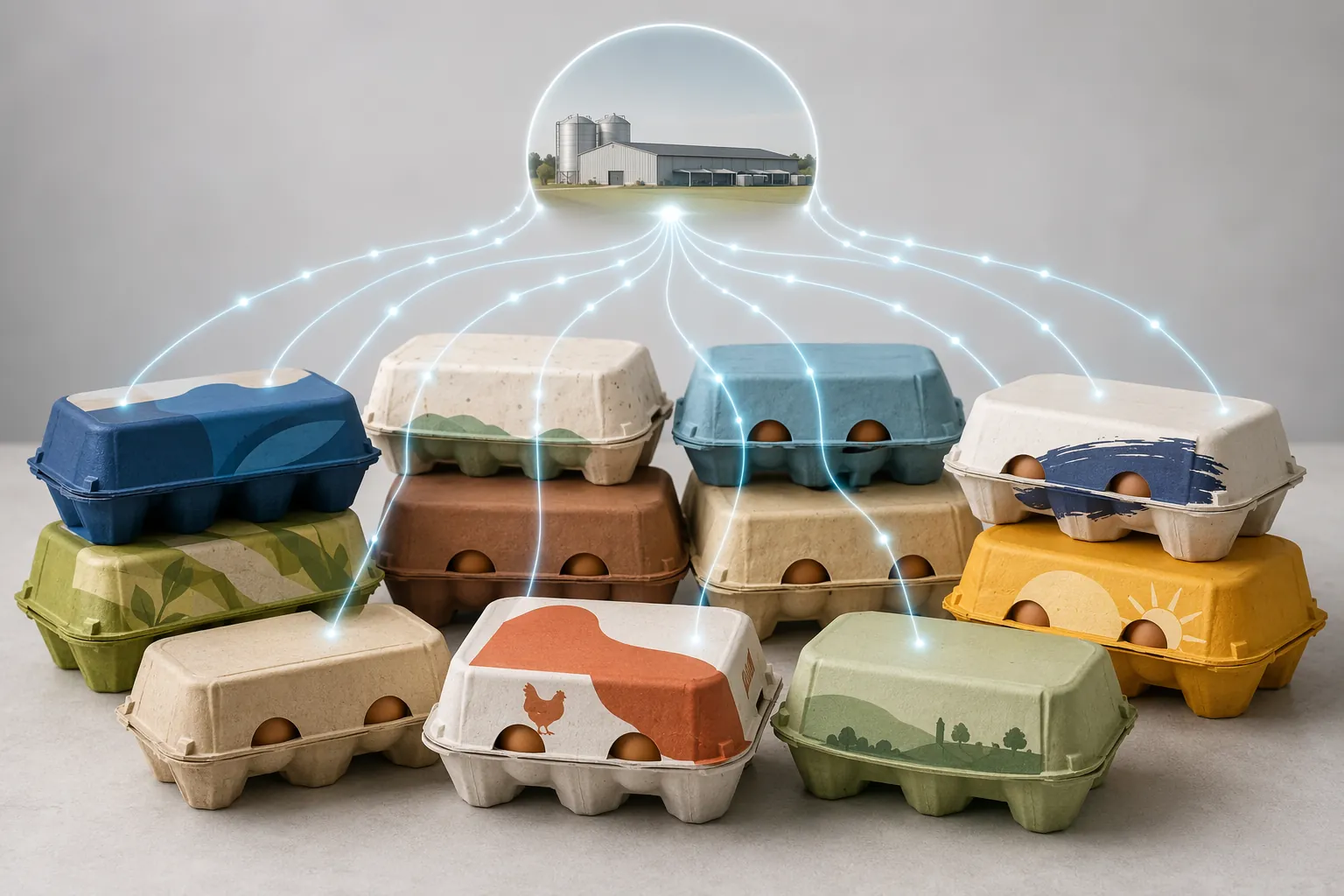
That is the center of the brand-name tracking problem in egg recalls. A consumer sees Clover, First Street, Nulaid, O Organics, Marketside, Raley's, Simple Truth, Sun Harvest, Sunnyside, or another store-facing label. A recall coordinator sees lot origin, Julian date, plant code, pallet movement, retailer shipment, UPC, and the question that cannot wait: which cartons are still on shelves, in back rooms, in distribution centers, or in home refrigerators?
One Egg Lot, Many Retail Names
Multi-brand egg distribution is efficient until the moment a food safety event moves backward through the network. The same physical product can be packed for a regional grocery banner, a national private label, a foodservice customer, and a value brand. Each customer may use different carton art, UPCs, item masters, warehouse descriptions, and consumer-facing names. The biological risk remains tied to the original lot; the recall execution burden shifts to everyone who has to translate that lot into retail language.
In the August Egg Company case, the FDA recall notice gave consumers a list of brand names and package details, while the outbreak investigation kept the public health thread attached to the producer, plant codes, dates, and distribution. Those two views have to match under pressure. If they do not, a team can know the affected plant and still miss a store brand that used the same eggs, or it can issue a broad notice that pulls more product than necessary because nobody trusts the crosswalk quickly enough.[1][2]
| What the public may see | What recall teams must connect it to |
|---|---|
| Brand name on carton | Producer, plant code, and lot record |
| UPC and package size | Customer item master and shipment history |
| Retail chain or store banner | Distribution center, store route, and sell-through status |
| Best-by or Julian date | Production window and affected recall scope |
The bottleneck is not that the data never exists. It is that it sits in formats and systems that were not built to be reconciled during an outbreak: ERP exports, retailer portals, quality records, distributor spreadsheets, warehouse management systems, customer service scripts, PDF recall notices, and sometimes email attachments forwarded between companies that each hold only a slice of the path.
Manual cross-referencing can work when one label, one customer, and one lot are involved. It starts to fail when the product has already split into many private-label identities. Each additional retailer adds a different naming convention. Each additional UPC adds another check. Each warehouse transfer adds another place where product can be delayed, relabeled, returned, or redistributed. The recall clock does not slow down while those files are being reconciled.
Repackaging Is Where the Trail Can Break
The Black Sheep Egg Company recall showed a different stress point. The FDA advised consumers, retailers, and distributors not to eat, sell, or serve recalled Black Sheep Egg Company eggs because of potential Salmonella contamination.[3] ABC News, citing FDA enforcement reports, reported that the recall involved more than 6 million eggs and that some eggs distributed to other companies in Arkansas and Missouri were resold under the Kenz Henz brand without traceable links back to the original lot.[4]
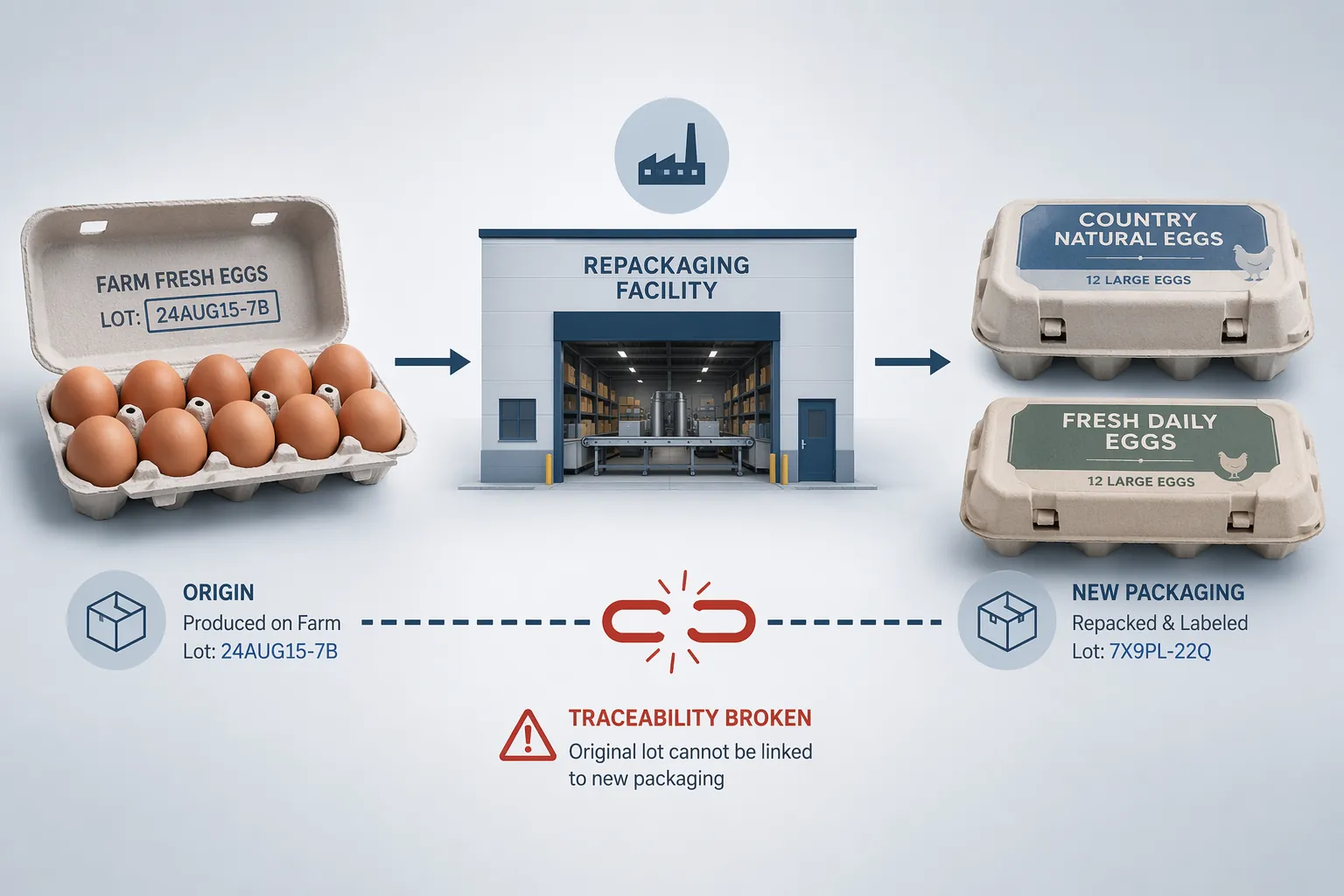
That is not just a labeling inconvenience. Repackaging changes the surface evidence available to a retailer, inspector, customer service agent, or consumer. If the new brand presentation is not tied back to the original lot and supplier record, the recall team has to reconstruct the link after the fact. By then, product may have moved again.
The Black Sheep case does not prove that every repackaging arrangement is opaque. It does show why a traceability system has to preserve parent-child relationships when eggs move from one owner, package, brand, or item code to another. A lot-level record that stops at the first sale is not enough for a multi-party recall.
What AI-Powered Lot Tracking Actually Has to Do
A useful traceability platform does not begin with a dashboard. It begins with a durable mapping between the production lot and every commercial identity the lot can take.
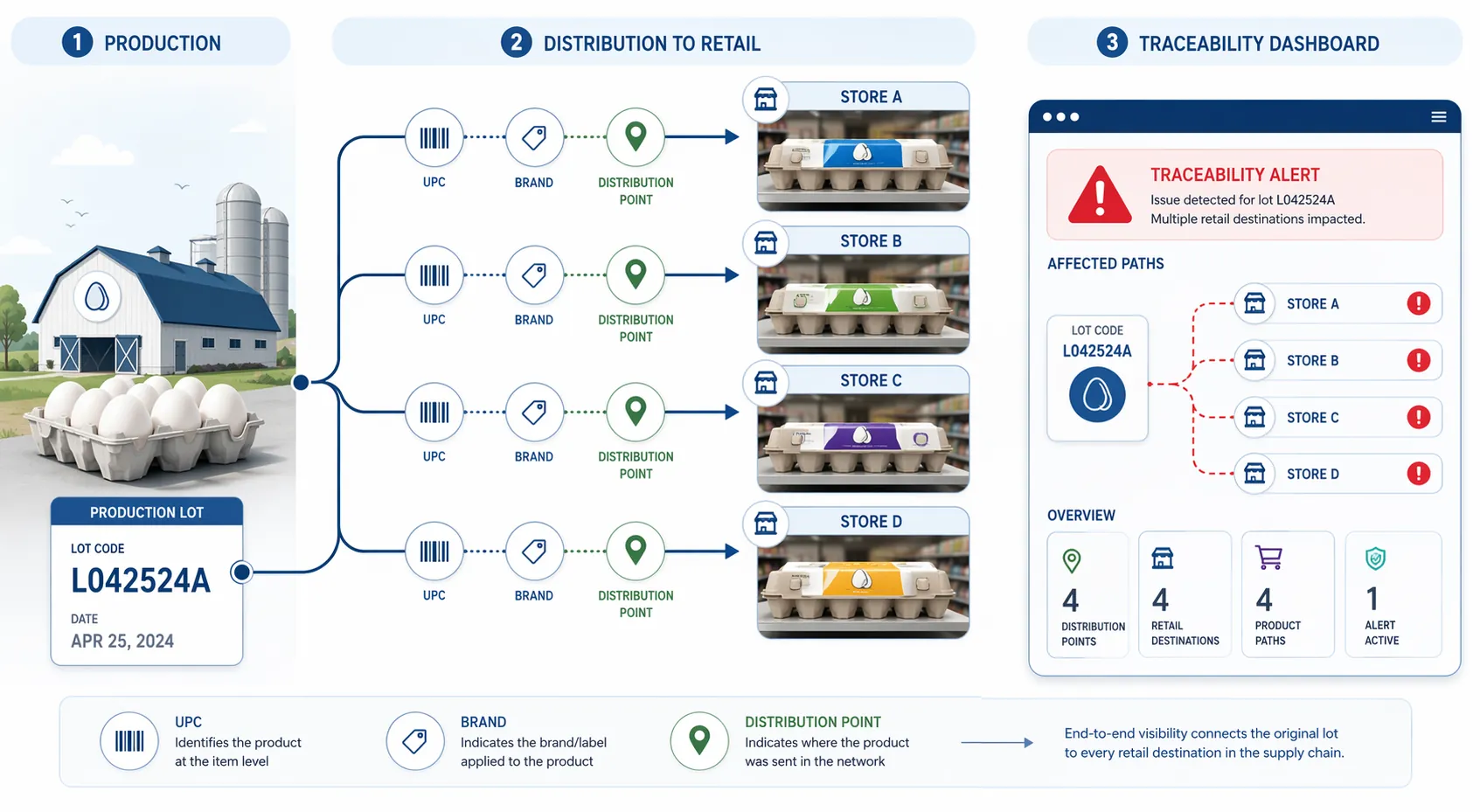
In practice, that means the system has to ingest the producer's lot records, carton configurations, customer item numbers, UPCs, shipment records, distribution events, and recall notice language. It then has to keep those records connected as the eggs move into retailer private labels, distributor systems, repackers, and store-specific names. AI is useful only where it reduces the matching work that would otherwise land on people during the recall: entity resolution, document extraction, exception detection, and rapid comparison between internal records and public-facing brand lists.
For an egg recall, the workflow should look less like a broad search and more like a controlled narrowing:
- Start with the affected production lot, plant code, and production-date window.
- Return every finished-goods item, carton configuration, UPC, and private-label brand mapped to that lot.
- Show where each mapped item shipped: customer, distributor, distribution center, store group, or other transfer point.
- Flag downstream transformations, including repackaging, relabeling, resale, returns, or cross-docking.
- Generate the recall scope in language that matches both internal lot records and consumer-facing brand names.
The difference matters because recall teams do not need a prettier spreadsheet. They need fewer unresolved joins. If a lot maps to four UPCs for one retailer and three for another, the system should surface those relationships without requiring a QA manager to compare item descriptions line by line. If a retailer's public brand name differs from the vendor name in the producer's ERP, that alias has to be known before the recall notice is drafted. If a repacker creates a new carton identity, the platform has to keep the original lot attached to the new brand presentation.
This is where AI can earn its place. Natural-language extraction can pull brand names, product descriptions, lot ranges, and date codes from recall documents or customer records. Matching models can identify likely equivalences between retailer item names and producer item masters. Anomaly detection can highlight a shipment or resale path that does not fit the expected customer list. None of that replaces food safety judgment. It changes what the human reviewer spends time on: confirming exceptions instead of building the first map from scratch.
The Recall Notice Is Part of the Data Problem
A recall notice is not merely a communication artifact. It is also a reconciliation test. If the internal trace says the affected eggs went to a retailer under one customer name, while the consumer-facing notice lists a different store brand, somebody has to prove those are the same product. In the August Egg recall, plant codes and Julian dates were the uniform anchors across brand identities. That is exactly the kind of cross-reference that a lot-level platform should produce quickly and preserve for audit review.[1][2]
The public health agencies' own counts also show why source control matters. The CDC page for the same outbreak reported a lower case count than the FDA's later final update, reflecting the timing difference between public pages and final outbreak closure.[1][5] Recall teams cannot control when every public page changes, but they can control whether their product scope is tied to the best available lot and distribution evidence.
Standards Help Only If the Events Are Captured
FSMA 204 and GS1 EPCIS matter here because they push the industry toward recording critical tracking events in a form that trading partners can exchange. GS1 US has published EPCIS recommendations for FSMA 204 critical tracking events, giving companies a common structure for capturing what happened, where it happened, when it happened, and which product was involved.[6]
But standards do not repair missing operational links by themselves. A company can support an interoperability format and still fail to capture the repackaging event that changed the brand name. It can record a shipment and still omit the retailer alias that customer service will need during a recall. It can store a lot code and still leave the UPC relationship in a separate commercial system. The practical test is whether the critical tracking events preserve the brand-lot chain across the actual ways eggs are sold.
FoodReady, for example, positions GS1 and FSMA 204 tools as part of a broader traceability technology stack, while other platforms focus on supplier compliance, recall automation, or predictive supply chain risk.[7] Those differences matter during vendor evaluation, but the recall use case should stay narrow: can the platform connect plant code, lot, UPC, brand, customer, distribution event, and downstream transformation without waiting for a manual spreadsheet build?
Vendor Claims Are Directional, Not Proof
The vendor landscape is already forming around this problem. FreshByte has analyzed the August Egg recall as a traceability challenge. Recall InfoLink sells automated recall management. FoodReady emphasizes compliance and GS1-aligned traceability tooling. TraceGains is known for supplier compliance networks. Paxafe works in predictive risk analytics. Together, they show that the market is moving beyond static recordkeeping, but they should not be treated as interchangeable recall solutions.[8][7]
Performance claims should be handled with care. Food Industry Executive published contributed data from Recall InfoLink leadership saying automated recall systems can cut response times by more than 50% and reduce labor or cost burdens by up to 90% per event.[9] Those figures are useful as a signal of where automation may reduce manual work. They are not independently audited benchmarks, and they do not answer the more important egg-recall question by themselves.
A platform that produces a fast answer to the wrong brand list is not a food safety improvement. Speed matters only when the data model is complete enough to identify every affected retail identity and precise enough to avoid dragging unaffected product into the recall.
Market growth tells a similar story from a distance. Yenra reported in 2026 that the global food traceability market is projected to reach $28.4 billion by 2030, with the traceability software subsector growing at a 15.1% CAGR.[10] That makes the category worth watching, but category growth is not a recall-control measure. The operating standard remains whether the system can close the gap between brand names and lot records before the manual process becomes the constraint.
The Practical Baseline for the Next Egg Recall
The August Egg and Black Sheep recalls exposed the same scalability failure from different angles. August Egg showed how quickly one production source can become many retail brands. Black Sheep showed how repackaging and resale can create blind spots if downstream identities are not tied back to the original lot. Combined, the recalls involved eggs sold under at least 12 brand names across more than 15 retail banners, according to FDA recall materials and FreshByte's case analysis.[1][2][3][4][8]
For a recall team, the buying question is no longer whether the software offers visibility. The question is whether it can return a defensible answer to a narrower query: given this plant code, Julian-date window, and lot record, show every impacted brand name, UPC, customer, distribution point, and downstream package identity.
If the answer still depends on waiting for each trading partner to reconcile its own spreadsheet, the process is not scaled for modern egg distribution. Multi-brand recalls have made lot-level brand mapping a baseline capability, not a premium feature. The next recall will be judged by whether the right cartons come off the right shelves before manual tracing becomes the bottleneck.
References
- Outbreak Investigation of Salmonella: Eggs (June 2025) — FDA, July 10, 2025
- August Egg Company Recalls Shell Eggs Because of Possible Health Risk — FDA
- FDA Advises Consumers Not to Eat, Sell, or Serve Recalled Black Sheep Egg Company Eggs — FDA
- Check your fridge: Millions of eggs recalled nationwide amid salmonella warning — ABC News
- Salmonella Outbreak Linked to Eggs — CDC
- GS1 US: EPCIS Recommendations for FSMA 204 Critical Tracking Events — GS1 US
- 4 Key Food Traceability Technologies — FoodReady
- Massive Egg Salmonella Recall Highlights Traceability Challenges — FreshByte Software
- Automating Recalls Dramatically Improves Speed, Accuracy, & Traceability — Food Industry Executive, June 2025
- AI Food Supply Chain Traceability: 16 Advances (2026) — Yenra, 2026
Comments
Join the discussion with an anonymous comment.