
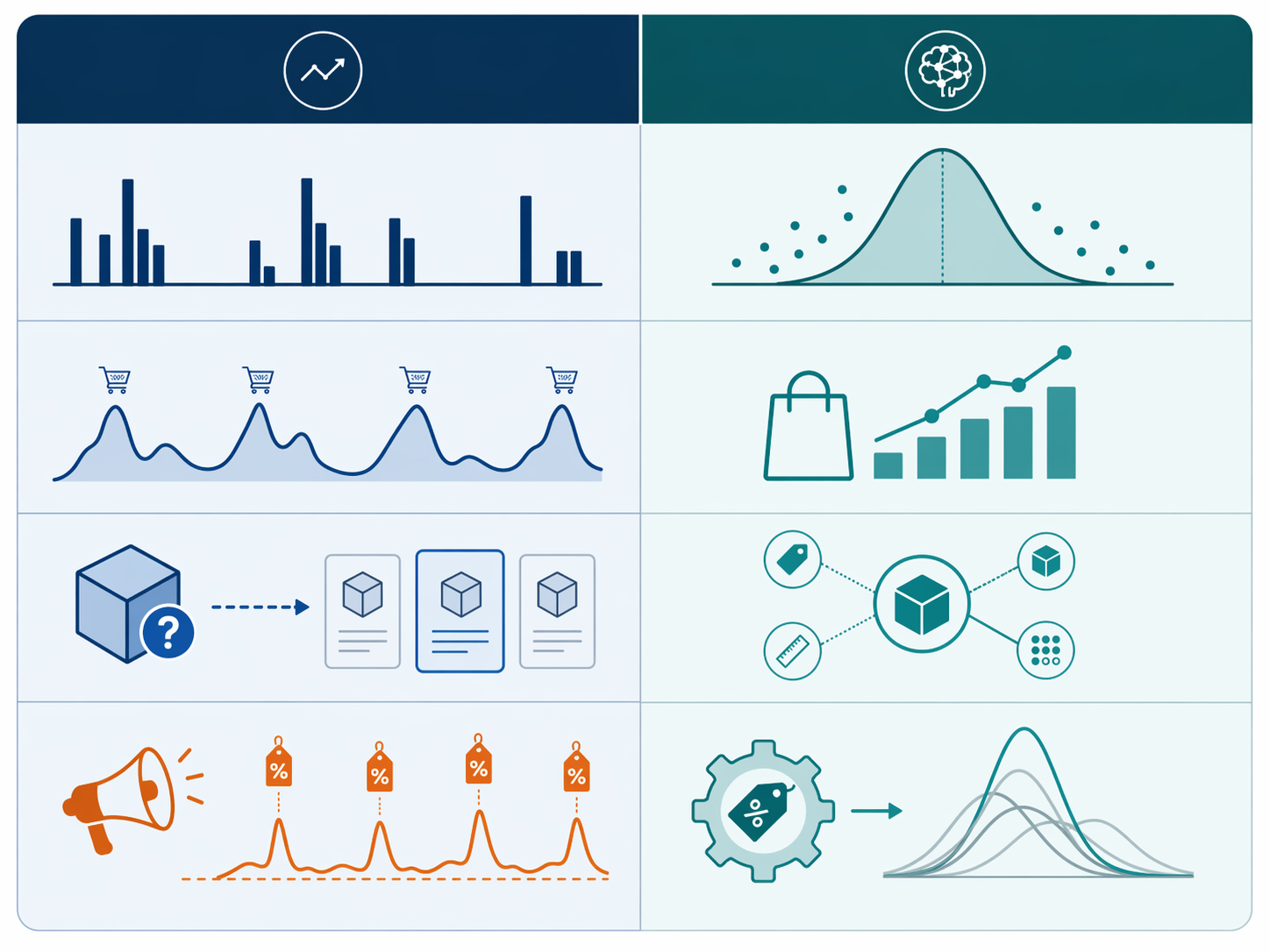
The worst way to buy AI-powered demand forecasting tools is to start with the question, “Which platform has the best forecast accuracy?” That question sounds disciplined, but it hides the demand problem. A spare part that sells twice a year, a grilling-season retail item, a zero-history product launch, and a heavily promoted beverage SKU do not fail for the same reason. They should not be evaluated with the same model story.
A better first screen is pattern fit. Before comparing demos, ask what the tool is being asked to forecast most often, where the economic pain sits, and whether the vendor’s architecture matches that demand shape.
| Dominant demand pattern | What makes it hard | Architecture that usually fits best | Examples with public evidence |
|---|---|---|---|
| Intermittent or lumpy demand | Many zero-demand periods; occasional demand spikes; point forecast accuracy can be misleading | Probabilistic engines, intermittent-demand models, service-level-aware inventory optimization | ToolsGroup, Syncron, Lokad-style intermittent planning |
| Seasonal retail peaks | High-volume SKU-store-day forecasting with local seasonality, weather, trend, calendar, and promotion effects | Retail-specialized ML with granular store/SKU planning logic | RELEX, Blue Yonder |
| New product introductions with little or no history | No item-level demand history; forecast must borrow signal from similar products and attributes | Attribute-based similarity, launch clustering, analog curves, graph transfer | o9 Solutions, Blue Yonder, Kumo.ai |
| Promotion-driven spikes | Baseline demand is distorted by trade activity, price changes, display, and cannibalization | Promotion engines, causal/event modeling, analog event curves, retail/CPG planning suites | Blue Yonder, RELEX, o9 Solutions |
| Sparse relational demand across many connected entities | Individual time series are thin, but related products, suppliers, stores, or customers may carry signal | Graph-native or relational AI that shares signal across connected nodes | Kumo.ai and other graph-oriented approaches |
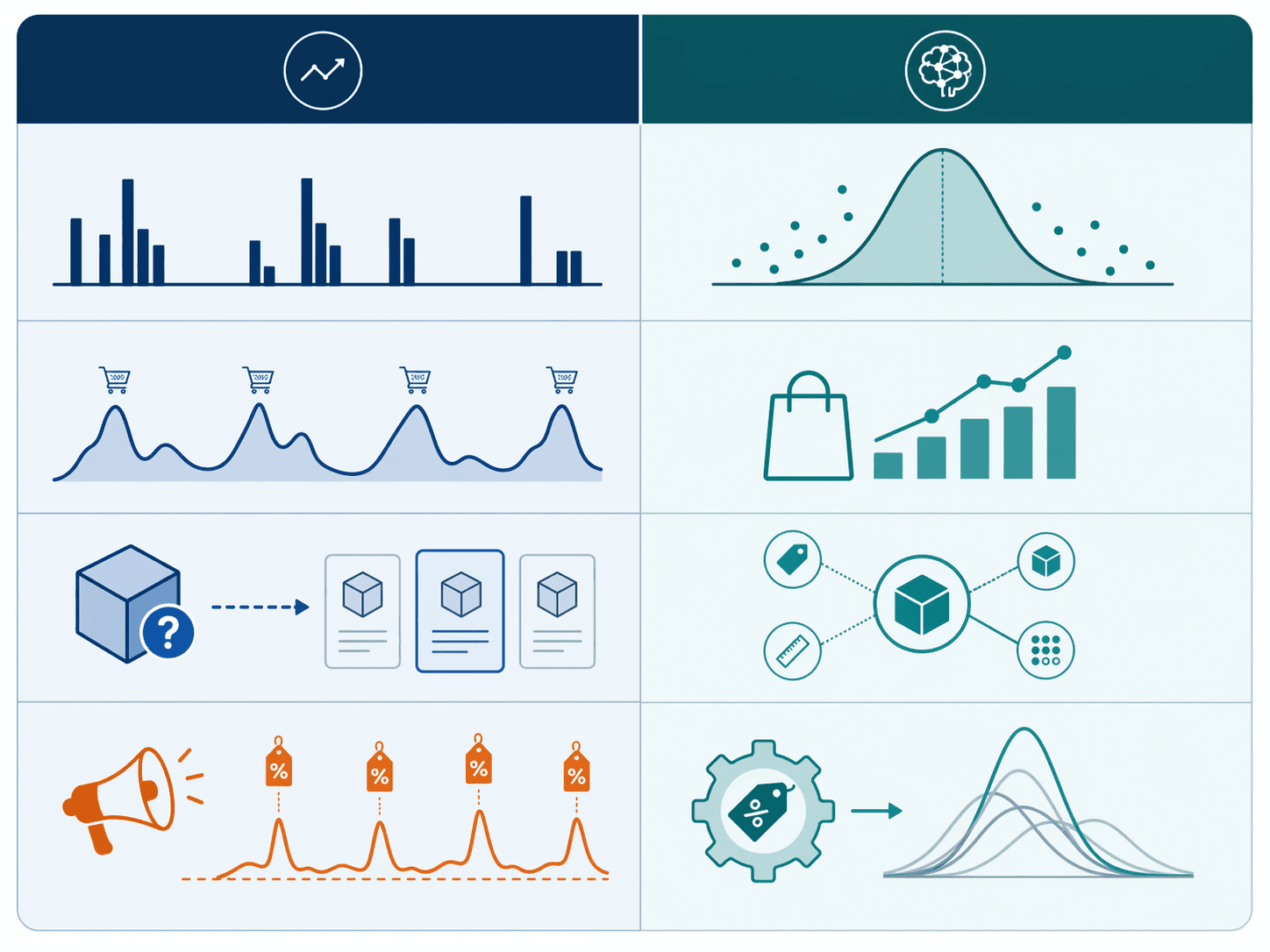
That map is not a ranking. It is a way to stop treating “forecasting” as one job. In most enterprise portfolios, the issue is not whether AI can forecast demand. The issue is whether the model is being punished for the wrong kind of uncertainty.
Start by separating intermittent from lumpy demand
The words “slow-moving,” “long tail,” and “lumpy” get used too loosely in software evaluations. They are often treated as colorful planner language, when they should be classification inputs.
A useful academic frame uses two measures: average demand interval, or ADI, and squared coefficient of variation, or CV². In a 2025 intermittent-demand forecasting study, demand is classified as intermittent when ADI is greater than 1.32 and CV² is less than or equal to 0.49; it is classified as lumpy when ADI is greater than 1.32 and CV² is greater than 0.49.[1]
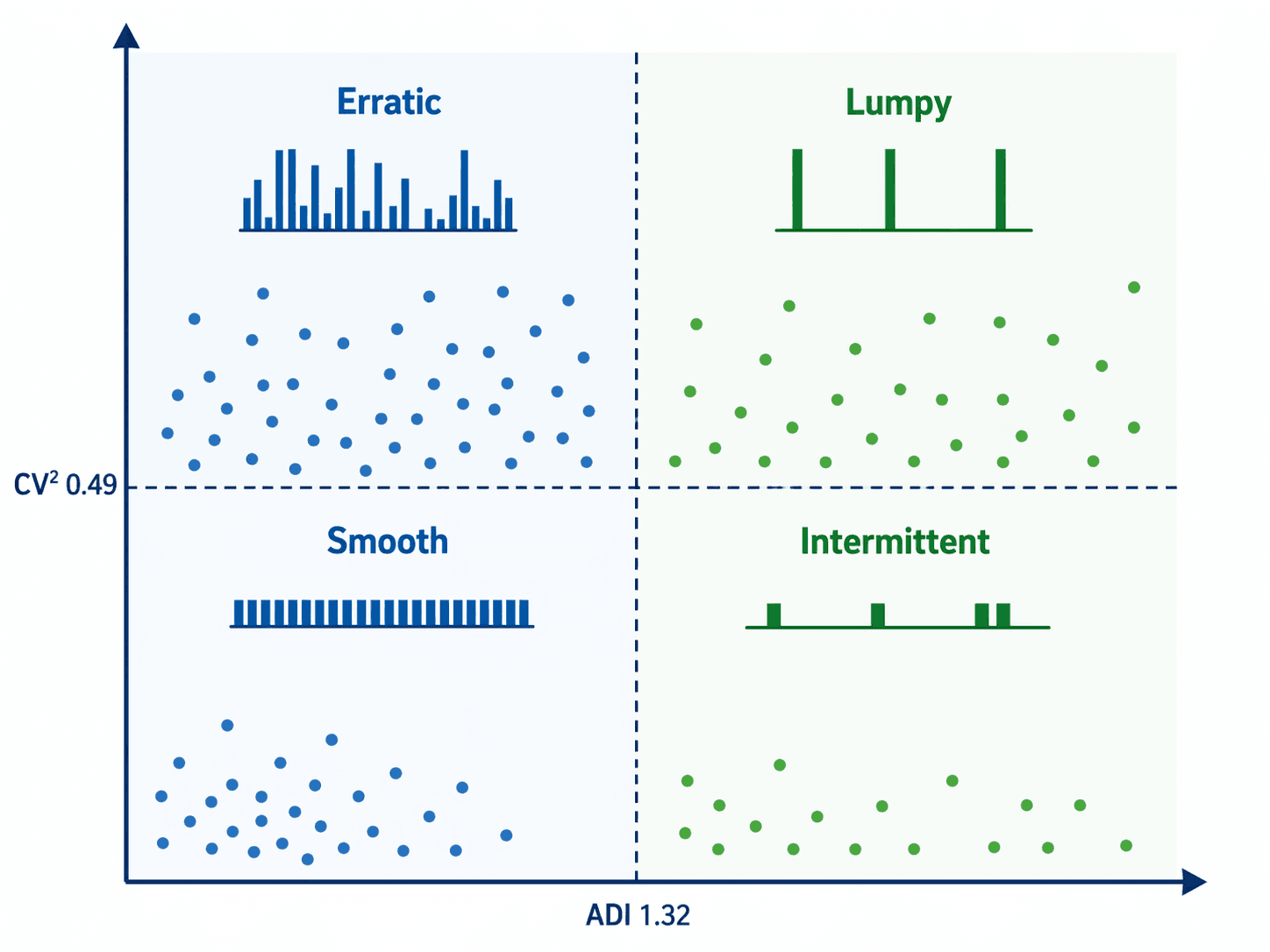
The threshold is not holy scripture. A business may tune cutoffs by replenishment lead time, service strategy, margin, or planning cadence. But the discipline matters. An item with predictable gaps between orders is a different problem from an item with both long gaps and highly variable quantities when demand finally appears.
This is where many vendor scorecards get sloppy. A model can show attractive aggregate accuracy while performing badly on the SKUs that create the most service pain. If 70% of the revenue comes from stable movers and 30% of the operational noise comes from spare parts, averaging the portfolio can make the hard problem disappear.
For intermittent and lumpy items, the planner often does not need a single clean number for next month. She needs a distribution: the probability of no demand, the probability of one order, the plausible upper tail, and the inventory position required for a chosen service level. That is why probabilistic engines deserve a serious look in spare parts and aftermarket settings.
Why probabilistic engines fit spare parts better than one-number forecasts
ToolsGroup makes the argument bluntly: for long-tail and intermittent demand, point forecast accuracy is often the wrong measure, because the business decision is really about inventory risk across a probability distribution. The company also describes one FMCG example in which intermittent demand represented 86% of SKUs and nearly 50% of revenue.[2]
Its aftermarket material gives a more concrete spare-parts case: Mitsubishi Electric reduced spare parts inventory by 30% while raising service levels from 87% to 97% using ToolsGroup’s probabilistic demand modeling, according to ToolsGroup’s published account.[3]
That is a vendor-published result, so it should not be read as a median outcome for every implementation. Inventory reduction and service improvement usually come from a bundle of changes: model selection, parameter work, segmentation, master-data cleanup, planner adoption, and policy redesign. Still, the case is directionally plausible because the architecture matches the demand pattern. Probabilistic planning is built for uncertainty in timing and quantity; that is exactly the aftermarket spare-parts problem.
Syncron approaches the same terrain from an aftermarket-specific angle. Its spare-parts forecasting material emphasizes failure patterns, install-base aging, and maintenance cycles rather than treating each part as a generic retail SKU. It also points to RMSSE as a more appropriate metric than MAPE for low-volume demand, and cites ML simulations showing 2–4% inventory value reductions while maintaining availability.[4]
That metric choice is not a detail. MAPE can behave badly when actual demand is zero or close to zero, which is exactly where spare-parts portfolios live. A tool that lets the evaluation team inspect low-volume performance by segment will usually be more useful than one that only reports a polished overall accuracy lift.
Seasonal retail needs granularity, not just a seasonality checkbox
Every demand planning demo has a seasonality slide. That does not mean every tool is equally prepared for retail seasonality at the level where planners actually make decisions: SKU, store, day, weather zone, promotion condition, and local calendar effect.
RELEX’s ICA Sverige case is useful because it sits at that operational grain. RELEX reports that ICA Sverige achieved a 32% safety stock reduction and a 6.69 percentage-point forecast accuracy gain by using AI to model seasonal patterns with inputs such as weather, trends, and promotions at SKU-store-day level.[5]
Again, those are vendor-published numbers. But the fit is credible: seasonal retail forecasting is not only a time-series problem. A strawberry forecast before a sunny holiday weekend and a snow-shovel forecast before a regional storm are shaped by local context. Retail-specialized ML platforms earn their keep when they can absorb those signals and still produce replenishment decisions at the right planning grain.
This is also where general enterprise AI platforms can look better in a boardroom than in a replenishment meeting. If the system cannot reconcile forecast, inventory position, pack constraints, store capacity, shelf life, and promotion timing, the model output still has to be translated by planners under time pressure.
Zero-history launches need borrowed signal
New product forecasting is where historical time-series logic runs out of road. A launch item has no item-level past. The forecast has to borrow signal from somewhere else: product attributes, category behavior, price tier, material, pack size, channel, launch curve, or a prior item that behaved similarly.
o9’s NPI planning material describes an attribute-based similarity engine that clusters new items using features such as price, category, material, and other attributes. It also describes cannibalization modeling through attribute-based substitution analysis, color ranking, and similarity modeling.[6]
In public case data for AB InBev, o9 reports a 60% reduction in out-of-stocks, a 53% decrease in inventory losses, and 70–90% touchless planning adoption. Those numbers should be treated like the other vendor-published outcomes here: useful as evidence of a plausible fit, not proof that the software alone produced the result.
That architecture matters because NPI failure is rarely caused by one missing algorithm. The uncomfortable part of launch planning is deciding which old demand is relevant enough to borrow. A premium glass bottle, a low-price multipack, and a seasonal limited-edition flavor may all sit in the same category hierarchy, but they should not inherit the same analog blindly.
A useful NPI tool should let teams inspect the similarity logic, override bad analogs, and model cannibalization rather than pretending that launch demand appears in isolation. When a new SKU steals demand from an existing one, the launch forecast and the baseline forecast are the same business event viewed from two sides.
Promotion-driven spikes are baseline problems first
Promotions create two forecasting problems. The obvious one is the spike: how much incremental demand will the display, discount, ad, or bundle generate? The quieter one is baseline damage. After enough promotional activity, the demand history no longer tells a clean story about normal demand.
Blue Yonder’s retail and CPG forecasting material argues that traditional forecasting struggles when demand is affected by promotions, pricing, and external events, and it describes AI forecasting that incorporates these demand-shaping variables.[7]
The important buying question is not whether a vendor says it handles promotions. It is how the tool separates baseline, lift, cannibalization, halo effects, forward buy, and post-promotion dip. In CPG and retail, a promotion engine is not an optional add-on if promoted volume is a large share of the business.
Analog curves also have a role here, especially when the event is new but not entirely unprecedented. A planner may not have history for this exact launch-and-promotion combination, but the company may have seen a similar brand, discount depth, season, retailer, or pack architecture before. The tool should make that borrowing explicit enough to challenge.
Where graph-native tools fit
Graph neural network vendors are interesting because they challenge the assumption that each SKU-location time series should be modeled mostly on its own history. In a graph view, products, suppliers, stores, customers, categories, and attributes become connected nodes. Sparse demand in one node can borrow signal from related nodes.
Kumo.ai’s own comparison material reports an intermittent FMCG example where WAPE improved from about 0.86 with a naïve approach to about 0.62 with a graph neural network, which it describes as roughly a 27% error reduction. The same source positions graph transfer as useful for new products because a new item can inherit signal from category, supplier, and similar-product nodes.[8]
A separate graph-forecasting article makes the broader case that time series alone can miss relational structure, while graph neural networks can use relationships among entities to improve demand prediction.[9]
The caution is obvious: Kumo.ai’s comparison page favors its own architecture, and there is no public head-to-head benchmark that runs every major AI demand forecasting tool on the same portfolio under the same rules. Still, graph-native systems belong on the shortlist when the data is relationally rich and individually sparse: marketplaces, multi-echelon networks, large assortments, supplier-linked portfolios, or businesses where product similarity and network context carry more signal than isolated history.
The architecture spectrum is more useful than vendor labels
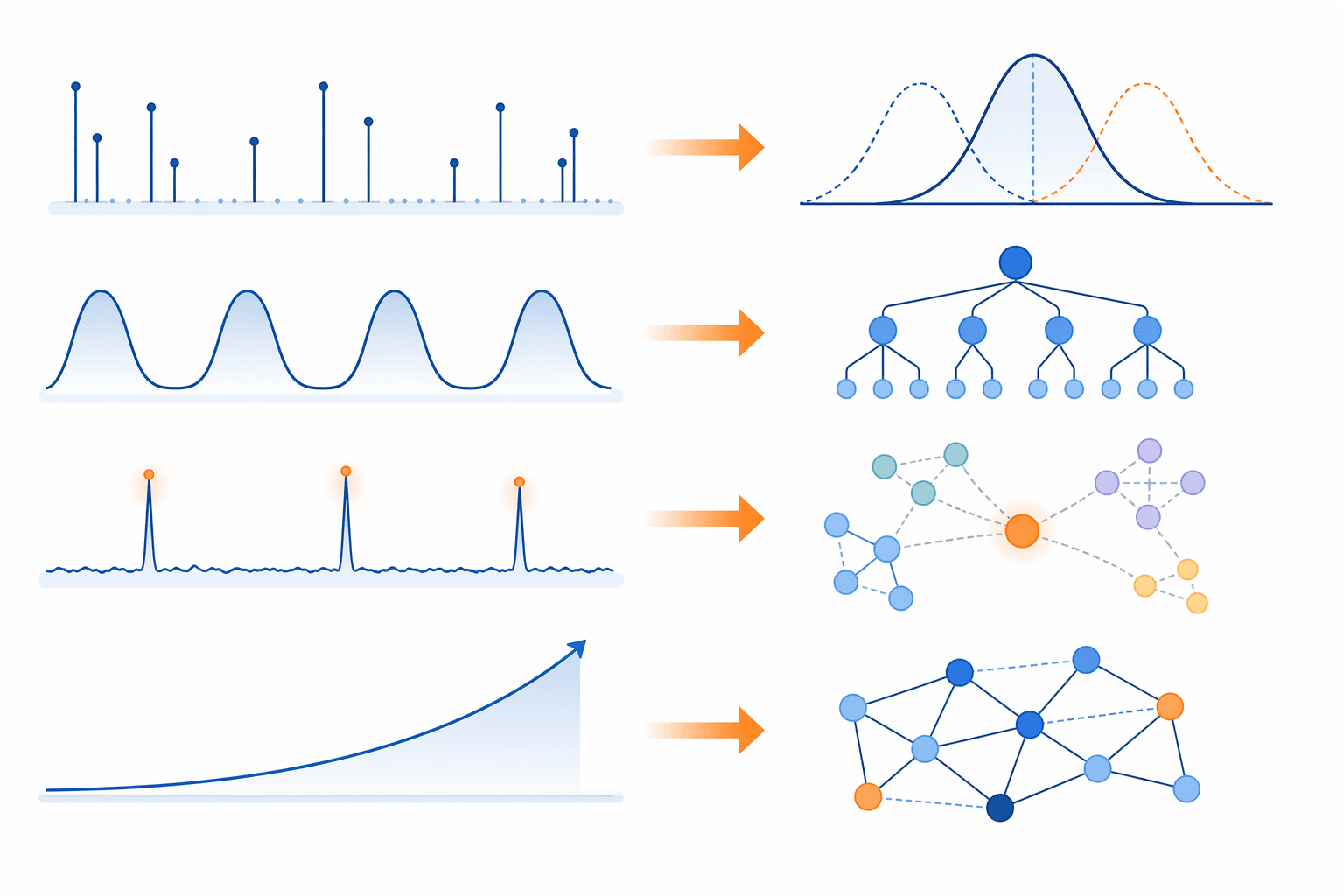
Vendor categories blur quickly. One platform calls itself autonomous planning, another decision intelligence, another supply chain AI. The more useful distinction is architectural.
| Architecture type | Best first fit | What to test in evaluation |
|---|---|---|
| Flat time-series AutoML | High-volume items with enough clean history and stable drivers | Segment performance, not just aggregate accuracy; ability to handle zeros and promotions |
| Integrated planning ML | Enterprises that need forecasting tied to S&OP, supply planning, scenarios, and financial planning | Whether demand-pattern handling is deep enough for the hard SKU segments |
| Retail-specialized ML | SKU-store-day retail forecasting with seasonality, weather, local events, and replenishment constraints | Granularity, promotion handling, fresh/short-life logic, and planner workflow |
| Specialized intermittent or probabilistic engines | Aftermarket, spare parts, service parts, and long-tail portfolios | Probability distributions, service-level optimization, low-volume metrics, and inventory policy outputs |
| Relational or graph-native AI | Sparse portfolios with meaningful relationships among products, locations, suppliers, customers, or attributes | Quality of graph construction, explainability of borrowed signal, and zero-shot or cold-start behavior |
This spectrum also explains why a single enterprise-standard answer can be dangerous. A retailer with deep seasonal peaks may reasonably start with RELEX or Blue Yonder. A manufacturer with a painful aftermarket business may get more value from ToolsGroup or Syncron. A CPG company with constant launches and promotions may need o9-style attribute planning or a retail/CPG suite with strong event logic. A marketplace or large sparse network may want to test graph-native forecasting.
Some well-known platforms are underrepresented in this discussion because their public materials are less granular on pattern-to-architecture evidence. That does not make them weak tools. It only means they are harder to place confidently from public documentation alone. For a related industry-fit view of several enterprise planning platforms, see o9 Solutions vs Kinaxis vs Blue Yonder for Demand Planning.
How to shortlist without pretending there is one winner
The practical buying sequence is straightforward, but it requires SKU-level work before the demo circuit starts.
- Classify the portfolio by demand pattern. Use ADI and CV² for intermittent and lumpy segments, and separately tag seasonal, promotional, launch, and lifecycle-sensitive items.
- Measure economic pain by segment. Do not let high-volume stable items dominate the evaluation if spare parts, launches, or promotions create most of the stockout cost, excess inventory, or planner intervention.
- Shortlist by dominant hard pattern. Put probabilistic engines near the top for spare parts; retail-specialized ML for seasonal store-level retail; attribute similarity for NPI; promotion engines for trade-driven demand; graph-native tools for sparse relational portfolios.
- Run the proof of value on ugly SKUs. Include zeros, launch items, discontinued items, promoted items, cannibalized items, and items with master-data defects.
- Evaluate decision quality, not only forecast error. Ask whether the forecast leads to better inventory placement, service levels, exception management, and planner trust.
If the business needs a broader function-by-function view before narrowing the demand planning shortlist, this overview of AI use cases in supply chain is the better starting point. If the shortlist is already forming but industry requirements are still unclear, use an industry-specific demand planning capability guide alongside the pattern-fit screen.
Implementation risk still decides the outcome
Pattern fit does not rescue bad data or weak adoption. A probabilistic spare-parts engine still needs usable demand history, lead times, supersession logic, service targets, and inventory policy alignment. An NPI engine still needs trustworthy attributes. A promotion model still needs event history that distinguishes price, display, retailer, timing, and execution.
ChainSignal’s analysis of AI demand planning pilots found that 55% fail to scale, and the failure modes are usually practical rather than glamorous: poor data readiness, unclear ownership, weak workflow integration, and pilots that never connect model output to planning decisions. For a deeper treatment, see why 55% of AI demand planning pilots fail to scale.
Before committing to any AI-powered demand forecasting tool, run a data-readiness check on the exact segments the tool is supposed to improve. Attribute completeness, promotion history, lost-sales treatment, substitution records, service-level targets, and lead-time quality will determine whether the model’s architecture has enough signal to work with. A structured data readiness assessment for AI inventory optimization can prevent a promising shortlist from becoming an expensive pilot cleanup project.
The buying conclusion is not to crown a universal winner. Shortlist tools according to the demand patterns that dominate the business economically, then validate them against the company’s own SKU-level pattern mix and data readiness. The right question is not which platform forecasts best in general. It is which architecture is most likely to survive contact with the demand your planners actually manage.
References
- Machine learning algorithms in intermittent demand forecasting, International Journal of Production Research, 2025.
- Forecasting the Long Tail and Intermittent Demand, ToolsGroup.
- How AI is Transforming Aftermarket Parts Planning, ToolsGroup.
- Why Spare Parts Demand Forecasting Is a Different Game, Syncron.
- From chaos to control: Mastering seasonal retail planning with AI, RELEX Solutions.
- AI-Driven NPI Planning Software, o9 Solutions.
- Why traditional forecasting fails and how AI is fixing it, Blue Yonder, 2025.
- Best AI Demand Forecasting Tools for Enterprise (2026), Kumo.ai.
- Time Series Isn't Enough: How Graph Neural Networks Change Demand Forecasting, Towards Data Science.
Comments
Join the discussion with an anonymous comment.