

Manual order entry rarely looks expensive while the queue is moving. A CSR opens an email, copies lines into the ERP, checks the customer number, fixes a unit of measure, asks about a missing ship-to, keys a rush order from a phone call, and moves on. The cost shows up later: the correction ticket, the credit memo, the sales rep asking why a quote sat untouched, the warehouse picking the wrong SKU, or the owner asking why the order desk needs another person when revenue has not moved enough to justify it.
For a mid-market B2B distributor, the business case for AI order management should start there — not with a promise that software will replace the order desk, but with a defensible calculation of what the current order flow actually costs. In Bizowie’s 2025 model, a typical $40M distributor processing about 15,000 orders per year carries an estimated annual manual order-entry cost of $88K–$157K once direct labor, error correction, lost CSR selling time, and lost competitive sales are included.[1]

Manual order entry is not one cost
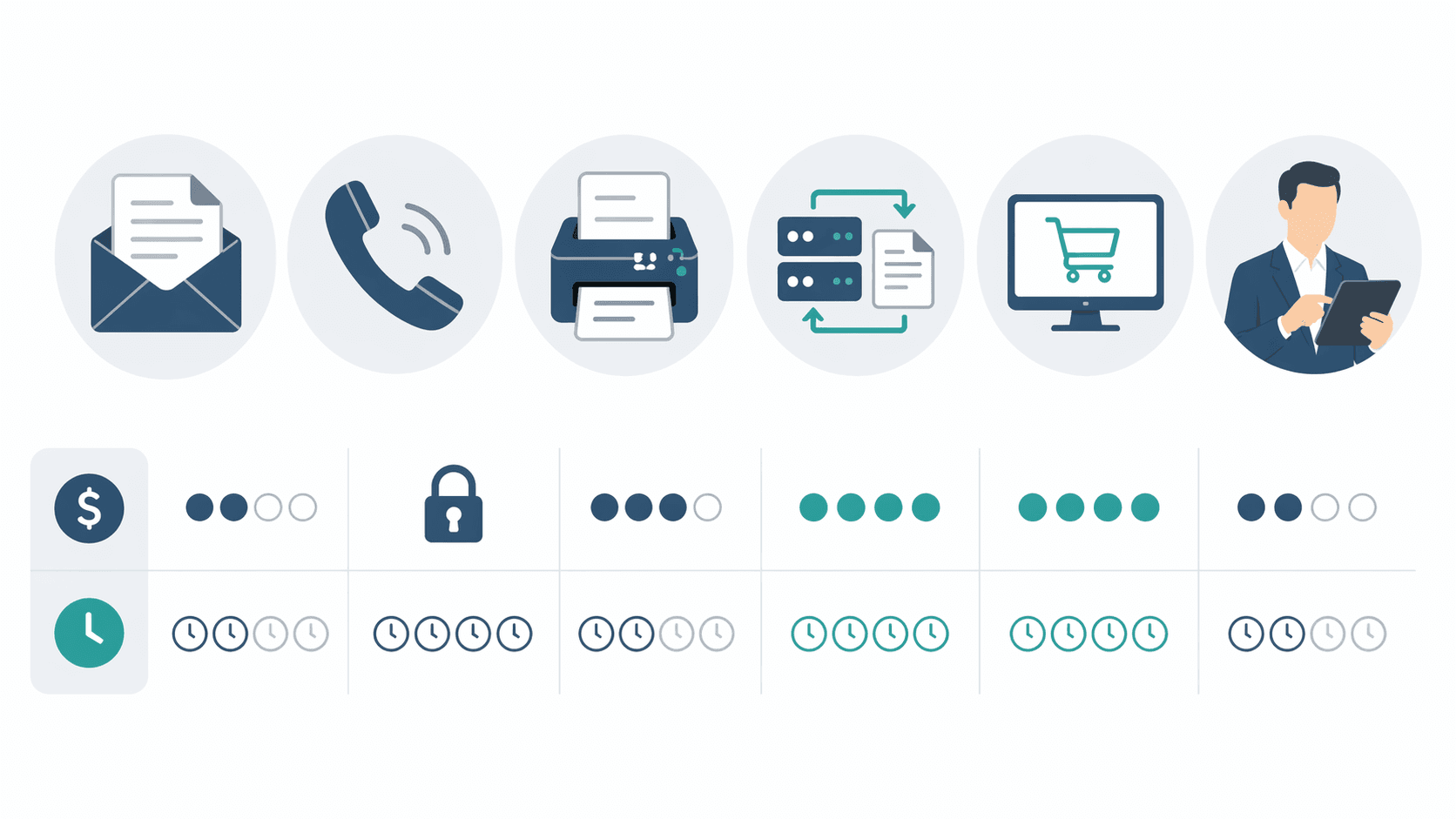
The first mistake in many internal ROI files is averaging every order into one neat processing cost. That may be convenient for finance, but it hides the way work actually lands on the order desk. Email, phone, fax, EDI, portals, sales rep orders, and standing orders all create different exception patterns. Some are ready for automation. Some are only partially movable. Some will stay stubbornly human because the customer wants to talk to a person.
Bizowie’s channel model is useful because it breaks the queue apart. In its distributor scenario, email represents 30–40% of order volume and takes about 5 minutes per order to process; phone represents 20–30% and remains structurally manual, although some volume can migrate to self-service; fax represents 5–15% and takes about 6 minutes per order; EDI represents 10–30% and can be fully automatable under the right integration conditions; web portal orders represent 5–25% and can also be fully automatable; sales rep orders represent 5–15% and take about 4 minutes per order; standing and repeat orders represent 10–20%.[1]
| Order channel | Typical share of volume | Manual burden | Automation posture |
|---|---|---|---|
| 30–40% | About 5 minutes per order | Strong candidate for OCR, templates, and AI parsing | |
| Phone | 20–30% | Inherently manual | Reducible through self-service migration, but not fully removable |
| Fax | 5–15% | About 6 minutes per order | Good candidate for OCR where fax volume remains meaningful |
| EDI | 10–30% | Low manual burden when integrated correctly | Fully automatable for suitable high-volume customers |
| Web portal | 5–25% | Low manual burden when adopted | Fully automatable after customer adoption |
| Sales rep orders | 5–15% | About 4 minutes per order | Movable through mobile entry and cleaner front-end capture |
| Standing/repeat orders | 10–20% | Often unnecessarily rekeyed | Strong candidate for templates and recurring order logic |
That table matters because it stops the business case from becoming a software brochure. A distributor with heavy email and fax volume has a different first move than one with a few dominant customers ready for EDI. A company whose customers still prefer the phone will not automate its way to a clean 100% touchless queue. The order mix decides the opportunity.
Start with direct labor, then widen the ledger
Direct labor is the easiest cost to defend because everyone can see it. If CSRs spend hours every day turning customer documents into ERP orders, that time has a wage, a benefit load, and a capacity limit. Bizowie estimates $63K–$105K in annual direct labor cost for manual order entry in its $40M distributor model.[1]
The cost model becomes more useful when it keeps that visible category beside the costs that usually get left out of the first spreadsheet:
- Direct labor: the model places this at $63K–$105K annually before the hidden categories are added.[1]
- Error correction: Bizowie models $20K annually, using a 1.5% error rate and $75 per error.[1]
- Opportunity cost of CSR time: the same model assigns $28K to lost upsell margin when CSRs are processing orders instead of following up on revenue opportunities.[1]
- Lost competitive sales: Bizowie estimates $12.6K in annual lost sales to faster competitors.[1]
Those numbers should not be pasted into every distributor’s board deck without adjustment. The 1.5% error rate, the $75 correction cost, and the upsell assumptions may be too high or too low for a given operation. Their value is that they force the right owner meeting. If sales disputes the lost competitive sales estimate, ask which rush quotes were delayed. If finance challenges the correction cost, pull a month of credit memos, returns, reships, and CSR rework. If the operations manager thinks the labor estimate is low, run a time study by channel instead of arguing from memory.
| Cost bucket | Annual estimate in $40M distributor model | What to validate internally |
|---|---|---|
| Direct labor | $63K–$105K | CSR time spent entering orders by channel, including benefits and supervision |
| Error correction | $20K | Order error rate, credit memo activity, reships, returns, customer service rework |
| Opportunity cost of CSR time | $28K | Quote follow-up, upsell capacity, account coverage, open opportunity aging |
| Lost competitive sales | $12.6K | Orders or quotes lost where speed, accuracy, or response time mattered |
| Total annual cost | $88K–$157K | Adjusted range after replacing assumptions with internal observations |
Per-order benchmarks help calibrate the range
The Bizowie model is the backbone here because it is channel-specific. Broader automation benchmarks still help check whether the direction is reasonable. IntelliChief reports manual purchase order processing at $30–$60 per order compared with $5–$10 per order for automated processing, a 70–80% reduction.[2] StealthAgents cites the same manual-versus-automated per-order comparison in its 2026 automation statistics.[3]
Those figures are not a substitute for the distributor’s own queue data. A simple repeat order from a clean email template will not cost the same as a six-line fax with a missing customer part number. Still, the benchmark gives operations leaders a useful guardrail: if the internal model shows no meaningful savings from automation, the current labor assumptions may be understated; if it shows near-total savings across all channels, the phone and exception work may be understated.
The APQC benchmarks reported via StealthAgents point in the same direction. Top performers process 94% of orders without human intervention, while bottom performers still require manual handling on more than 20% of orders. Organizations without automation spend $1.64 per $1,000 revenue on sales order management, compared with $1.11 for those with automation, a 32% difference.[3]
For a $25M–$100M distributor, that benchmark should be read carefully. Top-performer touchless rates are a maturity reference, not a promise that every mid-market operation can reach 94% after one implementation. Customer behavior, ERP constraints, product complexity, and master data quality decide how much of that gap is actually reachable.
The automation lever depends on the channel
A disciplined AI order management program does not treat every incoming order as the same kind of problem. The order desk already knows the differences. Email orders need extraction and validation. EDI orders need partner setup and clean mappings. Portal orders need customer adoption. Phone orders need a migration path, not a fantasy that customers will stop calling because a portal exists.
| Channel or order type | Primary lever | Modeled automation potential |
|---|---|---|
| OCR, AI parsing, standardized customer templates | 80–90% automation rate | |
| High-volume EDI customers | EDI implementation and partner mapping | 100% when properly integrated; $5K–$15K setup per partner |
| B2B customer portal | Self-service ordering and account-specific catalogs | 100% auto-processing after adoption; 60–75% adoption target over 18 months |
| Standing orders | Recurring order templates | 100% |
| Sales rep orders | Mobile order entry | 100% |
| Phone | Self-service migration and account coaching | Reducible, but 20–30% of customers may continue to prefer phone |
Email and fax: remove rekeying before chasing elegance
Email usually deserves early attention because it is both common and deceptively messy. A customer sends a PDF, a spreadsheet, a copied table in the body of an email, or last month’s PO with two lines changed. The CSR knows how to interpret it. The system does not — at least not without document capture, parsing rules, customer-specific history, and exception handling.
This is where OCR and AI parsing can earn their keep. The target is not to make every email perfect. The target is to remove the orders that are routine enough to validate automatically and leave the CSR with the exceptions that actually need judgment. Bizowie models 80–90% automation potential for email OCR and AI parsing.[1]
Fax belongs in the same operational family, although its volume varies by distributor. If fax is only a nuisance, it may not deserve a large standalone project. If it still represents a meaningful slice of volume, the 6-minute processing assumption in the Bizowie model makes it worth measuring separately rather than burying it inside “manual orders.”[1]
EDI: high upside, but only for the right customers
EDI is attractive because it can take whole streams of repeat work out of the CSR queue. It is also easy to overstate if the customer base is fragmented. Bizowie’s model treats EDI as fully automatable for appropriate customers and estimates $5K–$15K in setup cost per partner.[1] That setup cost makes the selection rule obvious: start with high-volume customers whose order patterns are stable enough to justify the mapping work.
The practical work is not just technical. Item cross-references, customer part numbers, ship-to records, contract pricing, units of measure, and order minimums all need to be clean enough that an automated order does not become a faster way to create an exception. If the master data is weak, the EDI project will surface the problem. It will not politely work around it forever.
Portals: the math depends on adoption, not just configuration
A B2B portal can turn clean customer orders into touchless orders, but only after customers use it. Bizowie’s framework targets 60–75% portal adoption over 18 months and treats portal orders as 100% auto-processing once adopted.[1] That distinction matters. Configuration is the internal milestone; adoption is the operating result.
The customers most likely to move first are usually the ones with repeatable buying patterns, frequent reorders, account-specific catalogs, and enough order volume to care about speed. The customers least likely to move are the ones who use the phone as part ordering channel, part inventory check, part relationship touchpoint. A portal rollout that ignores that split will produce clean software screenshots and disappointing volume migration.
Phone orders: keep the limit in the model
Phone orders are the place to be honest. Bizowie notes that 20–30% of customers will always prefer phone.[1] Some of that volume can shift when customers get better reorder tools, clearer order history, or account-specific portals. Some will not. The ROI model should not assume that phone work disappears. It should ask which phone calls are actually order entry, which are product questions, which are availability checks, and which are relationship management wearing an order-entry label.
Standing orders and sales rep entry: small fixes that prevent avoidable touches
Standing orders are often low-drama savings. If the same customer orders the same items on a predictable cadence, the order desk should not be rebuilding that order from scratch every time. Bizowie models standing order templates at 100% automation potential.[1]
Sales rep orders have a similar problem in a different costume. When a rep texts, emails, or verbally relays an order to the office, the company has not avoided data entry. It has simply moved the messy capture step to a CSR. Mobile order entry is modeled at 100% automation potential in Bizowie’s framework, but that depends on reps actually entering clean orders instead of preserving old shortcuts through a new tool.[1]
A phased program is easier to defend than a full redesign
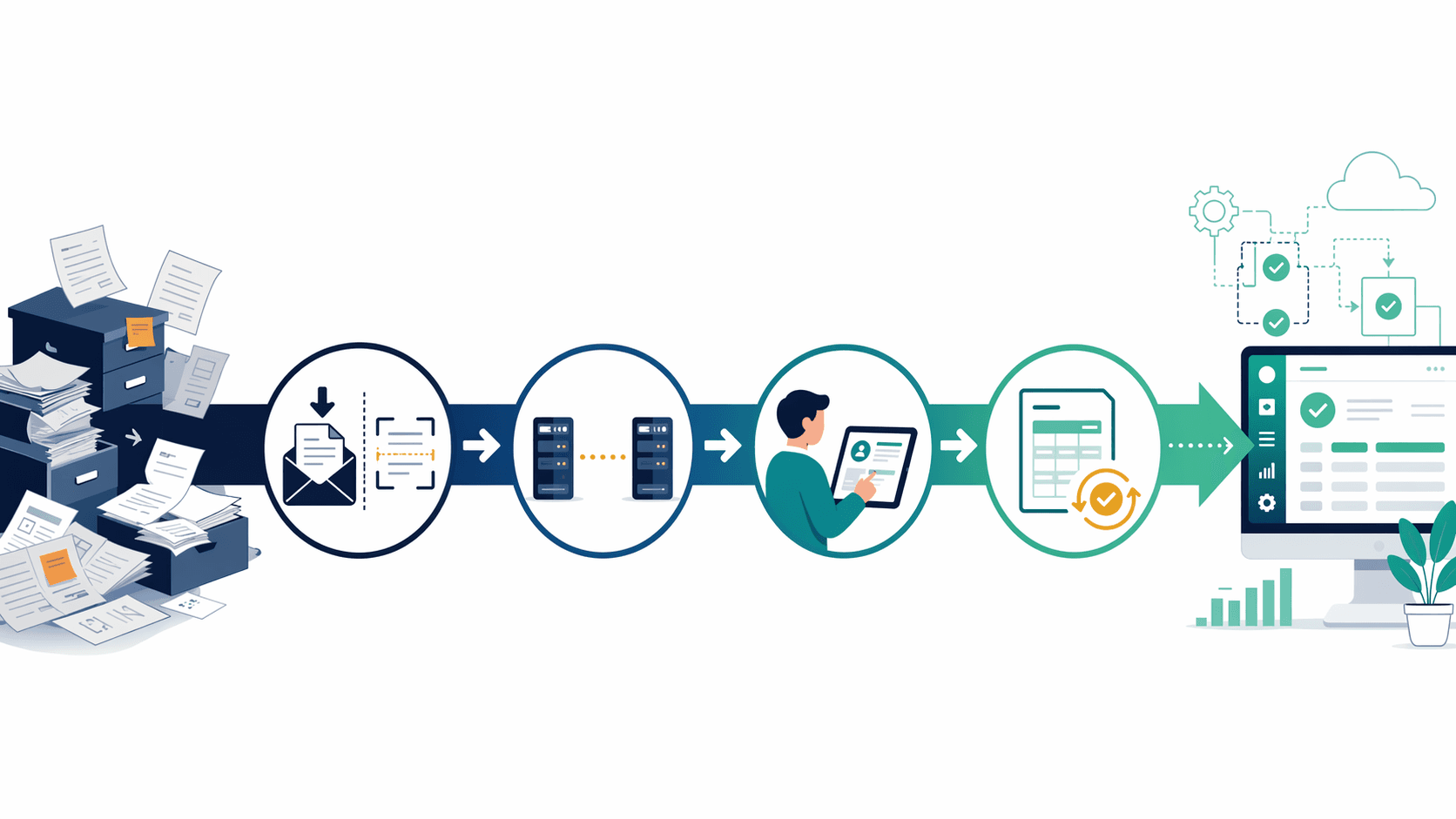
The order-entry problem is usually too tangled for one grand launch. The better path is to audit the queue, remove obvious rekeying, clean the data that automation depends on, and then push harder into EDI and portal adoption where the volume justifies it.
| Phase | Timing | Work that belongs there |
|---|---|---|
| Assessment and channel audit | Weeks 1–3 | Count orders by channel, time the work, identify error sources, separate routine orders from exceptions |
| Quick wins | Months 1–3 | Email templates, standing orders, master data cleanup, obvious workflow fixes |
| Core automation | Months 4–9 | OCR, AI parsing, EDI integrations, portal implementation |
| Adoption and optimization | Months 10–18 | Customer migration, CSR workflow tuning, exception review, portal adoption improvement |
The first three weeks are not paperwork. They are where the business case is either made defensible or left vague. Pull a representative sample of orders, tag each one by channel, record touches, note why a human intervened, and separate preventable work from judgment work. A CSR correcting a missing unit of measure is not doing the same job as a CSR advising a customer on a substitute item. Automation should attack the first category before anyone claims it can handle the second.
The quick-win phase is also where master data has to be treated as implementation work, not cleanup to be done later if there is time. Customer part numbers, item aliases, pricing records, ship-to addresses, and units of measure are the rails the system runs on. Bad master data turns automation into a faster exception generator.
The core automation phase is where spend rises, and so does scrutiny. Bizowie’s comprehensive deployment model assumes a $131K initial investment, $21K in annual ongoing cost, $91K in annual benefit, a 5-year net benefit of $242K, 112% ROI over 5 years, and payback at 1.7 years.[1] Those figures are plausible for the modeled order mix, but they are not a universal result. If the distributor’s email volume is lower, if portal adoption is slow, or if EDI partners are expensive to onboard, the payback moves.
Integration risk belongs in the same conversation as payback. ClearOmni reports that 42% of AI implementations cite integration challenges.[4] For distributors running older ERP environments, that is not an abstract risk. It can mean middleware, custom mappings, delayed testing, duplicate validation steps, or extra manual review during the first months after go-live.
What a realistic ROI case should and should not claim
A strong ROI case for AI order management should be adjustable. It should let an owner or finance lead change order volume, channel mix, CSR cost, error rate, correction cost, portal adoption, EDI setup cost, and ongoing software cost without breaking the logic. If the case only works when every assumption is favorable, it is not ready for an ownership meeting.
The most defensible claim is narrower than the usual automation pitch: a sub-two-year payback is plausible for a mid-market distributor when its baseline order mix resembles the $40M model, when email/fax/manual volume is high enough to matter, when master data remediation starts early, and when the first automation targets are chosen by actual queue concentration rather than software preference.[1]
The case should not claim 100% touchless order processing for this segment. Some customers will keep calling. Some POs will arrive incomplete. Some sales reps will need coaching. Some EDI mappings will take longer than expected. Some first-year savings will be consumed by data cleanup and ERP integration work. Those limits do not kill the business case; they keep it honest.
The operating posture is straightforward: audit the channels, calculate the fully loaded current cost, phase the program around the channels with the highest preventable manual burden, and treat the ROI model as a working file. The saved CSR time then has a job to do — faster quote follow-up, fewer corrections, cleaner account coverage, and less firefighting in the order queue.
References
- How Distributors Can Automate 80% of Manual Order Entry, Bizowie, October 2025.
- AI in Order Management: ERP Integration & ROI, IntelliChief.
- AI Order Management Automation Statistics 2026, StealthAgents, 2026.
- AI in Order Management: 2026 Trends, Benchmarks & Implementation, ClearOmni, 2026.
Comments
Join the discussion with an anonymous comment.