
Madewell’s return policy starts with a set of operating choices that are unusually useful to a reverse-logistics team: a 30-day return window, free returns for all three Insider loyalty tiers, a $7.50 deduction from the refund for non-members, buy-online-return-in-store availability, and seasonal or VIP extensions for higher-tier members.[1] None of that proves the company is using AI to route returned sweaters. It does something more basic, and more important: it ties many return events to a known customer segment before the item ever reaches the back room, carrier stream, or distribution center.
That distinction matters for anyone looking at Madewell as a reverse-logistics example and expecting a story about AI transformation. The documented Madewell evidence is a policy architecture, not a deployed dynamic-dispositioning system. But policy architecture is not cosmetic. In apparel returns, the policy determines which customers identify themselves, which returns arrive through stores instead of parcel networks, which transactions carry a fee signal, and which customers receive exceptions. Those are the fields that later decide whether an AI model has anything worth learning from.
What Madewell’s Policy Actually Structures
The documented mechanics are simple enough to fit on a returns portal, but each one changes the data shape behind the scenes. Madewell Insiders receive free returns across the program’s three tiers, while non-members pay a $7.50 return fee deducted from the refund.[1] The 30-day window gives operators a consistent time boundary. BORIS keeps some inventory close to stores instead of sending every unit into a central reverse-logistics path.[1] Tier-based extensions separate higher-value customer relationships from one-off transactions.
Narvar also reports that more than 60% of Madewell customers are enrolled in the Insider program.[1] For customer experience, that means a majority of shoppers can receive member treatment. For operations, it means a majority of returns can potentially be associated with loyalty identity, tier, purchase history, channel behavior, and return behavior. That does not make every return easy to disposition. It does make the data less anonymous.
| Policy Element | Operational Signal It Can Create | Why It Matters Later |
|---|---|---|
| Free returns for Insider members | Return event linked to loyalty identity and tier | Separates member behavior from anonymous or non-member returns |
| $7.50 non-member return fee | Fee exposure by customer status | Shows where policy changes may influence return channel choice or conversion to membership |
| 30-day return window | Consistent time boundary from purchase to return | Makes return timing easier to compare across products and seasons |
| Buy online, return in store | Store-level intake path for e-commerce returns | Keeps some units closer to local demand and store labor decisions |
| Tier-based extensions | Exception handling tied to customer value segment | Distinguishes premium service rules from standard return economics |
This is static segmentation. A member receives one treatment, a non-member another, and high-tier members may receive more flexibility. The policy is not making a fresh routing decision for every individual sweater based on local demand, condition, seasonality, margin, and transport cost. Still, static segmentation is often the first usable layer of a dynamic system because it forces identity and rules into the transaction.
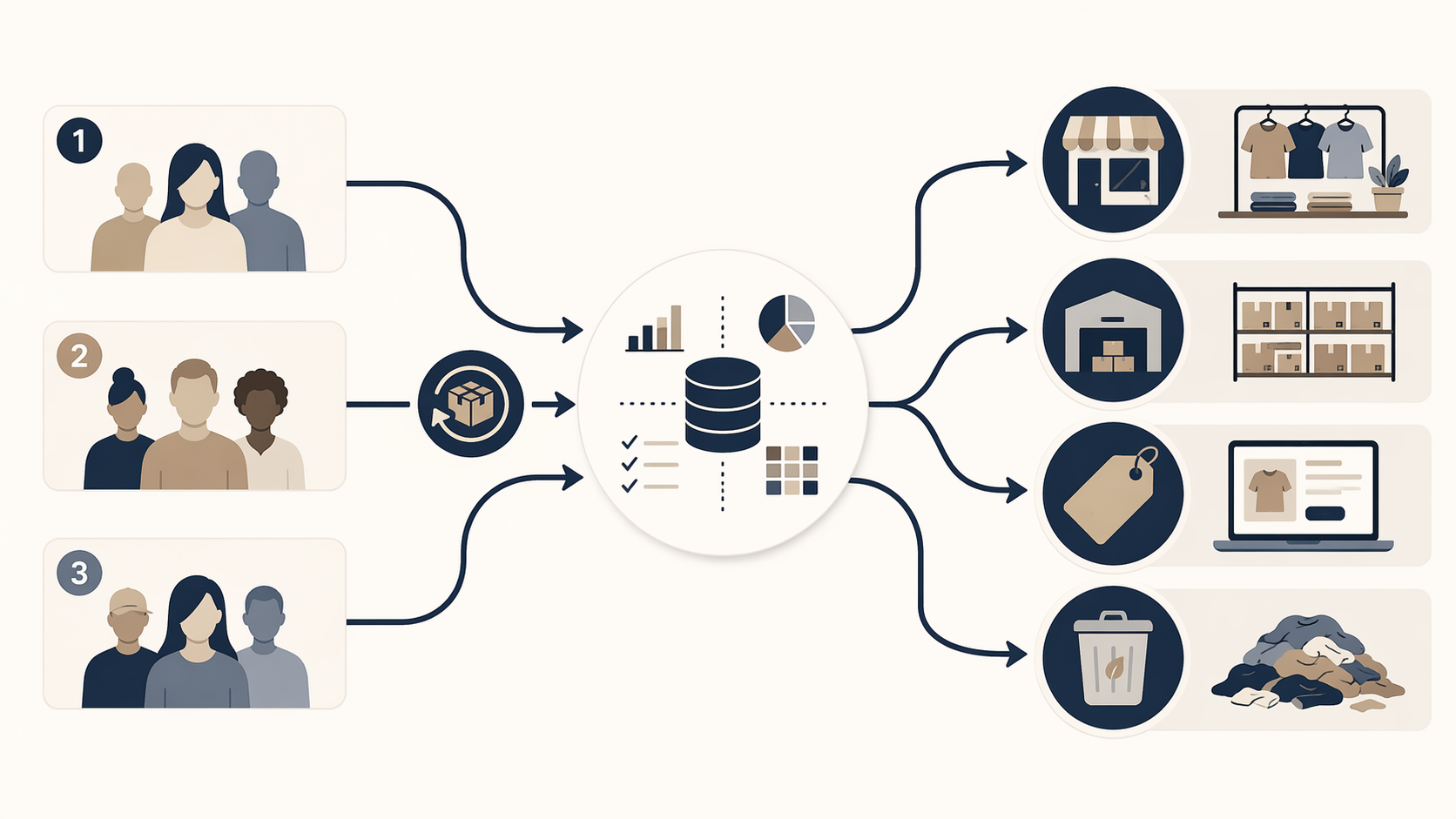
The Policy-Data-Dispositioning Pipeline
A useful returns AI program does not begin with a model. It begins with a return that can be described consistently: who returned it, what item came back, when it came back, where it entered the network, what condition it was in, what disposition was selected, and how much value was recovered. Madewell’s policy only covers part of that chain. It helps with customer identity, member segment, fee treatment, return window, and intake channel. It does not, from public documentation, tell us whether the company captures item condition in a structured way or uses machine learning for dispositioning.
That gap is exactly where many reverse-logistics AI claims get too loose. McKinsey’s reverse-logistics model names six levers: Demand, Data, Decisioning, Operations, Re-commerce, and Feedback.[2] Madewell’s visible policy sits most clearly in Data and, to a lesser extent, Demand. The rules encourage loyalty identification and may influence how customers choose to return. But Decisioning is a different lever. Decisioning asks whether the retailer can determine, at the item level, whether the returned product should go back to a store shelf, a central facility, resale, markdown, repair, donation, liquidation, or waste.
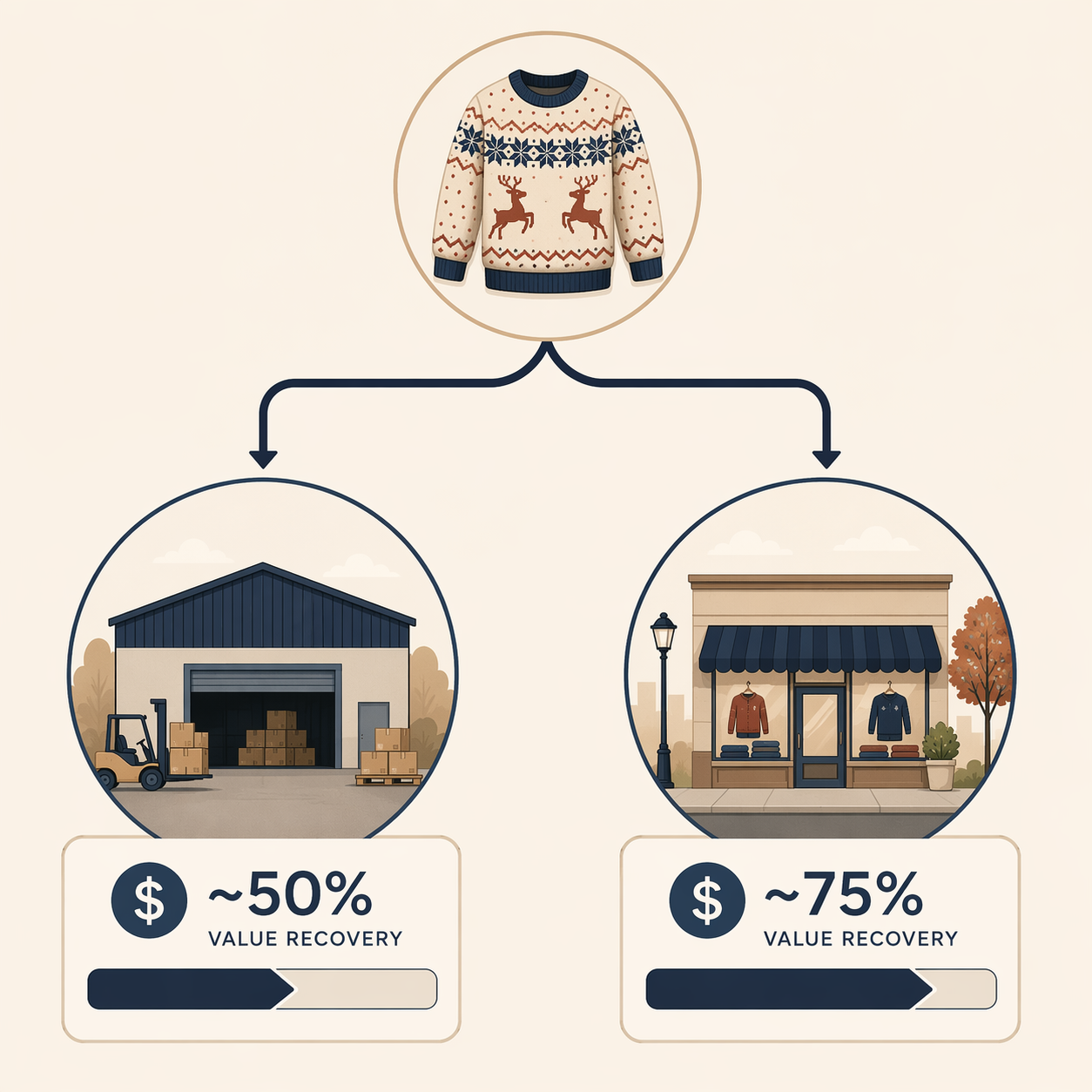
For a sweater, the operational question is rarely just “accept or reject the return.” It is whether the unit still has enough season, demand, condition, and margin to justify a specific path. A January return of a holiday sweater does not have the same recovery profile in every location. A store near active demand may have a different answer than a central facility processing returns after the selling window has collapsed.
McKinsey uses that exact type of holiday sweater scenario to explain dynamic dispositioning: routing the item to a central facility in January may recover about 50% of value, while routing it dynamically to a nearby store can lift recovery to about 75%.[2] This is McKinsey’s illustrative mechanism, not a documented Madewell result. Its usefulness is that it shows why dispositioning data needs to connect policy, item, channel, and recovery value rather than stopping at “return completed.”
A loyalty-linked policy can feed that system, but it cannot replace it. The model would still need product attributes, markdown cadence, local inventory positions, store labor constraints, resale eligibility, carrier costs, and actual recovery outcomes. If those fields live in different systems, use inconsistent definitions, or never get captured after the return is processed, the AI team has a data integration project, not a dispositioning engine.
Why Dynamic Dispositioning Is Still Rare
Dynamic dispositioning sounds obvious in a conference room because everyone can see the waste in sending the wrong unit to the wrong node. It is much harder inside a retailer that has stores, e-commerce, merchandising, finance, customer care, and distribution centers all using slightly different definitions of “good outcome.” Stores want sellable inventory and manageable labor. E-commerce wants a low-friction return promise. Merchandising wants fit and assortment feedback. Finance wants cost containment. The DC team wants volume it can actually process.
The industry data backs up that operating reality. In McKinsey’s 2025 survey of 30 supply chain executives, more than half said dispositioning was their greatest reverse-logistics challenge, and all but five still relied on basic data or no data for dispositioning decisions.[2] That is the part worth sitting with. The bottleneck is not that retailers have never heard of AI. It is that most do not yet have the structured, trusted, cross-functional data needed to let a model make profitable routing recommendations.
A static policy like Madewell’s can help because it creates repeatable categories. Insider versus non-member is a clear field. Tier is a clear field. Return window is a clear field. BORIS versus mailed return is a clear field. Those fields do not answer every dispositioning question, but they are cleaner than a pile of anonymous returns with free-text reason codes and no customer context.
The next layer is harder: item condition at intake, reason code accuracy, whether the unit was resold at full price, marked down, routed to recommerce, liquidated, or discarded, and how much value was recovered after transport, labor, and handling. Without that outcome loop, a model cannot learn which routing decision worked. It can only imitate historical process, including the bad parts.
The Cost Pressure Is Real, But It Should Stay in Its Lane
Apparel returns create enough cost pressure to justify this work, but industry averages should not be mistaken for Madewell-specific performance. Coresight Research reports a 24.4% average U.S. online apparel return rate and says size and fit account for 53% of apparel returns.[3] Noatum Logistics describes fashion e-commerce return rates in the 30% to 40% range.[4] Those figures explain why the category is under pressure. They do not disclose Madewell’s own return rate.
The handling economics are just as unforgiving. Coresight reports that return handling costs can reach up to 66% of the original item price.[3] At that level, a return policy is no longer a customer-service appendix. It becomes an operating system for who pays, who gets premium treatment, which channel absorbs the item, and whether the recovered value is worth the work.
That does not mean the answer is to make every return harder. Premium apparel brands still have to protect high-value customer relationships. Madewell’s structure is interesting because it does not treat all returns as equal friction. Members receive a different promise from non-members. Higher-tier customers can receive more flexibility. The policy protects the loyalty experience while giving operations a way to distinguish segments instead of spreading the same cost logic across every shopper.
Where Madewell Stops and an AI-Ready System Begins
The practical lesson is not that Madewell has solved AI-powered reverse logistics. The public evidence does not support that claim. The lesson is that loyalty-linked policy design can create the first layer of the data foundation McKinsey says retailers need for modern reverse logistics: more identifiable demand signals, cleaner return-event data, and a policy framework that can eventually support more granular decisioning.
There is also evidence that customers may tolerate more granular rules than retailers often assume. McKinsey’s 2025 consumer survey of 850 respondents found that 71% would not be less likely to shop with a retailer using dynamic, product- and customer-specific return policies.[2] That finding does not say every customer will love every fee or exception. It does suggest that a well-explained, segment-aware policy is not automatically a loyalty disaster.
For a supply chain leader, the implementation sequence should stay disciplined. First, segment customers in a way that is visible at return initiation. Then capture return events consistently across mail and store intake. Then connect those events to item condition, product attributes, local channel options, and final recovery values. Only after that does dynamic routing become a serious modeling problem rather than a slideware promise.
- Can every return be tied to a customer status, even if the shopper is not a loyalty member?
- Are mailed returns and store returns captured with the same event definitions?
- Is item condition recorded in structured fields before disposition?
- Can the team see the final disposition outcome and recovered value by item?
- Do store, DC, resale, markdown, and waste paths share enough data for a model to compare outcomes?
Madewell’s tiered return policy shows how a premium apparel brand can make returns data more structured without claiming a full AI transformation. Free member returns, a non-member fee, BORIS, a defined window, and tier-based extensions create customer-level signals that many reverse-logistics teams need before they can move toward dynamic dispositioning. Before buying or building reverse-logistics AI, the better first question is whether return rules, loyalty identity, store return flows, disposition outcomes, and recovery values are captured in a way a model could actually learn from.
References
- How Madewell Insiders Get VIP Treatment for Their Returns, Narvar, 2026.
- From cost center to competitive advantage: Modernizing reverse logistics with AI, McKinsey, 2026.
- The True Cost of Apparel Returns, Coresight Research.
- The Reverse Logistics Crisis: Fixing Fashion's Most Costly Supply Chain Weakness, Noatum Logistics.
Comments
Join the discussion with an anonymous comment.