
The Madewell sweater recall is not hard to describe at the style level. It is much harder to describe at the manufacturing level, and that is the part apparel operators should be looking at closely.
On July 16, 2026, the U.S. Consumer Product Safety Commission announced a recall of about 5,900 women’s sweaters sold by Madewell and T.J. Maxx after one fire incident. The affected products are styles NT611 and NT612 from the HO24 season, manufactured in China, imported by J. Crew Group, distributed by Madewell, and sold from December 2024 through October 2025. The stated hazard is direct: the sweaters violate the mandatory 16 CFR 1610 flammability standard for clothing textiles and pose a risk of serious injury or death from burn hazard.[1]
That is enough information to pull product from stores, warn consumers, and define the recalled styles. It is not enough information to answer the question every quality, sourcing, legal, and merchandising team asks once the first emergency call is over: why did one incident require the whole class of goods to be treated as suspect?
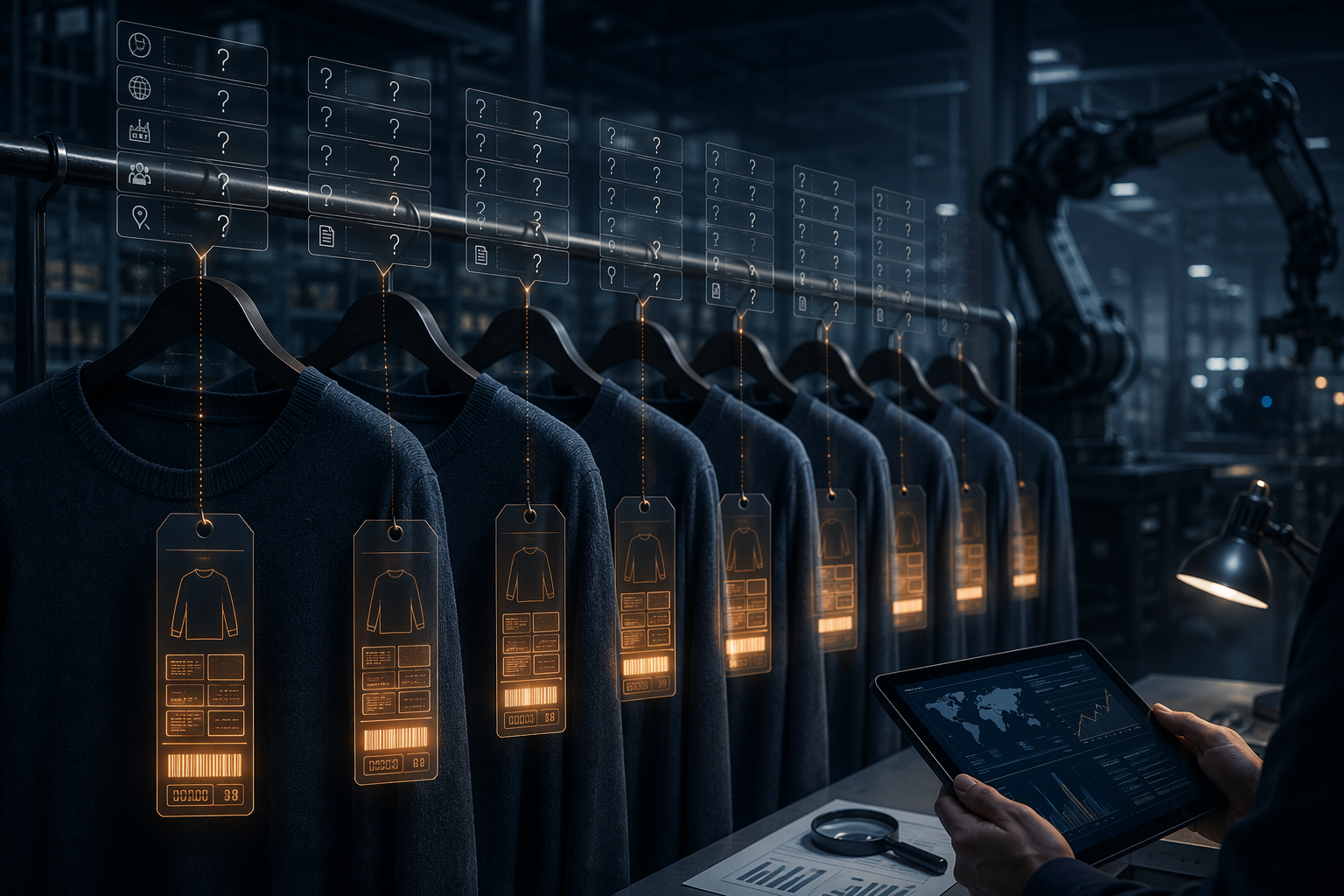
The Notice Identifies the Commerce Trail, Not the Production Genealogy
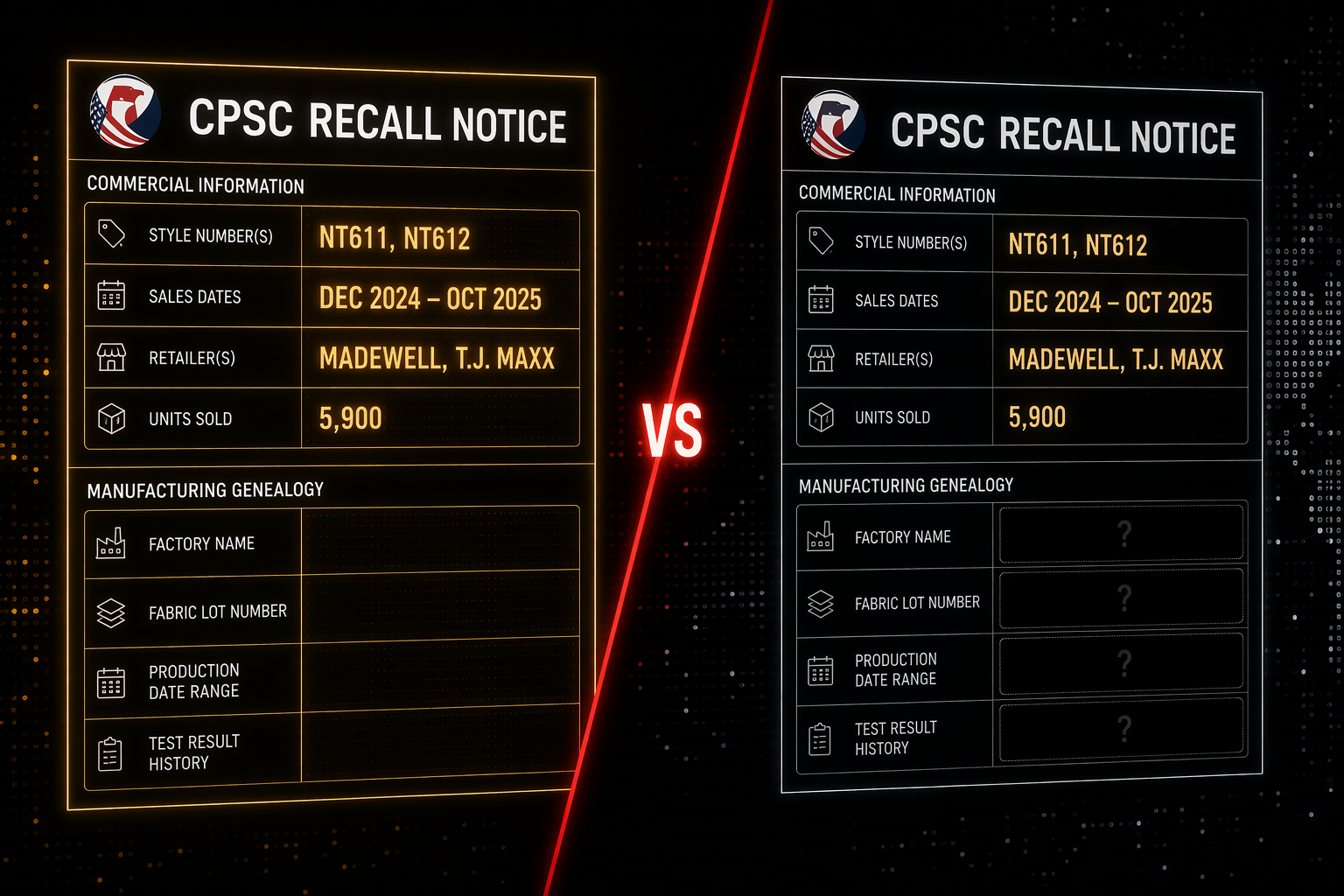
The CPSC notice is precise where retail and regulatory containment require precision. It names the importer, distributor, country of origin, style numbers, season code, sales channels, sales window, and unit count. It also states that one fire incident was reported.[1] For a consumer notice, that is the right first layer. Shoppers need to know whether the sweater in their closet matches the recalled product.
For supply chain containment, the missing layer matters just as much. The notice does not name a factory. It does not disclose a fabric lot. It does not give a production date range. It does not identify whether the problem was connected to a particular shipment, mill batch, finishing route, test classification, or sewing facility. It does not publish the test history that led from one fire incident to the conclusion that the recalled sweaters violated 16 CFR 1610.[1]
That absence should not be read as proof that a particular supplier failed. It also should not be read as proof that Madewell lacked internal records. Public recall notices are not production dossiers. But the operational effect is visible: the recall boundary sits at the style level. When the smallest defensible unit of evidence is “style NT611 and NT612, HO24,” the smallest defensible recall unit becomes all goods in that class.
| What the public recall record can identify | What it does not identify |
|---|---|
| Importer: J. Crew Group | Specific factory |
| Distributor: Madewell | Fabric lot or yarn lot |
| Country of origin: China | Production date range |
| Styles: NT611 and NT612, HO24 season | Finishing route or treatment history |
| Sales channels: Madewell and T.J. Maxx | Batch-level test result history |
| Sales window: December 2024 through October 2025 | Complaint-to-batch linkage |
This is the uncomfortable asymmetry supply chain teams should not ignore. Commercial traceability is often much cleaner than manufacturing traceability. A brand can know where a product was sold, when it was sold, and under which style number it moved through the assortment while still struggling to prove which fabric lot, production run, or supplier process created the risk.
Why One Fire Incident Can Become a Full-Class Recall
A recall is not a trial where every party waits for a perfect root-cause report. It is a containment decision made under time pressure. If a product category presents a burn hazard and the available data cannot separate exposed units from unaffected units, the conservative boundary wins. That is frustrating, expensive, and usually correct from a safety standpoint.
In apparel, the failure mechanism behind a flammability issue can sit in several places. It may relate to fiber composition, fabric weight, surface characteristics, finishing chemistry, laundering or brushing effects, or how the textile was classified and tested under the applicable standard. Those are industry-pattern possibilities, not findings in this recall. The CPSC notice does not disclose which mechanism applied here.[1]
The practical point is simpler. If style-level identifiers are not connected to batch-level manufacturing records, an operations team cannot credibly say, “only these units were made from the suspect fabric lot,” or “only this production window used the finish now under review,” or “only this factory shipment shares the failed test profile.” Without that chain, the product population stays broad.
That is where paper records, PDFs, lab reports, supplier emails, and spreadsheet exports become a liability. They may contain the answer. They may even contain all the pieces of the answer. But if those pieces cannot be joined quickly, consistently, and defensibly, they do not support a narrower recall boundary when the regulator is waiting and the product is already in consumers’ homes.
The Supplier Blind Spot Is Not Rare
Supplier-quality blind spots are a known cost center across manufacturing, not a special weakness unique to one apparel brand. ETQ Pulse of Quality survey data cited in industry coverage found that 61% of surveyed manufacturers said up to half of all product recalls are attributable to supplier issues, while 70% believed they had supplier control without the data to prove it. The same cited survey data reported that 39% of respondents put the cost per recall in the United States alone at $10 million to $49.99 million.[2]
Those numbers are not the cost of the Madewell recall. No published cost for this specific recall was available at the time of writing, two days after the CPSC notice. But the benchmark explains why the traceability question deserves more attention than the usual brand-reputation commentary. A recall boundary is a financial boundary, an inventory boundary, a customer-service boundary, and a legal exposure boundary. If the boundary has to be drawn around every unit of a style, every downstream team inherits the widest possible problem.
That does not make the factory the convenient villain. A named factory is not in the public record. The failure could have originated in material sourcing, finishing, test interpretation, a documentation gap, a production substitution, or a combination of issues. The point is that modern recall readiness requires enough production genealogy to test those possibilities against evidence instead of treating the entire commercial style as the only safe unit of action.
What AI Traceability Would Have to Do
AI traceability would not mean sprinkling a model over a messy archive and expecting it to clean up a recall after the fact. The system would have to do operational work before the incident, during signal detection, and after containment begins. In a flammability recall, that means connecting product identity to supplier quality evidence at a level below the style.
The first requirement is ingestion. Fabric composition records, mill certificates, test reports, purchase orders, factory production dates, shipment records, inspection reports, trim substitutions, and exception approvals need to enter a shared data layer in usable form. This is the same architectural reason many teams look at a supply chain control tower AI model: not because the dashboard is impressive, but because fragmented supplier data is not actionable until it can be normalized and queried across functions.
The second requirement is anomaly detection on quality data. A system should be able to flag test results that drift toward a threshold, fabric lots whose measurements differ from approved specifications, or suppliers whose documentation patterns change abruptly. For apparel, upstream inspection can also include AI-assisted fabric review using cameras and computer vision, but that should be treated as source control, not as a guarantee that a finished garment can never fail a safety standard.
The third requirement is linkage to field signals. A March 2026 product safety analysis described AI-powered review of consumer reviews, call logs, and CRM data as a way to detect hazard signals within hours rather than weeks.[3] In apparel, that does not replace compliance testing. It changes the first-response clock. If a consumer complaint mentions heat, smoke, melting, scorching, or fire, the system should not wait for someone to manually connect that language to a style number, lot history, and prior test exception.
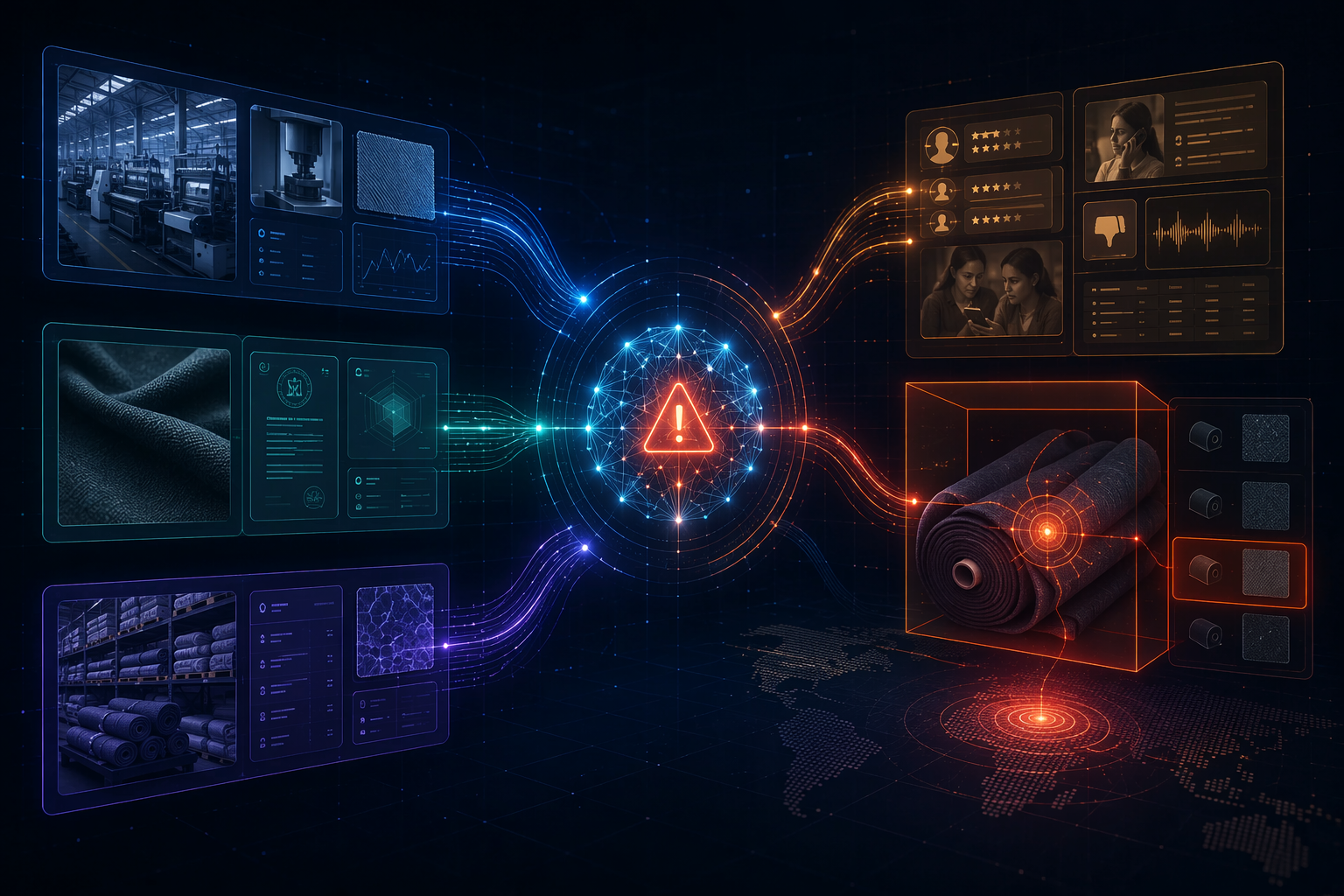
The sequence matters. Complaint analysis without production genealogy only tells the brand that a signal exists. Supplier documentation without complaint linkage only tells the brand what was supposed to happen. AI becomes useful when it can connect the event in the market to the batch history behind the goods.
A Narrower Recall Depends on Evidence the Brand Can Defend
In a better traceability posture, the first fire report would trigger a structured search, not a scramble through attachments. The team would ask which style, color, size, purchase order, shipment, fabric lot, factory run, and test package matched the reported unit. Then it would ask what else shared that same genealogy.
- If all recalled units shared one fabric lot, containment could start there.
- If only one production date range used a questioned finish, containment could follow that window.
- If a failed or borderline test result mapped to one shipment, the recall population could be compared against that shipment.
- If complaints clustered by channel or delivery period, customer outreach could be prioritized while the technical investigation continued.
Those are not claims about what happened in the Madewell case. They are the operating questions a traceability system must make answerable. The standard is not whether AI can predict every defect. The standard is whether the brand can isolate exposure once a credible signal appears.
Traceability Is Moving From Reporting to Control
The fashion industry is already moving in this direction for reasons broader than one sweater recall. Oritain’s 2026 traceability report says nearly two-thirds of fashion industry professionals see traceability as a competitive advantage, and 61% believe it will be extremely or very important to organizational success in the next three to five years.[4]
The pressure is not only regulatory. Vogue’s 2026 supply chain analysis reported that 95% of surveyed fashion executives said tariffs disrupted 2025 supply chains, and it described AI-driven traceability as part of a shift from compliance reporting toward operational control.[5] That distinction is important. A compliance file proves that a document exists. Operational control lets a team act on the document when the product, supplier, market, or regulator creates urgency.
The Madewell recall lands squarely in that shift. A brand does not need traceability only so it can publish a better sustainability claim or satisfy a documentation request. It needs traceability so that, when a hazardous signal appears, the recall team can move from “what style is this?” to “which exact production population shares the risk factors?”
The Smallest Recallable Unit Is the Real Test
The cleanest way to judge recall readiness is to ask for the smallest recallable unit a brand can defend. If the only reliable unit is the style, then one incident can pull every unit of that style into the same risk population. If the brand has real-time, AI-assisted traceability tied to supplier quality records, production genealogy, test results, and complaint signals, that unit can move closer to the actual risk population.
That does not eliminate recalls. It does not prove that a named supplier failed. It does not reveal the exact defect mechanism behind the Madewell sweaters, because the public record does not disclose it. What the recall does show is more practical: when fashion brands cannot connect commercial style data to factory, fabric lot, production window, and test history, they are forced into maximum-containment decisions at the moment when regulators, operators, and customers need the narrowest defensible answer.
References
- Madewell Recalls Women’s Sweaters Due to Risk of Serious Injury or Death from Burn Hazard; Violate Mandatory Standard for Clothing Textiles, U.S. Consumer Product Safety Commission, July 16, 2026
- With Rising Product Recalls, It Pays to Reevaluate Your Supply Chain, SupplyChainBrain
- How AI is Revolutionizing Product Safety: Essential Insights for Navigating Risks, Recalls, and Regulations, Product Law Perspective, March 2026
- 6 Key Issues Driving the Importance of Traceability in 2026, Oritain
- The Forces That Will Shape Fashion’s Supply Chains in 2026, Vogue, 2026
Comments
Join the discussion with an anonymous comment.