
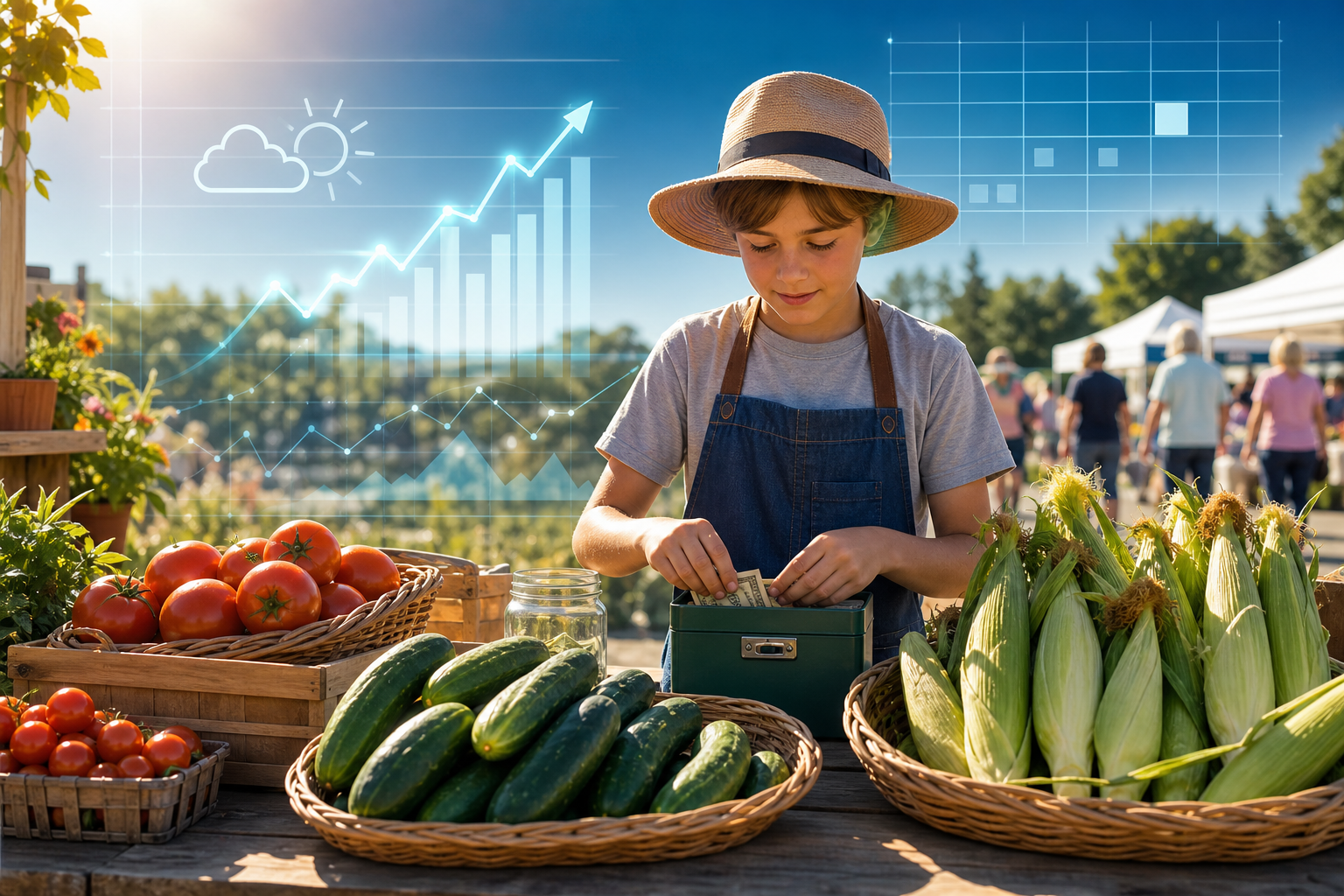
At a youth farm stand, the supply chain question is not abstract. A kid has tomatoes on the table, a cash box beside the price signs, and a limited number of Saturdays to learn whether people actually buy what was planted. By noon, the decisions are already operational: hold the price, offer a bundle, save the better-looking produce for late shoppers, or mark down the soft tomatoes before they become compost.
That is why teaching AI supply chain basics through kids' farm business startups is less of a stretch than it sounds. The farm stand compresses demand planning into a form small enough to see. What sold last time? What was the weather? Was it a weekday, a holiday weekend, or the first warm Saturday of the season? How much inventory came home unsold? The same questions sit under enterprise demand forecasting, just with more systems, longer lead times, more stakeholders, and more ways for the logic to disappear behind a dashboard.
One documented example of a 10-year-old running a farmers market booth is useful because the work is not decorative. The child tracks inventory, manages pricing, handles customer objections, and learns basic accounting while selling in a real market setting.[1] Those are not pretend business lessons. They are the same decision points that make or break a small produce operation: buy or grow too much, and cash gets trapped in inventory; bring too little, and the stand runs out while demand is still there.
The farm stand forecast starts with a notebook, not a model
The smallest useful forecasting system for a farm stand can begin with a notebook or spreadsheet. Each market day gets one row. The child records what was brought, what sold, what price was posted, what came home, what the weather felt like, and whether anything unusual happened: a school event, a competing vendor with cheaper cucumbers, rain at opening time, or a customer asking for smaller bundles.
The point is not to build a perfect dataset. The point is to make the business visible enough that an AI tool has something grounded to analyze. A chatbot cannot infer that the stand ran out of cherry tomatoes at 10:30 a.m. unless someone writes it down. It cannot know that a markdown cleared the last baskets unless the markdown is part of the record.
| Farm stand record | Why it matters for the forecast | Decision it can support |
|---|---|---|
| Units brought and units sold | Shows actual movement, not just what was available | How much to bring next time |
| Price and bundle offer | Separates demand from the effect of a discount or deal | Whether to hold price or change pack size |
| Weather | Explains why a good or bad sales day may not repeat | Whether to reduce inventory on rainy market days |
| Day of week and season | Connects sales to routine traffic and growing cycles | What to harvest or prepare for the next market |
| Leftover condition | Captures shelf-life pressure that sales totals miss | When to discount before quality drops |
A simple row might say: Saturday, sunny, 78 degrees, first week of July, brought 30 tomato pints, sold 24 at the posted price, discounted six near closing, two customers asked for smaller mixed baskets. A few weeks of that is not enough for a statistical victory lap. It is enough to start asking better questions.
Youth entrepreneurship programs already teach pieces of this work without calling it supply chain planning. Lemonade Day’s business plan framework asks kids to think through costs, pricing, customer profiles, and competition.[2] The 4-H Entrepreneurship Project also teaches youth to develop business plans.[3] A farm stand adds the perishable-inventory problem: the product has a clock on it.
From sales history to a usable AI prompt
The practical AI step is not magic forecasting. It is structured questioning. A parent, teacher, or youth program coordinator can help the child export the farm stand log from a spreadsheet, paste a small table into a chatbot, and ask for patterns in plain language. BoxHero describes small-business AI inventory use cases around AI reports, trend spotting with chatbot prompts, and reorder alerts; the useful part here is the prompt pattern, not the idea that a farm stand needs inventory software.[4]
A good prompt keeps the tool close to the actual business question:
Here is my farm stand sales log. For each market day, I recorded the date, weather, day of week, produce brought, units sold, price, units left over, and notes. Look for patterns in what sells more or less. Then estimate what I should bring next Saturday if the weather forecast is warm and sunny. Explain your reasoning and list what information is missing.That last sentence matters. Asking what information is missing turns the exercise from answer-taking into planning. The chatbot may notice that tomatoes sold better on sunny Saturdays, but it may also say there are too few observations to be confident. It may suggest bringing more cucumbers because they sold out twice, while also warning that sellouts hide true demand because the stand did not have enough inventory to observe how many customers would have bought more.
The child still has to translate the answer into action. If the tool suggests 35 tomato pints for a warm Saturday, the young seller has to ask whether 35 pints can be harvested, transported, displayed, and sold before quality drops. If the answer is no, the right plan may be 28 pints, better signage, and a preplanned markdown time.
The three decisions the forecast should touch
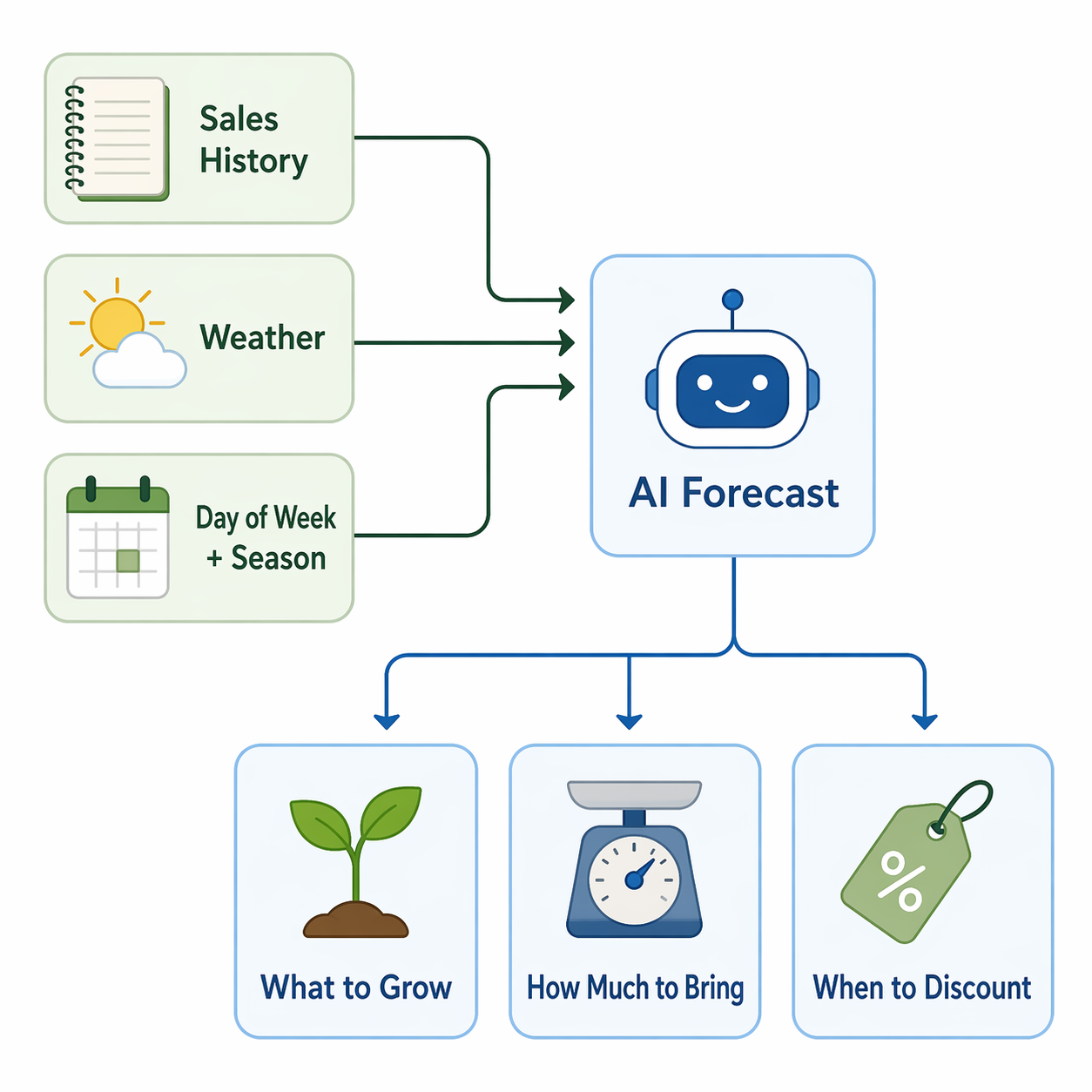
- What to grow: use repeated customer requests and sellout patterns to decide whether next season needs more of a crop, a different variety, or smaller package sizes.
- How much to bring: compare recent sales with the weather forecast, market day, and season instead of simply repeating last week’s quantity.
- When to discount: watch leftover quantity and produce condition early enough that a markdown protects cash rather than merely clearing waste.
Those decisions should not be separated too neatly. A discount decision teaches next week’s stocking decision. A sellout teaches next season’s planting decision. A customer objection about price teaches packaging, positioning, and maybe the need to compare nearby stands before setting a number.
Why supply chain leaders should recognize the pattern
At enterprise scale, the nouns change. The notebook becomes an ERP export. The sunny Saturday becomes a weather feed. The handwritten note about a competing vendor becomes market intelligence. The child deciding whether to bring more tomatoes becomes a planner balancing service levels, margin, waste, labor, supplier constraints, and sales input.
| Farm stand action | Enterprise equivalent | Shared forecasting logic |
|---|---|---|
| Write down what sold and what came home | Capture historical demand and inventory movement | Separate observed demand from available supply |
| Add weather and market-day notes | Add external demand signals | Explain variation that sales history alone cannot explain |
| Ask a chatbot for patterns | Run AI-assisted demand sensing or forecasting | Use past behavior plus context to estimate likely demand |
| Choose harvest and table quantities | Set production, replenishment, or allocation plans | Convert forecast into inventory action |
| Discount produce before closing | Use markdown, promotion, or reallocation | Respond when demand and inventory no longer match |
The farm stand is cleaner than a multinational supply chain, which is exactly why it is useful. Nobody has to debate whether a forecast override came from a key account manager, whether a promotion was loaded correctly, or whether a supplier lead time changed after the plan was published. The operating loop is exposed: data in, prediction out, decision made, consequence observed.
Enterprise benchmarks show why companies care about this pattern. Beam Data reports that AI demand forecasting in agriculture can improve forecast accuracy by 25–35% and reduce inventory costs by 20–30%; it also cites Church Brothers Farms as seeing a 40% short-term forecast accuracy improvement.[5] Those figures belong in the enterprise benchmark column. They should not be borrowed to imply that a child with a chatbot will produce the same measured return.
Still, the direction of travel matters. WiseYield lists AI yield predictions starting from €22/month, which weakens the old assumption that AI-supported agricultural planning is only available to large operators with large software budgets.[6] A farm stand does not need a full platform to teach the logic. It needs a small, honest dataset and an adult who will keep the tool from sounding more certain than the evidence allows.
What the child learns when the forecast is wrong
The best lesson may come when the AI forecast misses. Suppose the chatbot suggests bringing more sweet corn because the past two sunny Saturdays sold well. Then a storm arrives earlier than expected, foot traffic drops, and half the crate is still sitting there after lunch. That is not a failed class. That is the class.
The child can compare the forecast with the result, then ask what changed. Was the weather different from the forecast? Was the price too high? Did another vendor have better-looking corn? Did the stand open late? Was the sample too small? This is how AI literacy becomes operational literacy. The model produces an estimate; the operator investigates the miss.
There is also a useful accounting lesson in the miss. Unsold inventory is not just a sad basket at the end of the table. It is cash, labor, seed, water, packaging, and time. If a markdown turns likely waste into partial recovery, the child sees why pricing is part of supply chain execution rather than a separate math worksheet.
What educators can safely claim
There is no evidence in the available material that youth-run farm businesses are broadly adopting AI forecasting tools. This should be presented as a practical teaching possibility, not a documented trend. The claim that can be made is narrower and stronger: youth business programs already teach costing, pricing, customer thinking, competition, planning, and accounting; a farm stand data log plus a chatbot can extend those lessons into demand forecasting and inventory decisions.[1][2][3][4]
The adult role is to set boundaries. The child should not paste private customer information into a tool. The dataset should be small enough to inspect manually. The chatbot’s answer should be checked against the notebook, the weather, and the table. If the tool invents a pattern that is not in the data, that becomes another lesson: fluent output is not the same as reliable analysis.
A simple classroom or youth-program version can run without pretending to be an enterprise implementation. Students can use a hypothetical farm stand log, ask a chatbot for demand patterns, decide what to bring to the next market, and explain what they would watch during the sales day. The explanation matters as much as the answer because it shows whether they understand the link between forecast and decision.
Where the farm stand stops being a miniature enterprise
The farm stand strips away useful clutter, but it also strips away real constraints. Enterprise planners deal with procurement contracts, production schedules, transportation capacity, customer hierarchies, substitutions, promotions, minimum order quantities, and internal politics. A child can decide at 11:45 a.m. to mark down tomatoes. A national produce supplier may need sales approval, margin rules, customer commitments, and system updates before an equivalent action happens.
The data problem is different too. A farm stand may have too little history. An enterprise may have years of history contaminated by stockouts, promotions, one-time customer behavior, product changes, and bad master data. More data does not automatically mean cleaner judgment.
That distinction keeps the teaching case honest. The farm stand does not prove that AI forecasting is easy. It proves that the core structure is understandable: historical sales and outside variables feed a prediction, and the prediction is only valuable when someone converts it into an inventory, planting, pricing, or markdown decision.
The child at the table remains the planner. AI can suggest that warm Saturdays tend to sell more tomatoes. It cannot inspect which tomatoes are starting to soften. It cannot hear a customer say the basket is too large and decide to test a smaller bundle. It cannot take responsibility for bringing too much or marking down too late. That visible human decision is the reason the farm stand works as a teaching case in the first place.
References
- 13+ Business Skills Kids Learn Running a Farmers Market Booth, The Survival Mom
- Business Plan for Kids, Lemonade Day
- 4-H Entrepreneurship Project, SDSU Extension
- AI Inventory Management for Small Business, BoxHero
- AI Demand Forecasting in Agriculture, Beam Data
- Best AI Farming Software 2026, WiseYield
Comments
Join the discussion with an anonymous comment.