
IREN’s AI Cloud revenue target is not hard to understand on a spreadsheet. The company reported $33.6 million of quarterly AI Cloud revenue in Q3 FY26, or roughly $134 million annualized, and is aiming for $3.7 billion of AI Cloud ARR by the end of calendar 2026.[1] The hard part is the conversion path between those two numbers: about 480MW of AI capacity and roughly 150,000 GPUs are needed for the target, while only about 23,000 GPUs were deployed as of the latest operational update.[1][2]
That leaves roughly 127,000 additional GPUs to procure, install, power, cool, network, test, and hand over into customer service in a compressed window. The relevant question is therefore not whether AI demand exists. It is whether the physical sequence can hold: transformers before substations, substations before energized halls, cooling before rack density, GPUs before customer acceptance, and customer acceptance before recurring revenue.
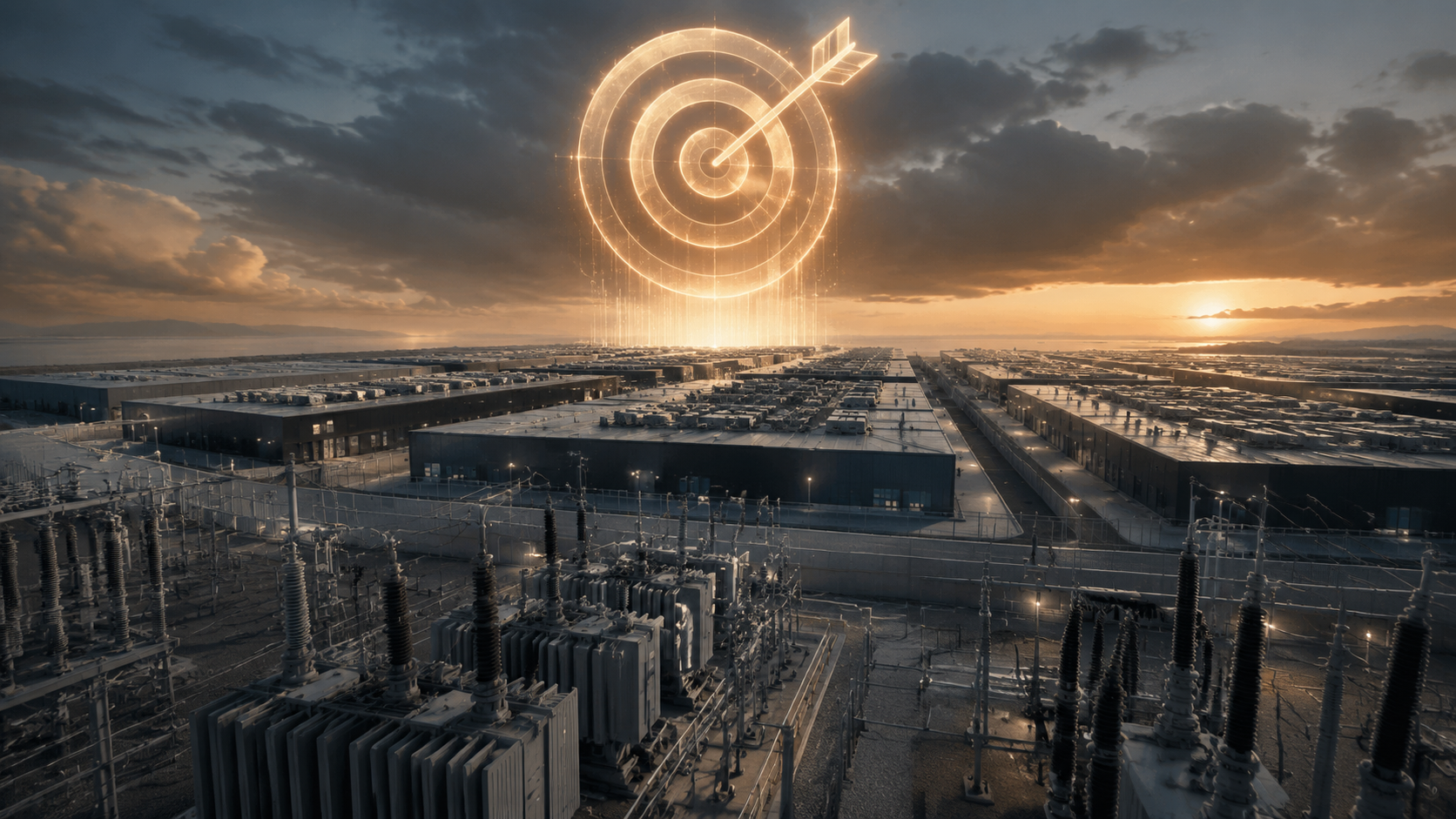
The Target Is A Capacity Schedule, Not Just A Sales Goal
IREN has one obvious advantage that many AI infrastructure stories lack: it already controls a large power estate. Management has described 4.5GW of secured power, while the $3.7 billion ARR target is estimated to require about 480MW of AI capacity.[1][2] On paper, the target uses only about a tenth of the secured power base.
But secured power is not the same as billable GPU capacity. A site can have land, high-voltage access, and an attractive interconnection narrative while still waiting on the transformer package that steps voltage into usable distribution, the switchgear that protects it, the cooling plant that can absorb the heat, and the commissioning team that signs off the load. In AI infrastructure, the revenue clock starts much later than the site-control announcement.
| Item | Reported Or Implied Status | Why It Matters |
|---|---|---|
| AI Cloud revenue | $33.6M in Q3 FY26, about $134M annualized | Shows the current run-rate before the planned end-2026 ramp |
| End-2026 AI Cloud ARR target | $3.7B | Requires a step-change in deployed, accepted capacity |
| AI capacity implied by target | About 480MW | Turns the sales target into an electrical and cooling requirement |
| GPU count implied by target | About 150k GPUs | Creates the procurement, deployment, and commissioning workload |
| GPUs deployed | About 23k | Leaves roughly 127k GPUs still to be deployed |
The company’s disclosed site plan gives the ramp a plausible physical map. Childress includes Horizon 1–4 with 200MW of critical IT load; Sweetwater is a planned 2GW campus with substation energization reported in Q3 FY26; Prince George adds 220MW; and the Nostrum acquisition in Spain brings 490MW into the longer-term portfolio.[1][2] Those are serious assets. They also create a sequencing problem: a megawatt in a campus plan is not interchangeable with an energized, cooled megawatt available for customer GPUs by a specific contract date.
The Transformer Queue Is Where The Schedule Starts To Bite
The cleanest reason to discount the full $3.7 billion target is not IREN’s demand story. It is the transformer calendar. Reuters reported in July 2026, citing Wood Mackenzie, that generator step-up transformer lead times had reached more than 160 weeks by Q1 2026, up from about 143 weeks in 2024.[3] pv magazine USA separately reported in May 2026, citing Burns & McDonnell, that transformer demand had surged 274% since 2019 and prices had risen 80% over five years.[4]
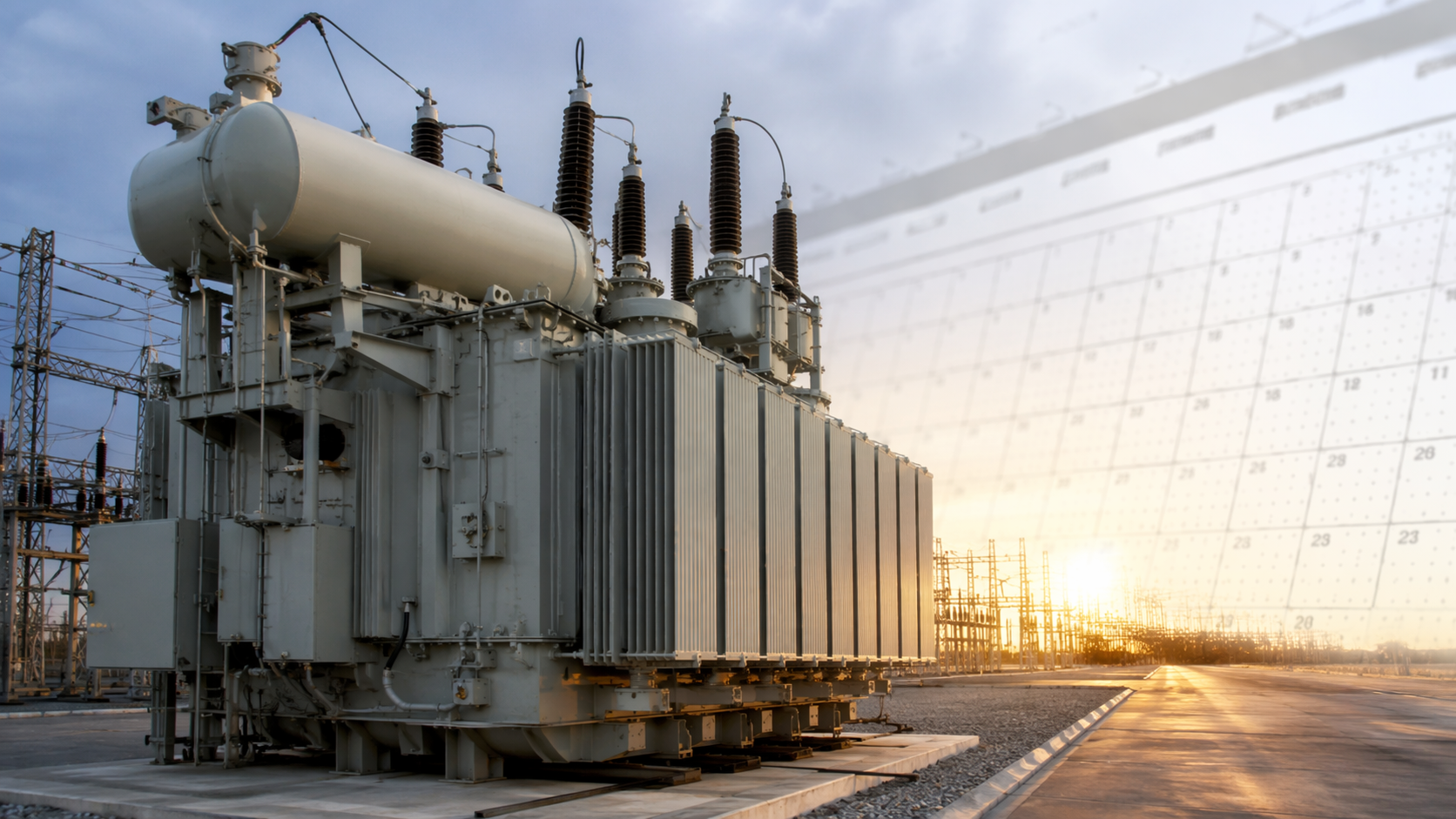
Those figures should be handled carefully. They are not raw Wood Mackenzie or Burns & McDonnell reports presented directly here; they come through Reuters and pv magazine. They also describe broad market conditions, not IREN’s exact purchase orders. Still, they matter because the bottleneck they identify sits directly in the path between IREN’s power estate and revenue recognition. A delayed transformer does not merely push back a construction milestone. It can idle downstream work: switchgear integration, load-bank testing, cooling validation, GPU burn-in, customer acceptance, and final service commencement.
Sweetwater is the obvious place to watch. A 2GW campus can anchor a long AI infrastructure story, but the timing of substation energization determines when that capacity becomes usable. If the substation package and related electrical equipment were ordered early enough, IREN may have more schedule protection than the industry average suggests. If not, the public target is leaning on compression in a part of the supply chain that has been doing the opposite.
Childress is different because it includes nearer-term AI deployment work around the Horizon phases and the 60MW air-cooled NVIDIA-linked deployment discussed in company and partner materials.[1][5] That does not make Childress frictionless, but it gives the near-term story more tangible shape than a distant multi-gigawatt campus. In procurement terms, the distinction is simple: capacity tied to named hardware, named counterparties, and dated deployment work deserves a different confidence level from capacity tied mainly to site optionality.
Interconnection Risk Has Not Disappeared Just Because Power Is Secured
Power constraints are not a theoretical industry worry. Spheron Network, citing Gartner, reported that 40% of AI data centers are projected to be power-constrained by 2027, and that grid interconnection approvals in major U.S. markets can run 24 to 36 months.[6] That does not prove IREN’s named sites will miss their schedules. It does explain why a broad “secured power” number is a weak substitute for site-by-site energization evidence.
For IREN, the better question is not whether 4.5GW exists in the portfolio. It is which blocks are actually available for AI load by the end of 2026, which require utility work, which require substation equipment still exposed to long-lead procurement, and which depend on mining-hall conversion. A customer buying AI capacity does not care that unused power exists elsewhere in the estate if the contracted cluster is waiting on utility acceptance or final commissioning.
The GPU Story Is Stronger Than The Electrical Story, But Still Not Automatic
IREN’s capital and hardware access are real advantages. The company raised about $9.3 billion over eight months, including $3.6 billion of GPU financing from Goldman Sachs and JPMorgan, along with customer prepayments and convertible notes.[7] That is not the profile of a would-be AI cloud provider trying to buy accelerators one batch at a time.
The Microsoft contract is the strongest part of the revenue bridge. IREN announced a $9.7 billion Microsoft agreement in November 2025, and the research record describes it as contributing about $1.9 billion of average annual revenue.[8] Dell is the hardware partner for that contract through a $5.8 billion GPU and ancillary equipment deal.[9] Those details matter because they connect customer demand, financing, and hardware procurement in the same revenue lane.
The NVIDIA-linked deployment also deserves more credit than a generic pipeline claim. IREN’s $3.4 billion NVIDIA partnership was announced in May 2026 and is connected to near-term deployment work, including the 60MW air-cooled Childress capacity described in the research materials.[5] A named hardware ecosystem and a defined deployment footprint do not eliminate execution risk, but they reduce the ambiguity around what equipment is supposed to show up and where it is supposed to land.
The harder part is the remainder of the $3.7 billion ARR target. The target combines the Microsoft-linked contribution with estimated revenue from roughly 74,000 additional GPU deployments across other sites, and the company’s own filings caution that the target is not fully contracted, that there can be no assurance it will be achieved, and that actual revenue may differ materially.[9] That language is not boilerplate to ignore. It is the boundary between contracted revenue visibility and capacity that still needs customers, equipment, site readiness, and acceptance.
Mining Halls Do Not Become AI Data Centers By Renaming The Load
IREN’s Bitcoin mining base explains why the company can move quickly on land and power, but it also explains why the retrofit burden is material. In Q3 FY26, Bitcoin mining still represented 91% of revenue, or $111.2 million of $144.8 million total revenue, while the company recorded $140.4 million of non-cash impairments from decommissioning ASICs.[1] That is a transition in progress, not a completed business mix shift.
Bitcoin mining facilities and AI cloud facilities both consume large amounts of electricity, but they impose different obligations. Mining can tolerate a different pattern of redundancy, environmental control, workload interruption, and customer assurance. AI customers expect dense GPU racks, stable network performance, higher service reliability, and a commissioning process that can prove the cluster performs as sold. The retrofit work is therefore not cosmetic. It reaches electrical distribution, cooling, slab and rack layout, fire systems, operations staffing, and customer delivery processes.
Rack density raises the difficulty. McKinsey reported that average power density rose from 8kW per rack in 2022 to 17kW per rack in 2024, while GB200 racks can reach 120kW; it also reported that liquid cooling was present in 22% of data centers in 2024 and in virtually all new AI-focused centers.[10] Those figures do not mean every IREN deployment requires the same cooling design. They do mean the company is moving into an infrastructure category where cooling design, not just power availability, governs how much compute can be accepted into service.
What Looks On Track, And What Still Looks Like A Stretch
The near-term revenue stack should not be treated as one uniform risk bucket. The Microsoft-linked revenue has the strongest claim to being on track because it has a named customer, large stated contract value, disclosed hardware partner, and financing architecture around the GPU purchase.[7][8][9] It still depends on delivery and commissioning, but the commercial and procurement chain is unusually visible.
The NVIDIA-backed Childress deployment sits in the next tier. It has partner substance and a more bounded physical footprint, especially compared with the broader multi-site expansion narrative.[5] The key watch items are whether the 60MW deployment is energized, populated, cooled, and accepted on the timeline implied by management’s revenue ramp.
The least certain portion is the stretch from those firm components to the full $3.7 billion ARR. That stretch requires additional GPU deployments, more customer conversion, and enough transformer, interconnection, and cooling progress across sites to turn capacity into service before year-end 2026. It is possible in the sense that IREN has capital access, demand signals, and site inventory. It is not yet supported by the same supply chain certainty as the Microsoft contract.
Competitive references do not change that conclusion much. Other AI infrastructure operators, whether more cloud-native or more power-site-driven, face their own site-specific constraints. The useful comparison is not who has the largest headline megawatt figure. It is who has the shortest path from high-voltage supply to customer-accepted GPU capacity.
Moving Up The Stack Does Not Remove The 2026 Bottleneck
IREN is also trying to make the business less exposed to bare-metal GPU rental economics. Fierce Network reported HyperFRAME Research CEO Steven Dickens’ view that the bare-metal GPU rental model “has got a shelf life” that “expires at the end of this year.”[11] IREN’s $625 million Mirantis acquisition, aimed at Kubernetes orchestration and enterprise support, fits that pressure: customers may eventually pay more for managed infrastructure than for raw accelerator access.[9][11]
That strategic move is sensible, but it does not solve the immediate 2026 delivery question. Orchestration software can improve the commercial wrapper around GPUs already in service. It cannot energize a delayed substation, shorten a transformer factory queue, or make a mining hall ready for high-density AI load without physical work.
The Feasibility Call
Dismissing IREN’s $3.7 billion AI Cloud ARR target as pure hype would miss the parts of the story that are genuinely strong. The company has raised substantial capital, secured major customer commitments, named important hardware partners, and assembled a power portfolio that many AI cloud entrants would struggle to replicate.[1][7][8][9]
But the full target should not be treated as on track simply because the power headline is large. The Microsoft-linked revenue and the near-term NVIDIA deployment have enough commercial and supply-chain definition to deserve the highest confidence within the plan. The rest depends on an unusually tight sequence of transformer delivery, substation energization, interconnection progress, cooling retrofit, GPU installation, and customer acceptance.
The binding constraint is therefore not aggregate power availability. It is whether the equipment that makes that power usable arrives and commissions fast enough. With transformer lead times reported above 160 weeks in the broader market, that is the clearest reason to discount the full end-2026 ARR target until IREN shows more site-level evidence of energized, cooled, customer-accepted AI capacity.[3]
References
- IREN Q3 FY26 Business Update and Financial Results, IREN, 2026.
- QZ analysis of IREN AI Cloud capacity and GPU requirements, Quartz, 2026.
- Reuters report on transformer lead times citing Wood Mackenzie, Reuters, July 2026.
- pv magazine USA report on transformer demand and pricing citing Burns & McDonnell, pv magazine USA, May 2026.
- NVIDIA and IREN partnership announcement, NVIDIA, May 2026.
- Spheron Network analysis citing Gartner on AI data center power constraints, Spheron Network, 2026.
- Fierce Network analysis of IREN capital raising and GPU financing, Fierce Network, 2026.
- IREN Microsoft contract announcement, IREN, November 2025.
- IREN filings on Dell hardware agreement, forward-looking ARR target, and Mirantis acquisition, IREN, 2026.
- McKinsey analysis of AI data center power density and liquid cooling, McKinsey, October 2024.
- Fierce Network report on bare-metal GPU rental model and Mirantis acquisition, Fierce Network, May 2026.
Comments
Join the discussion with an anonymous comment.