
For supply chain teams budgeting AI projects into 2027 and 2028, IREN is useful less as a stock story than as a pricing signal once the contract stack is put on the table: Microsoft signed a five-year, $9.7 billion GPU cloud contract tied to 200MW of capacity at IREN's Childress, Texas site, with a 20% prepayment and roughly $1.94 billion of annualized revenue at full deployment.[1] NVIDIA then agreed to a strategic partnership that gives it the right to invest up to $2.1 billion, through 30 million shares at $70, alongside plans to accelerate up to 5GW of AI infrastructure aligned with NVIDIA's DSX reference architecture.[2]
Those are not normal signals for a former Bitcoin miner. They say that large AI buyers and infrastructure suppliers are willing to underwrite capacity where the scarce asset is not only the GPU. It is powered land, grid position, construction execution, liquid-cooling-ready facilities, and the ability to turn all of that into billable compute before the economics move.
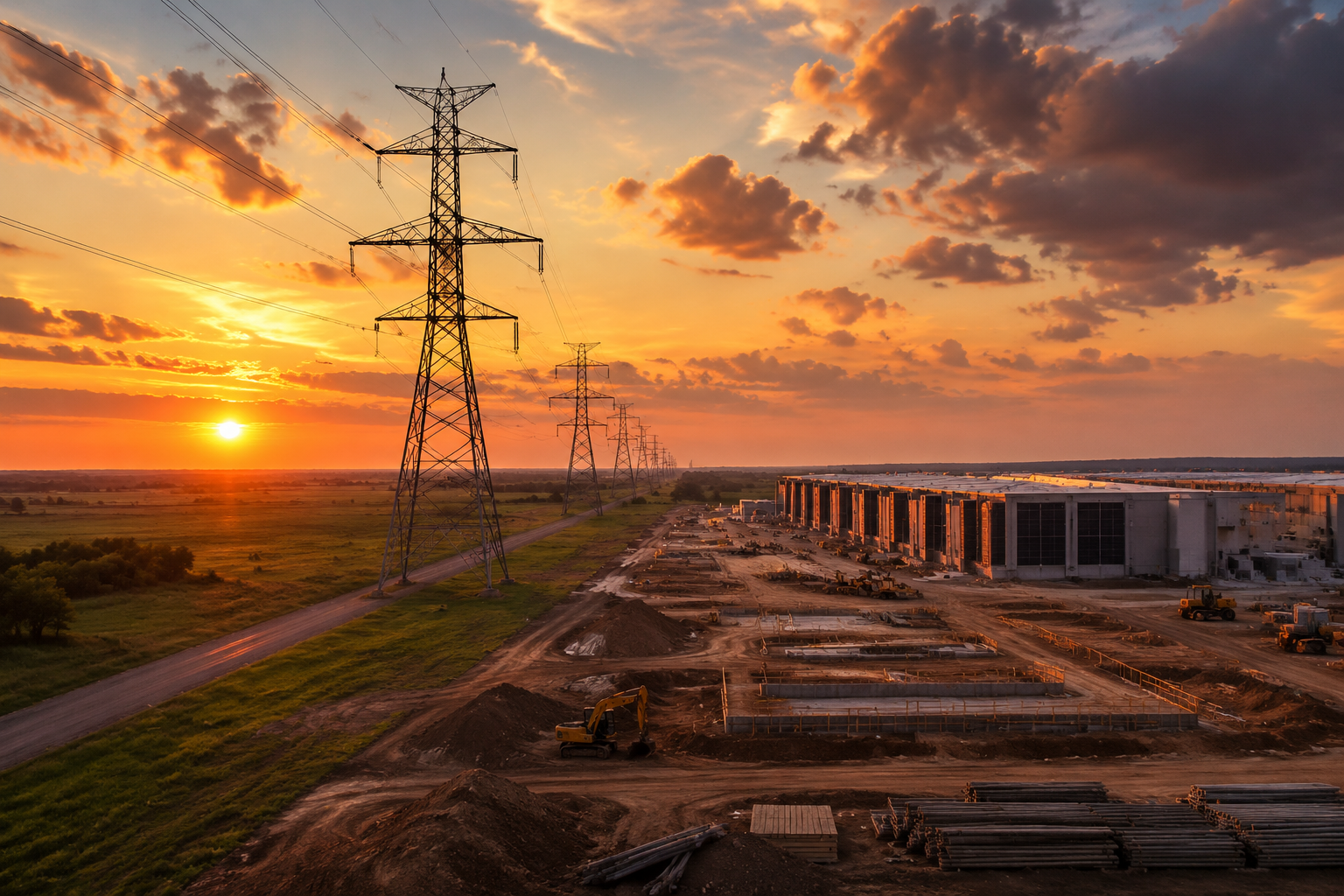
That matters to procurement because AI adoption plans often assume a familiar software curve: early scarcity, fast scaling, lower unit costs, easier renewals. The IREN case points to a less convenient curve. Compute may improve, but the facilities that host it still move through permitting, interconnection, transmission, equipment delivery, commissioning, and customer acceptance. Those stages do not compress just because model demand has.
Why a Bitcoin miner became relevant to AI buyers
IREN's pivot looks strange only if the starting point is crypto. If the starting point is power, it is more straightforward. Bitcoin mining rewarded companies that could secure low-cost electricity, develop large sites, manage high-density compute, and operate around volatile economics. That did not automatically make miners AI infrastructure providers, but it did leave some of them holding assets that became more valuable when AI demand ran into grid limits.
IREN says it has about 810MW of operating capacity and an approximately 5GW power portfolio in renewable-rich regions, with power costs described in the $0.03 to $0.04 per kWh range in British Columbia and West Texas.[3] Those figures are the part of the story supply chain leaders should not skip. A GPU fleet can be financed, leased, or purchased. A multi-gigawatt power position with interconnection rights is harder to improvise after a customer contract is signed.
The company has also been explicit that the constraint is physical. IREN's chief commercial officer, Morgan Rees, said that "permitting, grid interconnection and transmission capacity are multi-year problems," a plain statement that should sit inside every AI deployment budget that assumes falling compute costs by default.[3]

This is the neocloud model in its most concrete form. IREN is not selling a generic AI software promise. It is trying to convert controlled power, purpose-built data centers, NVIDIA GPUs, and cloud service contracts into a specialized AI compute platform. Microsoft did not need IREN to become another hyperscaler. It needed committed GPU capacity on a timeline and at a scale that justified prepayment.
The Microsoft and NVIDIA commitments validate capacity, not inevitability
The Microsoft contract is the anchor because it converts planned infrastructure into contracted demand. The reported structure matters: a five-year term, $9.7 billion total value, 200MW at Childress, and a 20% prepayment.[1] A prepayment of that scale does two things. It helps finance the build-out, and it shows that a major buyer is willing to reduce its own capacity uncertainty by taking exposure earlier in the project cycle.
The NVIDIA agreement is a different kind of signal. NVIDIA's up-to-$2.1 billion investment right does not simply say IREN wants NVIDIA GPUs. It places IREN inside NVIDIA's preferred infrastructure expansion path, including up to 5GW of DSX-aligned AI infrastructure and the Sweetwater campus as a flagship site.[2] For readers tracking NVIDIA as an infrastructure confidence indicator, this belongs in the same family of signals as the broader AI supply chain commitments discussed in NVIDIA budget planning for supply chain AI.
Still, validation is not the same as completed revenue. IREN has announced a target of 150,000 GPUs and $3.7 billion of annualized revenue by the end of 2026, but that target is an internal estimate and the company cautions that there is no assurance it will be achieved.[4] That distinction is not pedantic. Procurement teams should treat contracted capacity, financed capacity, targeted capacity, and commissioned capacity as separate buckets.
| IREN signal | What it supports | What it does not prove |
|---|---|---|
| $9.7B Microsoft contract | A hyperscale buyer is willing to contract major GPU cloud capacity from IREN | That all 200MW will be deployed without construction, commissioning, or utilization risk |
| 20% Microsoft prepayment | Customer capital can help bridge the infrastructure build-out | That IREN's economics are insulated from future GPU price or performance shifts |
| $2.1B NVIDIA investment right | NVIDIA sees strategic value in IREN's power-backed AI infrastructure path | That every neocloud provider will receive comparable supplier support |
| Approximately 5GW power portfolio | Power and site control can be a durable sourcing advantage | That the full portfolio is immediately available as AI compute capacity |
| $3.7B annualized revenue target | Management's intended scale by end of 2026 | A fully contracted or guaranteed revenue base |
This is where the case gets useful for AI sourcing. A supply chain leader does not need to decide whether IREN is fairly valued. The relevant question is whether major AI capacity buyers are behaving as if compute will be easy to source later. Microsoft and NVIDIA are not behaving that way. They are positioning around sites, power, architecture, and capital commitments now.
The build-out clock is slower than the AI roadmap
AI software roadmaps can change by quarter. AI data center infrastructure cannot. A useful planning assumption is that major capacity comes online in staged waves, not in a single market-clearing event. IREN's timeline fits that pattern: Sweetwater 1 was energized in April 2026, while Sweetwater 2 is targeted for 2028.[5]
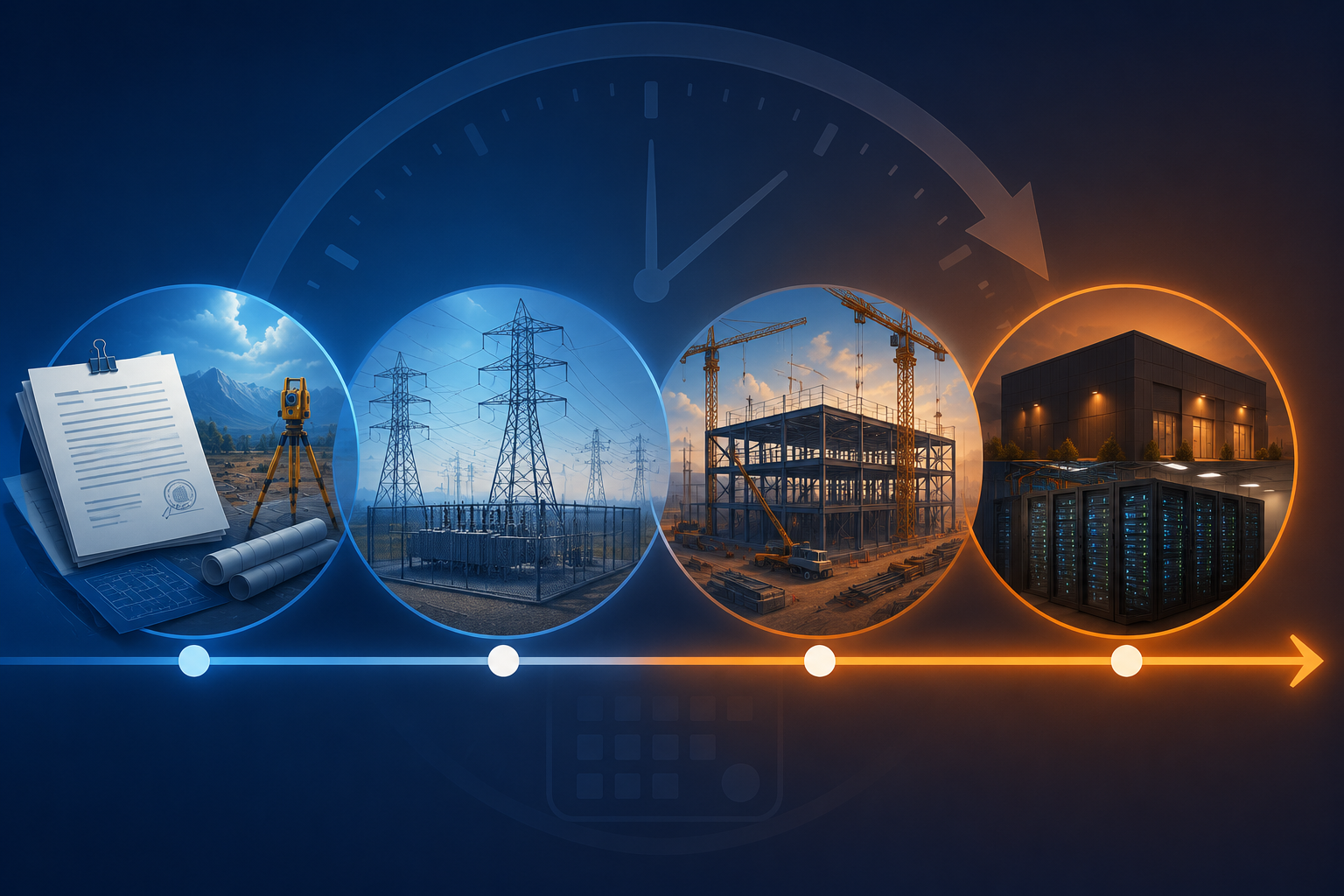
That staging is exactly the point. Between a signed contract and usable AI compute sit site work, substation and transmission coordination, data hall construction, cooling systems, power distribution, GPU delivery, rack integration, software environment readiness, burn-in, and customer acceptance. Any one of those can move the revenue date. In warehouse automation, this is the familiar difference between a purchase order and a stable go-live. AI infrastructure has more expensive parts, but the project logic is not exotic.
The broader market context does not make this easier. Goldman Sachs has modeled a baseline of about $7.6 trillion in cumulative AI capital expenditure from 2026 through 2031, while emphasizing that the result is highly sensitive to assumptions about silicon useful life, data center costs, and power bottlenecks.[6] Futurum Group separately estimates hyperscaler capital spending at $660 billion to $690 billion in 2026.[7] Those numbers are not proof that every project earns a return. They are evidence that the capacity race is large enough to keep pressuring equipment suppliers, utilities, engineering firms, and permitting processes at the same time.
The International Energy Agency's projection, as cited in the infrastructure discussion around AI power demand, that data center electricity demand would double from 2022 to 2026 adds another constraint layer.[3][6] Even where generation is available, transmission and interconnection queues can decide whether a data center is real capacity or just a slide in an investor deck.
This is why the IREN case is more than a clever corporate pivot. It shows that AI capacity is being sourced from players that already solved parts of the physical problem. Power-backed neoclouds are not replacing hyperscalers across the board, but they can absorb demand where buyers want specialized GPU capacity and are willing to contract around project risk.
What changes for supply chain AI sourcing
The first change is category design. AI compute is becoming a procurement category that extends beyond choosing a SaaS vendor or selecting a hyperscaler region. A supply chain organization buying forecasting optimization, computer vision, generative planning assistants, simulation, or autonomous sourcing tools is indirectly buying GPU availability, cloud commitments, and infrastructure risk.
That does not mean every procurement team should contract directly with a neocloud. Most will still buy through application vendors, system integrators, hyperscaler marketplaces, or managed platforms. But the diligence questions should move one layer deeper. If a vendor's pricing assumes abundant inference capacity, the buyer should know where that capacity comes from, whether it is reserved, and how much of the cost can be passed through under scarcity.
- Ask whether the AI vendor runs on a hyperscaler, neocloud, owned infrastructure, or a blended model.
- Separate training, fine-tuning, batch inference, and real-time inference needs; they do not stress infrastructure in the same way.
- Request the vendor's capacity commitment terms, not just its model performance benchmarks.
- Check whether compute cost increases can be passed through during renewal or usage spikes.
- For critical workflows, model what happens if deployment is delayed by six months because capacity is not available on the promised region, latency profile, or price.
The second change is budget timing. IREN's contracts do not prove that compute prices will stay high, but they weaken the easy assumption that capacity abundance arrives quickly. If Microsoft is willing to sign a five-year, $9.7 billion contract with prepayment for capacity tied to a specific site, then a midsize manufacturer or retailer should be careful about building a 2027 AI business case on a simple "GPU costs will fall" line item.[1]
The third change is vendor risk scoring. Infrastructure exposure belongs in AI vendor due diligence alongside data quality, workflow fit, security, and implementation support. ChainSignal's domain-specific AI vendor checklist is a useful starting point, but the IREN case adds a sharper infrastructure question: if the vendor's model depends on cheap, available GPU capacity, who actually owns that risk?
The risks sit inside the model, not outside it
IREN's story is credible because the contracts and power portfolio are concrete. It is also risky for the same reason: the model requires large capital commitments before the revenue base fully matures. Secondary analysis notes that IREN secured about $9.3 billion in total funding over eight months across customer prepayments, convertible notes, GPU leasing, and project financing, and also cites a $5.8 billion Dell deal for NVIDIA GB300 GPU procurement.[8] That is a serious financing stack, but it is still a financing stack tied to execution.
The pivot was also early in the reported revenue mix. SBO Financial's analysis cited Q2 FY25 AI cloud revenue of $2.7 million compared with $113.5 million from Bitcoin mining, even though the trajectory has shifted materially since the Microsoft and NVIDIA announcements.[8] That older revenue split should not be used to dismiss the pivot, but it does show how recently the business depended on a different profit engine.
Customer concentration is the next underwriting issue. A $9.7 billion Microsoft contract is validation, but it also concentrates a large part of the near-term AI cloud story around one anchor customer.[1] If deployment timing, utilization, technical acceptance, or commercial terms move differently than expected, the effect would not be diversified away by dozens of similar contracts.
GPU depreciation may be the most uncomfortable question because it links accounting to technical cadence. SBO Financial flags contested five- to six-year useful-life assumptions for GPUs, while NVIDIA has shifted toward annual chip iteration cycles.[8] If performance per watt improves quickly enough, older GPUs can remain useful but become less attractive for premium workloads. That would pressure neocloud economics if contracts, debt service, or leasing structures assume a longer period of high-value utilization.
None of this makes the IREN model invalid. It makes the model underwriteable. A buyer should not ask only whether a neocloud has GPUs. The better questions are whether it has power, whether the data halls are commissioned, whether the anchor customer contracts are matched to the financing structure, and whether the GPU fleet can still earn the assumed rate if the next NVIDIA generation arrives on schedule.
Planning through 2028 without pretending scarcity disappears
For supply chain organizations, the practical response is not to delay AI strategy until infrastructure catches up. Waiting for perfect compute availability is just another way to let competitors learn first. The response is to stop treating compute as an invisible utility in every AI business case.
A stronger 2027 or 2028 plan has separate assumptions for model capability, data readiness, integration labor, change management, and compute supply. Some use cases can tolerate batch processing, lower service levels, or smaller models. Others, such as real-time exception management, vision inspection, or agentic planning workflows connected to operational systems, may need predictable latency and reserved capacity. The sourcing strategy should reflect that difference.
It is also worth stress-testing AI vendor economics before the pilot becomes operationally embedded. If a transportation control tower, warehouse labor tool, or supplier-risk platform is priced attractively during a pilot, procurement should ask what happens when usage scales, when inference demand spikes, or when the vendor's own compute provider reprices capacity. AI service pricing will not be shaped only by model competition. It will also be shaped by whether enough powered, commissioned GPU capacity exists in the right places.
IREN does not prove that AI compute will become easy to buy. It proves something narrower and more useful: power-backed neocloud capacity has become credible enough for Microsoft and NVIDIA to underwrite at scale. That should change procurement behavior. Ask AI vendors where their compute comes from, how capacity is contracted, how pricing changes under scarcity, and what happens if the infrastructure provider's build-out or GPU economics miss plan.
References
- Can IREN Turn $9.7 Billion Into a Sustainable AI Giant? — HyperFRAME Research, November 3, 2025.
- NVIDIA and IREN Announce Strategic Partnership to Accelerate Deployment of up to 5 Gigawatts of AI Infrastructure — NVIDIA Newsroom.
- How IREN Broke Through the AI Power Bottleneck — Bloomberg.
- IREN Expands AI Cloud Capacity to 150,000 GPUs — IREN.
- IREN pausing Bitcoin expansion to focus on AI data center build-out — Data Center Dynamics.
- Tracking trillions: The assumptions shaping scale of the AI build-out — Goldman Sachs.
- AI CapEx 2026: The $690B Infrastructure Sprint — Futurum Group.
- IREN AI Infrastructure — SBO Financial.
Comments
Join the discussion with an anonymous comment.