
Flooding becomes a water supply chain problem the moment it stops being only rainfall on a map. A treatment plant can have operators on site and still be constrained by chlorine delivery, a flooded access road, a disabled pump, a sewer network pushing dirty water into the wrong place, or turbidity moving faster than manual testing cycles. For utilities, the operational question behind AI for water supply chain disruption after flooding is not whether a model can predict a flood. It is whether the right materials, assets, crews, control decisions, and water-quality safeguards can still line up while the network is changing state.
The scale justifies treating this as more than an emergency-response topic. Floods have doubled since 2000, with global losses estimated at $388 billion per year, according to UNDRR reporting [1]. During recent disruption periods, 45% of water utilities reported treatment chemical shortages, and 33% of U.S. chlor-alkali capacity for chlorine and sodium hydroxide was concentrated on the hurricane-prone Gulf Coast, according to WaterOperator.org’s discussion of EPA chemical supply chain analysis [2]. Those numbers matter because treatment chemicals are not optional consumables. If procurement, supplier risk, transportation, and dosing data sit in separate systems, the utility learns about the constraint late.
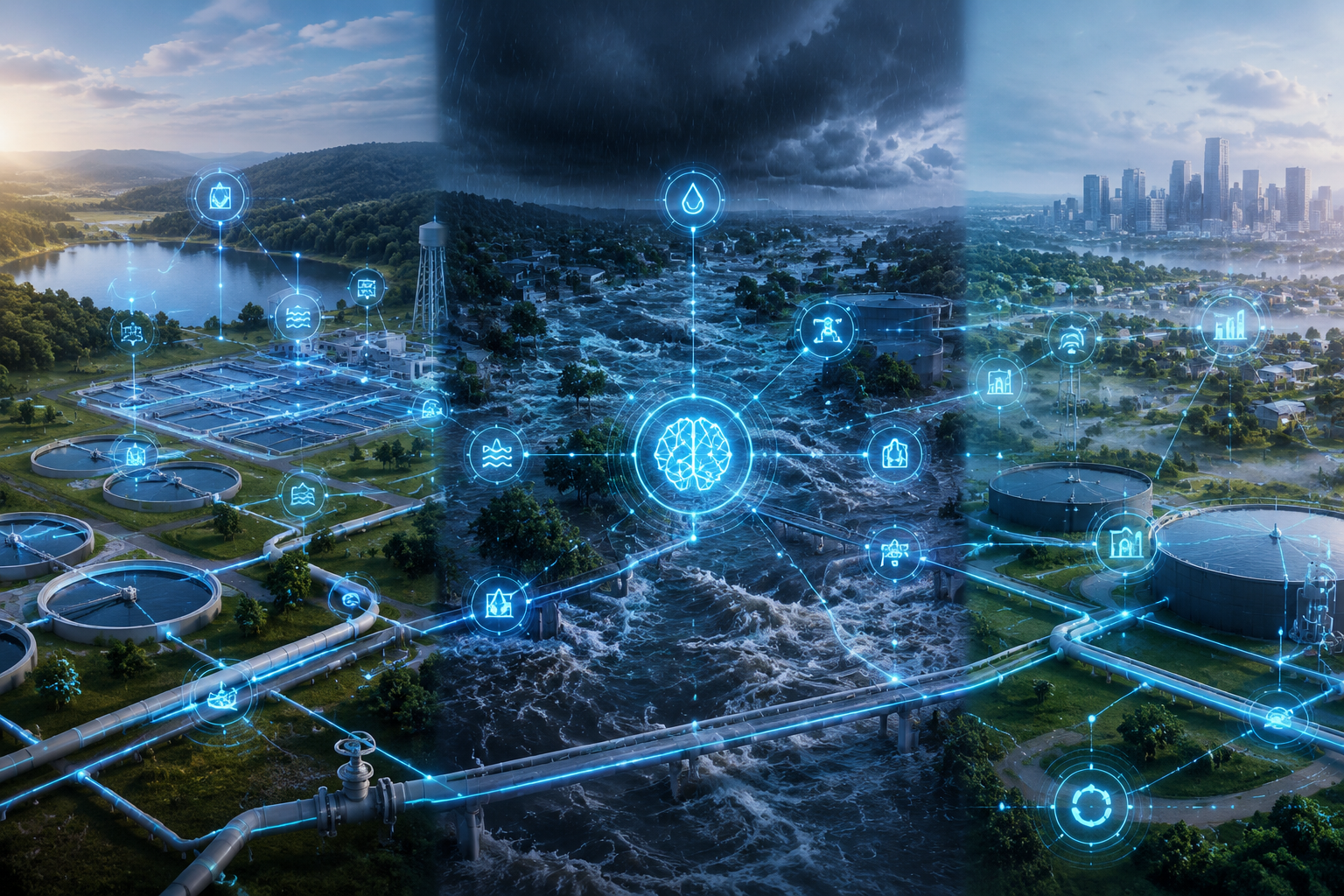
The Four Failures That Arrive Together
A flooded utility rarely gets one clean failure mode. The chemical shortage is tied to a port, plant, supplier, rail route, or trucking corridor. The maintenance backlog is tied to which roads are passable and which crews can safely reach the asset. The damaged pump station is tied to real-time hydraulic behavior upstream and downstream. The water-quality problem is tied to runoff, intrusion, sediment, biological risk, and whether dosing can be adjusted before the customer-facing consequence appears.
| Flood-driven failure mode | What breaks operationally | Where AI can shorten the loop |
|---|---|---|
| Treatment chemical disruption | Supplier availability, allocation, delivery timing, and on-site inventory become uncertain. | Supplier risk scoring, dynamic safety stock, inventory anomaly detection, and dosing forecasts. |
| Blocked logistics and supplier disruption | Crews, pumps, generators, parts, and chemicals cannot move on normal routes. | Route risk monitoring, supplier escalation triggers, and location-aware work prioritization. |
| Damaged infrastructure | Pipes, pumps, gates, valves, lift stations, and treatment assets operate outside normal assumptions. | Asset-specific flood forecasting, anomaly detection, digital twins, and automated control. |
| Water-quality volatility | Turbidity, contaminants, intrusion risk, and dosing requirements change faster than manual review. | Real-time water-quality monitoring, contamination detection, and autonomous dosing support. |
This is why a single flood-risk score is a weak operating tool. The useful layer is the one that connects forecast, stock position, supplier exposure, network hydraulics, asset health, crew dispatch, and water-quality telemetry into a decision sequence. If a 48-hour forecast does not change reorder timing, temporary stock placement, pump protection, bypass planning, or route escalation, it is only a better weather briefing.
Before the Flood: Forecasts Need a Supply Chain Job
Pre-flood AI is most useful when it is asset-specific enough to trigger physical preparation. Jacobs describes Flood IQ as an AI platform that provides 24- to 72-hour actionable flood forecasts for utility and city assets by integrating weather, river-gauge, and sensor data [3]. That lead time is short, but in utility operations it can still be enough to move temporary pumps, raise vulnerable electrical components, change chemical reorder points, pre-position repair parts, or call suppliers before every nearby system is asking for the same material.
Broader flood-prediction work is improving the signal available to operators. Google Research has described machine-learning approaches for high-resolution urban flash flood forecasting [4]. Penn State has reported an AI-powered global flood prediction model intended to improve flood forecasting and water management [5]. For a utility supply chain team, those advances become operational only after they are translated into named assets, named suppliers, named stock items, and named routes.
The practical pre-flood workflow is narrow and repetitive: identify exposed assets, map the dependent materials and crews, check supplier and logistics exposure, and adjust inventory thresholds while there is still time to move. A dynamic safety-stock model should not merely raise inventory everywhere because rain is forecast. It should distinguish between chemicals with fragile supplier geography, items with long replenishment windows, mobile equipment that can be shared across sites, and parts whose absence would keep a treatment or distribution asset out of service.
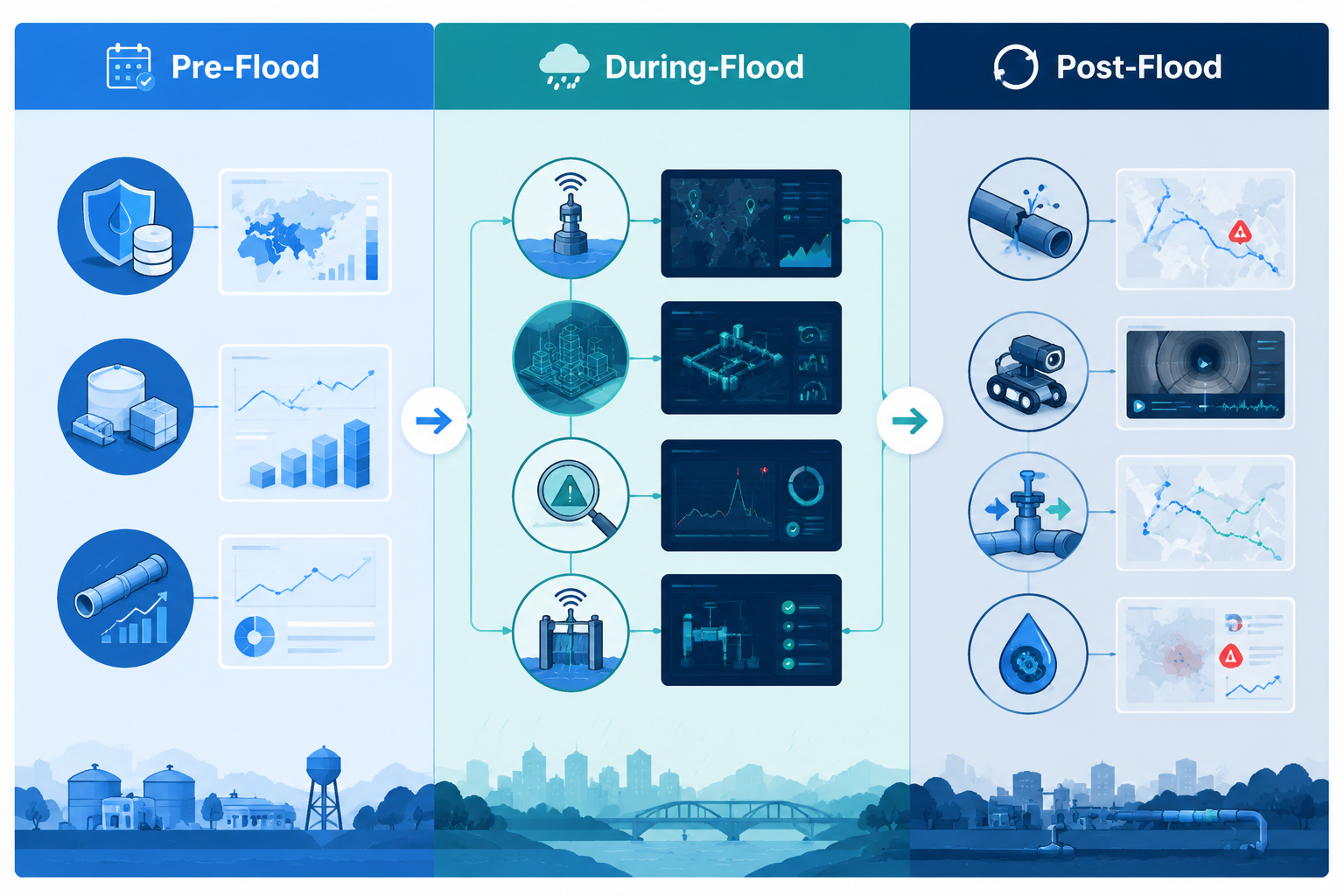
During the Flood: The Test Is Whether the Loop Closes
The hardest phase is not prediction. It is control under degraded conditions. Water and wastewater networks do not pause while procurement waits for an updated supplier file or maintenance waits for a post-event inspection list. Alarms multiply, sensor reliability may vary, roads close, and operators have to decide which intervention prevents the next constraint from becoming a service failure.
This is where digital twins and real-time monitoring have a stronger claim than dashboard-only resilience programs. XMPro describes a flood prediction and response platform for water utilities that integrates more than 7,700 sensors into a real-time digital twin [6]. The sensor count itself is not the value. The value comes when live data changes the operating choice: which pump to run, which gate to open, which basin has capacity, which crew to hold back, which asset is becoming unsafe, and which customer zone may need an alternate supply path.
South Bend, Indiana is one of the clearer public examples because the system moved beyond advisory analytics. Its smart sewer program used real-time controls for pumps and gates and has been associated with an 80% reduction in combined sewer overflows and $400 million in deferred capital expenditure [7]. WaterTechSH also describes the South Bend approach as using AI and real-time control to transform sewer and overflow management [8]. The important point for water supply chain continuity is not that every city can reproduce those figures. It is that the intervention sits inside the live infrastructure system rather than stopping at risk scoring.
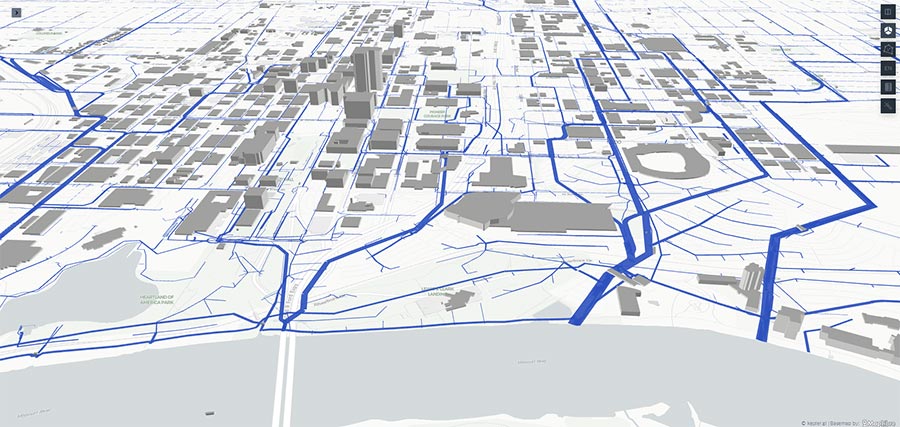
Other utility examples show adjacent parts of the during-flood loop. United Utilities has used AI monitoring across 78,000 kilometers of sewer network and reported a 20% reduction in flood and pollution incidents [7]. Wessex Water reported a 97% reduction in false alarms through AI-driven anomaly detection [7]. False alarms sound like an instrumentation problem until a storm puts the control room under pressure. Every false positive that consumes attention, truck rolls, or supervisor review is time taken from a real overflow, pump fault, or water-quality excursion.
For supply chain leaders, the during-flood AI layer should be judged by whether it reduces avoidable dispatches, protects scarce crews, and keeps the treatment and distribution network in a controllable state. A model that flags a vulnerable pump station is useful. A model connected to asset status, spares availability, road access, upstream levels, and downstream consequence is more useful. A control layer that can recommend or execute gate and pump changes under governance is useful in a different way again.
After the Flood: Recovery Is a Queueing Problem
Once the water recedes, the utility inherits a queue. Pipes need inspection. Pump stations need electrical checks. Roads may reopen unevenly. Customers may report pressure, discoloration, or service issues. Treatment plants may still be managing unusual influent or source-water conditions. The AI work shifts from immediate control to triage: which break is most likely, which inspection footage needs attention first, which district can be rerouted, which inventory movement looks abnormal, and where contamination risk is rising.
CCTV inspection is a good example because the bottleneck is obvious. AWS describes a United Utilities use case in which AI reduced sewer CCTV survey processing from 10 days to 2 days, an 80% improvement [9]. The same AWS discussion cites a SewerAI Pacific Northwest case study in which AI defect detection found 32.99% more defects than manual surveys [9]. After a flood, faster processing is not just administrative efficiency. It changes which crews are sent to which defects while the recovery window is still open.
Pipe-break prediction has the same recovery logic. AWS cites VODA.ai work in Cape Town where AI pipe-break prediction achieved a 58% reduction in bursts, and also cites Tucson’s use of machine-learning-based pipe break prediction for proactive maintenance [9]. Those are not chemical supply examples, but they affect the same continuity chain. A predicted burst can change valve operations, crew schedules, repair-part staging, tanker planning, and customer-zone risk before the next failure consumes the day.
Distribution control matters after the peak event as well. Anglian Water’s AI-powered flow control was reported to achieve £2.4 million in savings and a 20% flow reduction [10]. In flood recovery, the comparable value is not only savings; it is the ability to route limited hydraulic capacity around damaged or suspect parts of the network while maintaining service pressure and reducing avoidable stress on weakened assets.
Water quality is the part of recovery where supply continuity and public health meet directly. EFC Network describes AI applications for real-time contaminant detection, pH and turbidity tracking, harmful algal bloom detection, and autonomous chemical dosing adjustment [11]. DLT similarly describes AI use cases in water that include water-quality monitoring and dosing optimization [12]. The boundary here is important: these tools can accelerate detection and adjustment, but they do not remove the need for sampling protocols, operator review, regulatory reporting, and conservative fail-safe rules.
The Investment Case Should Name the Constraint
Broad ROI claims around AI in water are easy to overuse. The credible cases name the constraint that changed. In Grand Rapids, Michigan, AI analysis identified inflow and infiltration fixes estimated at $30 million to $50 million compared with an original $1 billion infrastructure estimate, or roughly 3% to 5% of the projected cost [7]. That is not a generic statement that AI is cheaper than construction. It is a case where better targeting changed the capital plan.
Energy optimization examples show a different constraint. AWS cites EMAGIN in Calgary achieving 21% energy savings at a wastewater plant with a 3-month payback, and Createch360 in Italy achieving a 19% energy reduction with a 1- to 2-year payback [9]. Global Infrastructure Hub separately reports quantified outcomes for AI process optimization in water treatment [13]. These cases can support an internal business case, but they should not be pasted directly onto flood resilience without asking what the flood use case is relieving: chemical scarcity, crew scarcity, asset capacity, inspection backlog, alarm overload, or capital pressure.
That distinction matters for vendor shortlisting. A supplier-risk model that helps procurement secure treatment chemicals before a regional shortage is not evaluated like a real-time control system. A CCTV defect-detection model is not evaluated like a hydraulic digital twin. A water-quality anomaly model is not evaluated like predictive maintenance. The operating layer may connect them, but the evidence for each function still needs to match its failure mode.
What a Layered AI Operating Model Looks Like
A flood-resilient water supply chain does not require every AI function to be bought at once. It does require the utility to stop treating forecast, inventory, supplier, logistics, SCADA, asset health, and water-quality systems as separate islands during the event window. The practical model has three phases, but the data should carry across all three.
- Pre-flood: translate flood forecasts into exposed assets, vulnerable suppliers, chemical safety-stock changes, spare-part staging, and access-route risk.
- During-flood: connect sensors, SCADA, pumps, gates, tanks, alarms, work orders, and route status so operators can act on changing network conditions.
- Post-flood: prioritize inspections, predict breaks, reroute distribution, detect inventory anomalies, and monitor water quality until the system returns to a stable state.
The same asset should be visible across the phases. A pump station flagged as exposed before the flood should not disappear into a separate maintenance queue afterward. Its predicted flood exposure, live operating behavior, spare-part dependency, inspection history, crew accessibility, and downstream customer consequence should travel together. That continuity is where AI can reduce delay; it is also where many deployments become harder than the slideware suggests.
The Readiness Boundary
The evidence is strongest where utilities already have dense telemetry, mature SCADA integration, usable asset records, and enough operating history to train or validate models. Many quantified examples come from larger utilities or well-instrumented systems in developed markets. Smaller utilities, or systems with thin sensor coverage and fragmented work-order data, may still benefit from AI, but their first constraint may be data readiness rather than model selection.
Model generalization is another boundary. Flood behavior outside historical experience can expose weak assumptions in training data, hydraulic models, supplier-risk scoring, and route-risk logic. A model that performs well in ordinary storms may be less reliable when rainfall intensity, upstream releases, sediment loads, road closures, power interruptions, and supplier disruptions combine in a pattern the system has not seen. Stress testing against severe and unusual scenarios belongs in the implementation plan, not in a post-incident review.
Cybersecurity and governance also become more serious as AI moves closer to control. A dashboard that recommends safety-stock changes carries one risk profile. A cloud-connected system that recommends or automates protective pump and gate actions carries another. Utilities need role-based authority, audit trails, fail-safe operating modes, manual override, model monitoring, and clear rules for when an AI recommendation is advisory versus executable.
AI can build a flood-resilient water supply chain when it connects forecasts, inventory, supplier risk, logistics, control systems, asset health, and water-quality monitoring into an actionable operating layer. It cannot do that work where the underlying signals are missing, the control interfaces are immature, the model is untested against unfamiliar flood conditions, or no one has decided who is allowed to act when the recommendation arrives.
References
- UNDRR flood loss and frequency reporting, UNDRR, https://www.undrr.org/
- Understanding Water Treatment Chemical Supply Chains, WaterOperator.org citing EPA, https://wateroperator.org/
- Jacobs Introduces Flood IQ to Help Utilities and Cities Anticipate and Manage, Jacobs, https://www.jacobs.com/newsroom/press-release/jacobs-introduces-flood-iq-help-utilities-and-cities-anticipate-and-manage
- Protecting cities with AI-driven flash flood forecasting, Google Research, https://research.google/blog/protecting-cities-with-ai-driven-flash-flood-forecasting/
- AI-powered model predicts floods, improves water management worldwide, Penn State University, https://www.psu.edu/news/research/story/ai-powered-model-predicts-floods-improves-water-management-worldwide
- Flood Prediction & Response in Water Utilities, XMPro, https://xmpro.com/solutions-library/flood-prediction-response-in-water-utilities/
- How AI can help manage water risk, World Economic Forum, https://www.weforum.org/stories/climate-action/ai-water-risk-management/
- Fighting the Flood: How AI is Transforming Sewer and Overflow Management, WaterTechSH, https://www.watertechsh.com/fighting-the-flood-how-ai-is-transforming-sewer-and-overflow-management/
- Building autonomous water utility operations with agentic AI on AWS, AWS, https://aws.amazon.com/blogs/industries/building-autonomous-water-utility-operations-with-agentic-ai-on-aws/
- AI to optimise water distribution networks, Global Infrastructure Hub, https://www.gihub.org/infrastructure-technology-use-cases/case-studies/ai-to-optimise-water-distribution-networks/
- AI in Water Management: Six Ways Artificial Intelligence Can Help Solve Problems Across the Water Sector, EFC Network, https://efcnetwork.org/ai-in-water-management-six-ways-artificial-intelligence-can-help-solve-problems-across-the-water-sector/
- AI in Water: 10 Ways AI is Changing the Water Industry, DLT, January 6, 2025, https://www.dlt.com/blog/2025/01/06/ai-water-10-ways-ai-changing-water-industry
- AI for process optimisation for water treatment, Global Infrastructure Hub, https://www.gihub.org/infrastructure-technology-use-cases/case-studies/ai-for-process-optimisation-for-water-treatment/
Comments
Join the discussion with an anonymous comment.