
The useful question about a generative AI procurement assistant is not whether people in procurement are experimenting with GenAI. They are. The harder question is whether the assistant can survive contact with the procurement workflow: intake forms that arrive half-complete, supplier records that disagree across systems, approval rules that change by region, contract clauses that legal still owns, and ERP constraints that do not care how fluent the answer sounded.
That tension is visible in the adoption numbers. Hackett reported that only 4% of procurement organizations had achieved large-scale GenAI deployment, even as 49% had piloted GenAI in 2024 and documented gains included 2.6x ROI, 58% faster cycle times, a weighted average productivity improvement of 9.9%, and an effectiveness or quality improvement of 9.5%.[1] Deloitte’s 2024 CPO survey also found early adopters reporting up to 5x ROI, with about half reporting a doubling of ROI versus traditional methods.[2] These are not trivial results. They are also not proof that a chat window can be dropped on top of procurement and called transformation.

The gap widened further when Gartner placed GenAI for procurement in the “trough of disillusionment” in July 2025 and projected that it would reach full productivity within five years.[3] That is not a verdict against the use case. It is a warning about maturity: the individual user experience has moved faster than the enterprise operating model.
What a Generative AI Procurement Assistant Actually Is
A generative AI procurement assistant is a conversational procurement interface powered by large language models and retrieval from enterprise or approved knowledge sources. In practical terms, it lets a user ask for help in natural language, interprets the intent, retrieves relevant policy or transaction context, and supports a procurement action such as creating an intake request, routing an approval, drafting RFP language, summarizing a contract, or answering spend questions.
That makes it different from three adjacent technologies that are often blurred together in procurement software demos.
| Pattern | How it behaves in procurement | What to watch |
|---|---|---|
| Rules-based chatbot | Follows predetermined scripts or FAQ decision trees. | Useful for narrow support, but brittle when request wording or policy context varies. |
| RPA | Automates repetitive keystrokes or handoffs across systems. | Can move data, but does not understand intent or generate procurement content. |
| Generative AI procurement assistant | Understands varied phrasing, retrieves context, generates summaries or drafts, and guides a user through a procurement task. | Needs governed data access, validation, and clear boundaries around what it may update. |
| Agentic AI | Acts more autonomously across multiple steps, often planning and executing sequences with less human triggering. | Requires a higher trust, control, and exception-management model. |
The distinction matters because a procurement assistant usually remains human-in-the-loop. It may draft, summarize, recommend, and prepare an action, but a buyer, category manager, approver, or legal reviewer still validates the output before it changes a commercial commitment. That is not a weakness; for many procurement environments, it is the only responsible deployment model.
Where the ROI Evidence Is Strongest
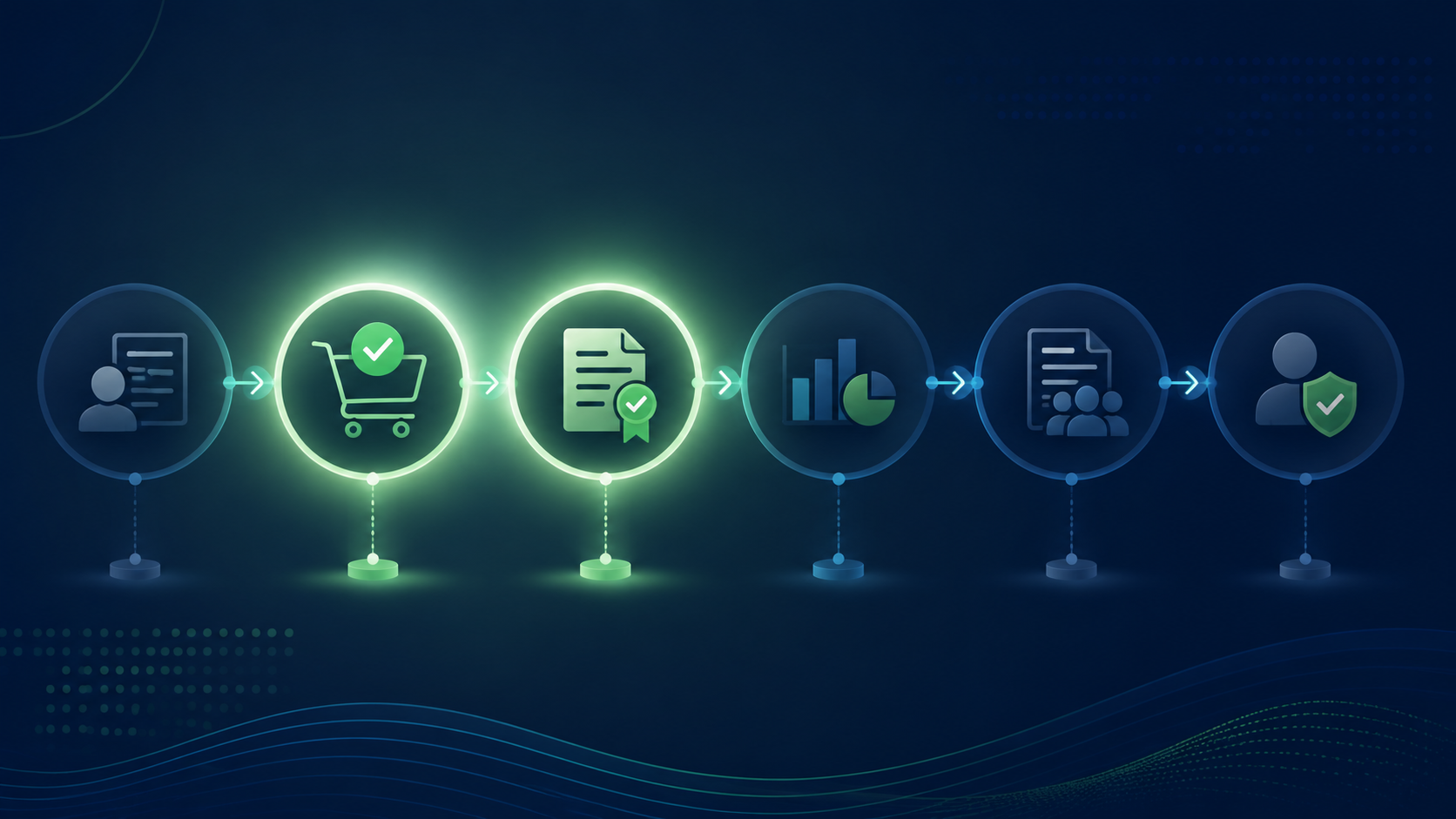
The strongest evidence clusters around work where language volume is high, decision paths are bounded, and the cost of delay is visible: guided buying, intake, and contract review. These are not glamorous tasks, but they are exactly where procurement organizations lose time to clarification loops, policy interpretation, manual reading, and rework.
Guided buying and intake
A guided buying assistant is most useful before a purchase becomes a cleanup problem. The user describes what they need; the assistant asks for missing information, checks buying channels or policy, suggests preferred suppliers or catalogs where available, and prepares the request for routing. If it works, fewer vague requests land on an intake team’s desk, and fewer noncompliant purchases need to be corrected after the fact.
Zip reports 40–60% reductions in intake-to-PO cycle time and says ROI is typically proven within 90 days for its AI procurement orchestration use cases.[4] That is vendor-published evidence, so it should be read as customer-case or commercial benchmark data rather than an independent market average. Still, the direction of value is plausible because intake is one of the few areas where the assistant can remove steps rather than merely make a user feel faster. A shorter clarification loop changes the queue for procurement operations, approvers, and requesters.
The operational test is concrete: does the assistant reduce the number of requests returned for missing information, route correctly based on policy, and create cleaner downstream records in the S2P or ERP system? If the answer is only that requesters like the interface, procurement has improved the front door without proving that the house is easier to run.
Contract summarization and review
Contract review is another credible early use case because the assistant is attacking a visible bottleneck: reading, extracting, comparing, and summarizing dense text. A contract summarization assistant can identify renewal dates, payment terms, liability language, termination rights, data protection clauses, or deviations from approved templates. It can also prepare a first-pass risk summary for procurement and legal review.
Ivalua reports up to an 80% reduction in manual contract review time through automated risk extraction and summarization.[5] As with other vendor-published metrics, procurement leaders should ask what contract types were included, whether the reduction applies to first-pass review or total legal cycle time, and how exceptions were handled. A fast summary is valuable only if the reviewer can trust what was extracted and, just as important, what was not.
This is where the assistant’s role should be deliberately modest. It can read more quickly than a person, but it should not quietly convert a summary into approval. Legal and procurement still need an auditable trail showing the source clause, the extracted risk, the reviewer’s decision, and any escalation. The saved time comes from reducing manual reading and triage, not from pretending contractual judgment has disappeared.
Spend Q&A
Spend Q&A assistants promise a familiar benefit: category managers and executives ask plain-language questions instead of waiting for a report. A user might ask which suppliers account for the largest share of contingent labor spend, where off-contract purchases are rising, or which categories have fragmented tail spend. The assistant can translate the question into queries, retrieve relevant spend data, and explain the answer in business language.
The value here depends heavily on data quality. If supplier names are duplicated, category taxonomies are inconsistent, or invoice descriptions are thin, the assistant may produce a confident answer to a poorly grounded question. Spend Q&A can reduce analyst effort, but it does not fix the underlying classification and master-data work by itself.
Sourcing, RFP, and supplier onboarding support
Sourcing and RFP assistants are useful for first drafts: supplier research prompts, scope language, evaluation criteria, clarification questions, and response summaries. Supplier onboarding assistants can help collect documents, explain requirements, and guide suppliers through missing fields. These are sensible applications of generative AI because they involve language-heavy, repetitive work.
The evidence is thinner than it is for intake and contract review. The research base supports these as promising use cases, but standalone independently verified ROI figures are not yet as clear. Procurement teams should therefore treat them as workflow accelerators to test against specific measures: RFP drafting time, supplier response normalization effort, onboarding rework, and exception rates.
Why Individual Adoption Has Outrun Enterprise Deployment
The adoption gap is not just a matter of budget caution. Procurement executives can use general GenAI tools weekly and still be far from deploying a governed procurement assistant. One is an individual productivity behavior. The other is an enterprise capability tied to system access, policy interpretation, workflow ownership, and auditability.
That distinction explains why broad enthusiasm and scaled deployment can coexist so awkwardly. The reported 94% weekly GenAI use figure refers to self-reported use of any GenAI tool by procurement executives, not necessarily a dedicated procurement assistant embedded in enterprise workflows.[6] It should not be compared casually with the 4% large-scale deployment figure as if both measure the same behavior.[1]
Fragmented data is the first constraint
A procurement assistant needs more than a language model. It needs usable data about suppliers, contracts, catalogs, policies, users, approval thresholds, taxonomies, and transaction history. Gartner reported that 74% of procurement leaders said their data was not AI-ready.[3] That figure is a more useful warning than any generic concern about AI accuracy because it points to the work that actually blocks scale.
Supplier master data is a typical failure point. If the same supplier appears under multiple names, with inconsistent risk attributes or region-specific records, an assistant may retrieve the wrong context or route a request incorrectly. The result is not always a dramatic hallucination. More often, it is quiet friction: a category manager has to reconcile the output, procurement ops has to repair the record, or an approver receives a request that should never have reached them.
Integration determines whether the assistant can act
A standalone assistant can answer questions and draft text. A procurement assistant that changes work has to connect with ERP, S2P, CLM, supplier information management, identity, approval, and reporting systems. That integration is where many pilots slow down. The assistant must know which fields are required, which system owns the record, which approval chain applies, and when a human must intervene.
This is also where procurement leaders should be cautious about demo logic. A clean demo may show a user asking for a laptop, receiving a recommended item, and generating a purchase request. In production, the same request may depend on employee location, budget owner, preferred supplier rules, asset standards, security approval, catalog availability, tax treatment, and whether the ERP accepts the resulting data. The assistant’s fluency is the least difficult part of that chain.
Hallucination risk becomes workflow risk
In procurement, an incorrect answer is not merely embarrassing. A fabricated policy exception, misread limitation-of-liability clause, or inaccurate supplier risk summary can change a commercial decision. That is why human-in-the-loop validation is not a temporary training wheel. It is part of the control design.
The practical safeguard is to keep the assistant close to source material. Contract summaries should link to the clause being summarized. Policy answers should cite the policy version. Spend answers should show the data scope and filters. RFP drafts should be reviewed by the category owner before supplier release. These controls slow down the fantasy of autonomy, but they make the productivity gain usable.
Benefit overestimation is already a management risk
Hackett reported that 53% of procurement leaders had moderate-to-major concerns about overestimating potential GenAI benefits.[1] That concern is well placed. A pilot can show that a user drafts an RFP faster or summarizes a contract more quickly, while the organization still fails to reduce total cycle time because review queues, approval bottlenecks, or data cleanup remain unchanged.
The cleanest ROI cases measure an end-to-end process, not a task performed in isolation. Intake-to-PO cycle time is stronger than “time spent writing intake notes.” Manual contract review reduction is stronger when paired with exception accuracy and reviewer acceptance. A spend Q&A assistant is more credible when it reduces analyst backlog or improves sourcing decisions, not just when executives enjoy asking questions in natural language.
How to Read the ROI Benchmarks Without Overreading Them
The current ROI evidence supports investment, but not complacency. Deloitte’s early-adopter findings come from a CPO survey context and reflect early results, not a guarantee that every organization will reproduce up to 5x ROI at scale.[2] Hackett’s broader benchmark data is valuable because it pairs ROI and cycle-time gains with low large-scale deployment, making the maturity gap visible in the same conversation.[1] Vendor-published claims from Zip and Ivalua are useful directional evidence, especially because they map to concrete procurement processes, but they should be validated against the buyer’s own workflow, data, and control requirements.[4][5]
| Use case | Evidence strength | Best measure to validate internally |
|---|---|---|
| Guided buying and intake | Relatively strong, with vendor-published cycle-time reduction and broader benchmark support. | Intake-to-PO cycle time, returned requests, policy-compliant routing, downstream data quality. |
| Contract summarization | Relatively strong for manual review time reduction, with vendor-published evidence. | Review time, extraction accuracy, exception identification, legal or procurement reviewer acceptance. |
| Spend Q&A | Promising but dependent on spend data quality and taxonomy consistency. | Analyst backlog reduction, answer traceability, sourcing actionability. |
| Sourcing and RFP support | Useful for drafting and summarization, but less independently quantified as a standalone assistant use case. | Drafting time, category manager edits, evaluation consistency, supplier clarification volume. |
| Supplier onboarding | Operationally plausible, especially for document collection and guidance, but evidence is less mature. | Onboarding cycle time, missing-document rates, supplier rework, master-data completeness. |
The most defensible business case starts with a bounded workflow and a baseline. How long does intake take today? How many requests are returned? How much contract review time is spent on first-pass extraction? Which supplier onboarding fields are most often missing? Without those baselines, the assistant can look impressive while leaving the actual queue unchanged.
What Mature Evaluation Looks Like
A procurement team evaluating a generative AI procurement assistant should spend less time asking whether the model can produce polished text and more time testing whether the workflow remains governed when the assistant is wrong, incomplete, or uncertain. The right questions are operational.
- Which system of record does the assistant read from, and which system is allowed to be updated?
- Can every recommendation, summary, or answer be traced back to a contract clause, policy, supplier record, or transaction dataset?
- Who validates AI-generated RFP language, contract risk summaries, supplier recommendations, and approval routing?
- What happens when required data is missing, conflicting, outdated, or outside the assistant’s permission scope?
- Does the assistant reduce end-to-end cycle time, or does it move cleanup work to procurement operations, category management, legal, or finance?
Those questions are not procurement pessimism. They are how a promising assistant becomes a controlled capability. A narrow assistant that reliably reduces intake-to-PO friction may be more valuable than a broad assistant that claims to transform procurement but cannot explain which policy it applied or which supplier record it trusted.
The Realistic Position in 2026
By Q3 2026, the case for generative AI procurement assistants is strong enough to take seriously and immature enough to evaluate carefully. The best-supported returns sit in bounded workflows where the assistant reduces language-heavy manual effort and shortens measurable queues. Guided buying, intake, and contract summarization deserve priority because the evidence is more concrete and the work is close to recurring procurement pain.
The deployment reality is less forgiving. Fragmented data, ERP and S2P integration, supplier master quality, hallucination risk, validation design, and change resistance explain why pilots and individual use have outrun large-scale enterprise deployment. Procurement leaders should evaluate the generative AI procurement assistant as a high-potential, bounded workflow tool with proven early returns, not as a mature autonomous procurement platform ready to scale without data readiness, integration work, and governance.
References
- Embracing the Future: How Generative AI Is Revolutionizing Procurement in 2025, The Hackett Group
- CPOs Steering GenAI in Procurement Through Uncharted Waters, Deloitte
- Generative AI for Procurement Has Entered the Trough of Disillusionment, Gartner, July 30, 2025
- AI for Procurement: A 2026 Guide to ROI & Orchestration, Zip
- Generative AI in Procurement: Use Cases, Benefits & What's Next, Ivalua
- State of AI in Procurement in 2026, Art of Procurement
Comments
Join the discussion with an anonymous comment.