
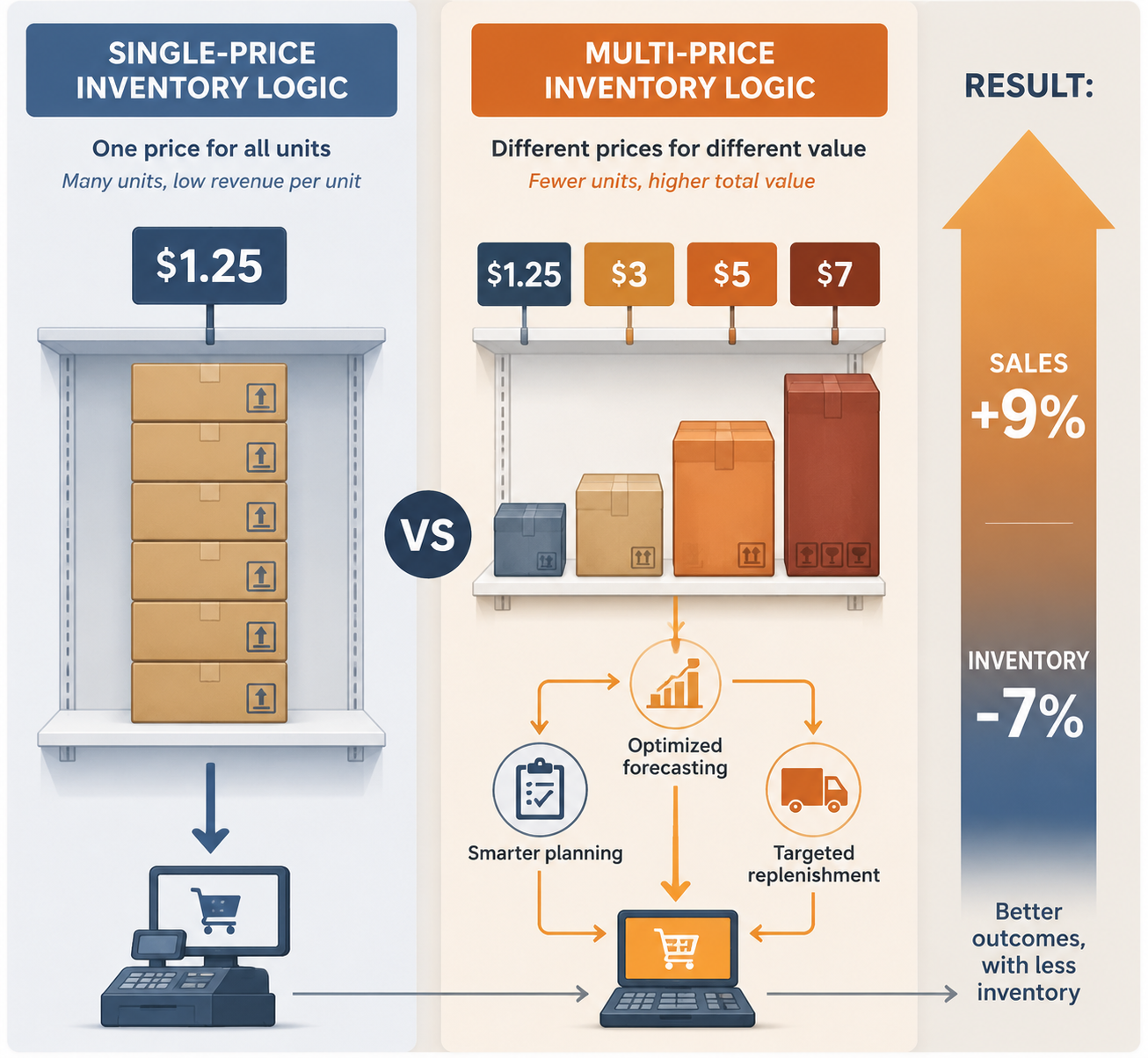
Dollar Tree’s multi-price move changed the basic math of replenishment. A chain built for a mostly uniform $1.25 price point now has to plan items priced across bands that reach $10, with different margins, velocities, shelf-space requirements, and handling loads moving through more than 9,000 stores.[1] That is the real inventory problem: the unit on the shelf is no longer economically interchangeable with the unit next to it.
The headline result is strong, but it needs careful handling. In Q4 2025, Dollar Tree reported inventory down 7% year over year while sales rose 9%, creating a 16-point spread between inventory and sales movement.[2] That is not a clean ROI figure for one platform. It is a corporate operating result shaped by merchandising mix, forecasting and replenishment changes, transportation visibility, warehouse execution, store delivery changes, tariff actions, and management discipline.

Why The Old Inventory Logic Stopped Working
In a single-price environment, planners can lean on a simpler operating assumption: many items share similar price architecture, and the store’s replenishment challenge is heavily tied to unit volume. A case of low-priced goods takes up trailer space, carton touches, backroom space, shelf labor, and checkout activity in ways that are easier to compare across categories.
Multi-price breaks that shortcut. A $5 item and a $1.25 item may both occupy one facing, but they do not contribute the same sales dollars, margin dollars, replenishment cadence, or inventory carrying profile. A higher-price item can lift revenue while reducing the number of physical units needed to produce that revenue. That is why the reported inventory decline matters more when paired with the detail that physical units declined more than dollar inventory: the mix itself compressed handling volume per sales dollar.[2]
CEO Michael Creedon put the store-level implication plainly: the broadened multi-price assortment creates incremental demand while producing “fewer things to put on the shelf.”[2] That sentence carries more operating content than a broad technology claim. Fewer physical units can mean fewer cartons to unload, fewer shelf touches, less congestion in a small backroom, and a different way for finance to interpret inventory reduction. The question is whether lower inventory reflects better productivity, a higher-value mix, or both.
By year-end 2025, higher price bands represented about 16% of sales, while gross margin expanded 59 basis points for the full year and 150 basis points in Q4 2025.[2] Those numbers support the view that multi-price was not a side rack experiment. It had become large enough to change how the network should forecast demand, allocate inventory, and judge store labor load.
The Stack Is A Workflow, Not A Vendor List
Dollar Tree selected RELEX in October 2021 for integrated forecasting and replenishment across Dollar Tree and Family Dollar.[3] The timing matters. The measurable 2025 results arrived after a multi-year operating rebuild, which fits the reality that large replenishment systems do not usually change store execution in one season. For readers benchmarking the lag between selection and measurable operating results, that arc is closer to the multi-year curve discussed in AI inventory optimization ROI timelines than to a quick software payback story.
The useful way to read the stack is from shelf backwards, then forward again. A store sells through a multi-price assortment. Forecasting has to distinguish whether demand is shifting because the customer wants more units, because the customer is trading into higher price bands, or because the assortment has changed. Replenishment then decides how much inventory to position without treating all units as equal. Distribution centers need the labor, slotting, and throughput capacity to move the resulting mix. Transportation has to make delivery promises visible. Store teams need the load to arrive in a form they can unload without burning payroll.
Public reporting describes RELEX as the forecasting and replenishment layer, FourKites as the real-time visibility layer in place since 2018, and new warehouse management, transportation management, and labor management systems as execution layers being added to the operating estate.[4] That combination is closer to end-to-end planning and execution than to a standalone forecasting upgrade.
| Operating Question | System Layer | What Changes In A Multi-Price Model |
|---|---|---|
| What will each store need? | Forecasting and replenishment | Demand planning must separate unit demand, price-band mix, margin profile, and shelf-space economics. |
| Where should inventory sit? | Inventory planning and DC execution | The network has to protect availability without assuming that every carton carries the same revenue density. |
| When will the store receive it? | Transportation visibility | Store managers need delivery-level visibility so labor and receiving work are not planned blind. |
| How hard is it to receive? | Delivery equipment and store process | Physical unit compression only helps if cartons, trailers, and unload methods reduce actual store handling time. |
The RELEX announcement confirms the selection and intended scope, but it does not publish RELEX-specific ROI or implementation milestones.[3] That distinction matters. The evidence supports a broader conclusion: Dollar Tree built a stack capable of supporting a more complex price architecture. It does not support isolating the 7% inventory reduction as a RELEX-only result.
For the demand planning layer specifically, the case is a useful companion to AI-driven demand forecasting for inventory optimization. The Dollar Tree example shows why the forecast cannot stop at “more” or “less” demand. In a multi-price model, the forecast has to help decide whether the next carton adds profitable availability or just pushes more labor into an aisle that no longer needs the same unit density.
Physical Execution Decides Whether The Forecast Reaches The Shelf
Forecast accuracy does not unload a trailer. The more convincing part of Dollar Tree’s operating case is that planning upgrades sit beside distribution, transportation, and store delivery changes. Public reporting points to improved service levels, improved in-stock metrics, better DC throughput, and higher shipping productivity through 2025.[4] Those are the kinds of measures that show whether a planning change is making it through the chain of custody.
The store-facing piece is especially concrete. Dollar Tree’s rotacart delivery system reached more than 600 stores and reduced unloading time to approximately one hour.[5] That does not prove AI caused the inventory result, but it does show how the physical layer can convert better planning into a store labor benefit. If the trailer arrives with a better mix but the receiving process still consumes the afternoon, the network has only moved complexity downstream.
Fleet modernization also belongs in this chain. Dollar Tree added about 900 liftgate trailers in 2023 and planned roughly 2,000 more, according to reporting on the rotacart rollout.[5] Liftgate capacity is not an AI feature, but it changes the feasibility of executing a delivery model that asks stores to receive freight faster and with less strain.
At the network level, Dollar Tree operates 16 U.S. distribution centers and has a 1.25 million-square-foot hub under construction.[4][6] The company also has multi-year freight contracts covering about 75% of volumes, reducing spot-market exposure.[4] Those details are supporting evidence, not background color. A multi-price assortment adds planning precision requirements, but it still has to pass through doors, docks, trailers, and store receiving routines.
Why Fewer Units Can Still Mean Better Availability
A 7% inventory reduction can sound risky in a value retail chain, because lean inventory is only useful if the shelf is still ready when the customer arrives. The reason Dollar Tree’s result is credible is the pairing: inventory fell while sales rose, and public reporting also cites improved service levels and in-stock metrics.[2][4] The available evidence does not say the network simply starved stores of product.
The mechanism is easier to see at shelf level. In the old model, driving more sales often meant pushing more similar low-price units through the same store space. In the new model, a planner may protect availability on a higher-price item that generates more revenue from fewer units, while reducing excess depth on slower or lower-value items. The store can carry fewer physical pieces and still produce more sales dollars if the assortment and replenishment decisions are right.
That is also where the finance read becomes tricky. Dollar inventory and unit inventory no longer tell the same story. If higher-price items make up more of the mix, dollar inventory may not fall as quickly as physical units. Conversely, a lower unit count can produce meaningful labor relief even if the balance sheet inventory change looks modest. In Dollar Tree’s case, the reported direction is favorable on both sides: sales up, inventory down, and physical units down more than dollar inventory.[2]
For inventory leaders comparing this with broader retail benchmarks, the useful comparison is not “AI adopted” versus “AI not adopted.” It is whether the retailer connected the use case to a measurable operating constraint. Dollar Tree’s case fits the narrower pattern covered in verified AI inventory optimization ROI for retailers: inventory efficiency becomes persuasive when it is tied to service, throughput, and labor effects, not just a model accuracy claim.
Tariffs Add Another Planning Variable, Not A Separate Story
Tariffs matter here because they add another reason pricing, sourcing, assortment, and inventory cannot be planned in separate queues. Dollar Tree’s reported tariff playbook uses five levers: supplier negotiations, product reengineering, country-of-origin shifts, assortment adjustments, and targeted pricing actions.[7] Each lever can change which items remain viable, which price band they fit, how much inventory should be bought, and how quickly the network should clear old stock.
The timing is not instant. Reported tariff changes carry an approximately four-month lag as effects flow through inventory.[7] That lag is exactly the kind of delay that creates planner noise: today’s cost change may not be visible in store margin or replenishment behavior until existing inventory has moved through the system.
Dollar Tree also reported about $100 million in execution cost for 2025 price actions.[7] That figure should be treated as a single reported data point from that earnings context, not as a recurring cost assumption. It does, however, reinforce the main operating lesson: price architecture changes are not only shelf-label decisions. They create work in buying, costing, assortment planning, inventory flow, and store execution.
What The Case Supports — And What It Does Not
Dollar Tree’s fiscal 2025 ended Jan. 31, 2026, so the Q4 2025 figures sit in a fiscal period that crosses the calendar-year boundary.[2] As of Q3 2026, the case is best read as a multi-year operating result from a retailer that changed its price architecture, technology estate, and physical distribution process in overlapping waves.
The case supports a measured conclusion: AI-powered forecasting and replenishment can help a multi-location retailer manage a multi-price inventory model when it is connected to visibility, warehouse execution, transportation planning, labor systems, and store delivery processes. Dollar Tree’s reported 7% inventory reduction alongside 9% sales growth is credible evidence that the operating model improved.[2]
It does not support a clean separation of credit among RELEX, FourKites, WMS, TMS, labor management systems, rotacart, fleet upgrades, tariff mitigation, merchandising mix, and execution discipline. Public sources show the chain of custody well enough to explain why the result is plausible. They do not expose enough implementation detail to assign exact contribution by component.
That limitation is useful for other retailers. The practical lesson is not to copy a vendor stack name for name. It is to ask whether the inventory system can still answer the store’s old questions after the price model changes: what should be on the shelf, how many physical units should move, which inventory dollars are productive, who can see the delivery, and how long the unload will take. For leaders mapping their own use cases, Dollar Tree’s mix of forecasting, replenishment, visibility, execution, and labor changes is better compared against the broader landscape of AI inventory management use cases that deliver real ROI than treated as a single-platform success story.
References
- Dollar Tree Plans 325 Net-New Stores in 2026, Doubles Down on Multi-Price Assortment — Retail TouchPoints
- Multi-price strategy drives Dollar Tree sales gains — Supermarket News
- Dollar Tree and Family Dollar Select RELEX for Integrated Forecasting and Replenishment — BusinessWire, Oct. 19, 2021
- Dollar Tree makes distribution, tech upgrades — Supply Chain Dive via Yahoo Finance
- Dollar Tree rotacart deliveries reach 600 stores — Supply Chain Dive
- Dollar Tree builds 1.25M sq ft hub to grow its supply chain — SCW Magazine
- Dollar Tree turns tariffs into a supply chain lever — Supply Chain 360
Comments
Join the discussion with an anonymous comment.