
The quickest way to get demand sensing and AI demand forecasting wrong is to ask which one is more accurate. They are built for different decisions. AI-powered demand forecasting supports the 3–18 month plan: capacity, procurement, financial commitments, seasonal buys, and the baseline that S&OP or IBP teams argue over. Demand sensing supports the 0–8 week response window: replenishment, allocation, promotion correction, and short-term volatility that shows up after the longer-range forecast has already been approved.
That distinction matters because a forecast can be directionally right and still fail operationally. If store-level POS starts moving, weather shifts demand, or an event pulls sales forward, the issue is not always that the 12-month forecast was bad. The issue may be that the company is using a strategic planning signal to make a tactical replenishment decision.

A useful first cut is simple: if the decision will be executed months from now, improve forecasting. If the decision must change in the next few days or weeks, evaluate sensing. If both decisions exist in the same portfolio, separate the horizons instead of forcing one model to serve both.
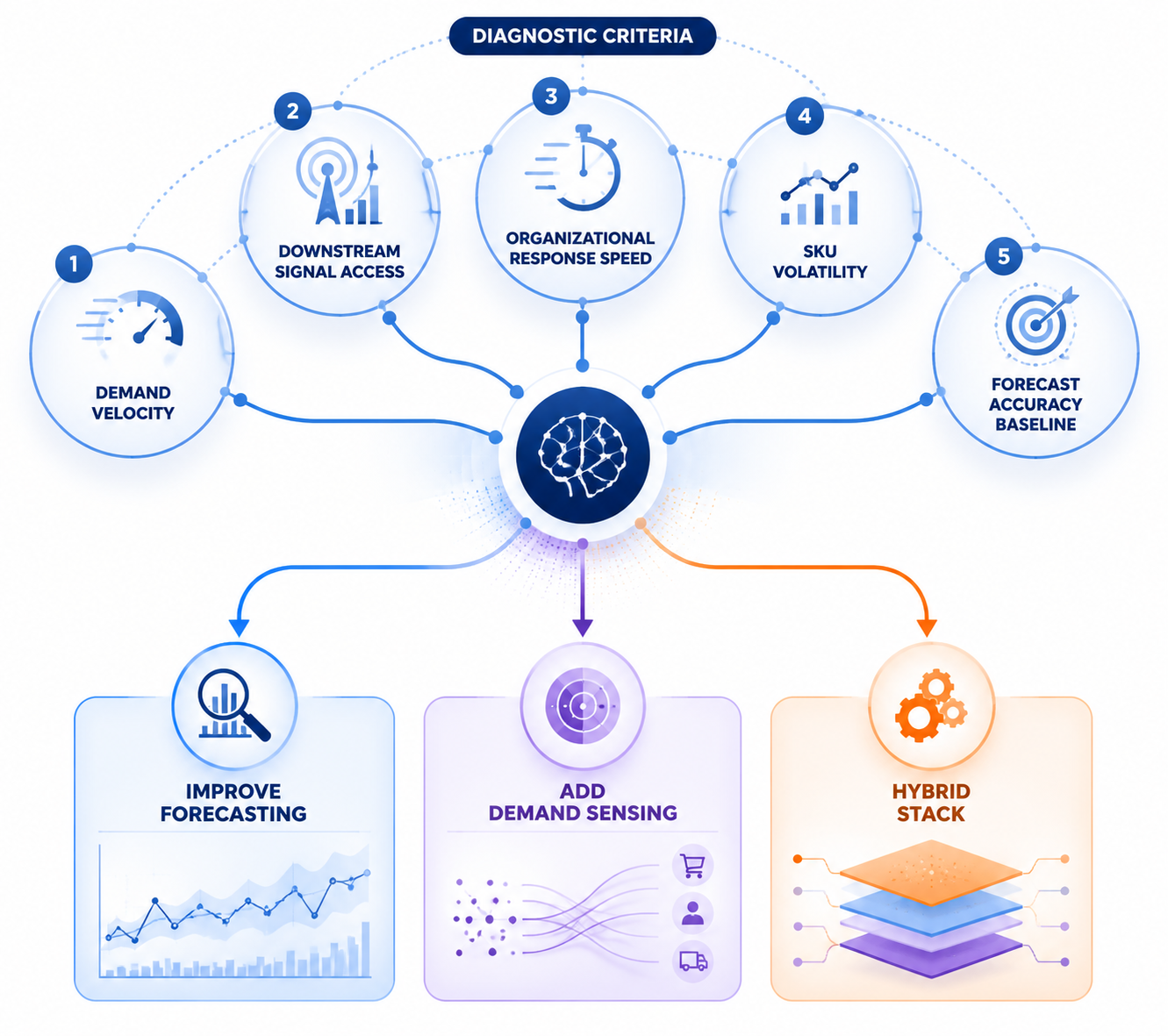
The Five Questions That Decide Fit
Before shortlisting tools, put the portfolio through five questions. They are less glamorous than an AI demo, but they expose whether sensing will create a better decision or just another recommendation the operation cannot act on.
| Diagnostic question | If the answer is mostly no | If the answer is mostly yes |
|---|---|---|
| Does demand change faster than the planning cycle? | Upgrade AI forecasting, review planning cadence, and measure forecast value added. | Demand sensing may help catch short-term shifts before the next formal cycle. |
| Can the business access downstream and external signals? | Fix data sharing, data latency, and master data before adding a sensing layer. | Sensing can use POS, weather, promotion, event, and similar signals to adjust near-term demand. |
| Can replenishment, allocation, or production respond inside 0–8 weeks? | A better signal may not change inventory outcomes if execution is locked. | Sensing can influence orders, stock transfers, allocation, and promotion response. |
| Is volatility concentrated in specific SKUs, customers, channels, or locations? | Per-SKU model selection and segmentation may be enough. | Use sensing selectively where volatility has an actionable short-term pattern. |
| Is the current forecast baseline already strong? | Work on data hygiene, model selection, and FVA before buying another layer. | Sensing may be worth testing against a strong baseline where short-term signal lift can be isolated. |
The external-signal question is becoming harder to ignore. AWS and Kearney describe AI-powered forecasting environments that can ingest more than 200 external signals, including POS, weather, social, and event data, and they argue that more than 80% of today’s supply chain data is generated outside the enterprise.[1] That does not automatically make demand sensing valuable. It means the old internal-history-only forecast is increasingly blind to some signals that customers, retailers, and markets already know.
When AI Forecasting Should Come First
AI forecasting should come first when the business is still struggling to produce a reliable baseline. That includes companies with unstable item-location history, inconsistent promotion coding, poor substitution logic, weak hierarchy maintenance, or planner overrides that are not measured after the fact.
Horizon Solutions argues that, despite widespread machine learning adoption, average industry forecast accuracy has improved by only 1–3 percentage points, with data quality remaining the dominant constraint.[2] That is the kind of number that should slow down a sensing business case. If the historical record is dirty, the item master is unreliable, and promotion history is not cleanly captured, a near-real-time layer will inherit more confusion than intelligence.
This is also where forecast value added matters. Mature planning teams increasingly measure whether planner overrides improve accuracy or add noise, and Horizon Solutions identifies FVA as standard practice in mature demand planning operations.[2] Without that discipline, a company may buy demand sensing to correct a problem that is actually coming from unmanaged manual intervention.
The same source describes ensemble forecasting with automatic per-SKU model selection as having moved from differentiator to table stakes between 2023 and 2026.[2] Treat that as a vendor assessment, not a law of nature, but the direction is right: many portfolios need better model selection by SKU, channel, and pattern before they need another class of short-term signal.
Forecasting upgrades are usually the better starting point when demand is slow-moving, replenishment lead times are long, production is constrained months ahead, or the main planning pain is budget alignment rather than weekly allocation. A building materials manufacturer, for example, may need better long-range views of seasonal demand and capacity more than it needs daily sensing of downstream demand pulses. That example is hypothetical, but the decision logic is common: if the business cannot act inside the sensing window, the sensing signal will not carry much operational value.
When Demand Sensing Earns Its Place
Demand sensing becomes more attractive when the planning cycle is slower than the market. The clearest candidates are fast-moving consumer goods, fresh food, retail, spare parts with intermittent spikes, promoted items, and channel mixes where downstream sales behavior appears before orders arrive through the normal planning process.
The work is tactical. A sensing layer may detect that a promoted SKU is selling through faster than the forecast expected, that regional weather is pulling demand into a shorter window, or that POS movement is diverging from order history. The useful question is not whether the model is impressive. It is whether someone can change replenishment quantities, redirect inventory, update allocation rules, or revise production priorities before the window closes.
The published improvement ranges are meaningful, but they are not interchangeable. E2open documented a CPG deployment where demand sensing improved the baseline demand planning forecast by 13–38%, depending on horizon.[3] Kinaxis cites 2023 Kearney data indicating 5–20% accuracy gains and 5–10% safety stock reduction from demand sensing.[4] RELEX reports that Atria reached 98.1% weekly forecast accuracy in a fresh food demand sensing deployment.[5] Tredence, citing McKinsey research, says AI-driven demand sensing can reduce forecast errors by 20–50%.[6]
Those figures should be read as evidence of potential, not as a planning assumption. They come from different baselines, horizons, product categories, and measurement methods. Several are vendor-reported or vendor-cited examples. A fresh food weekly forecast case, a CPG deployment, and a generalized consulting range do not produce one universal expected lift.
A better use of the numbers is to design the pilot. Pick the SKUs where a short-term signal should plausibly matter. Compare sensing against the current baseline over the same horizon. Measure the result in the decision unit the business actually uses: cases ordered, units allocated, service level protected, waste avoided, expedited shipments reduced, or inventory released. Accuracy alone is too easy to celebrate while the warehouse still ships the wrong mix.
The Data Readiness Trap
Demand sensing is often sold around signal richness: POS, weather, events, promotions, search, social, syndicated data, market feeds. Signal richness is not the same as usable data. The business needs access rights, refresh frequency, clean product-location mapping, stable customer and channel hierarchies, and a way to reconcile external signals with internal order and shipment history.
Industry commentary from Mike Coers reports that 60% of organizations still struggle with poor data quality for forecasting models.[7] That matters more for demand sensing than for a slide deck, because sensing compresses the time available to investigate bad inputs. If a daily POS feed arrives late, maps to the wrong item, or conflicts with known promotion timing, the planner may have less than a week to decide whether the alert is real.
Data readiness is not a single enterprise score. A company may have excellent POS visibility with one retail customer, weak distributor visibility in another channel, and no useful event data for a third. That usually argues for selective deployment. Add sensing where signal access is strong and the operational decision is clear; keep improving forecasting where the data is still too thin or too slow.
Response Speed Is the Hard Constraint
The sensing window is short. If a company identifies a demand shift in week two but cannot change supply, move inventory, adjust order quantities, or update allocation until week nine, the model may be correct and still commercially useless. This is where many planning transformations quietly disappoint: the forecast signal improves, but the operating model does not move any faster.
Response speed has several owners. Demand planning may detect the change. Replenishment may own the order. Sales may own customer commitments. Supply planning may own production feasibility. Logistics may own transfer timing. Finance may own guardrails on inventory exposure. If the sensing recommendation has to cross all of those desks before action, implementation should focus as much on decision rights as on algorithms.
- Use demand sensing for replenishment when order quantities can still be changed before the next delivery or production release.
- Use it for allocation when scarce inventory can be redirected toward channels or locations showing stronger near-term demand.
- Use it for promotions when sell-through signals arrive early enough to correct replenishment, not merely explain the post-event variance.
- Use it for volatility management when the organization has predefined rules for acting on alerts.
If those actions are blocked by frozen production schedules, rigid order policies, customer minimums, or long transportation lead times, the better implementation may be policy redesign rather than sensing software.
How a Hybrid Stack Actually Works
A hybrid stack does not mean two models competing for one official number. It means each model owns the horizon it is suited for, and the handoff is explicit.
| Planning layer | Typical horizon | Primary data | Decision owner | Main decisions |
|---|---|---|---|---|
| AI forecasting | 3–18 months | Historical orders, shipments, seasonality, product hierarchy, promotions, pricing, internal business assumptions | Demand planning, S&OP, supply planning, finance | Capacity, procurement, budget, seasonal buy, baseline plan |
| Demand sensing | 0–8 weeks | Near-real-time internal and external signals such as POS, weather, events, promotions, and channel activity | Replenishment, allocation, demand planning, inventory management | Order adjustments, inventory positioning, short-term allocation, promotion response |
The baseline forecast still matters. It sets the plan the business is willing to fund and supply. Sensing then reads the near-term environment against that baseline and proposes tactical changes. The two outputs should not be averaged blindly. A short-term POS spike may justify a replenishment change without changing the annual demand plan. A sustained pattern may eventually feed back into the forecasting layer, but only after the team understands whether it represents true demand, forward buying, channel shift, stockout recovery, or promotion timing.
This separation also protects the long-range forecast from being blamed for the wrong job. A 12-month forecast is not designed to react to a two-week weather event. A sensing model is not designed to replace the capacity plan. When the organization mixes those responsibilities, planners spend the cycle explaining variance instead of improving decisions.
A practical operating pattern
- Maintain the AI forecast as the baseline for the monthly or weekly planning cycle, with clear horizon ownership.
- Run sensing only against the near-term horizon where the business can still act.
- Route exceptions to the team that owns the decision: replenishment, allocation, demand planning, or supply planning.
- Measure whether the sensing recommendation improved the operational outcome, not only whether it improved statistical accuracy.
- Feed confirmed structural changes back into the forecasting model after the short-term noise has been separated from persistent demand.
Do Not Let the AI Roadmap Outrun the Planning Discipline
The tooling conversation is moving faster than the operating discipline in many companies. Gartner reported in 2025 that only 23% of supply chain organizations had a formal AI strategy, even among organizations already deploying AI, as cited by Open Sky Group.[8] That gap shows up in implementation: teams pilot advanced models before agreeing who can override them, which metric proves value, or how quickly the organization must respond.
For demand sensing, the minimum implementation design should answer four questions before the pilot starts: which SKUs are in scope, which signals are trusted enough to use, which decisions can change inside the 0–8 week window, and what metric will prove that the change was worth making. Without those answers, a pilot can produce attractive accuracy charts and still leave planners with no executable decision.
For AI forecasting, the equivalent discipline is baseline governance. The team needs clean historical data, model selection by demand pattern, documented overrides, FVA measurement, and a regular process for retiring assumptions that no longer hold. Forecasting is not less advanced because it uses history. It is less useful when the history, hierarchy, and human interventions are unmanaged.
Choosing Forecasting, Sensing, or Both
Stable demand with slow operational response favors AI forecasting upgrades. The priority is a stronger baseline, better per-SKU models, cleaner data, and tighter FVA discipline. Demand sensing may be interesting later, but it should not be the first investment if the business cannot act on a short-term signal.
Fast-moving demand with usable downstream signals favors adding demand sensing. The best-fit environments have frequent short-term variation, access to POS or other external signals, and replenishment or allocation teams that can change decisions before the window closes.
Mixed portfolios usually need both, but not everywhere. Use forecasting as the planning backbone. Add sensing selectively where demand velocity, signal access, SKU volatility, and response speed make the incremental layer actionable. A slow, stable SKU and a promoted high-velocity SKU should not be forced through the same decision logic just because they sit in the same ERP.
The implementation choice is not about whether demand sensing is better than AI forecasting. It is about whether the business is solving a strategic planning problem, a tactical response problem, or both. No model creates value if data quality cannot support the signal or if replenishment speed cannot support the decision.
References
- AI-Powered Demand Forecasting, AWS Executive Insights / Kearney.
- Top Demand Planning Trends 2026, Horizon Solutions, 2026.
- AI-Led Forecasting: What's Already Working in the Supply Chain, E2open.
- What is demand sensing?, Kinaxis.
- Demand sensing: Conquer manufacturing supply chain chaos, RELEX Solutions.
- How to Implement Demand Sensing: A Step-by-Step Guide (2026), Tredence, 2026.
- LinkedIn/Mike Coers industry analysis.
- Supply Chain AI Statistics: 18+ Statistics You Should Know for 2026, Open Sky Group, citing Gartner 2025.
Comments
Join the discussion with an anonymous comment.