
The uncomfortable part of CSRD supply chain reporting is not that companies lack ambition. It is that many large enterprises are trying to produce assurance-grade Scope 3 evidence from a workflow that still behaves like an annual reconciliation exercise.
MIT’s 2025 State of Supply Chain Sustainability report puts the contradiction plainly: only 39% of companies had embedded sustainability into routine operational decisions, while 66.1% still used spreadsheets for Scope 3 emissions reporting.[1] That pairing matters more than either number alone. It suggests that sustainability is being reported more often than it is being operated.
For supply chain teams, this is not an abstract reporting problem. It shows up as supplier master data cleanup, late transport files, duplicate lane records, missing weight or distance fields, procurement category mismatches, and long email threads about whether a number is primary data, activity-based data, or a defensible estimate. By the time executives arrive for sign-off, the people closest to the work have often spent weeks proving that the enterprise can disclose something, not building a data layer that helps them manage anything.

The waste pattern behind manual CSRD reporting
A typical reporting cycle produces more operational knowledge than the final disclosure suggests. Teams learn which suppliers can provide product-level information, which logistics providers can return usable shipment data, which business units still classify spend inconsistently, and where inventory buffers are hiding transport and warehousing emissions. Then, after the report is filed, much of that learning disappears into folders, workbook tabs, and one-off reconciliation logic.
That is why the business case for CSRD supply chain reporting AI should not start with “faster reporting.” Faster reporting is useful, but it is a small prize if the company simply automates the same annual scramble. The larger question is whether the infrastructure built for CSRD can become a shared operating layer for procurement, logistics, inventory, sustainability, finance, and risk.
This distinction becomes especially important under the April–May 2026 legislative state of Omnibus I, where the CSRD scope is framed around companies with 1,000+ employees and €450 million+ turnover, while member-state transposition may still create national-level variation through 2027. The exact compliance timetable matters, but postponement does not remove the underlying data problem. It only changes how long companies have to decide whether they are building a disclosure machine or an intelligence asset.
What AI changes when it is attached to the data backbone
The useful AI pattern emerging in CSRD supply chain reporting is not one model that “does Scope 3.” It is a layered architecture: automated data capture from enterprise systems, intelligent classification across emissions categories, and reporting output that can serve multiple frameworks from the same underlying evidence base. That pattern appears across vendor-sourced architectures and implementation guidance, so it should be treated as an industry direction rather than a universal standard.
| Layer | What it does | Why it matters operationally |
|---|---|---|
| Automated data capture | Pulls supplier, purchasing, shipment, inventory, invoice, and activity data from systems such as ERP, TMS, WMS, procurement platforms, and supplier portals | Reduces repeated manual file handling and gives teams a current view of where data is missing or inconsistent |
| Intelligent classification | Maps transactions, suppliers, categories, lanes, and activities to relevant Scope 3 logic and emissions factors | Turns messy operational records into comparable signals for procurement, logistics, and sustainability teams |
| Multi-framework output | Uses the same governed data layer to support ESRS, IFRS S1/S2, GRI, CDP, and management reporting | Prevents each reporting requirement from becoming a separate spreadsheet ritual |
The first layer is often the least glamorous and the most decisive. If shipment data, purchase orders, supplier attributes, and inventory movements still arrive as manually formatted extracts, AI has very little to optimize. Automated capture does not mean every supplier suddenly provides perfect primary data. It means the enterprise can see, earlier and more consistently, which records are complete enough to use, which require estimation, and which should be escalated before the reporting deadline.
The classification layer is where CSRD work starts to become reusable. Spend categories can be mapped to purchased goods and services. Freight movements can be associated with upstream transportation and distribution. Supplier records can be tagged by region, material, risk, or data quality. Normative’s guidance distinguishes primary data from activity-based data under ESRS E1 and notes the practical boundary that AI cannot create data where none is reported.[2] That boundary is healthy. It keeps automation from becoming a confidence trick.
Not every Scope 3 category benefits equally from this approach. Purchased goods and services and upstream transportation are usually more mature candidates because they sit close to procurement, logistics, and invoice data. Categories such as franchises or investments can involve different ownership structures, weaker operational control, and less consistent activity data. A serious CSRD AI program should acknowledge that unevenness rather than promising a smooth automation curve across all 15 categories.
The third layer is where the investment case changes. Net0 describes a single AI backbone that can produce ESRS, IFRS S1/S2, GRI, and CDP outputs from one data pipeline.[3] As a vendor claim, that should not be read as independent proof of enterprise-wide efficiency. But it is directionally consistent with the operating model many companies need: one governed data layer, many reporting and decision uses.
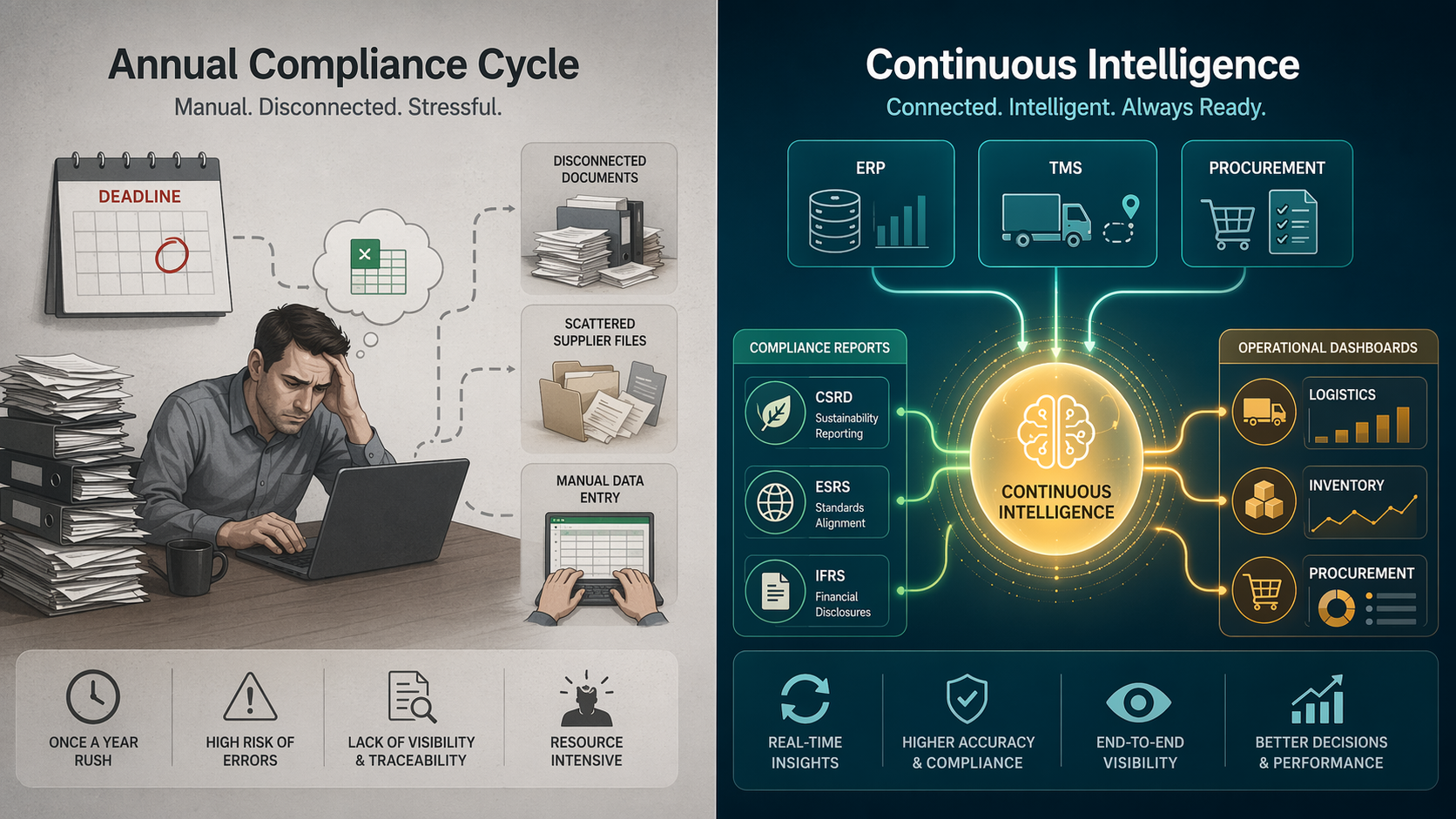
The same evidence can serve assurance and operations
Assurance teams care about traceability: where a number came from, when it was updated, which method was used, who approved it, and whether the same logic can be applied again. Operations teams care about a different set of questions: which suppliers are causing delays, which lanes are expensive and emissions-heavy, which inventory positions are excessive, and which procurement choices are locking in future reporting pain.
Those are not competing needs. A shipment-level dataset with reliable origin, destination, carrier, mode, weight, and timing can support emissions calculation, freight cost analysis, service review, and lane redesign. A supplier record that captures product category, location, data quality, emissions factor source, and contract status can support ESRS disclosure, procurement negotiation, supplier engagement, and risk review. The same record does not answer every question, but it stops each function from rebuilding its own partial truth.
This is also where AI can improve the rhythm of management. Instead of discovering missing transport attributes in the fourth quarter, a team can see data gaps by lane or carrier during the year. Instead of asking suppliers for everything at once, procurement can prioritize requests where spend, emissions exposure, and data weakness overlap. Instead of treating emissions factors as static lookup work, sustainability and finance can review exceptions, methodology changes, and material movements together.
For a deeper tactical view of Scope 3 automation mechanics, ChainSignal’s companion article on AI-enabled Scope 3 carbon emissions tracking in supply chains sits closer to the workflow level. The strategic point here is narrower: the data foundation built for CSRD becomes more defensible when it also improves decisions before the reporting period closes.
The ROI case is adjacent, not CSRD-specific
The strongest ROI numbers often cited around AI and supply chains do not come from CSRD deployments. They come from adjacent operational research, and they should be used that way. McKinsey’s 2024 work on AI in distribution operations reports 5–20% logistics cost reductions, 20–30% inventory reductions, and 5–15% procurement spend reductions from AI-enabled distribution and operating improvements.[4] Those figures are relevant to a COO evaluating shared infrastructure, but they are not proof that a CSRD reporting tool will automatically deliver those savings.
The bridge is the data layer. If CSRD reporting forces a company to normalize supplier, shipment, inventory, and purchasing data, then the same foundation can feed optimization work: freight consolidation, mode review, inventory repositioning, supplier performance segmentation, and anomaly detection. The compliance budget does not create savings by itself. It creates the opportunity to stop rebuilding the same data foundation for every operational initiative.
Accenture’s 2024 supply chain research makes the competitive version of that point. Companies with the most mature supply chains were 23% more profitable, and they were six times more likely to have broad AI deployment than their peers.[5] Again, this is not CSRD-specific causation. It is evidence that companies able to industrialize data and AI across the supply chain are operating with a different management capability.
That distinction matters in budget conversations. A narrow CSRD automation proposal competes with every other compliance request. A shared operational intelligence proposal can be evaluated against logistics cost, working capital, procurement efficiency, resilience, and assurance readiness. The evidence threshold is higher, but the investment logic is more durable.
Where environmental and operational signals overlap
The most convincing use cases are rarely framed as “emissions only.” They detect operational deviations that also carry environmental consequences: unusual energy use, abnormal production patterns, refrigeration failures, excessive transport rework, avoidable expedited freight, or process instability that creates waste.
Fiegenbaum Solutions reports pilot-program data in chemical and food processing environments where AI anomaly detection reduced unplanned emissions incidents by up to 35%.[6] Because this is pilot data from a solution provider, it should be treated as a concrete example rather than a general benchmark. Its value is in showing how the same anomaly signal can matter to plant operations, environmental performance, and reporting evidence.
That overlap is exactly where CSRD infrastructure can become useful outside the reporting calendar. If the system flags an emissions-relevant anomaly only after year-end, it is a disclosure aid. If it flags the issue while operations can still respond, it becomes a management tool. The difference is timing, ownership, and whether the signal reaches someone with authority to act.
Timing matters, but forecasts are not outcomes
The market is moving quickly enough that waiting for a fully settled playbook has its own cost. Gartner’s April 2026 forecast projects agentic AI in supply chain management software reaching $53 billion by 2030, with enterprise adoption rising from 5% in 2025 to 60% by 2030.[7] That is a forecast, not an outcome, and it should not be used as proof that any particular implementation will succeed.
It does, however, affect timing. If supply chain software is moving toward AI agents that monitor exceptions, recommend actions, and coordinate workflows, then CSRD reporting infrastructure built as a static annual repository may age quickly. Companies do not need to buy the most advanced agentic system now. They do need to avoid data designs that make continuous monitoring, exception management, and cross-framework reporting harder later.
The practical investment question is therefore not whether AI can make the CSRD report easier to assemble. It can, within the limits of available data. The better question is whether the enterprise is willing to fund the reporting layer as part of a broader supply chain data backbone: governed enough for assurance, current enough for operations, and flexible enough to serve more than one framework.
The board-level judgment
AI-driven CSRD supply chain reporting is strategically defensible when it converts repeated compliance effort into reusable operational intelligence. That means the program should be judged on whether it improves data availability during the year, exposes supplier and transport exceptions earlier, supports multiple reporting frameworks from one governed pipeline, and gives procurement, logistics, finance, sustainability, and IT a common evidence base.
It is much harder to defend when it is sold as a narrow automation layer for an annual disclosure. AI cannot manufacture missing supplier data, eliminate methodological judgment, or turn vendor ROI claims into company-specific savings. The business case becomes credible only when CSRD is not the only beneficiary of the infrastructure.
For companies already in scope, the decision is not whether supply chain reporting work will happen. It will. The choice is whether the effort leaves behind another archive of reconciled spreadsheets, or a data backbone that management can use before the next reporting deadline arrives.
References
- State of Supply Chain Sustainability 2025, MIT, 2025.
- ESRS E1 and Scope 3 guidance, Normative, May 2026.
- ESRS, IFRS S1/S2, GRI, and CDP reporting from one AI data pipeline, Net0, April 2026.
- Harnessing the power of AI in distribution operations, McKinsey & Company, 2024.
- Next stop, next-gen, Accenture, 2024.
- AI anomaly detection pilot programs, Fiegenbaum Solutions, 2025/2026.
- Gartner Forecasts Agentic AI in Supply Chain Management Software to Reach $53 Billion by 2030, Gartner, April 2026.
Comments
Join the discussion with an anonymous comment.