
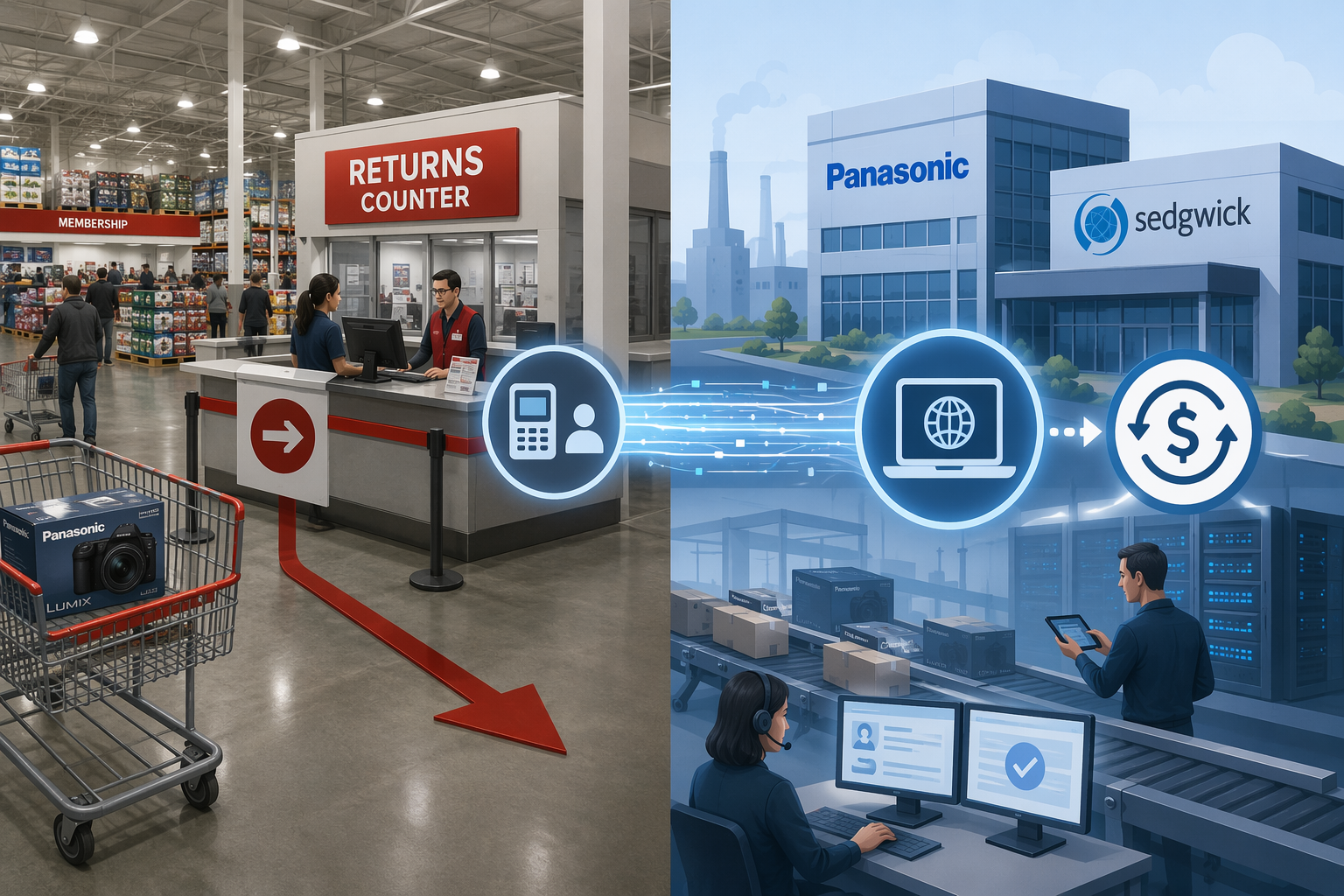
The useful detail in the Costco Panasonic toaster recall logistics is not that Costco posted a notice. It is that the affected Costco member is not being sent back to the warehouse returns counter. For Costco item #2024930, the member-facing instruction is to go through Panasonic’s recall process, with Panasonic using Sedgwick as the administrator rather than asking Costco stores to process the toaster oven as an ordinary return.[1]
That routing choice tells most of the operating story. A product sold through Costco, Amazon, and Panasonic.com from October 2024 through April 2026 is now under a July 16, 2026 recall covering about 11,480 units in the United States and 2,184 in Canada.[2] The hazard language is serious enough: shock and fire hazards. But the execution model is quieter and more important for retailers. Panasonic owns the consumer remedy path; Costco’s job is to identify, notify, and keep any affected product out of normal commerce and normal returns flow.
The return path starts outside the returns counter
A store-level return is easy to describe and hard to control. The member walks in with a product, the service desk searches the receipt or membership history, a refund is issued, the item gets a disposition code, and the back office later tries to make the vendor recovery match the transaction. That path works when the retailer is intentionally leading the recall. It is not the cleanest path when the manufacturer has already established a recall administrator, refund rule, and intake channel.
For this recall, Panasonic tells consumers to call 888-943-2391 or use the Sedgwick recall portal at ToasterOvenRecall.expertinquiry.com. The refund is stated as the purchase price plus applicable sales tax.[3] Those two details matter. The phone number and portal keep the consumer in a single recall record. The refund rule gives the administrator a defined financial obligation instead of leaving each retail location to interpret whether the transaction should be treated like a goodwill return, a safety recall, or a vendor-funded adjustment.
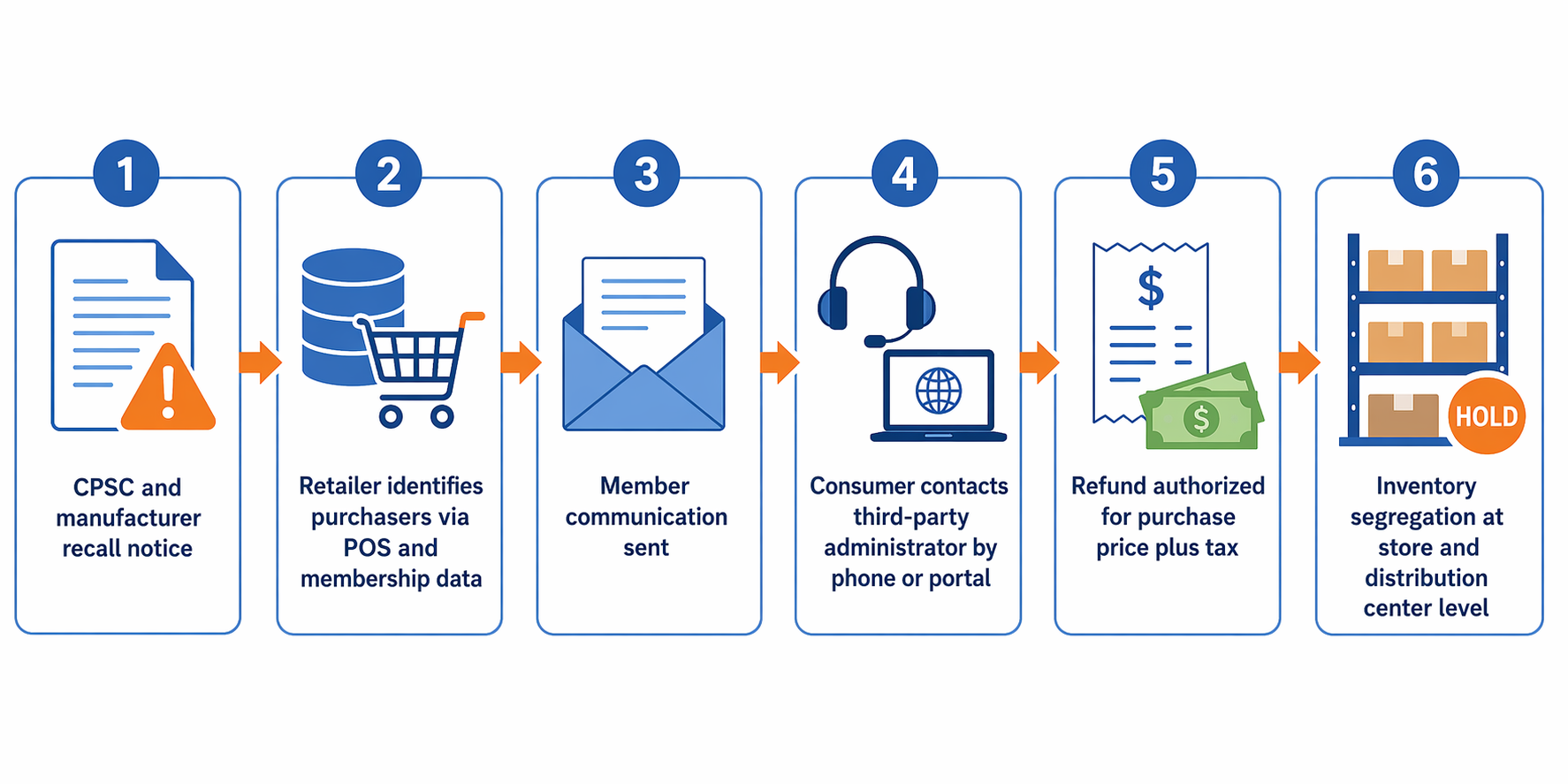
| Stage | Primary operator | Operational purpose |
|---|---|---|
| Recall notice | CPSC and Panasonic | Establish the affected model, hazard, sales period, and remedy |
| Purchaser identification | Costco | Use SKU, sales, and membership data to locate likely affected members |
| Member communication | Costco and Panasonic | Route the member to the manufacturer-led recall channel |
| Consumer intake | Sedgwick for Panasonic | Capture claim information through phone or portal |
| Refund authorization | Panasonic/Sedgwick | Issue purchase price plus applicable sales tax under the recall remedy |
| Product handling and segregation | Panasonic/Sedgwick for consumer flow; Costco for any store/DC stock | Keep affected product out of resale and out of ordinary return disposition |
The cleanest recall transactions are the ones that never become normal returns. Once an affected appliance enters the ordinary returns stream, it competes with open-box disposition, salvage, vendor return authorization, damage handling, and customer-service exception logic. The recall administrator may still need the unit back, or may need proof of destruction or disabling, but the key is that the claim record, refund approval, and product disposition stay attached to the recall rather than to a warehouse return lane.
Why the manufacturer-led model changes the workload
Recall operations often get flattened into the phrase “reverse logistics,” as if the central problem is shipping product backward. In this case, the bigger operational split is between transaction ownership and customer access. Panasonic has the duty to administer the remedy. Costco has the customer relationship and the sales data for its channel.
Generic recall models usually divide into manufacturer-led and retailer-led execution. In a manufacturer-led model, the manufacturer or its administrator handles the consumer claim, refund, replacement, and product return or disposition. In a retailer-led model, the retailer may refund the shopper first and then recover from the vendor through debit documentation, claims, or other settlement processes. Reverse-logistics guidance generally treats the retailer as a critical node even when the manufacturer leads, because the retailer still controls store instructions, inventory holds, and customer communication at the point where confusion is most likely to surface.[4]
The Panasonic-Costco recall sits clearly on the manufacturer-led side. Panasonic’s public recall page names Sedgwick as the recall administrator and directs consumers to the dedicated phone and portal process.[3] Costco’s member-facing recall page points members away from Costco’s returns desk and toward that same manufacturer process for item #2024930.[1]
That does not mean Costco has no cost. It means Costco’s visible cost is not mainly the refund drawer. The retailer has to identify probable purchasers, publish and distribute member instructions, prevent stores from accepting the item into the wrong returns path where possible, and place any remaining inventory under the right hold or segregation procedure. If a member still walks into a warehouse with the toaster oven, the service desk needs a simple answer that does not create a duplicate refund or strand the unit in ordinary returns.
The money follows the remedy record
Cost recovery is where recall process design becomes accounting discipline. In a retailer-led recall, a store or ecommerce retailer may issue the refund, collect or dispose of the product, and later charge the supplier. That can be practical for fast-moving grocery items or private-label programs where the retailer wants one uniform shopper experience. It also creates reconciliation work: item eligibility, duplicate claims, tax treatment, freight, disposal, labor, and vendor debit support.
Here, the public materials point to a different allocation. Panasonic funds the stated remedy through the Sedgwick process: purchase price plus applicable sales tax.[3] Costco’s burden is more like controlled enablement. It supplies the route to the affected member and protects its own network from processing a manufacturer liability as if it were a discretionary retail return.
The cost context is still worth respecting. PLS Logistics cites Food Marketing Institute and Grocery Manufacturers Association data that put the average direct cost of a recall at about $10 million, and notes that reverse logistics costs can exceed the cost of the original outbound shipment.[5] That benchmark should not be treated as an estimate for this toaster oven recall. The cited figure is an average from older industry material, not a current Panasonic exposure calculation, and the public record is only two days old as of this writing. Actual claim volume, freight cost, administrator workload, and any Costco vendor-recovery documentation are not public.
Even so, the benchmark explains why the routing decision matters. Every unit that bypasses the warehouse returns desk also bypasses a chain of store labor, exception approvals, return-to-vendor handling, inventory adjustments, member refund audits, and later recovery matching. The cost does not disappear. It moves to the party administering the recall, where the claim record and refund authorization can stay together.
Customer identification is the retailer’s real contribution
The model only works if Costco can reach the right members with enough confidence. The recalled Panasonic toaster ovens were sold over an 18-month window, from October 2024 through April 2026.[2] That is a long enough period for households to move, email addresses to age, and units to be gifted or resold. It is also a contained enough period for a membership retailer to run a targeted SKU-level search rather than rely only on broad public awareness.
Membership-linked purchase history is a recall asset because it connects the item number to a household contact path. The public Costco page confirms the affected Costco item number and provides the recall direction, but it does not disclose Costco’s internal query, match rate, or delivery metrics for this event.[1] That distinction matters. It is reasonable to describe the readiness requirement: SKU-level sales history, member contact data, and a repeatable notice process. It is not reasonable to claim from the public record that every affected Costco purchaser has already been reached.
A useful comparison comes from earlier recall-reporting on Costco’s data capability. In a 2020 Supply Chain Digital article about recall execution and prevention, an industry example described Costco identifying affected purchasers in a fruit recall within 24 hours by using membership-linked purchase data.[6] That example is not proof of what happened in the Panasonic toaster oven recall. It is a benchmark for the kind of data posture that makes the manufacturer-led model viable: the retailer does not have to process every refund, but it must be able to find the likely purchasers quickly enough for the manufacturer’s remedy channel to matter.
What has to be ready before the notice goes live
- Item-level matching: Costco item #2024930 has to map cleanly to the recalled Panasonic toaster oven, with no ambiguity for adjacent models or replacement SKUs.
- Sales-window filtering: the October 2024 through April 2026 sales period has to be applied consistently to member communications and any internal exception handling.
- Channel-specific instructions: store employees need to know that the member should be routed to Panasonic/Sedgwick, not refunded through the ordinary counter process.
- Duplicate-refund prevention: a member who contacts Sedgwick should not also receive a standard Costco return refund for the same recalled unit without a controlled exception.
- Inventory holds: any remaining store, depot, ecommerce, or return-center stock has to be blocked from sale and segregated from ordinary disposition.
- Audit trail: communications, holds, exceptions, and vendor correspondence need to be reconstructable after the initial notice cycle ends.
The weak point is rarely the first memo. It is the second and third contact: the member who brings the unit to a store anyway, the call-center agent who sees a purchase record but not the latest recall instruction, the returns clerk who has a safety concern in hand and a line of members waiting. If those teams do not have a short, current instruction, the operating model collapses back into ad hoc retail returns.
Inventory segregation still belongs to the retailer
A manufacturer-led consumer process does not remove the retailer’s duty to control product inside its own network. Any affected units still in a warehouse, depot, ecommerce returns area, damage cage, or vendor-return lane have to be isolated. The public recall materials establish the affected product, sales period, and remedy, but they do not publish Costco’s internal hold codes or DC instructions for this event.[1][2]
That gap is normal; hold-code procedures are operational documents, not public notices. From a readiness standpoint, the requirement is still concrete. The item must be blocked at POS if any sellable inventory remains, marked for non-sale handling if it appears in returns, and kept out of mixed salvage or liquidation channels until the recall disposition is confirmed. If the recall administrator requires product return, proof of destruction, or another disposition method, the retailer’s internal handling has to preserve that evidence rather than overwrite it with a generic return status.
Traceability frameworks increasingly push companies to prove process control rather than merely announce it. SupplyChainBrain’s discussion of recall readiness in the context of GS1 US and FSMA Rule 204 emphasizes that recall performance depends on process proof, data capture, and the ability to trace affected product through the supply chain.[7] This toaster oven is not a food traceability case, and FSMA Rule 204 is not the governing rule for an electric appliance. The transferable lesson is narrower: recall readiness depends on whether the company can show what product moved where, which customers were likely affected, and what actions were taken after the notice.
Hazard context without turning the operation into theater
The safety issue should not be minimized. The CPSC announcement describes shock and fire hazards, with reports including tripped circuit breakers and one unit that stopped working; it also says no fires or injuries had been reported at the time of the announcement.[2] That combination usually produces a more deliberate recall cadence than an event with confirmed injuries, active fire incidents, or immediate stop-use urgency across a much larger installed base.
For operations teams, that matters because the first 48 hours are not only about public risk language. They are about whether the retailer can get the instruction into every place a consumer might touch: recall page, member letter, call-center script, warehouse service desk guidance, ecommerce support, and returns disposition. A recall with no reported injuries can still create a messy field operation if the member sees one instruction online and hears another at the counter.
The upstream defect becomes a downstream data problem
Health Canada identifies the issue as involving fiberglass sleeve insulation at Panasonic Manufacturing (Xiamen) Co., Ltd. in China.[8] That is a component-level quality failure upstream. By the time it reaches a Costco member’s kitchen, the operational problem has changed form: find the households, route the claim, stop resale, control returns, and maintain records that can withstand later review.
That is why recall readiness cannot sit only in product quality or legal. A component problem becomes a POS-data problem, a member-communication problem, a store-training problem, a tax-refund problem, and a disposition problem. The cleaner the manufacturer’s administrator channel is, the more important it is that the retailer not accidentally create a parallel channel with different answers.
What this recall is useful for
It is too early to call the Panasonic toaster oven recall successful. The announcement is only two days old as of July 18, 2026. Public materials do not show return rates, member-contact completion, Sedgwick claim volume, Costco exception rates, or vendor recovery documentation. Those are the numbers that would tell an operator how cleanly the field execution actually ran.
What the case already shows is a useful recall-readiness pattern. Costco can reduce its processing load only if the data, communication, and segregation systems are ready before the notice appears. Panasonic can own the refund and return path only if the consumer is routed into one administrator record. Store and DC teams are protected only if the instruction keeps affected units out of ordinary returns and ordinary resale. That is the practical benchmark in this recall: not a dramatic reversal of responsibility, but a clean handoff that depends on preparation most customers never see.
References
- Recalls & Product Notices, Costco.
- Panasonic Recalls Electric Toaster Ovens Due to Shock and Fire Hazards, U.S. Consumer Product Safety Commission, July 16, 2026.
- NB-G200/205 Product Recall Information July 2026, Panasonic.
- How Reverse Logistics Plays a Key Role in a Smooth Product Recall, ReturnLogic.
- Disruption from Your Supply Chain: Product Recalls, PLS Logistics.
- Data analytics changing face of recall execution and prevention, Supply Chain Digital.
- Proof in the Process: What Recalls Reveal About Supply Chain Readiness, SupplyChainBrain.
- Panasonic FlashXpress Toaster Oven recalled due to electric shock hazard, Health Canada.
Comments
Join the discussion with an anonymous comment.