
The expensive mistake is rarely buying a bad dashboard. It is buying a supply chain digital control tower platform before naming the bottleneck it is supposed to remove.
A control tower demo can make every operating problem look like a visibility problem: late shipments glow red, routes fall out of tolerance, inventory exceptions stack up, and someone says the business finally has “one version of the truth.” That may be useful. It may also leave the same dispatcher, planner, customer service agent, or logistics manager doing the same manual work after the alert appears.
The market pressure makes that selection error easier, not harder. The supply chain control tower market is estimated at $8.75 billion in 2026, and 37% of organizations are prioritizing control tower investments; Locus’s 2026 vendor-published provider analysis also cites Blue Yonder survey findings that only 66% of supply chain leaders feel ready for the future, down from 73% in 2025, and that 43% say they need an entirely new approach.[1] Those numbers justify urgency. They do not justify treating every control tower as the same operating model.
Start With The Operating Model, Not The Label
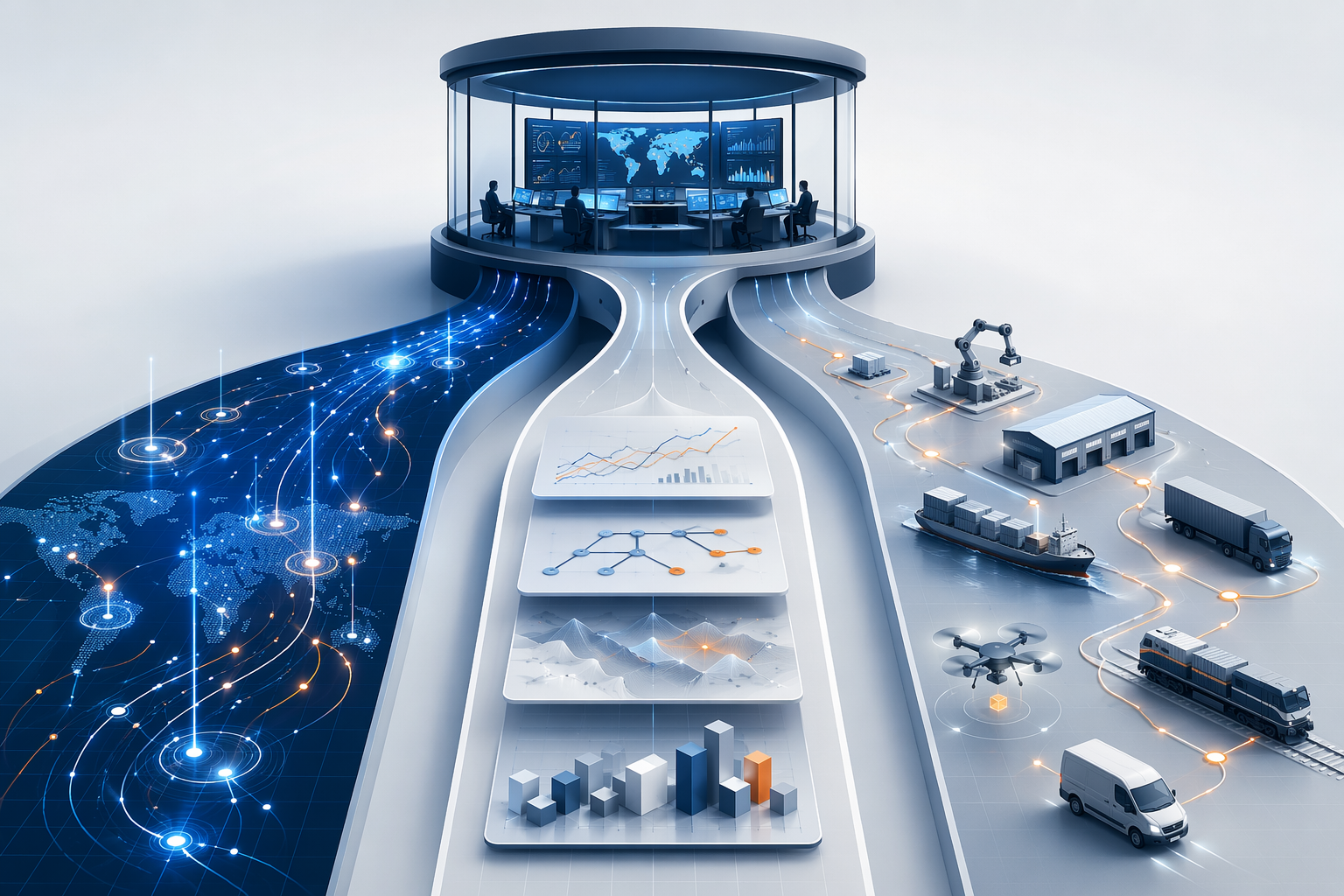
The most useful split in the current market is not between “basic” and “advanced” control towers. It is between three architectural starting points: visibility-led, planning-led, and execution-led. Locus’s 2026 provider analysis lays out that taxonomy with vendor examples: project44, FourKites, and E2open as visibility-led; Blue Yonder, Kinaxis, and o9 as planning-led; and Locus as execution-led.[1] Because Locus is a vendor that places itself in the execution-led category, the taxonomy should not be treated as neutral market law. It is still a helpful way to ask the right first question: what work changes after go-live?
| Model | Primary job | Best fit when the bottleneck is | What still needs attention |
|---|---|---|---|
| Visibility-led | Track-and-alert | The organization does not reliably know what is happening across carriers, modes, partners, or milestones. | People still need to decide and act after the alert. |
| Planning-led | Simulate-and-optimize | The organization makes weak upstream tradeoffs because plans, scenarios, inventory assumptions, or network decisions are fragmented. | The plan still has to reach daily operations, docks, routes, and exception teams. |
| Execution-led | Automate-and-act | The organization sees exceptions but responds too slowly or inconsistently at dispatch, routing, carrier-exception, or delivery levels. | Automation depends on reliable inputs, clear rules, and operational adoption. |
These are not sealed boxes. A planning suite may include visibility features. A visibility provider may add workflow and predictive ETAs. An execution platform may integrate with planning and order management systems. The point is not to classify vendors for sport. The point is to identify which layer is expected to absorb the operational pain.
When Visibility Is The Bottleneck, Track-And-Alert Is A Legitimate Starting Point
A visibility-led control tower earns its keep when the business cannot answer basic operating questions quickly enough: where is the shipment, which carrier has it, which milestone failed, which customer is exposed, and which lane or mode is repeatedly causing exceptions?
That problem is real in multi-modal networks, outsourced logistics environments, and companies that still reconcile carrier portals, spreadsheets, TMS exports, EDI feeds, and customer emails by hand. In that environment, clean tracking and exception alerts are not cosmetic. They reduce the time teams spend finding the problem before they can even start solving it.
The failure mode appears when leaders expect visibility to become execution by itself. A red late-shipment alert does not rebook capacity, resequence a dock, call a customer, approve an expedite, or rebalance a route. Someone still owns the next move. If that ownership is ambiguous, the control tower becomes a better way to watch delays accumulate.
This is why visibility-led platforms fit best when the current bottleneck is uncertainty rather than slow action. If teams already know what is going wrong but cannot respond quickly enough, another alert layer will add pressure without removing work.
When Planning Is Fragmented, The Control Tower Belongs Upstream
Planning-led control towers answer a different question: which decision should the business make before the exception hits the floor? That can mean scenario planning, inventory positioning, supply allocation, network design, demand-supply balancing, or tradeoff analysis across service, cost, and risk.
Blue Yonder, Kinaxis, and o9 are placed in this planning-led group in the Locus taxonomy because the model emphasizes simulate-and-optimize workflows rather than same-day dispatch automation.[1] The value is not that these platforms make operations look tidy on a map. The value is that they help planners compare choices before a poor choice becomes an operational emergency.
This model fits companies where the painful decisions are upstream: whether to pre-build inventory, shift supply, change a sourcing assumption, rebalance a network, accept a service compromise, or run a different allocation plan. If planners are trapped in disconnected spreadsheets and regional assumptions, better execution tooling downstream may only make bad plans move faster.
The risk is distance from the daily operating cadence. A better scenario model has limited value if it never changes the work of transportation planners, warehouse schedulers, customer service teams, procurement, or logistics managers. Planning-led deployments need a deliberate handoff: what decisions are binding, who can override them, when they refresh, and how exceptions flow back into the next plan.
For broader context on how AI is changing control tower capabilities, ChainSignal’s article on AI-powered supply chain control towers is the more natural place to go deeper into predictive and optimization patterns.
When Execution Is Slow, Alerts Are Too Late
Execution-led control towers move closest to the point where supply chain work actually changes. Instead of stopping at “this shipment is late” or “this plan is better,” the model aims to automate or orchestrate actions such as routing, dispatch, delivery sequencing, exception handling, and reassignment.
That distinction matters in networks where the clock is the constraint. Dense delivery operations, field distribution, same-day routing, appointment-sensitive logistics, and high-volume last-mile environments do not have much tolerance for an alert that waits in a queue while a dispatcher triages manually. Locus’s provider analysis describes execution-led platforms as automate-and-act systems and reports customer metrics including 25% efficiency gains and 45% more deliveries per vehicle.[1] Those are vendor-published customer claims, not a general guarantee for every operation.
The more useful question is whether the organization has repeatable decisions that can be safely automated or tightly orchestrated. If every exception requires a cross-functional negotiation, execution automation may expose governance gaps. If the data feeding routes, orders, capacity, geocodes, cutoffs, or service rules is unreliable, the system may simply automate bad assumptions faster.
Execution-led investment is strongest when teams already have enough visibility to know the problem and enough planning alignment to know the preferred tradeoff, but the actual response is still too slow, too manual, or too dependent on the best dispatcher in the building.
ChainSignal’s piece on agentic AI logistics control towers covers the autonomy trajectory in more detail; the buying decision still starts with whether action speed is the actual bottleneck.
A Short Diagnostic Before Vendor Selection
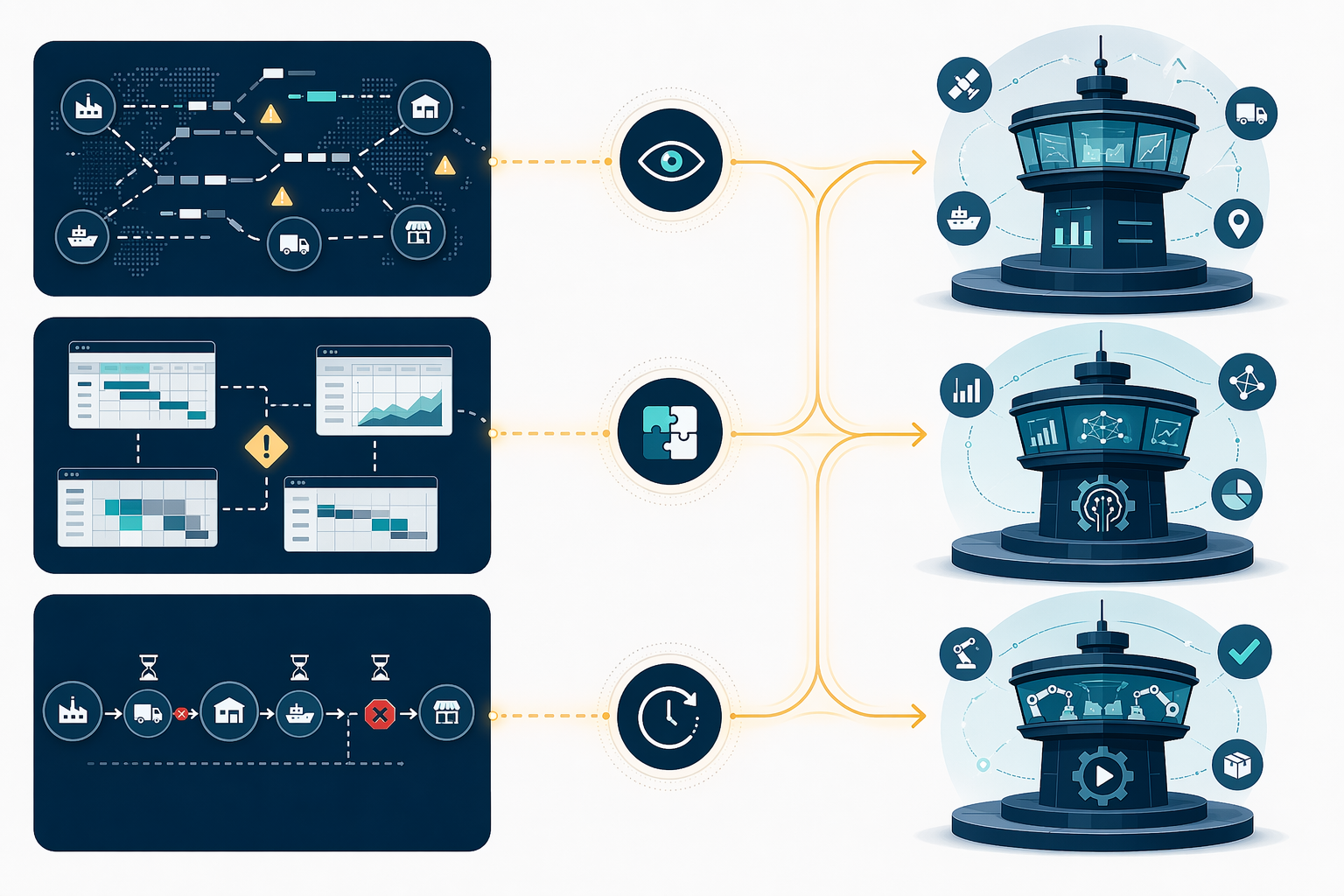
The cleanest way to avoid a mismatched control tower is to ask where the work is actually stuck. Not where the data is prettiest. Not which workflow looked most modern in the demo. Where the cycle time, rework, escalation, or service failure is being created.
- Choose visibility-led if teams lose time discovering shipment status, reconciling partner data, identifying exceptions, or understanding exposure across modes and customers.
- Choose planning-led if teams lose value before execution starts because scenarios are fragmented, tradeoffs are made late, or network and inventory decisions are not evaluated consistently.
- Choose execution-led if teams see the problem in time but action is delayed by manual routing, dispatch decisions, exception triage, or inconsistent operating rules.
- Be cautious with any model if the underlying master data, ownership rules, or cross-functional decision rights are too weak to support the workflow it promises.
The same incident can reveal different bottlenecks in different companies. A late inbound shipment may be a visibility problem if no one knew it crossed a risk threshold until the customer called. It may be a planning problem if the company had no viable supply alternative or inventory buffer decision. It may be an execution problem if everyone knew the risk early but no one rebooked, rerouted, resequenced, or notified the customer fast enough.
ROI Evidence Helps, But It Does Not Pick The Model For You
Broad ROI figures are useful for business-case sizing, but they are a poor substitute for bottleneck diagnosis. Accenture’s June 2023 control tower analysis says true supply chain control towers can reduce logistics costs by 3% to 5% and inventory by 5% to 15%.[2] That is a directional value range, not proof that a visibility-led, planning-led, or execution-led deployment will solve the same problem in the same way.
Deloitte reports delivering more than 20 control towers across five industries, generating more than $1 billion in client value, and describes one logistics program that achieved 212% ROI with a payback period under one year.[3] That is meaningful deployment evidence. It also reflects specific programs, scopes, operating changes, and client contexts; it should not be copied into a business case as if platform selection alone produced the outcome.
McKinsey-attributed statistics, cited by secondary sources, are also often used in AI supply chain business cases: AI-powered optimization is associated with 20% to 50% reductions in forecasting errors and logistics cost reductions of up to 15%.[4] Because the figures are appearing here through a secondary source rather than a directly verified original McKinsey publication, they are best treated as context for potential value, not as a model-selection rule.
The better ROI question is more operational: which manual step disappears, which decision moves earlier, which exception no longer waits for a person, which escalation path shortens, and which team stops maintaining a shadow spreadsheet because the official workflow finally works?
Where Hybrid Architectures Make The Choice Harder
Most mature supply chain technology stacks are hybrid. A company may use a visibility platform for carrier tracking, a planning suite for scenario modeling, a TMS for transportation execution, an order management system for customer promises, and an execution layer for routing or dispatch automation. The control tower may sit above these systems, inside one of them, or across several of them.
That does not make the three-model distinction irrelevant. It makes it more important. Hybrid architecture can hide the fact that the first funded phase still has to solve one primary operating problem. If the first phase is sold as visibility, planning, execution, collaboration, AI, orchestration, and resilience all at once, the implementation team will eventually have to decide which workflow goes live first. Better to make that decision before procurement.
Layered stacks also create handoff risk. Visibility alerts must feed planning or execution workflows. Planning recommendations must be translated into operating rules, inventory decisions, transportation constraints, or customer commitments. Execution automation must respect upstream plans and feed back what actually happened. The seams matter because that is where work falls back into email.
For readers already comparing functional depth inside a chosen architecture, ChainSignal’s article on the four functional clusters of a supply chain control tower is a better companion piece. This decision comes one step earlier: which layer deserves to lead?
The Practical Selection Rule
A supply chain digital control tower program should be selected against the bottleneck it is meant to remove.
- If the bottleneck is knowing what is happening across partners, modes, milestones, and customers, start with a visibility-led model.
- If the bottleneck is making better upstream tradeoffs before disruption reaches operations, start with a planning-led model.
- If the bottleneck is the speed and consistency of action once exceptions occur, start with an execution-led model.
Hybrid architectures are common, and many organizations will eventually need capabilities from more than one model. The first investment still needs a primary bottleneck to answer. Without that discipline, the control tower becomes another expensive layer of awareness, and the same people are left turning red exceptions into action by hand.
References
- 10 Best Supply Chain Control Tower Providers in 2026 — Locus
- Benefits of Supply Chain Control Tower Solutions — Accenture
- The Supply Chain Control Tower — Deloitte
- Supply Chain AI Statistics — Open Sky Group
Comments
Join the discussion with an anonymous comment.