
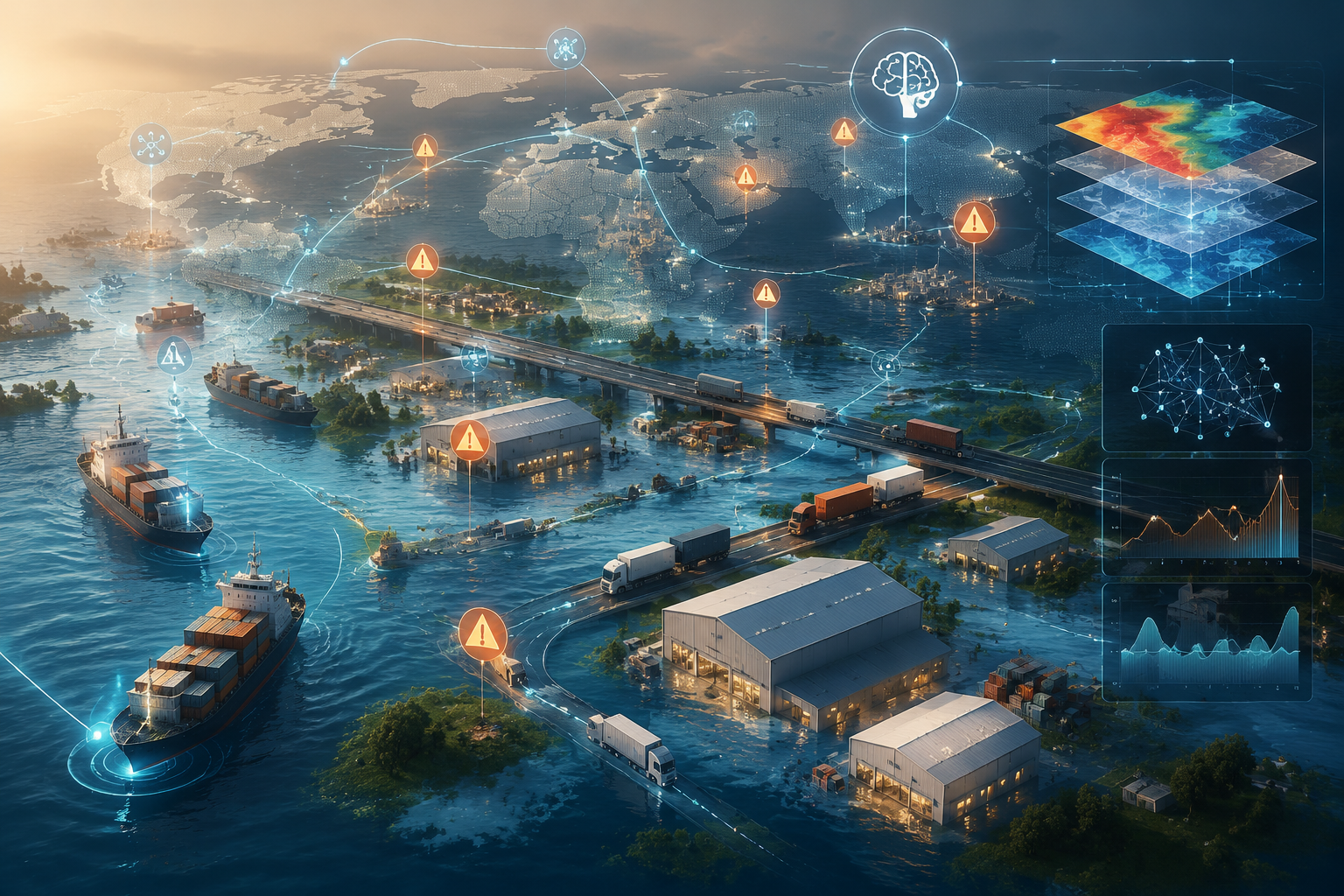
AI for flood-driven supply chain disruption is not one category. The market breaks into four jobs: flood forecasting, multi-tier supplier exposure, logistics rerouting, and digital twin simulation. That matters because supply chain software spend is projected to grow from $29 billion in 2023 to $62 billion in 2028, while 85% of supply chain risks still sit in tier 2-4 suppliers that manual mapping tends to miss.[1]
Four tiers, four jobs
| Tier | What it does | Representative examples | Best fit |
|---|---|---|---|
| Flood forecasting data | Provides flood outlooks that planning systems can ingest before disruption hits | Google Flood Hub, ClimateAi | Teams that need earlier warning and cleaner inputs |
| Multi-tier supplier risk mapping | Maps which suppliers, lanes, and regions sit inside the exposure zone | Everstream Analytics, Altana Atlas | Networks with opaque tier-2-plus sourcing |
| Logistics visibility and rerouting | Tracks shipments, exceptions, and route changes while freight is in motion | FourKites, project44 | Operations teams that can still reroute, expedite, or rebook |
| Integrated digital twin simulation | Tests scenario tradeoffs across inventory, capacity, and transport before action | Planning suites with simulation modules | Large networks with mature master data and planning discipline |
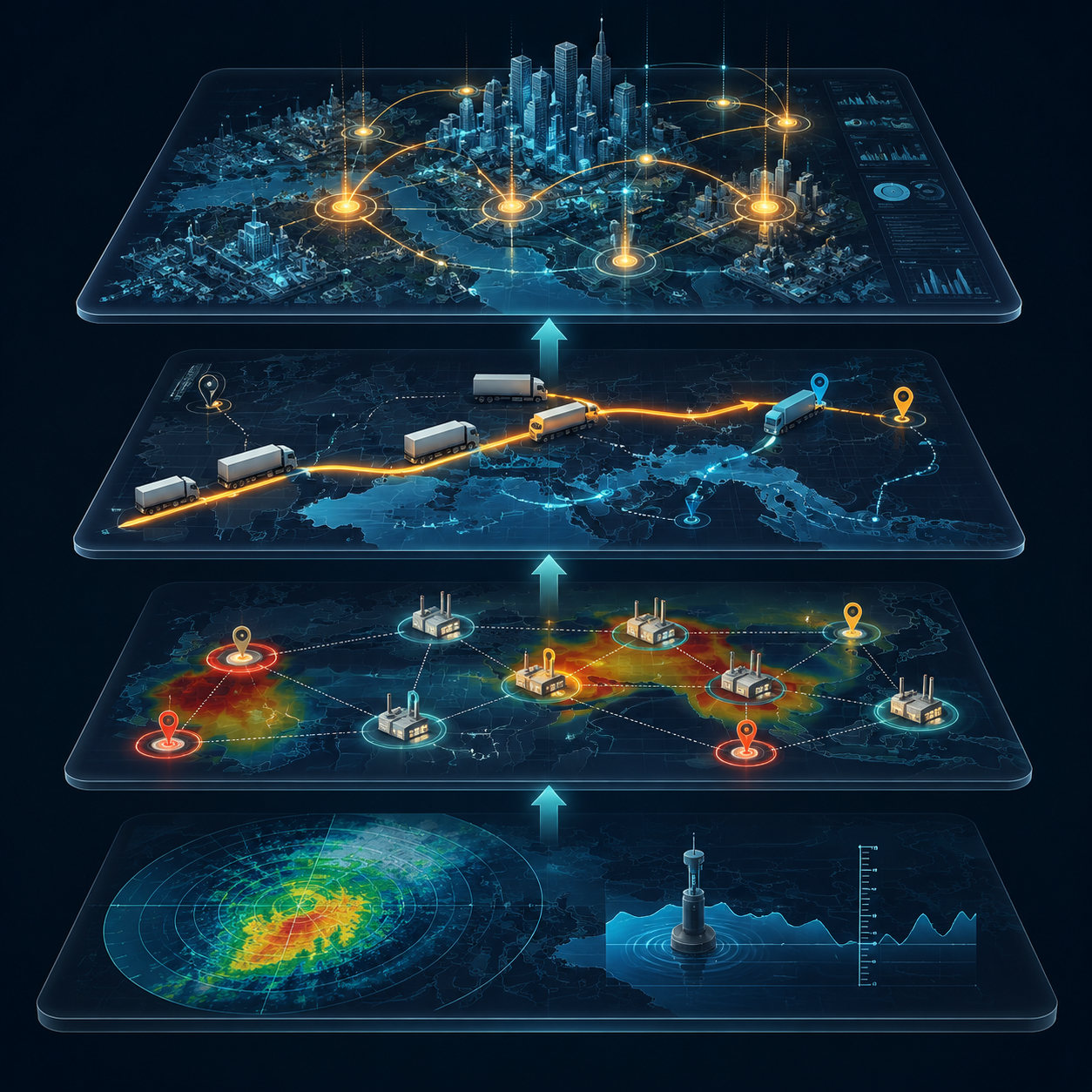
That table is the whole market in miniature. The tiers are related, but they are not interchangeable: a flood feed will not reroute a truck, and a rerouting engine will not discover that a supplier two steps upstream is hidden from your ERP view.
Tier 1: Forecasting data first
Google Flood Hub is the cleanest public baseline in this category: it offers open-access flood forecasts up to 7 days ahead across 80 countries, covering 460 million people.[2] For buyers, that matters because it is a data layer you can test against your own network without first signing a platform contract.
ClimateAi sits one layer higher. Its published case study says a roofing manufacturer used the platform to anticipate Hurricane Ian months in advance, adjust supply timing, and capture an additional $15 million in sales.[4] That is a single deployment, not a universal ROI claim, but it is still a better proof point than most flood demos ever show.
If the only problem is earlier warning, this tier may be enough. If the vendor is also promising to decide inventory, freight, and procurement actions for you, the conversation has already moved into a different tier.
Tier 2: Find what ERP views miss
The reason this tier exists is visibility debt. Foundation Capital’s cited Veridion data says 85% of supply chain risks sit in tier 2-4 suppliers, beyond manual mapping methods.[1] That is why supplier exposure tools matter more than weather dashboards once a buyer is dealing with a real network, not a slide deck.
Everstream Analytics is the most documented example in this bucket. Its materials report 50-70% faster time to identify and assess disruption impact, 5% lower expedited freight costs, 10% better on-time performance, 30% lower revenue losses from disruptions, and more than $2 million in annual savings for temperature-sensitive freight.[3] Those are vendor-reported results, so they should be read as strong signals of maturity rather than independent benchmarks.
Altana Atlas belongs in the same tier when the question is not "where will floodwater rise?" but "which upstream nodes are exposed, and how far does the blast radius extend?" If you are deciding whether to start with disruption planning or broader exposure mapping, the internal comparison in Which AI Capabilities Should You Invest in for Disruption Planning? is the better companion piece.
Tier 3: Move freight under pressure
FourKites and project44 are most useful when the alert has already fired and someone has to keep freight from turning into a delay cascade. The job here is live visibility, ETA drift, exception handling, and rerouting. In a flood event, this tier only pays off if planners actually have alternate routes, modes, or carriers to activate; otherwise the software just reports the damage faster.
This is also where the flood feed stops being abstract. If you want the mechanics behind that handoff, the real-time flood monitoring use case is the better lens than a generic risk overview.
Tier 4: Simulate the network, not just watch it
The digital twin tier is where the conversation finally becomes operational rather than diagnostic. These environments test what happens if a port closes, a linehaul lane is cut, or a supplier cluster goes offline, then let the team compare inventory buffers, reroutes, and source shifts before taking action.
This tier is not for teams that still need to clean up master data. ERP, TMS, WMS, supplier master, lane data, and override rules all need to be trusted enough that the simulation means something. For buyers already moving toward a control tower architecture, it is usually a layer in the stack, not a standalone answer.
The appetite for AI is real, though the flood use case still has to earn its keep. RELEX's 2026 survey says 67% of supply chain leaders report higher confidence in AI than in 2025, and 71% plan to invest in generative AI over the next 3-5 years.[5] Dataiku, citing BCG, says agentic AI represented 17% of total AI value in supply chains in 2025 and is projected to reach 29% by 2028.[6] For flood resilience, that should raise the standard for human override, not lower it.
What separates a fit from a mismatch
| Buyer check | What to ask | Common mismatch |
|---|---|---|
| Data coverage quality | Does the flood layer cover the actual countries, ports, inland corridors, and supplier regions we ship through? | A polished demo that only looks good in one region or on headquarters locations |
| Integration requirements | What can connect to ERP, TMS, WMS, and supplier master data without a long custom project? | A forecast that cannot reach planning workflows before the flood window closes |
| Human oversight | Who overrides the model when the road is technically closed but the local operator knows it is still passable? | Autonomy claims without a clear escalation path |
| Total cost of ownership | What is the real cost after data prep, integration, exception handling, and internal analyst time? | A subscription price that looks low until the implementation work starts |
Where the stack changes by geography
| Network profile | Starting stack | Why it usually fits |
|---|---|---|
| Monsoon-heavy or coastal manufacturing | Tier 1 plus Tier 3 | The first problem is early warning, then transport execution once routes start failing |
| Global sourcing with opaque upstream suppliers | Tier 1 plus Tier 2 | The main risk is not the flood alert itself; it is the hidden exposure in tier 2-4 suppliers |
| Port-centric distribution with flexible routing options | Tier 1 plus Tier 3 | Visibility and rerouting matter more than deep supplier simulation if alternatives exist |
| Large, process-mature planning organizations | Tier 1 plus Tier 4, sometimes with Tier 2 | Scenario testing only works when the underlying data is clean enough to trust |
The geography test is where the market stops being abstract. Southeast Asia, coastal Europe, and South American river or port corridors do not need a vendor that merely talks about resilience; they need a stack that can show flood coverage, supplier exposure, and rerouting logic in the same operating window. A free public feed like Flood Hub is often the best first check because it is transparent about where it works and easy to compare against the paid layer above it.[2]
The shortlist usually becomes sensible once the buyer stops asking for one vendor to cover the full problem. A better answer is a combination: a reliable flood feed, a mapping layer if supplier opacity is real, and a transport or simulation layer only if the organization can actually act on what it sees. If the internal answer to who overrides the model is still vague, the procurement is not ready for the most automated pitch yet.
References
- Shock-proofing supply chain with AI: a $62 billion opportunity — Foundation Capital
- Early warning of complex climate risk with integrated artificial intelligence — Nature Communications
- Artificial Intelligence's Role in Supply Chain Risk Management — Everstream Analytics
- Climate Risk: An Essential Element of Supply Chain Risk Mapping in 2026 — ClimateAi
- Supply chain AI in 2026: The numbers behind the hype — RELEX Solutions
- Supply chain AI trends 2026: building resilient operations — Dataiku
Comments
Join the discussion with an anonymous comment.