
For supply chain leaders buying AI hardware in Q3 2026, the uncomfortable question is no longer whether the CHIPS Act mobilized money. It did. The better question is whether that mobilization has become usable capacity: qualified wafers, advanced packaging slots, HBM supply, staffed ramps, and predictable allocation windows.
On the headline scorecard, the answer looks impressive. Semiconductor companies have announced more than $770 billion in private U.S. investments across more than 160 projects in 30 states, according to the Semiconductor Industry Association’s tracker updated in July 2026.[1] Commerce awards have also moved from press releases into contracts: GAO reported $33 billion in grants and $7.15 billion in loans across 52 awarded projects, with roughly 40% of projects targeting leading-edge logic relevant to AI.[2]
That is capital formation at a scale the U.S. semiconductor base had not seen in decades. It matters. It also does not mean the AI chip supply chain is resilient. Nearly 40% of projects were delayed to 2028 or later, only 24 of 161 milestones had been completed as of mid-2025, and only one leading-edge fab had been certified complete in the cited period.[2][3] A purchasing team cannot allocate against a future ribbon cutting. An AI product manager cannot ship against an award notice. Finance cannot treat an announced fab shell as a lower component price.

The Investment Scorecard Still Has a Throughput Problem
The distinction between announced investment and dependable supply is not semantic. It is the difference between a supplier telling procurement that capacity is “coming” and operations knowing which quarter it can book, qualify, and consume parts at volume.
The SIA tracker captures the breadth of private-sector commitment: more than 160 projects spread across 30 states and more than $770 billion in investment announced from 2020 through July 2026.[1] That figure is best read as a mobilization signal, not a supply guarantee. It includes investments catalyzed by the policy environment, not exclusively funded by CHIPS Act awards, and many projects remain in phases that do not yet change procurement options.
The GAO data is less theatrical and more useful for allocation planning. Awards through the reporting period covered 52 projects, $33 billion in grants, and $7.15 billion in loans.[2] But the operational evidence is thinner: 24 completed milestones out of 161 and one certified leading-edge fab as of mid-2025.[2] That ratio is what belongs in the risk committee packet. It says the policy has created a pipeline, while the pipeline has not yet become broad-based semiconductor resilience.
| Signal | What it measures | What it does not prove |
|---|---|---|
| $770B+ in private investment | Capital commitment across the U.S. semiconductor ecosystem | Near-term availability of AI accelerators, HBM, or packaging capacity |
| 52 awarded projects | Federal award activity moving into contracted projects | Completed ramps or qualified output |
| 24 of 161 milestones completed | Execution progress against reported project milestones | That most funded capacity is ready for procurement use |
| Nearly 40% delayed to 2028 or later | Timing risk in the project pipeline | That constraints will ease on a 2026 planning horizon |
This is where discussions of the CHIPS Act, AI, and semiconductor supply chains often go wrong. “More fabs” becomes shorthand for “more AI chips,” and the shorthand hides the handoffs that actually decide availability. Wafer starts matter, but AI accelerators also need advanced process capacity, reticles, substrates, interposers, HBM stacks, advanced packaging, test, qualified yield, and customer-specific allocation decisions. A fab announcement does not clear all of those gates.
For readers tracking where semiconductor money is being committed by geography and segment, ChainSignal’s earlier analysis of AI chip supply chain investment trends is still the better map. This scorecard is narrower: whether the investment has changed the dependable supply picture for AI hardware buyers. So far, the answer is uneven at best.
AI Demand Breaks the Usual Capacity Story
In a normal semiconductor cycle, new capacity eventually softens tightness across a broader market. AI has made that assumption less reliable because the demand profile is severely skewed. Deloitte’s 2026 outlook estimates that AI chips account for roughly half of semiconductor revenue while representing less than 0.2% of unit volume.[4] That is not a rounding error. It is a structural reallocation of attention, wafers, engineering capacity, packaging priority, and memory supply toward a tiny number of very high-value devices.
The consequence is that supply chain stress does not remain confined to the flagship accelerator market. When the highest-margin AI devices absorb scarce leading-edge and packaging resources, other buyers do not simply wait in a neat queue. They see longer commitments, tougher allocation conversations, and price pressure in adjacent components. Deloitte reported that DDR4 and DDR5 prices rose about fourfold from September to November 2025, with another roughly 50% increase projected through the first half of 2026.[4]
That memory price spike matters because it shows how the AI buildout can transmit scarcity beyond the parts with the most investor attention. A procurement team may not be buying the most advanced GPU package directly. It may still inherit the consequences through server BOMs, industrial compute modules, networking equipment, or memory contracts whose suppliers are reprioritizing capacity around AI demand.
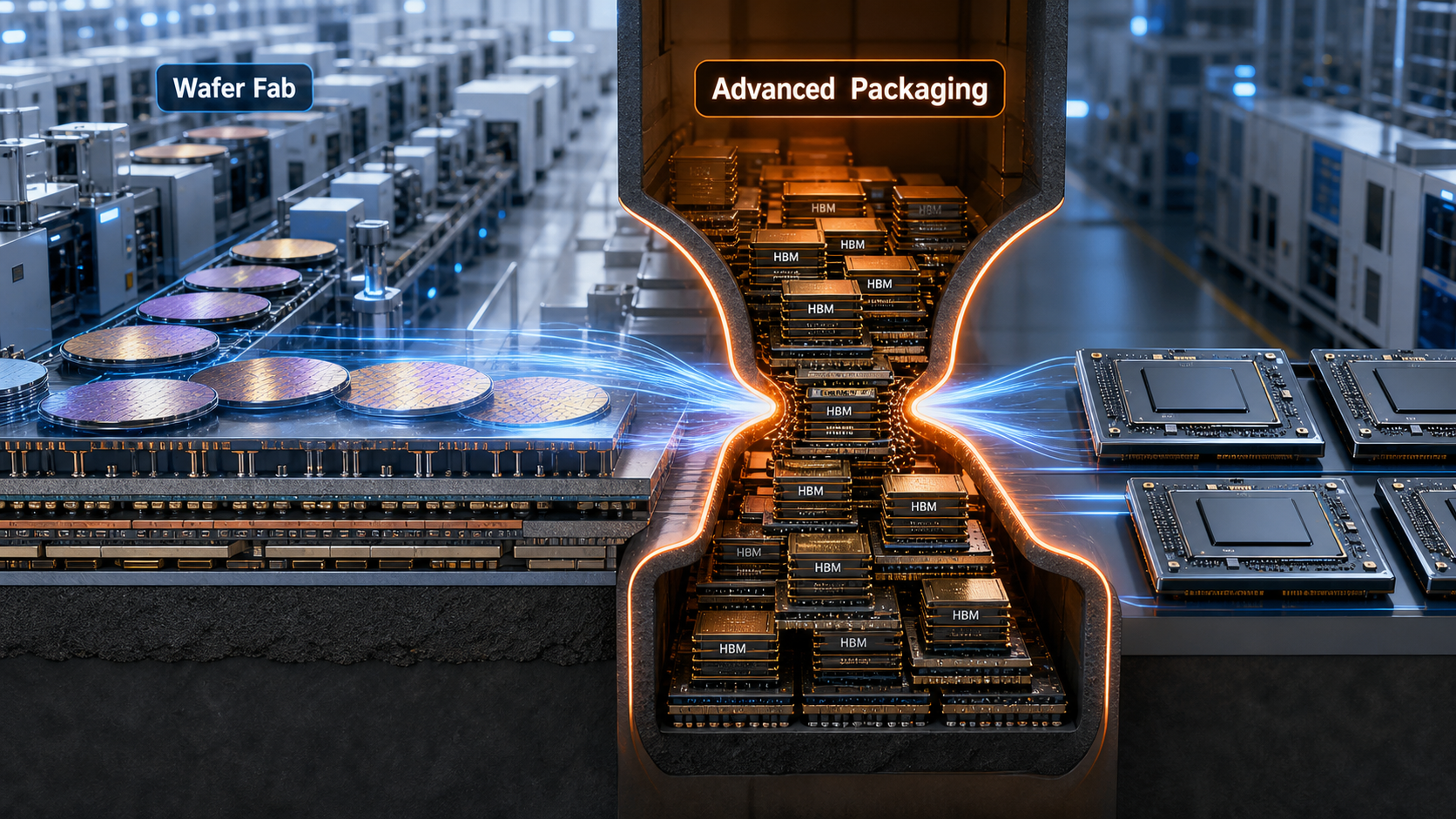
The binding constraint is often not the wafer fab alone. Advanced packaging and high-bandwidth memory decide how many finished AI accelerators can actually leave the system. Enki AI’s 2026 supply chain risk guide identifies advanced packaging and HBM as persistent bottlenecks, while Deloitte expects HBM shortages to extend beyond 2026.[3][4] Micron has also described the AI memory environment as “unprecedented,” and ChainSignal’s coverage of Micron’s AI memory supply constraints is a useful companion for the vendor-level evidence.
This is why an AI chip buyer can look at a domestic fab buildout and still have no relief in the quarter that matters. If packaging slots are scarce, HBM is committed, or qualification is still pending, wafer capacity alone does not convert into shippable accelerators. The supply chain does not fail at the most glamorous step. It fails at the constrained step.
The Bottlenecks Are Operational, Not Just Strategic
The long-cycle strategic case for the CHIPS Act is still legitimate. The U.S. share of global semiconductor manufacturing fell from about 40% in 1990 to roughly 12% today, and policy discussions have framed 20% by 2030 as a target.[5][2] Rebuilding a manufacturing base from that position was never going to be a two-year procurement fix.
But boards approve product roadmaps on nearer horizons than national industrial recovery. An OEM waiting on AI inference modules, an EMS provider negotiating server allocations, or a cloud hardware team locking next-generation accelerator supply does not experience the CHIPS Act as a strategic arc. It experiences the program through schedule risk, supplier leverage, qualification delays, and escalation calls.
Labor is one of the less photogenic constraints, and one of the more consequential. New fab capacity requires process engineers, technicians, construction specialists, maintenance talent, and managers who can turn facilities into repeatable yield. The Conference Board reported that 40 CHIPS office staff were laid off in March 2025, about one-third of the office.[6] That does not by itself prove award execution will fail. It does mean the administrative side of an already complex ramp has less margin for slippage.
The manufacturing labor problem and the government execution problem are different, but they converge in the same place: delayed usable output. A fab can be funded and still struggle to staff a ramp. A project can be awarded and still wait on milestone reviews, environmental steps, tooling readiness, or customer qualification. The buyer only sees the result when a promised allocation window becomes conditional.
That is the practical reason milestone completion deserves more attention than aggregate grant totals. Grant dollars announce intent. Milestones show whether intent is passing through the system.
What Has Become More Dependable?
Some things have become more dependable, though not always in the way buyers want. The U.S. now has a clearer pipeline of semiconductor projects, stronger private commitment, and a policy-backed basis for supplier conversations. For supply chain leaders, that can improve long-term visibility. It gives procurement a more concrete set of supplier roadmaps to interrogate and gives executives a better basis for deciding where to support qualification, prepayment, or dual-sourcing work.
The Act has also changed the tone of some supplier negotiations. Domestic capacity is no longer a vague aspiration; it is a funded and partially awarded pipeline. That matters for sectors with longer qualification cycles, defense or regulated requirements, and buyers willing to co-develop supply over several years. The problem is that AI hardware procurement is being judged on a faster clock than many of these projects can meet.
The dependable part, then, is the direction of investment. The undependable part is the conversion rate. Supply chain leaders can reasonably expect more domestic semiconductor capability later in the decade. They should not translate that expectation into relaxed 2026 or 2027 assumptions for advanced AI packages, HBM-backed accelerators, or memory-sensitive server BOMs.
Where Procurement Risk Remains Concentrated
The highest-risk procurement conversations are no longer only about whether a supplier has wafer capacity. They are about whether the supplier can secure the full stack of constrained inputs and process steps needed to ship an AI system. That includes HBM allocation, advanced packaging access, substrate availability, test capacity, and the internal priority given to one customer’s demand over another’s.
Deloitte projected global semiconductor sales of $790 billion in 2025, up 25.6%, and $975 billion in 2026.[4] Moody’s also pointed to ongoing supply chain bottlenecks in its 2026 semiconductor outlook.[7] Growth at that scale can hide operational fragility. Revenue can rise while the parts a specific buyer needs remain unavailable, repriced, or locked behind allocation commitments.
The zero-sum nature of AI capacity allocation is the key procurement issue. When AI chips represent about half of industry revenue with less than 0.2% of unit volume, suppliers have an obvious incentive to favor the most profitable AI programs.[4] That does not mean every non-AI buyer loses supply. It means buyers in automotive, industrial, medical, networking, and consumer electronics need to assume that priority rules have changed.
ChainSignal’s earlier article on how the AI chip boom is reshaping semiconductor supply through 2028 is useful here because the issue is not simply shortage. It is reallocation. Capacity that exists on paper can become effectively unavailable if a buyer is on the wrong side of supplier prioritization.
The Board-Level Implication
The CHIPS Act has improved investment momentum. It has not yet delivered near-term semiconductor resilience for AI-dependent supply chains. That distinction should shape how boards and executive teams handle product commitments, supplier concentration, and capital plans.
A responsible 2026 plan does not assume domestic self-sufficiency arrives in time to clear the bottleneck. It treats chip availability as a strategic constraint alongside capital allocation, roadmap timing, customer commitments, and revenue risk. If a product launch depends on a scarce accelerator, HBM-backed module, or packaging slot, that dependency belongs in the same conversation as market demand and engineering readiness.
The practical posture is not pessimism. It is discipline. Procurement should know which suppliers control the constrained packaging path, which memory commitments are firm rather than forecast, which domestic projects have completed meaningful milestones, and which customer promises require executive-level allocation protection. The CHIPS Act may improve the supply base over the long cycle. It does not remove the need to manage advanced packaging, HBM, and skilled ramp execution as prolonged constraints.
References
- Semiconductor Supply Chain Investments, Semiconductor Industry Association, updated July 2026.
- GAO-26-107882, U.S. Government Accountability Office, December 2025.
- AI Chip Supply Chain Risk 2026 Guide, Enki AI.
- 2026 Global Semiconductor Industry Outlook, Deloitte.
- The CHIPS Act: What it means, PwC.
- Talent gap and CHIPS office layoff data, The Conference Board.
- Semiconductors in 2026, Moody’s.
Comments
Join the discussion with an anonymous comment.