
For anyone measuring the Boeing 737 MAX supply chain impact, the uncomfortable lesson is not only that a design decision and a regulatory process failed. It is that a production network spread across more than 65 countries, with roughly 3 million parts in each aircraft, still left decision-makers with too little reliable visibility into where operational risk was accumulating below Tier 1.[1]
That is the part procurement and supplier quality teams recognize immediately. A supplier can be contractually accountable and still sit on top of a sub-tier chain no one has mapped well enough. A buyer can have a quarterly business review deck and still miss a rising pattern of purchase-order churn, late deliveries, quality escapes, or financial stress two tiers upstream. The dashboard may look orderly until a shortage meeting proves it was mostly showing the part of the network already known.
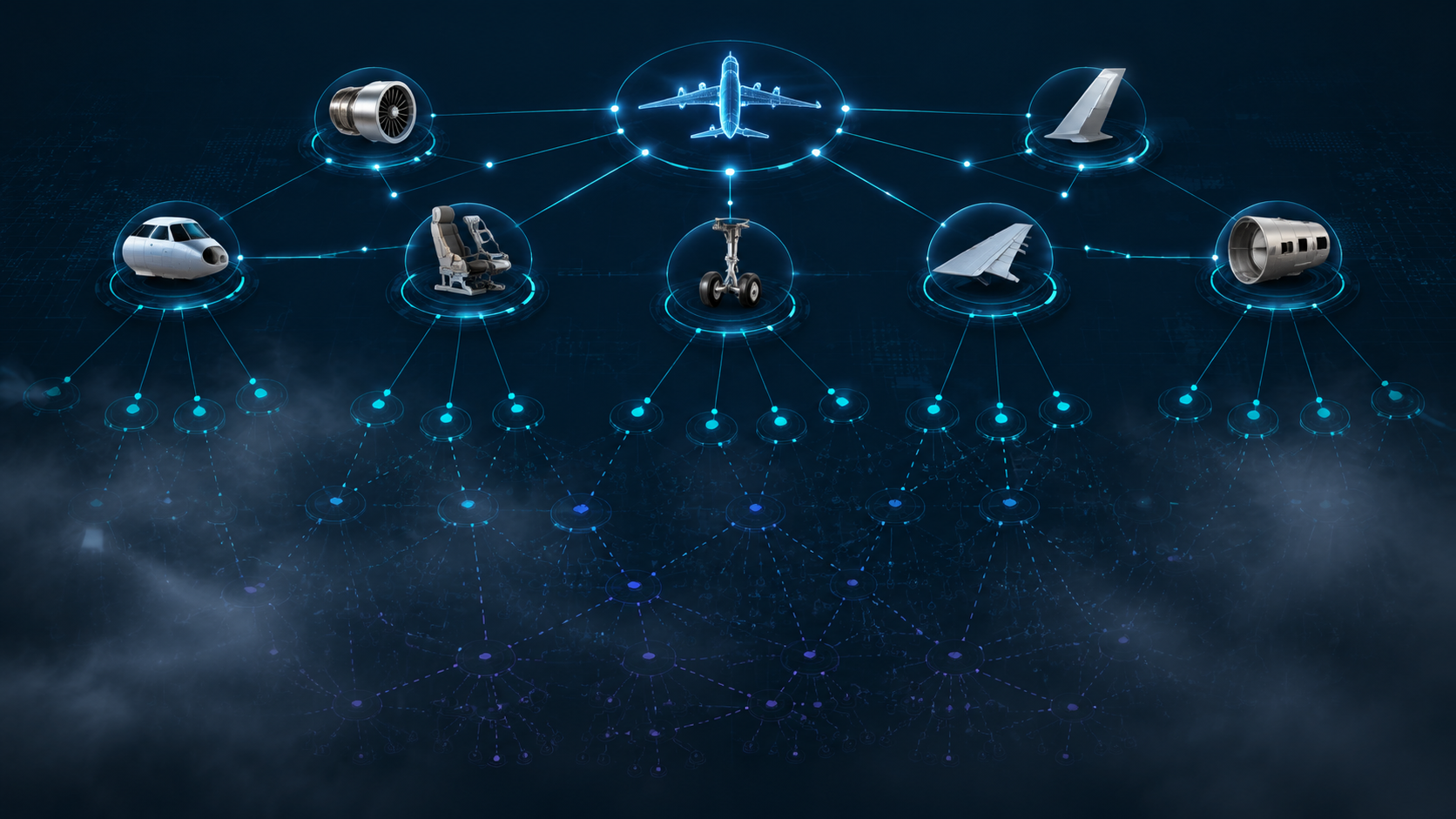
The 737 MAX story made that gap more than theoretical. Boeing’s reliance on Spirit AeroSystems as a sole-source fuselage supplier created a concentration exposure that could be described in a sourcing file, but that does not mean the broader operational implications were continuously scored, stress-tested, and escalated. State of Flux has argued that an AI-based diversification or concentration-risk analysis could have flagged this single point of failure years before the door-plug incident.[2] That is a narrower claim than saying AI would have prevented the crisis. It is also the more useful claim.
The Blind Spot Was Below the Contract Line
Traditional supplier management is often strongest where the commercial relationship is cleanest: Tier 1 performance, contracted delivery dates, corrective action reports, and scorecards for suppliers the OEM directly manages. The 737 MAX supply chain exposed the weakness of that model in a highly outsourced aerospace program. The risk was not just whether a named supplier was important. It was whether the organization could see how that supplier’s own dependencies, quality systems, capacity constraints, and delivery behavior were changing.
The practical visibility questions are blunt:
- Where does a sole-source part, process, or assembly create a true single point of failure?
- Which suppliers are repeatedly changing purchase orders, missing delivery commitments, or asking for schedule relief?
- Which quality nonconformance patterns are starting upstream before they become a line-stop event?
- Which sub-tier suppliers are exposed to labor disputes, financial distress, geopolitical disruption, or regulatory pressure?
- Which supplier relationships are invisible because they are not in the ERP vendor master, the contract repository, or the category manager’s working file?
Those questions are not answered by asking Tier 1 suppliers to self-report risk once a quarter. They require a live model of evidence. That is where AI supplier risk scoring becomes relevant: not as a procurement fashion term, but as a way to connect weak signals that normally sit in different systems, different functions, or outside the company entirely.
What an AI Risk Score Would Actually Combine
The useful version of AI supplier risk scoring is not a black-box number that tells a procurement director to worry. It is a scored explanation of why a supplier, part family, facility, region, or sub-tier dependency has moved into a different risk band.
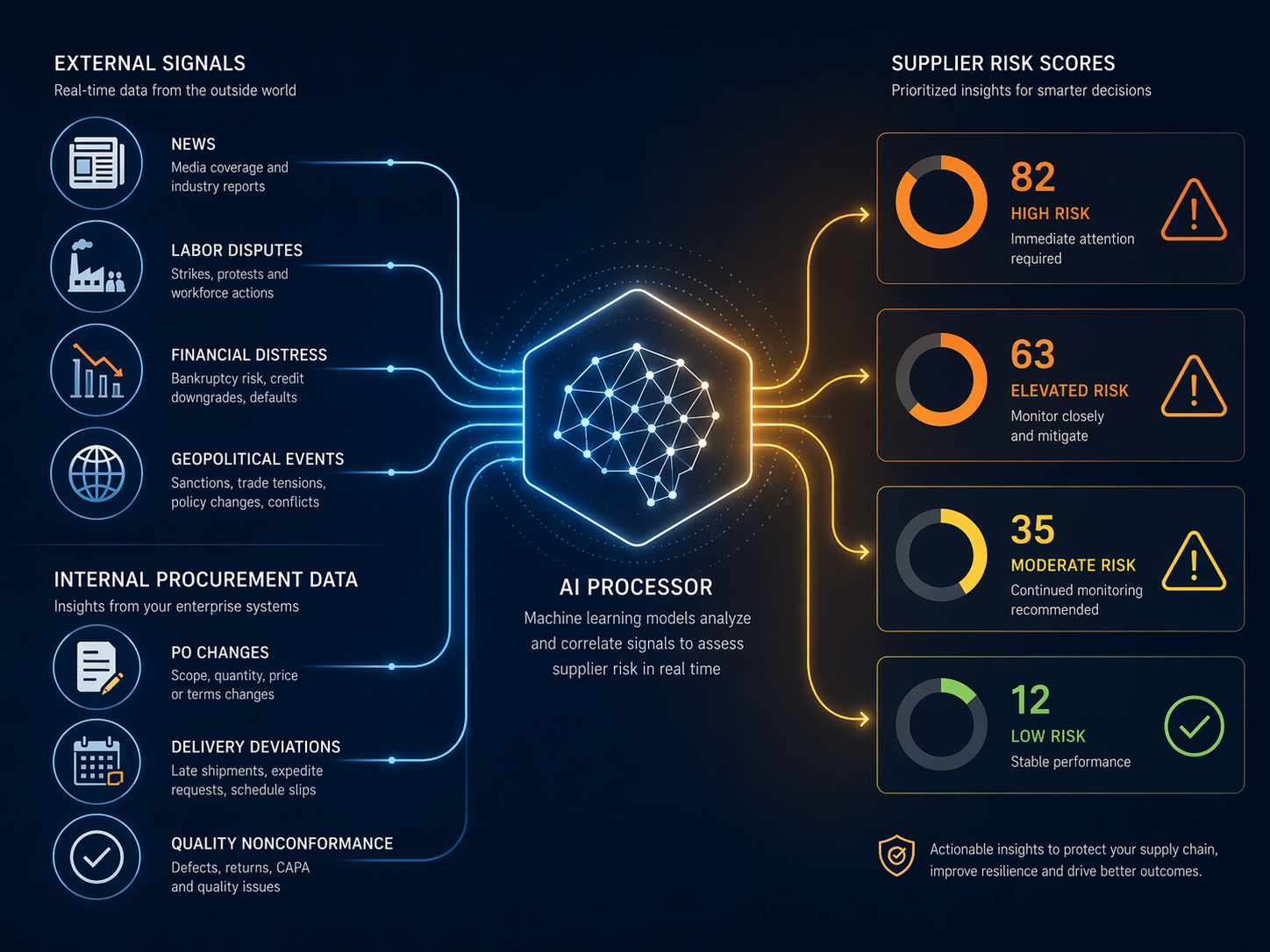
In an aerospace setting, the external stream can include labor disputes, financial distress signals, geopolitical events, sanctions exposure, natural-disaster alerts, facility-level news, and other public indicators. The internal stream is just as important: purchase-order change frequency, delivery deviations, expedite activity, late acknowledgments, inspection results, quality nonconformance rates, corrective action aging, and engineering-change disruption.
The point is not that any one signal proves a coming failure. A supplier with a delivery deviation may be recovering. A news alert may be irrelevant to the plant that makes the part. A PO change may be driven by the OEM, not the supplier. The value comes when the system connects signals that a human review cadence would usually separate: the same supplier has rising PO changes, more delivery slippage, a worsening quality pattern, and a sub-tier facility in a region with a new disruption.
| Risk Signal | Why It Matters In A 737 MAX-Type Network | What AI Adds |
|---|---|---|
| Sole-source exposure | A critical assembly or process depends on one supplier relationship. | Ranks concentration risk across parts, assemblies, facilities, and sub-tier links. |
| Purchase-order change frequency | Repeated changes can indicate instability in planning, capacity, or requirements. | Detects abnormal change patterns before they appear as shortages. |
| Delivery deviations | Late or inconsistent shipments create schedule risk that may compound across assemblies. | Connects supplier behavior to part criticality and production impact. |
| Quality nonconformance | Defects and escapes can become shortage drivers when rework, inspection, or containment absorbs capacity. | Surfaces upstream quality patterns across suppliers, parts, and plants. |
| External disruption | Labor, financial, geopolitical, or regulatory events can hit sub-tier suppliers before Tier 1 performance changes. | Links public signals to mapped supplier relationships and affected commodities. |
This is also why AI network mapping for aerospace suppliers belongs in the same conversation as risk scoring. A score is only as useful as the network it is scoring. If the model sees Tier 1 and misses the sub-tier supplier that owns a constrained process, the organization has automated the old blind spot.
The Shortage Evidence Is Useful Because It Is Specific
The best evidence for AI supplier risk scoring in aerospace is not a broad promise that predictive analytics improves resilience. It is a set of narrower reported outcomes showing that early-warning signals can reduce shortages and expand what the organization can see.
McKinsey reported that one aerospace OEM reduced component shortages by about 25% using an AI early-warning system that monitored signals including purchase-order change frequency and delivery deviations.[3] That figure should not be treated as an industry-average ROI claim. It is a single-company result. But it is still highly relevant because the monitored signals are exactly the kind that become visible before a shortage is formally declared.
The same McKinsey analysis reported that quality nonconformance was the root cause of more than 30% of part shortages at one U.S. aerospace manufacturer.[3] That detail matters. In many shortage reviews, the conversation starts too late, after materials are already missing. If quality nonconformance is a major shortage driver, then supplier risk scoring cannot be limited to financial health, country risk, or delivery performance. It has to ingest quality data and show where defects, escapes, containment actions, or corrective action delays are starting to threaten availability.
That is the operational difference between a performance dashboard and an early-warning system. A dashboard may show a supplier went red last month. An early-warning model should show that a critical component family is drifting toward shortage because PO changes are rising, delivery deviations are worsening, and quality nonconformance is clustering around a constrained supplier process.
Visibility Expansion Is a Separate, Harder Win
Shortage reduction is one type of evidence. Network discovery is another. EY reported that a defense contractor expanded visible supplier relationships from about 15,000 to about 500,000 using AI-driven supply chain mapping tools, a roughly 33x expansion.[4] Again, this is not proof that every aerospace company will find the same multiplier. It is proof that the starting inventory of known supplier relationships can be dramatically incomplete.
That matters for any procurement leader using the Boeing case to justify investment. The business case should not say only that AI predicts risk better. It should say the organization may not even know enough of the supplier network to run a credible risk process. If the known map contains 15,000 relationships and AI-supported discovery finds hundreds of thousands more, the problem is not dashboard usability. The problem is that risk governance has been operating on an incomplete map.
The defense contractor example also shows why sub-tier mapping and risk scoring should not be bought as isolated projects. Mapping without scoring produces a larger diagram. Scoring without mapping produces confident analysis on an incomplete network. The useful operating model connects both: discover relationships, attach parts and facilities where possible, enrich them with external signals, and compare those signals against internal procurement and quality behavior.
What Would Have Been More Visible Earlier
Applied to a 737 MAX-type supply chain, AI supplier risk scoring would not rewrite engineering decisions or regulatory oversight. It would give sourcing, quality, and operations teams a better chance to see operational fragility before it hardens into crisis.
The first earlier signal is concentration. A model can rank assemblies and processes by sole-source dependency, lack of qualified alternates, regional clustering, and recovery difficulty. Spirit AeroSystems’ role as a sole-source fuselage supplier is the obvious example from the Boeing discussion.[2] The useful output would not be a generic “high risk” label. It would be a prioritized list of where dual sourcing is impossible, where contingency inventory is insufficient, where qualification lead times are long, and where executive acceptance of the exposure needs to be explicit.
The second signal is instability. Purchase-order changes and delivery deviations rarely look dramatic one at a time. In aggregate, they can show that planning assumptions are deteriorating. McKinsey’s aerospace OEM case is important because it ties shortage reduction to precisely those signals rather than to a vague risk score.[3]
The third signal is upstream quality pressure. If quality nonconformance caused more than 30% of part shortages at one U.S. aerospace manufacturer, then supplier quality data belongs near the center of any risk model, not in a separate corrective-action workflow reviewed after the supply plan has already failed.[3] This is where an internal link to AI supplier quality monitoring in recall prevention is relevant even outside aerospace: the mechanism is different by industry, but the warning pattern is familiar.
The fourth signal is external exposure. Labor disputes, financial distress, geopolitical events, and regulatory actions often appear outside procurement systems first. They become operationally useful only when mapped to actual suppliers, facilities, parts, and programs. A strike alert is not a supply chain insight until the system can show which supplier site, sub-tier dependency, or production schedule is exposed. The same logic applies to AI strike response planning and to regulatory-risk monitoring in defense supply chains.
The Buying Decision Should Start With Data Readiness
The case for AI supplier risk scoring is strong enough to pilot. It is not strong enough to ignore implementation reality. In complex manufacturing, the obstacles are rarely limited to model performance. They begin with data ownership, supplier participation, and whether the organization is prepared to act on risk signals that cut across sourcing, quality, engineering, and operations.
Data quality is the first gate. Supplier names do not match across ERP, quality, logistics, contract, and engineering systems. Part numbers may be duplicated, superseded, or managed differently by business unit. Facility-level supplier information is often weaker than legal-entity-level information. If the model cannot connect a nonconformance trend to the supplier site and part family that matter, the score may be technically impressive and operationally thin.
Supplier onboarding is the second gate. Sub-tier visibility often requires suppliers to share relationships they consider commercially sensitive. Some will resist. Some will provide incomplete data. Some will participate only if the OEM makes the requirement part of a broader governance process rather than a one-time data request. AI can infer and enrich relationships from external sources, but inferred links still need confidence levels, validation workflows, and escalation rules.
Organizational readiness is the third gate. A risk score that no one owns becomes another ignored alert. Procurement may see concentration risk, supplier quality may see nonconformance, operations may see schedule impact, and engineering may control qualification of alternates. The operating model has to specify who reviews the signal, who can require supplier action, who funds mitigation, and when an executive decision is needed because the exposure was deliberately accepted.
Boeing’s own AI direction is worth noting here, but carefully. Boeing said its GenAI Academy trained 8,000 employees, including on AI for supply chain applications, in a December 2025 corporate publication.[5] That signals organizational readiness work and a stated strategic interest in applying AI. It does not independently prove Boeing has solved supplier risk visibility, and it should not be cited as evidence that any specific AI control would have prevented a 737 MAX failure.
A Practical Business Case After the MAX Crisis
The cleanest business case does not claim that AI explains every Boeing failure in hindsight. It claims that a 65-country, 3-million-parts-per-aircraft network cannot be governed responsibly with Tier 1 visibility alone.[1] It claims that sole-source exposure, sub-tier opacity, quality nonconformance, delivery deviation, and PO volatility are measurable signals. It then asks whether the company can detect those signals early enough to change a sourcing, quality, inventory, qualification, or recovery decision.
The reported aerospace evidence is already enough to frame a disciplined pilot: one OEM reduced component shortages by about 25% using AI early-warning signals, one U.S. aerospace manufacturer found quality nonconformance behind more than 30% of shortages, and one defense contractor expanded visible supplier relationships from about 15,000 to about 500,000 through AI-driven mapping.[3][4] Those are not universal guarantees. They are credible proof points for a use case that has moved beyond theory.
For procurement and risk leaders, the hard question is therefore not whether AI can make supplier risk look more sophisticated. It is whether the organization is willing to expose dependencies early, assign accountability before a shortage meeting, and treat sub-tier visibility as an operating control rather than a presentation layer. AI supplier risk scoring earns its place when it makes that control more complete, more timely, and harder to ignore.
References
- Boeing 737 MAX, OEC, 2024.
- Boeing & Aviation, State of Flux, 2024.
- Addressing continued turbulence: The commercial-aerospace supply chain, McKinsey, 2024.
- How can digital supply chains help manage aerospace risk, EY, 2024.
- Shaping AI for the sky, Boeing Innovation Quarterly, Dec 2025.
Comments
Join the discussion with an anonymous comment.