
The hard part of AI satellite supply chain logistics at Amazon Kuiper, now Amazon Leo, is not making a dashboard look modern. It is making satellite production visible early enough that a quality issue, machine fault, or cycle-time drift does not travel quietly from one workstation into the next. A mega-constellation factory has little patience for the traditional aerospace rhythm of finding problems after a long build interval, convening a review, and working backward through handoffs.
Kuiper’s manufacturing goal explains why. Amazon has described a full-rate production target of up to five satellites per day, with its Kirkland, Washington factory designed around high-volume satellite manufacturing rather than one-off spacecraft assembly.[1] The same production system depends on a broader material flow: Amazon opened a 184,000-square-foot Everett logistics center as the single point of entry for externally procured Kuiper materials, and the program had more than 190 suppliers in Washington state alone.[2] Those facts are not interesting because they make the supply chain sound large. They are interesting because every late part, process deviation, and engineering change has more chances to collide with takt time.
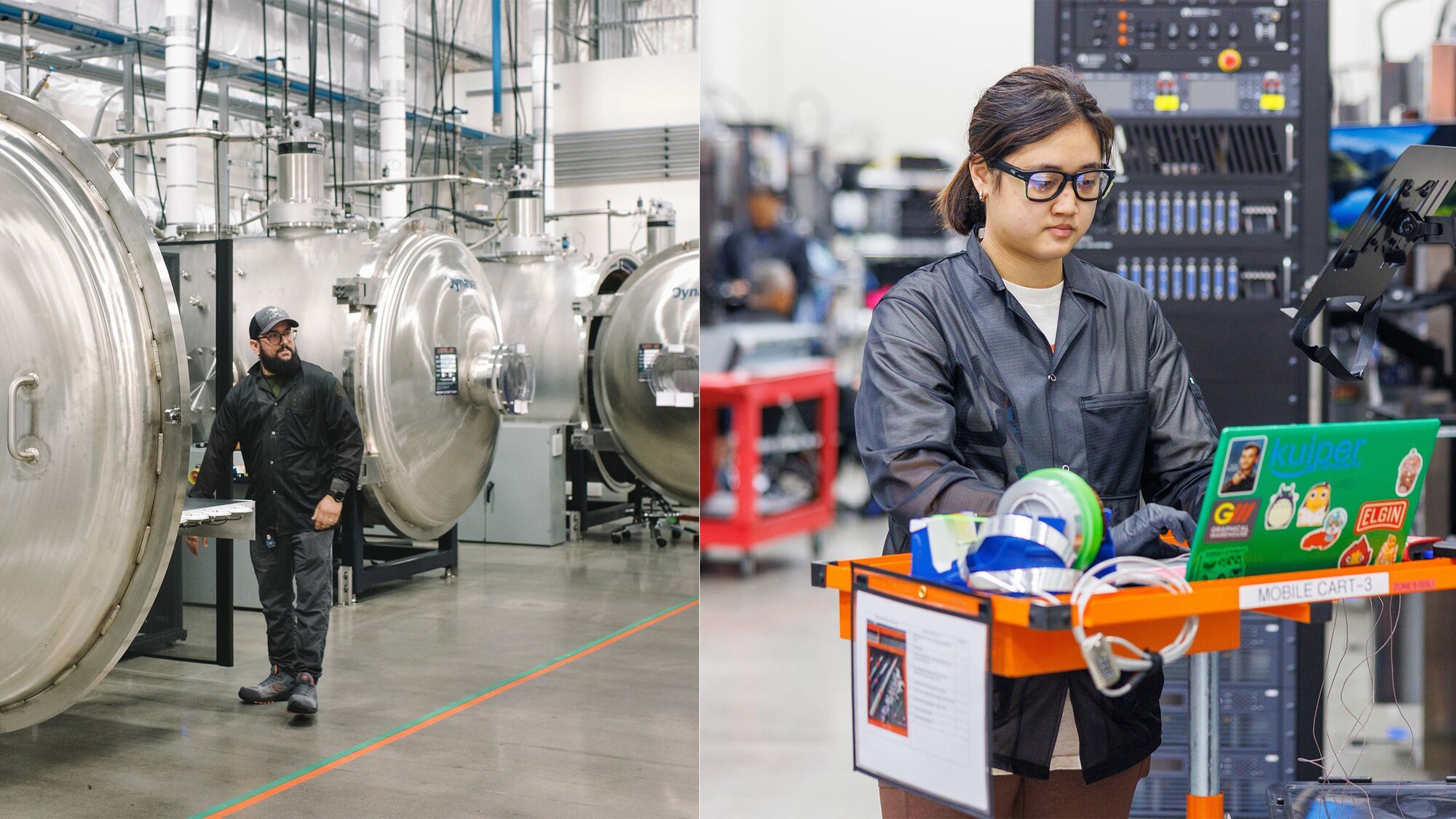
That is the useful way to read Amazon’s AWS IoT SiteWise case study on Kuiper production. The case is not proof that every satellite manufacturer can buy a platform and get the same result. It is a concrete example of how an aerospace factory can connect machine data, operational dashboards, and management reporting tightly enough to improve Overall Equipment Effectiveness, reduce unplanned downtime, cut scrap and rework costs, and identify bottlenecks. AWS published the case, and AWS is also the platform provider, so the claims need to be kept inside their public evidence boundary. Still, the implementation pattern is specific enough to examine.
Why Kuiper’s Factory Problem Is Different
Traditional satellite production often tolerates long feedback loops because the product volume is low and the engineering content is high. That does not mean the work is casual; it means the operating model was built around deep reviews, specialized labor, and tightly controlled exceptions. A constellation factory trying to build satellites repeatedly, at a much higher cadence, has a different failure mode. The factory can still be precise, but it cannot depend on late discovery.
Amazon’s own production context points in that direction. Its Kirkland factory is co-located with Redmond research and development operations, and Amazon has said that this arrangement helped reduce satellite test time from months to days.[1] That compression is valuable only if production feedback is fast enough to support it. When a CNC machine begins drifting, a fixture adds avoidable variation, or a workcell starts missing expected cycle time, the cost is not confined to one part. The hidden cost is the queue of downstream work that continues behaving as if nothing has changed.
This is where near real-time monitoring matters. In many factories, “real time” means the data technically exists before anyone with authority can use it. Kuiper’s AWS case is more practical: it shows a layered architecture meant to collect data on the factory floor, decide what needs immediate visibility, preserve what needs historical analysis, and put the right metrics in front of operators, engineers, and managers.
What Kuiper Actually Monitored
The AWS case study centers on CNC machining and assembly operations. Kuiper uses AWS IoT SiteWise to collect CNC machine data in near real time, with Overall Equipment Effectiveness as the primary KPI.[3] That choice matters. OEE is not a vague “factory health” score. It pushes attention toward whether equipment is available, whether it is performing at the expected rate, and whether the output meets quality expectations.
The visible metrics in the Kuiper implementation include OEE, defect rates, cycle times, and overall throughput efficiency.[3] Those are ordinary manufacturing measures, but their usefulness depends on timing and context. A defect rate found in a weekly report may support a corrective action. A defect rate visible while the same condition is still active can stop a bad run from becoming a batch of scrap.
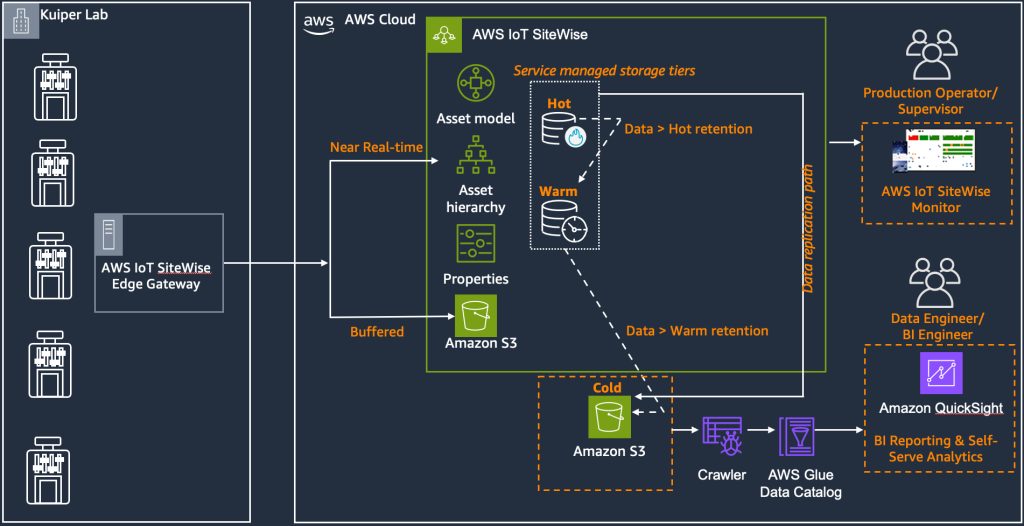
The architecture is worth slowing down over because it is the part other aerospace manufacturers can actually compare with their own plants. Kuiper did not simply push all factory data into a cloud warehouse and hope analytics would happen later. AWS describes an on-premises collection layer using AWS IoT SiteWise Edge, followed by selective forwarding to the cloud through both streaming and buffered ingestion paths.[3]
| Layer | What It Does In The Kuiper Case | Why It Matters Operationally |
|---|---|---|
| IoT SiteWise Edge | Collects factory-floor data on premises from CNC and assembly operations | Keeps machine data close to the process and supports faster local visibility |
| Streaming path | Feeds near real-time operational monitoring | Helps teams see downtime, cycle-time drift, and defect signals while action is still possible |
| Buffered ingestion path | Moves selected data for cloud processing in a more cost-aware way | Avoids treating every data point as equally urgent or equally expensive |
| SiteWise Monitor | Displays dashboards for OEE, defect rates, cycle times, and throughput efficiency | Gives production and quality teams a shared operating picture |
| Amazon QuickSight | Supports management reporting and longer-horizon trend analysis | Lets leaders inspect historical patterns without confusing trend review with line response |
The Architecture-To-Outcome Chain
The first operational gain comes from collecting machine data without waiting for manual consolidation. A CNC machine can produce useful signals long before a finished satellite component fails inspection. Runtime, stoppages, cycle behavior, and process variation all help describe whether the cell is producing as expected. If that data stays trapped at the machine or appears only in a retrospective report, the production director inherits the consequence rather than the signal.
SiteWise Edge handles the factory-floor side of that problem in the Kuiper case. Keeping collection on premises is not just a cloud architecture preference. It reflects a manufacturing reality: the line needs continuity even when not every packet should be treated as a live cloud event. The edge layer gives the system a place to normalize and structure machine data close to production, while the forwarding strategy separates immediate operational visibility from broader analysis.
The streaming path is the part that earns the phrase near real time. It feeds SiteWise Monitor dashboards that track OEE, defect rates, cycle times, and throughput efficiency.[3] In practical terms, this is where a maintenance team can see a machine availability issue before the day’s schedule is already lost, where a quality lead can watch defect movement instead of waiting for an end-of-shift rollup, and where production supervision can see whether a bottleneck is forming around a particular process step.
The buffered path serves a different purpose. Not all data needs to be watched with the same urgency, and not all data deserves the same cost profile. AWS describes Kuiper using selective forwarding with streaming and buffered ingestion for cost optimization.[3] That distinction is easy to overlook, but it is one of the more credible parts of the design. A factory that treats every signal as an emergency creates noise; a factory that stores everything for later creates latency. Kuiper’s pattern separates line response from historical processing.
The dashboards then become more than status boards if the organization uses them to shorten the interval between deviation and action. OEE gives production a consolidated view of equipment effectiveness. Defect rates give quality a way to identify whether a condition is local, recurring, or spreading. Cycle times show whether the assumed production rhythm is still true on the floor. Throughput efficiency connects machine behavior to the larger production promise.
AWS reports that the Kuiper implementation improved OEE, reduced unplanned downtime, reduced scrap and rework costs, and improved throughput by identifying bottlenecks.[3] Paul Palcisco, Director of Production at Kuiper Production Operations, is named in the case as the validating production leader.[3] Those outcomes are operationally plausible because they follow from the visibility chain: collect the right data, expose it quickly enough, route it to the people who can act, and preserve enough history to see whether the same problem keeps returning.
The management layer matters too, but it should not be confused with line control. Kuiper uses Amazon QuickSight for long-term trend analysis, management reporting, and historical data inspection.[3] That is where leaders can review whether a corrective action held, whether a particular workcell is chronically underperforming, or whether an engineering change created a new production burden. The dashboard that helps a supervisor respond during a shift and the trend report that helps management change the process are related, but they are not the same tool.
What Changed and What Has Not Been Disclosed
The documented outcomes are meaningful, but they are not complete public benchmarks. AWS says Kuiper improved OEE, reduced unplanned downtime, lowered scrap and rework costs, and improved throughput through bottleneck identification.[3] The case study does not disclose percentage improvements, baseline OEE, downtime hours avoided, scrap dollar savings, rework labor reduction, or payback period. It also does not publish a full before-and-after production data set.
That limitation does not make the case useless. It does mean the evidence should be read as a credible implementation case, not as a transferable ROI model. A production leader can reasonably take from Kuiper that near real-time machine and assembly monitoring can improve visibility into OEE, quality, cycle time, and bottlenecks. A finance leader should not take from the public material that a specific percentage gain is available for budgeting unless Amazon or AWS discloses the underlying baseline and result.
There is also a production-scale caveat. Project Kuiper was rebranded as Amazon Leo in November 2025, and as of July 2026 the constellation buildout remained short of full deployment. Publicly available launch-status summaries list 396 production satellites launched by July 2026, below the original FCC half-constellation milestone of about 1,618 satellites by July 30, 2026, with a conditional waiver granted.[4] That does not undercut the factory monitoring architecture, but it does limit what outsiders can say about proven performance at the complete intended run rate.
The source itself also matters. AWS published the primary case study, and AWS is an Amazon company. The case includes named production validation, which is better than anonymous marketing language, but it remains vendor-published evidence. The right standard is not to dismiss it because a vendor wrote it. The right standard is to keep the claim narrow: Kuiper has publicly documented a working AI-enabled industrial IoT monitoring architecture with directional manufacturing improvements, but not a disclosed, independently audited ROI result.
Why The Supply Chain Context Belongs In The Monitoring Story
Kuiper’s supply chain context can pull the conversation toward warehouse orchestration, launch cadence, or supplier maps. For this case, the supply chain point is narrower. Kuiper’s external material flow and supplier base increase the penalty for poor production visibility. When procured materials enter through a central logistics point and feed a factory expected to build satellites at high cadence, the manufacturing line becomes the place where supplier quality, design maturity, machining performance, and assembly discipline meet.
That is why OEE and defect visibility are not merely factory metrics. A recurring defect may point to a machining issue, but it may also expose a supplier variation, a tolerance stack-up, or an engineering change that has not stabilized. Cycle-time drift may be a maintenance issue, but it can also show that the assumed process time no longer matches the actual configuration being built. Near real-time monitoring does not solve those upstream causes by itself. It gives the production organization a faster way to prove that the problem is active, measurable, and tied to a specific part of the flow.
For manufacturers comparing control-tower approaches, this distinction is important. Visibility that only describes yesterday’s miss is a reporting layer. Visibility that changes who can act during the shift starts to become an execution layer. The difference is explored further in Three Control Tower Models and Why Only One Delivers ROI, but the Kuiper case shows the same principle inside a satellite factory: operational data has to arrive where the decision is still open.
What Other Aerospace Manufacturers Can Copy
The copyable part is not “be Amazon.” It is the monitoring pattern. Start with a production constraint that matters, instrument the operations that create or constrain throughput, distinguish immediate response data from historical analysis data, and put OEE, defect rate, cycle time, and throughput efficiency in front of the teams that own the outcome.
- Choose metrics that correspond to real decisions, not metrics that merely look complete.
- Keep factory-floor collection close enough to production that machine signals are not delayed by enterprise reporting cycles.
- Separate near real-time operational dashboards from longer-horizon executive analysis.
- Use buffered ingestion where the value is historical context rather than immediate intervention.
- Treat vendor case-study outcomes as directional until baselines, percentages, and cost data are disclosed.
Lower-volume satellite manufacturers may not need Kuiper’s exact cadence or infrastructure scale. They may still need the same separation of concerns. A plant building fewer spacecraft can suffer from the same problem of late visibility, especially when parts are expensive, rework is specialized, and test windows are scarce. In those settings, even a narrower deployment around critical CNC operations, environmental test preparation, or high-value assembly steps can be more useful than a broad AI program with no production owner.
Some adjacent AI quality work will use different sensors. Computer vision, for example, may be better suited to visual receiving and inspection problems than machine telemetry is. The same operating question still applies: whether the system changes the moment at which a defect becomes visible. A related example appears in Computer Vision for Autonomous Receiving and Quality Inspection in Warehouses.
What Probably Depends On Amazon
Kuiper benefits from an unusual combination: a satellite program inside a company that already owns a major cloud platform, has deep logistics discipline, and can justify infrastructure investment around very large production targets. That does not make the case irrelevant to other aerospace manufacturers, but it does mean replication is not just a software selection exercise.
A manufacturer trying to reproduce the pattern needs reliable machine connectivity, clean equipment modeling, an operations team willing to act on live metrics, and enough governance to prevent dashboards from becoming competing versions of the truth. It also needs a cost model for ingestion and storage. Kuiper’s use of streaming and buffered paths is a reminder that data architecture becomes a manufacturing economics issue once production volume rises.
There is a cultural requirement as well. If production, quality, maintenance, and engineering do not agree on what a metric means, faster visibility can simply accelerate arguments. OEE can point to an availability problem, but someone still has to decide whether the response belongs to maintenance, process engineering, scheduling, or supplier quality. The system makes the disagreement visible sooner; it does not remove the need for ownership.
Kuiper Inside The Wider Aerospace AI Shift
Kuiper is not the only aerospace manufacturing program testing AI against production constraints. Satellite Today reported OHB Systems COO Andreas Lindenthal saying AI test environments can reduce satellite verification test phases by up to 50%.[5] Separately, Scale AI lists a $5.7 million AI-powered satellite constellation production project with MDA focused on supply chain optimization, manufacturing schedules, and production performance.[6]
Those examples should not be treated as interchangeable with Kuiper’s SiteWise deployment. OHB’s claim concerns verification-test compression, while MDA’s funded project targets broader production and supply chain optimization. They do, however, show that aerospace AI is moving into the unglamorous parts of constellation delivery: testing, scheduling, production performance, and bottleneck control. That is where the cost of a late signal becomes visible.
The Calibrated Takeaway
Amazon Kuiper’s use of AWS IoT SiteWise is a credible use-case example for AI-powered manufacturing monitoring in advanced aerospace production. The strongest evidence is not a headline percentage. It is the traceable architecture: factory-floor data collection through SiteWise Edge, selective streaming and buffered ingestion, SiteWise Monitor dashboards for OEE and quality visibility, and QuickSight for historical management review.
The public case supports a narrow but useful conclusion. Near real-time monitoring can help a high-volume satellite factory improve OEE, reduce unplanned downtime, cut scrap and rework costs, and identify bottlenecks when the data is connected to production decisions. It does not yet provide public percentage gains, disclosed ROI, independent audit results, or complete proof at the full intended satellite production rate.
References
- Amazon's Project Kuiper opens new satellite production facility. About Amazon. 2024.
- Amazon opens Project Kuiper satellite logistics hub in Everett. GeekWire. 2024.
- Optimizing Operational Efficiency for Project Kuiper's Satellite Manufacturing with AWS IoT SiteWise. AWS IoT Blog.
- Amazon Leo. Wikipedia.
- AI Heads to Space with a Constellation of Use Cases. Via Satellite.
- AI-Powered Satellite Constellation Production Optimization. Scale AI.
Comments
Join the discussion with an anonymous comment.