
The useful question about AI-generated video for supply chain training is no longer whether an avatar can read a script on screen. It is whether a small team can keep training current across plants, regions, languages, systems, and compliance cycles without waiting weeks for a shoot, an agency edit, or a localization vendor.
Mondelez is the cleanest example of what that shift looks like in practice. In a Synthesia-published case study, the company says a four-person team supports training for more than 150 global manufacturing plants, produces content 4x faster, and has seen 40% higher employee engagement after moving supply chain training production into AI video workflows.[1] The detail that matters is not just the avatar. It is the operating leverage: fewer people waiting on production capacity, fewer stale modules sitting in circulation, and fewer plant trainers improvising around content that no longer matches the process.
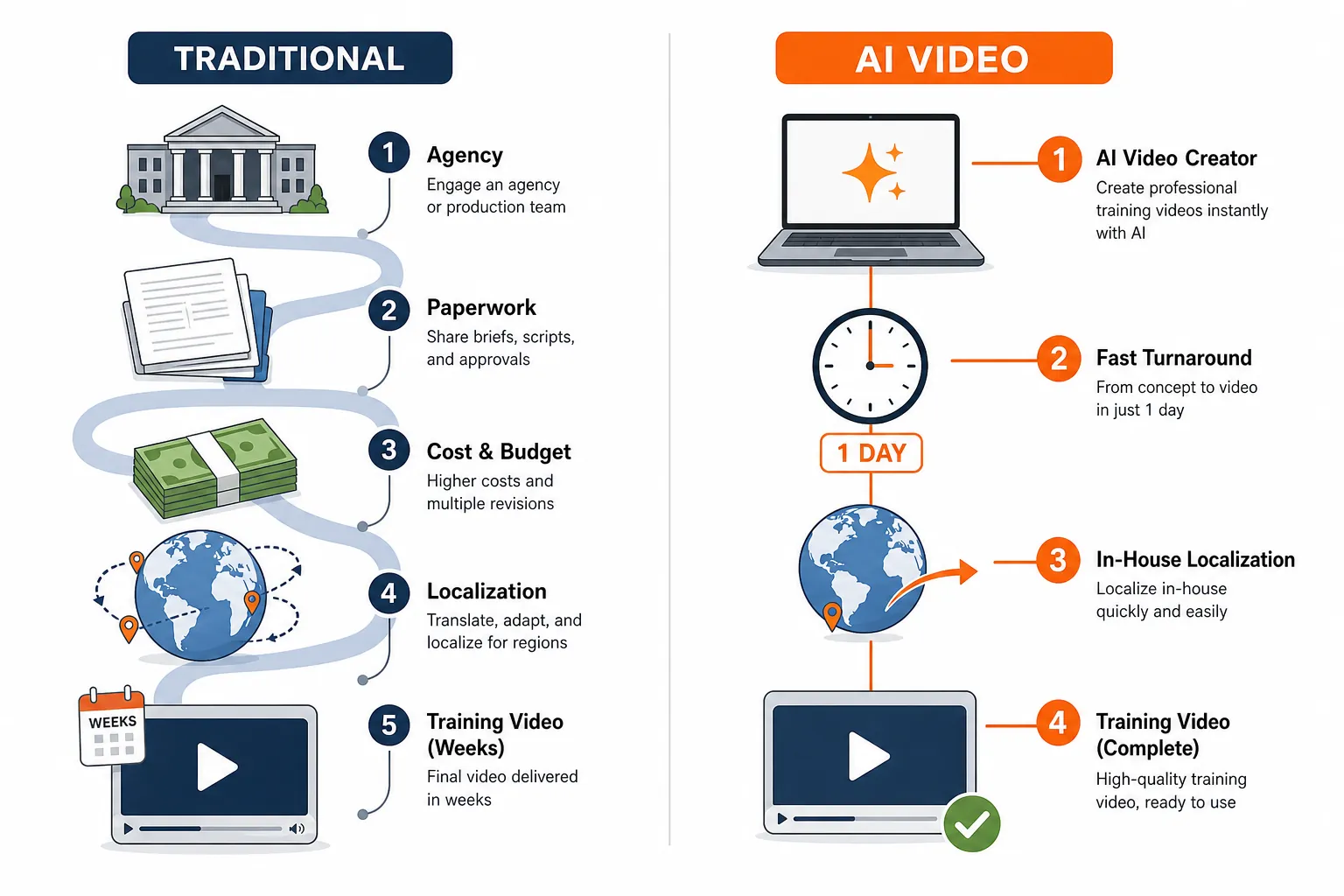
One Mondelez example makes the production change concrete. The company had a traditionally produced agency video that cost $50K; its team rebuilt the same training in-house in a single day using AI video.[1] That does not prove the new version taught better. It does show how much friction can be hiding inside ordinary corporate training production. When a module is expensive to remake, teams tolerate outdated examples, mismatched terminology, and local workarounds longer than they should.
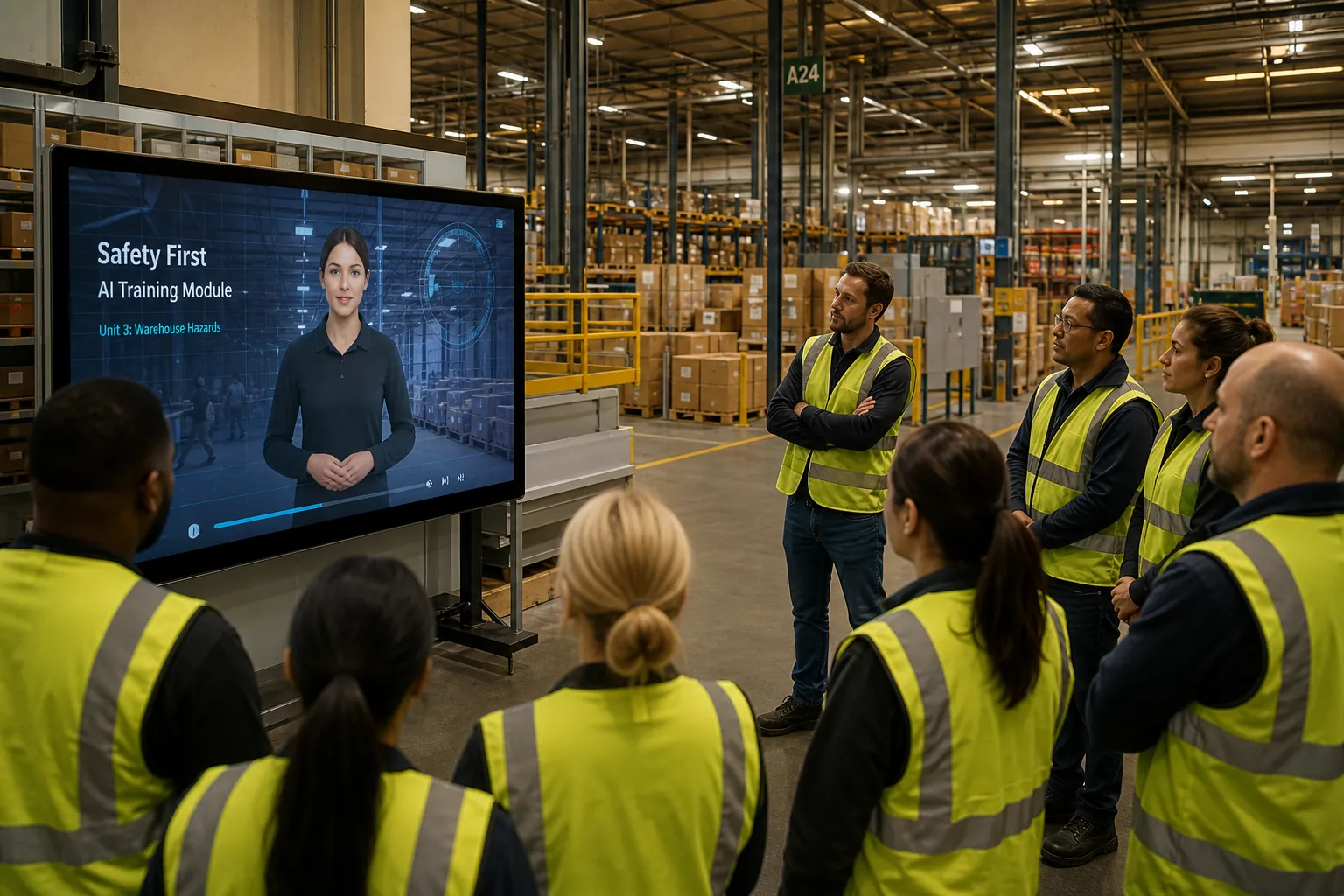
For supply chain training, that lag is not a cosmetic problem. A safety refresher that takes too long to update after a procedural change becomes a gap between the official process and the working process. A warehouse system walkthrough recorded before an interface change turns supervisors into translators. An English-only SOP video may be technically available globally while still being practically unavailable to a large part of the workforce.
From Video Project To Training Capacity
Carlsberg shows the same pattern from a different angle. Through its Integrated Supply Chain Academy, the company built more than 100 internal AI video creators across the organization, according to Synthesia's case study.[2] That is a more important signal than a polished pilot. It means content creation was not kept inside one central media team; it was pushed closer to the people who understand the training demand.
The Carlsberg deployment also addresses the part of global training that usually happens quietly after launch: localization. The company says it now creates content in English and adapts it for every market, eliminating the need for a second external localization supplier.[2] It also reports redirecting more than €30K in annual agency spend and delivering AI-generated training through SCORM into its corporate LMS.[2]
Those details matter because they place AI video inside the training system rather than beside it. A video that cannot be assigned, tracked, translated, revised, and delivered through existing LMS workflows is still a media asset looking for a process. Carlsberg's case is useful because it includes the unglamorous mechanics: creators, markets, localization, LMS delivery, and agency spend.
Both Mondelez and Carlsberg are vendor-documented cases, not independent audits. The metrics should be read as public disclosures from named customers in Synthesia's case study library, with the usual promotional framing that comes with vendor material. Still, they clear a practical bar that many AI training claims do not: they name the organization, describe the workflow change, give operational measures, and show how the content reaches learners.
What The Deployments Actually Solve
The immediate win is not cinematic quality. It is shorter distance between a training need and a usable module. In a plant or warehouse environment, the difference between a one-day update and a multi-week production queue changes which topics get refreshed at all.
| Training Bottleneck | What AI Video Changes | Why It Matters In Supply Chain Training |
|---|---|---|
| Agency production cycles | Internal teams can script, generate, revise, and republish modules faster | Safety, SOP, and system changes do not wait for a production calendar |
| Localization handoffs | Base content can be adapted into market-specific versions | Regional trainers spend less time making unofficial translations |
| Expensive reshoots | Minor script or process changes can be regenerated without filming | Old examples and outdated screens are less likely to remain in circulation |
| Central team overload | Trained internal creators can produce bounded content closer to operations | More sites can get usable content without every request becoming a custom media project |
This is where the Mondelez and Carlsberg examples are stronger than generic AI video arguments. They do not merely say that AI video is cheaper or faster. They show AI video being used where supply chain training usually strains: plant coverage, repeat updates, language adaptation, and LMS-compatible delivery.
Does AI-Generated Video Teach?
Production speed is only half the issue. A training team can create bad content quickly, localize confusion efficiently, and still report strong completion numbers. The harder question is whether AI-generated video can support learning outcomes well enough for the kinds of training it is being asked to carry.
A December 2024 UCL study, described in a Synthesia post, gives useful but bounded evidence. The study involved 500 adult participants and used a food-safety training topic. It found that AI-generated synthetic video performed equally well as human-instructor video on recall and recognition, that 77% of participants preferred video over text, and that completion time was 20% faster for video-based learning.[3]
That is encouraging for procedural supply chain training because food safety sits close to the compliance and operations topics many plants already teach. Recall and recognition are also relevant outcomes for rule-based modules: identify the correct step, remember the hazard, recognize the approved behavior.
The caveats belong next to the confidence. The study was conducted in collaboration with Synthesia, used Synthesia's AI video platform for the AI condition, and was published through UCL's arXiv preprint channel rather than as an independently replicated field study inside a live warehouse, logistics, or plant-floor training environment.[3] It supports the claim that AI-generated video can teach certain adult-learning content comparably to human-instructor video under study conditions. It does not prove that every supply chain training topic, audience, or site condition will perform the same way.
Where AI Video Fits Best
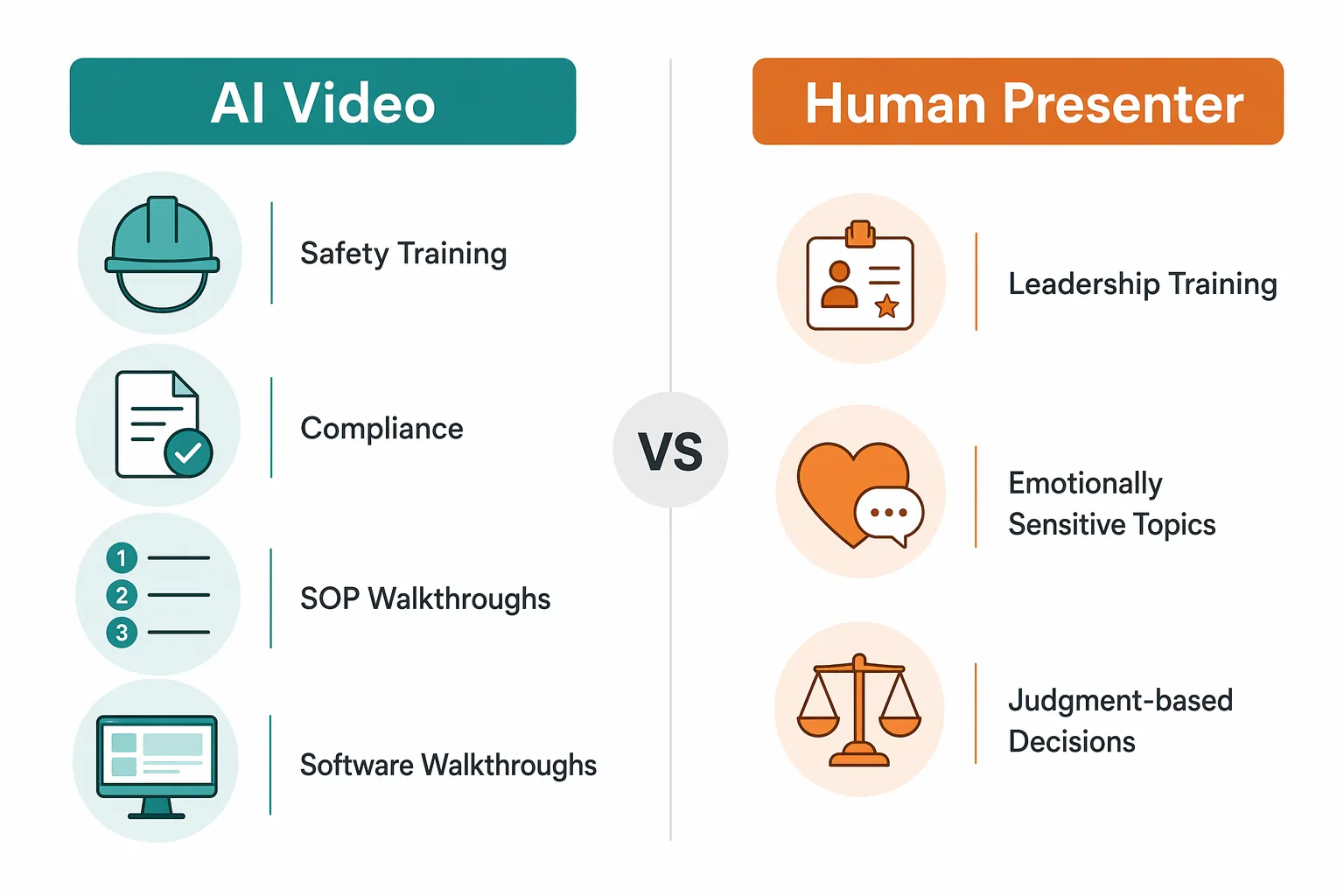
The strongest fit is bounded, repeatable instruction: topics where the correct answer is stable enough to script, the learner needs consistent exposure, and the training value comes from clarity rather than emotional presence. In supply chain environments, that usually points to safety refreshers, SOP walkthroughs, compliance onboarding, warehouse software walkthroughs, equipment-adjacent process training, and short updates after a procedural change.
- Safety refreshers: strong fit when the module reinforces known rules, PPE requirements, hazard recognition, or reporting steps.
- SOP walkthroughs: strong fit when the process is linear, version-controlled, and likely to need future updates.
- Compliance onboarding: strong fit when every worker needs the same baseline explanation and completion tracking.
- Software walkthroughs: strong fit when screen changes require frequent edits and localized narration.
- Market-specific adaptations: strong fit when the central message is consistent but terminology, language, or examples need local adjustment.
The Silicon Review's May 2026 analysis draws a similar line between training types that transition cleanly to AI avatars and areas where human presence still matters. It also reports industry cost ranges of $20 to $100 per AI-generated module versus $10K to $50K for traditional agency video, which should be treated as industry-reported benchmarks rather than verified universal pricing.[4]
Cost ranges can be persuasive, but the better test is maintenance. If a topic changes often, exists in several languages, and needs consistent assignment across many sites, AI video has a structural advantage. If a topic rarely changes and depends on trust in a specific leader, the production savings may be less important than the signal sent by having that person appear directly.
Where A Human Presenter Still Belongs
Some training carries more than information. Leadership messages, post-incident safety conversations, ethics scenarios, union-sensitive changes, and emotionally weighted topics often ask the presenter to carry credibility, accountability, or care. An AI avatar can state the policy. It may not be the right messenger when the organization needs workers to believe that a real person is taking responsibility for the message.
Judgment-based training is also harder to reduce to a clean script. A module on how to escalate a near miss may work well as AI video if it teaches the steps, forms, and reporting channel. A module built around a serious incident, supervisor behavior, or tradeoff between speed and safety may need a human facilitator, discussion, or site leader because the learning outcome is not just recall. It is interpretation under pressure.
That distinction keeps the technology useful. AI video does not need to replace every presenter to be valuable. In many supply chain training programs, the backlog is filled with procedural content that should have been updated months ago. Moving that work into a faster production model frees scarce human attention for the sessions where presence, debate, and judgment matter.
How To Read The Current Evidence
The current evidence is good enough to support deployment for bounded supply chain training use cases. It is not strong enough to claim that AI-generated video is generally superior to human-led training.
Mondelez and Carlsberg show production viability at global supply chain scale: smaller teams, faster production, localized content, reduced vendor dependence, and LMS-compatible delivery.[1][2] The UCL study adds evidence that AI-generated video can match human-instructor video on recall and recognition for an adult food-safety topic, with faster completion in that setting.[3] The Silicon Review analysis helps explain why the economics are pulling companies in this direction, while also reinforcing that not every training category should move at the same speed.[4]
For a supply chain L&D team, the practical starting point is not a company-wide replacement plan. It is a content inventory. Look for modules that are scripted, repetitive, compliance-driven, multilingual, expensive to update, or stuck behind production queues. Those are the places where AI-generated video can become boring infrastructure quickly.
The evaluation should still separate production metrics from learning metrics. Faster creation, lower cost, and higher engagement are useful signals, but engagement may mean completion, time in module, clicks, or a platform-specific measure. For safety and compliance training, the stronger proof comes from recall checks, observed behavior, supervisor verification, audit findings, incident reporting quality, or error reduction after the module is used.
AI-generated video is production-ready for supply chain training where the work is procedural, repeatable, localized, and frequently updated. It is not a reason to remove human presenters from training moments that depend on credibility, emotional weight, leadership presence, or sensitive judgment. Used that way, the technology is less a novelty than a way to keep the official training system from falling behind the operation it is supposed to support.
References
- How Mondelez Accelerates Supply Chain Training Across 150+ Global Manufacturing Plants — Synthesia
- Carlsberg takes supply chain training in-house with AI video — Synthesia
- New UCL study shows the benefits of using AI-generated videos for adult learners — Synthesia
- How AI Avatars Are Replacing Traditional Corporate Training Videos — The Silicon Review, May 2026
Comments
Join the discussion with an anonymous comment.