
By mid-2026, the supply chain AI conversation has moved past curiosity. The sharper question is whether companies are building an AI value chain that can survive contact with real planning calendars, exception queues, master data disputes, and decision rights.
The benchmark tension is hard to miss. ABI Research data cited in recent supply chain AI benchmarking says 94% of supply chain companies plan to deploy AI within two years, while Gartner data cited in the same market coverage says only 23% of organizations already deploying AI have a formal AI strategy.[1] Those figures come from different surveys, with different samples and question wording, so they should not be treated as a matched statistical comparison. They are still directionally consistent enough to matter: AI is being funded, tested, and used faster than many organizations are designing the operating model around it.

That is the practical meaning of the AI value chain in this article: not the semiconductor-to-cloud-to-model supply chain behind AI products, but AI applied across the supply chain operating value chain. The stall point is rarely a lack of interesting use cases. Planning, procurement, warehousing, transportation, inventory, and customer fulfillment all have them. The stall point is the handoff from a promising tool to a governed way of working.
The Gap Is No Longer About Awareness
A supply chain team can now look busy with AI without being structurally ready for AI. A forecasting pilot may run in one business unit. A transportation team may use an optimization layer. Procurement may experiment with supplier-risk summarization. Warehouse supervisors may test labor-planning recommendations. None of that proves the company has agreed on data ownership, model review, escalation rules, or which decisions AI is allowed to influence.
This is why the 94% intent figure is less reassuring than it looks. High intent can mean the market accepts that AI belongs in supply chain operations. It does not mean those organizations have resolved how AI-generated recommendations will flow through S&OP, procurement governance, carrier selection, inventory policy, or warehouse execution. The 23% formal-strategy figure points to the more uncomfortable benchmark: many companies are already deploying before they have documented how deployment should scale.[1]
That does not make every early deployment reckless. Some teams need controlled experimentation before they can write a credible strategy. But there is a difference between learning through pilots and letting each function invent its own AI operating model. The first creates evidence. The second creates fragmentation that becomes expensive just when executives ask for scale.
Confidence Is Rising, Trust Is Not
The trust bottleneck shows up clearly in RELEX Solutions’ 2026 supply chain AI survey. In a sample of 500 organizations, 67% of supply chain leaders said they were more confident in AI than they had been a year earlier, but only 10% said they trusted AI to make critical decisions without human review.[2]
That is not hypocrisy. It is what happens when leaders believe the analytical capability is improving faster than the organization’s decision controls. A replenishment recommendation can be useful and still require a planner to check the promotion calendar. A logistics exception alert can be accurate and still need a manager to weigh customer priority against cost. A supplier-risk model can surface a weak signal and still require human review before a sourcing decision changes.
The governance question is therefore not whether humans should stay “in the loop” as a comforting phrase. It is which humans review which decisions, under what thresholds, with what evidence, and with what accountability if the recommendation is accepted or overridden. Without that specificity, organizations end up with the worst version of human review: everyone is theoretically responsible, but no one owns the decision path.
For readers comparing this with more autonomous agentic systems, ChainSignal’s coverage of agentic AI in supply chain is the more detailed companion. The important point here is narrower: confidence in AI outputs does not automatically translate into permission for AI to make critical supply chain decisions.
The Readiness Ceiling Shows Up Before the Model Fails
Many AI projects look like software evaluations when they are actually operating-model tests. The model may be good enough to detect a demand shift, rank a supplier risk, or propose a better allocation. The organization may still be unable to act because item hierarchies differ by region, service-level definitions are inconsistent, transportation data arrives late, or the planning team does not trust master data maintained somewhere else.
Gartner readiness data cited in the same 2025 market coverage puts a number on that ceiling: only 29% of supply chain organizations had built the capabilities needed for future readiness.[1] That finding reinforces the strategy gap without simply repeating it. A documented AI strategy is one artifact. Readiness is the harder question of whether the organization has the data, skills, workflows, and governance to make that strategy executable.
This is where pilot performance can mislead. A pilot is often protected from the messiest parts of the workflow. It may use a cleaned dataset, a narrow SKU set, a limited geography, or a friendly team already motivated to make the experiment work. Scaling removes that protection. The AI recommendation has to cross functions that may not share definitions, incentives, or tolerance for risk.
A use-case catalog cannot solve that problem by itself. Selecting the right use cases matters, but a company can pick sensible use cases and still fail to scale them if every deployment becomes a negotiation over data access, business rules, and accountability. For teams still sorting use-case priority, ChainSignal’s AI use case library is useful. The strategic issue here is what must be true before those use cases can become repeatable operating capability.
The ROI Window Is Longer Than the Steering Committee Calendar
The investment signal is strong, but the payback timing is less convenient. Deloitte reported that 85% of organizations increased AI investment, while only 6% saw ROI in under a year; its analysis points to a more typical satisfactory-return window of two to four years.[3]
That timing matters because many supply chain AI business cases are still written as if a pilot can prove the economics, fund the next stage, and satisfy annual budget pressure all at once. Some projects will produce fast tactical savings, especially where the process is narrow and the baseline is poor. But the broader AI value chain usually requires investment that does not map neatly to a one-year benefit case: data harmonization, integration work, workflow redesign, training, model monitoring, and governance.
The better benchmark is not whether every AI initiative pays back inside one budget cycle. It is whether the portfolio is sequenced so that near-term wins support the longer build. A transportation project might produce visible savings sooner than an enterprise planning data foundation. That does not make the data foundation optional. It means leadership has to stop pretending every layer of the AI operating model will monetize at the same speed.
This is also where profitability claims need careful handling. Accenture has reported that companies with AI-mature supply chains are 23% more profitable and six times as likely to use AI and generative AI widely.[4] That is meaningful positive evidence, but it should not be read as a transferable guarantee. AI maturity may travel with other advantages: better data discipline, stronger process governance, more resilient operating models, and leadership teams already capable of cross-functional execution.
For a deeper treatment of where business cases go wrong, see ChainSignal’s analysis of what supply chain AI ROI actually looks like. The short version for executives is simple enough: if the financial model assumes scaled benefits before the data and decision model are scalable, the ROI problem has been created before the software is implemented.
Workforce Adoption Is Already Outrunning the Formal Strategy
The AI value chain is not only being built by executives and transformation offices. It is also being improvised by employees who find tools that help them move faster. ActivTrak data cited in 2025 supply chain AI statistics found that 72% of logistics employees already used AI tools, the highest adoption rate across industries in that dataset.[1]
That kind of adoption can be encouraging. It suggests that the workforce does not need to be convinced that AI has practical value. It can also create risk if the organization has not defined acceptable use, data boundaries, review standards, and escalation paths. A planner summarizing supplier updates with an AI assistant is not the same risk profile as a team letting AI-generated recommendations alter allocation decisions. Both may be happening before the formal strategy catches up.
The managerial task is not to suppress bottom-up usage until a perfect policy exists. That usually drives the activity underground. The better task is to observe where employees are already pulling AI into the workflow, separate low-risk productivity use from decision-impacting use, and build controls around the latter. Adoption without governance is not proof of maturity. Governance without adoption is just a binder.
What Early Movers Change
Deloitte’s agentic supply chain work frames maturity around data architecture, technology stack, workforce, and governance.[3] Those categories are useful as long as they are not treated as a slide to admire. In practice, early movers change how work is owned.
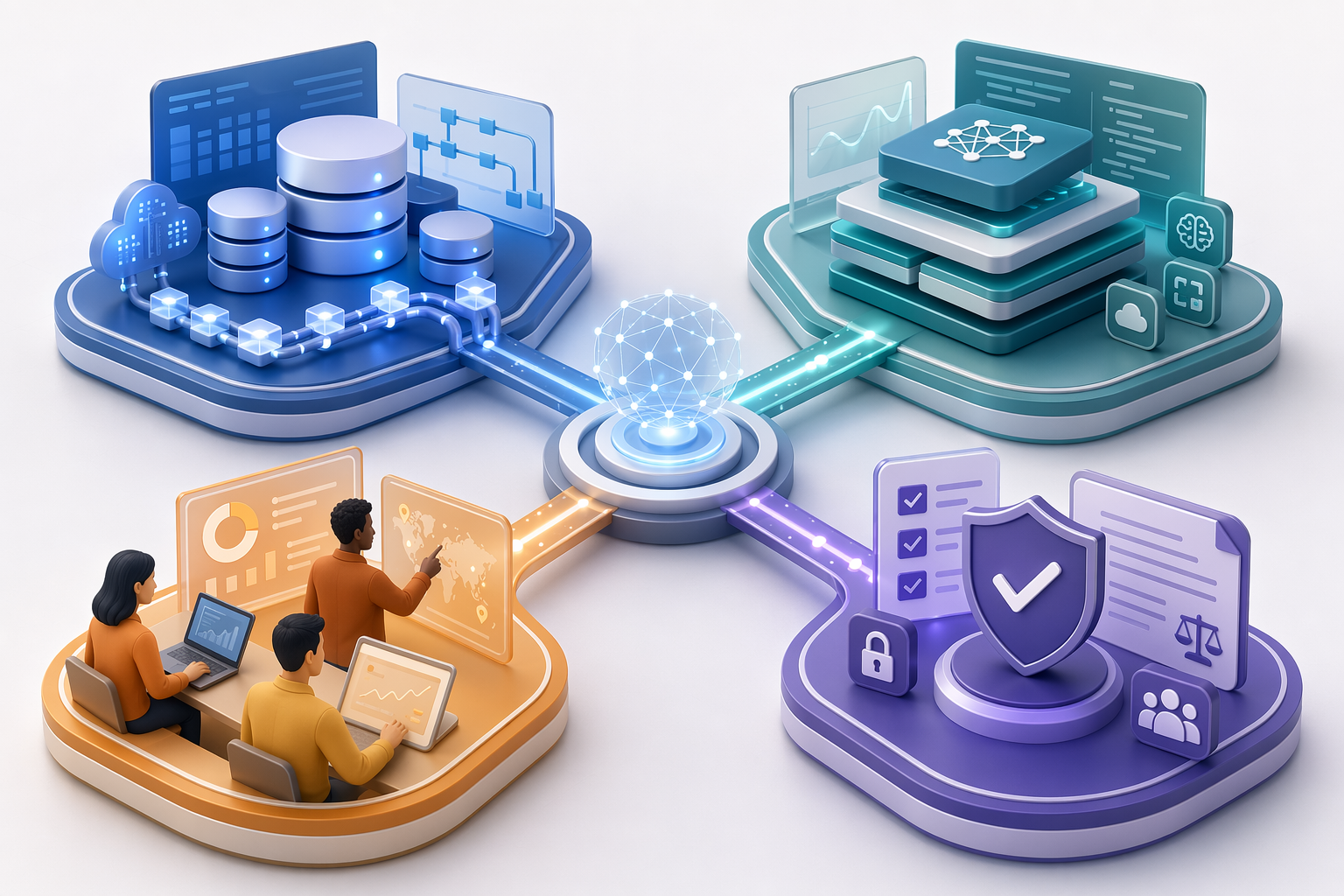
They Treat Data Architecture as an Operating Asset
The first difference is not that mature organizations have more data. Most supply chain organizations have plenty of data. The difference is that mature organizations make the data usable across decisions. They work through definitions, lineage, latency, access rights, and stewardship before expecting AI to produce consistent recommendations across regions and functions.
This is dull work until it is absent. Then it becomes the reason a promising model cannot scale. If inventory policy uses one product hierarchy, demand planning uses another, and finance reconciles margin at a different level, AI will not magically create a shared operating language. It will expose the fact that one does not exist.
The practical test is whether a new AI use case can plug into trusted data services rather than beginning with a bespoke extraction and cleanup effort. If every project starts by rebuilding its own data foundation, the company is not scaling AI. It is repeating preparation work under a new project name.
Warehouse teams face this problem early because operational data is both rich and unforgiving. ChainSignal’s guide to machine learning readiness for warehouse management covers that narrower setting, but the lesson generalizes: model ambition has to be matched by data discipline at the point of execution.
They Rationalize the Stack Before It Hardens Into Sprawl
A fragmented AI stack is often the technical shadow of fragmented ownership. Planning buys one capability, logistics pilots another, procurement experiments with a third, and IT is later asked to integrate tools that were never selected against a common architecture. Each choice may have been defensible locally. Together, they can make scaling harder.
Early movers do not necessarily centralize every decision. They do create standards for where models run, how data is accessed, how outputs are logged, how vendors are evaluated, and how AI capabilities connect to existing systems of record and systems of execution. The purpose is not architectural neatness. It is to prevent the same control problem from being solved differently in every function.
Agentic AI raises the stakes here because autonomous or semi-autonomous agents may interact with multiple systems, trigger workflows, and recommend actions across planning and execution. BCG’s 2026 work on AI agents in supply chains argues that these systems can support a self-funding transformation model, where value from early deployments helps finance broader capability building.[5] That is plausible as a sequencing logic, but only if the stack is designed so early tools do not become isolated assets with no path into the enterprise operating model.
They Put Workforce Design Close to the Workflow
Training is usually discussed too generically. A supply chain organization does not need one universal AI literacy program and then a celebration of adoption. It needs role-specific clarity. A demand planner needs to know when to challenge a forecast driver. A transportation manager needs to know when an optimization recommendation violates customer or carrier constraints. A procurement lead needs to know when a generated supplier-risk summary is evidence and when it is only a signal for further review.
The work also changes for managers. If AI removes some analysis time but increases the need for exception review, managers have to redesign meetings, approval thresholds, and performance metrics. Otherwise, the tool creates a faster stream of recommendations that still waits in the same old decision queue.
This is one reason workforce adoption can look high while operating maturity remains uneven. People may use AI to draft, summarize, search, classify, or compare. That does not mean the organization has redesigned the decision process around AI-supported work. The difference matters because productivity tools can spread informally; decision systems need explicit accountability.
They Make Governance Operational, Not Ceremonial
Governance is where many AI strategies become either too vague or too heavy. Too vague, and teams do not know what is allowed. Too heavy, and every improvement requires a review process designed for a much riskier decision. The mature version is tiered.
| AI use pattern | Governance question that matters |
|---|---|
| Productivity support, such as summarizing internal notes | What data can be used, and what outputs require verification? |
| Analytical recommendation, such as inventory or routing options | Who reviews the recommendation, and what evidence must be visible? |
| Decision-impacting workflow, such as allocation or supplier action | What thresholds, approvals, audit logs, and override rules apply? |
| Autonomous or agentic execution | What actions are permitted, what limits stop the agent, and who is accountable? |
The table is deliberately plain because the operating questions are plain. A company does not need mystical AI governance. It needs decision rights, evidence standards, monitoring, escalation, and accountability that match the risk of the use case.
This is also where the 10% trust figure should change the executive conversation.[2] If only a small minority of leaders trust AI to make critical decisions without human review, then the practical path is not to wait for trust to appear. It is to design the review model that lets trust accumulate through observed performance, controlled scope, and clear accountability.
A More Honest Benchmark for 2026
The easy benchmark is whether a company has AI projects. By that measure, many organizations can claim progress. The more useful benchmark is whether those projects are becoming an AI value chain: connected capabilities that improve supply chain decisions across functions without depending on heroic cleanup, informal workarounds, or permanent pilot protection.
A realistic executive review should ask five questions before celebrating or canceling the portfolio:
- Is there a documented AI strategy that names priority decisions, not only priority technologies?
- Can new use cases reuse trusted data foundations, or does every project rebuild the basics?
- Are review rights, override rules, and accountability clear for decision-impacting AI?
- Is workforce adoption being observed and governed where it already exists?
- Does the ROI plan distinguish near-term savings from the two-to-four-year infrastructure build?
Those questions are less exciting than a demo. They are also closer to the work that separates scaled capability from a portfolio of disconnected experiments. Organizations are not necessarily behind because they lack AI tools. They are behind if they lack the strategy, data foundation, governance model, and ROI horizon long enough for AI to become operational infrastructure rather than a recurring pilot expense.
References
- Supply Chain AI Statistics: 18+ Statistics You Should Know for 2026 — Open Sky Group
- Supply chain AI in 2026: The numbers behind the hype — RELEX Solutions
- Resilient by design: The agentic supply chain — Deloitte
- Accenture supply chain AI maturity research — Accenture, 2024
- How AI Agents Are Transforming Supply Chains — BCG, 2026
Comments
Join the discussion with an anonymous comment.