
A truck accident does not stay inside the safety department. It becomes a missed appointment, a rejected delivery window, a replacement load, a claims file, a customer escalation, and sometimes a driver trying to explain a sequence of seconds that nobody in dispatch saw clearly. For supply chain leaders evaluating AI, that is the practical entry point: truck accidents are one of the more concrete forms of supply chain disruption, because the vehicle, freight, driver, and service promise are all exposed at the same time.
The scale justifies treating accident prevention as a resilience use case, not a side project. In 2023, U.S. truck accidents were associated with 5,078 fatalities and 86,842 injuries, while trucks moved 72.5% of U.S. domestic freight tonnage in 2022.[1][2] The FMCSA Large Truck Crash Causation Study is commonly cited for the finding that 87% of truck accidents involved human error, which matters operationally because behavior risk is one of the few disruption sources a fleet can try to detect before the shipment fails.[3]
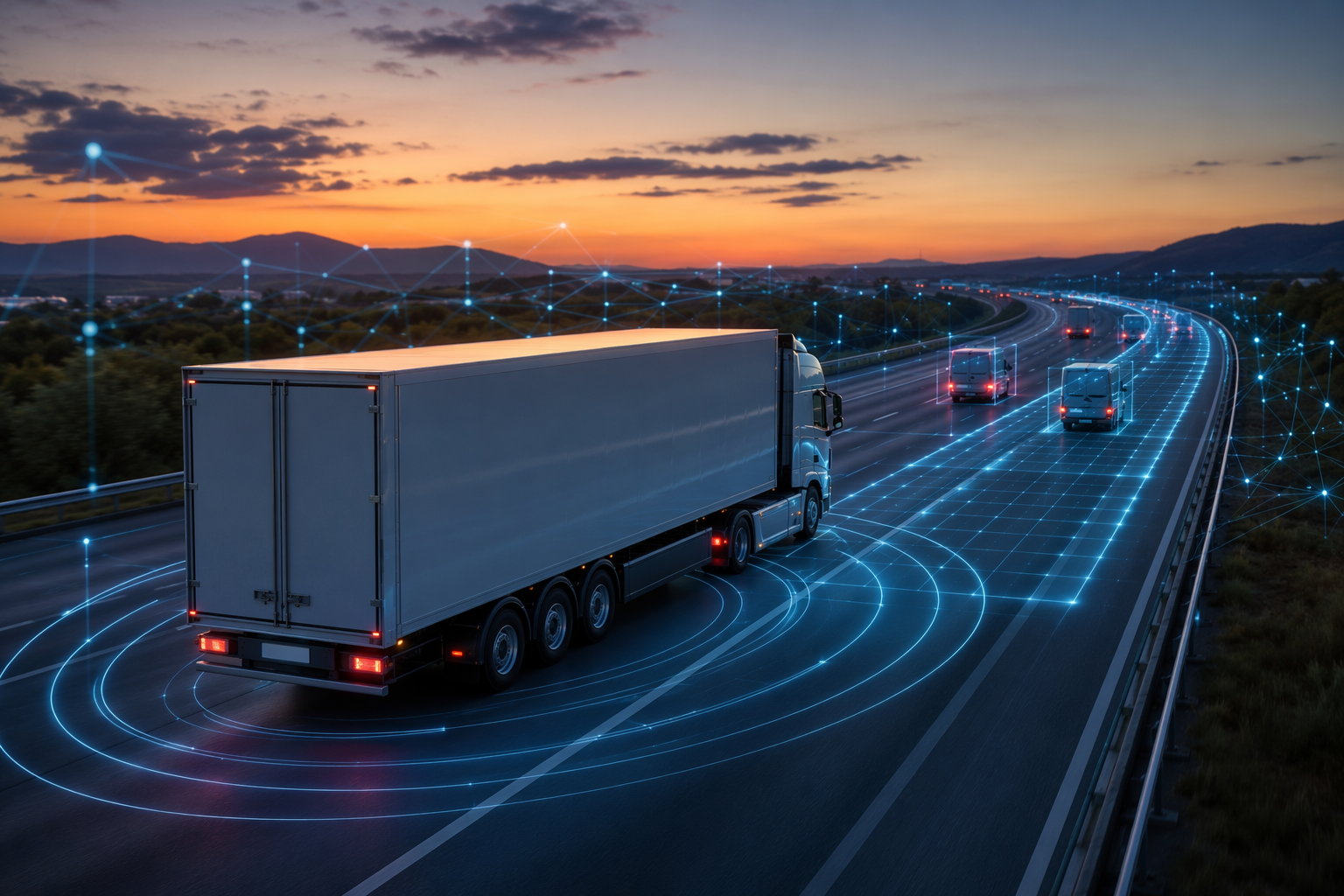
That does not mean every camera or alert system automatically improves continuity. The stronger case for AI in truck accident prevention is layered: one system sees driver fatigue, another watches collision and lane risk, another flags likely mechanical failures, another changes route exposure, and the fleet platform turns detections into coaching, maintenance action, or dispatch decisions. The point is not that AI makes freight movement risk-free. It is that the right signals can move earlier in the workflow, before the stopped truck becomes the first time anyone notices the risk.
Where AI Changes The Fleet Workflow
The useful distinction is between systems that record what happened and systems that change what happens next. Traditional telematics can show speed, location, harsh braking, and hours-of-service data. AI-powered safety platforms add pattern recognition: the driver’s eyelids are closing more often, the vehicle ahead is decelerating too quickly, a component is behaving like it did before previous failures, or a route is carrying more exposure than the load requires.
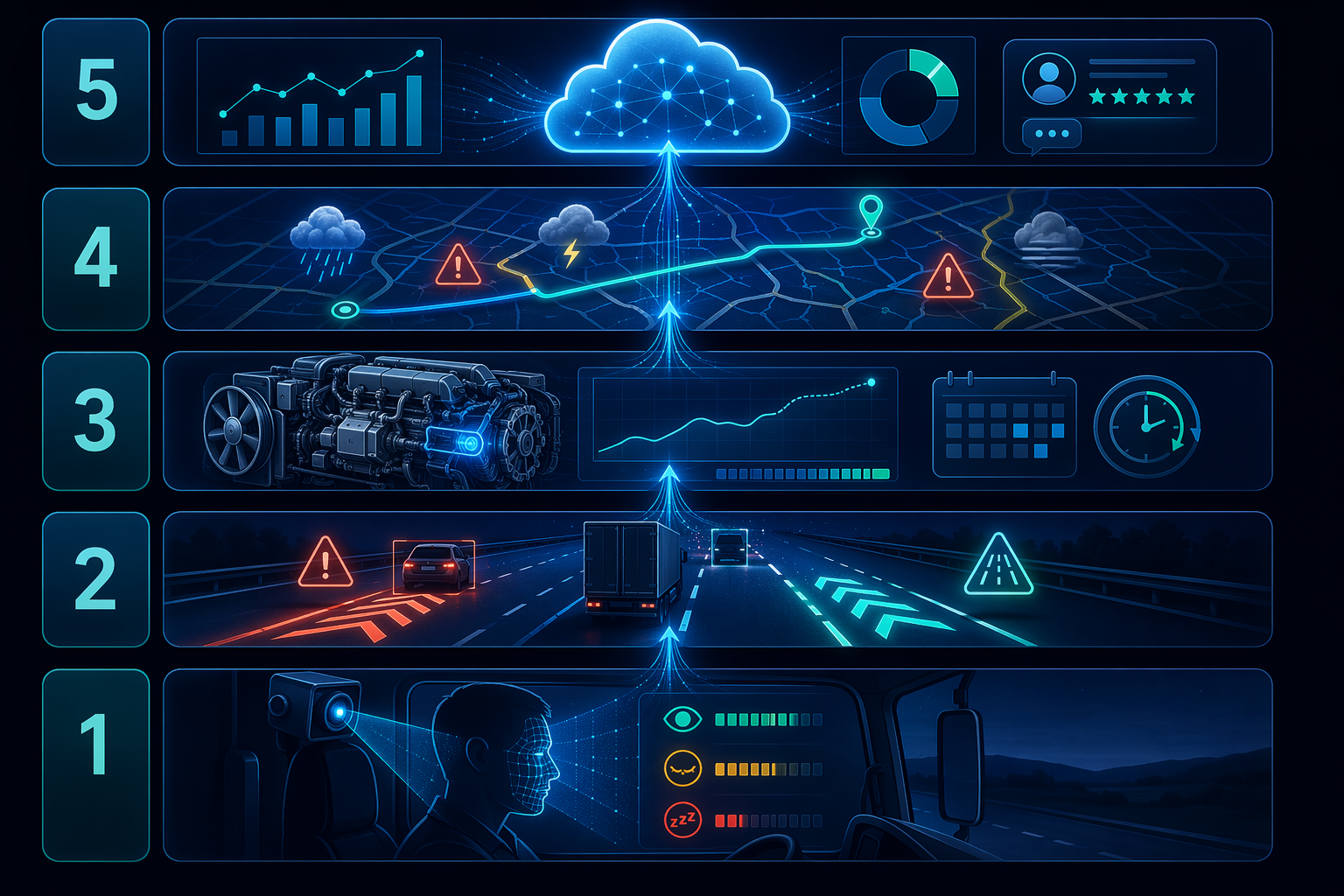
The operating model is best understood as a five-layer safety stack.
| Layer | What It Detects Or Changes | Why It Matters For Supply Chain Continuity |
|---|---|---|
| Computer-vision driver monitoring | Fatigue, distraction, phone use, seatbelt use, and other behavior indicators | Moves human-error risk from post-incident review into real-time alerting and coaching |
| ADAS | Forward collision risk, unsafe following distance, lane departure, and related road events | Reduces exposure to the crash types most likely to stop a vehicle immediately |
| Predictive maintenance | Failure patterns in vehicle health, components, and fault data | Prevents breakdowns that create missed delivery windows and emergency maintenance work |
| Accident-aware route optimization | Weather, incidents, congestion, road risk, and historical accident exposure | Reduces the amount of time freight spends in avoidable hazard conditions |
| Cloud video telematics and coaching | Event evidence, driver trends, scorecards, coaching queues, and exoneration footage | Turns isolated alerts into repeatable behavior change and claims defense |
Dashcams usually get the attention because they are visible and politically sensitive. But the resilience value comes from how the layers work together. A driver monitoring system may catch fatigue before a lane event. ADAS may warn or intervene when following distance collapses. Predictive maintenance may keep the same truck from being dispatched into a preventable roadside failure. Route optimization may keep the load away from a corridor where weather and incident data are already deteriorating. The coaching platform is what decides whether those signals become durable operating practice or just another stream of ignored alerts.
Driver Monitoring: The Human-Error Layer
Computer-vision driver monitoring systems use in-cab or road-facing video to detect fatigue, distraction, and unsafe behaviors in real time. Some systems monitor 10 to 17 fatigue indicators per driver with alert accuracy above 90%.[4] In fleet terms, that changes the timing of intervention. Instead of reviewing harsh-braking events next week, the system can alert on a driver who is drifting toward a risky condition during the shift.
This layer is also where the program can become brittle. A driver may accept coaching after a near miss; the same driver may resist a system perceived as constant surveillance. The distinction matters. A safety director buying AI for accident prevention is not just buying detection accuracy. They are buying a labor relationship, a coaching process, an escalation policy, and an explanation of what is recorded, who reviews it, and how it will be used.
ADAS: The Collision And Lane-Event Layer
Advanced driver assistance systems bring the road-facing side of prevention into the stack. Forward collision warning, lane departure warning, and related safety functions target the events that can move from normal driving to a service failure in seconds. NMFTA cites National Safety Council findings that ADAS can reduce heavy truck accidents by more than 40%, though the exact transferability depends on vehicle mix, feature configuration, and operating environment.[5]
ADAS is not a substitute for dispatch discipline or driver judgment. It is a last line of operational friction before the crash. That makes it valuable, but also limited: a forward collision warning may prevent a rear-end event, while doing nothing about a route planned through worsening conditions or a truck that should not have left the yard with a known component risk.
Predictive Maintenance: The Overlooked Disruption Layer
Accident prevention and breakdown prevention are often discussed separately, but the freight consequence can be similar: the truck is out of service, the appointment is at risk, and the replacement plan costs money. AI maintenance systems look for failure patterns in vehicle data before a defect becomes a roadside event. FleetPulse-style predictive maintenance is reported to predict 89% of fleet failures two to four weeks in advance, and one national LTL carrier documented a 23% reduction in roadside breakdowns.[6]
That two-to-four-week window is important. It gives operations a chance to pull the vehicle into planned maintenance rather than letting the failure choose the time, place, freight, and customer. A maintenance prediction that never reaches scheduling is just a dashboard. A prediction tied to dispatch rules, parts availability, and shop capacity can protect service reliability.
Route Optimization: Reducing Exposure Instead Of Just Reacting To It
Accident-aware route optimization adds another kind of prevention: avoiding conditions that make incidents more likely. These systems can incorporate historical accident data, weather, congestion, road closures, and real-time incident feeds. The practical question is not whether a route is shortest in miles, but whether it keeps the driver, freight, and schedule out of avoidable risk.
DHL has reported a 26% accident reduction associated with AI-supported route planning.[7] That should not be read as a universal route-optimization outcome for every fleet. It does show that route decisions can be part of accident prevention, rather than a separate transportation-planning exercise that only optimizes distance, fuel, or appointment time.
Cloud Coaching: Where Detection Becomes Behavior Change
The cloud layer is where vendors such as Samsara, Motive, Netradyne, Seeing Machines, and Powerfleet compete most visibly: video telematics, event review, driver scorecards, coaching workflows, claims evidence, and fleet analytics. This is also where many deployments succeed or fail. A fleet can detect hundreds of risky events and still change little if supervisors do not review them consistently, if drivers receive only punitive feedback, or if dispatch incentives quietly reward risky behavior.
The better implementations treat coaching as an operations loop. The system detects an event, filters it for severity and relevance, assigns review, gives the driver a clear behavioral correction, and tracks whether the pattern changes. When video also exonerates a driver after a non-fault incident, the same platform can reduce claims friction and help preserve trust.
What The Evidence Actually Shows
The strongest numbers in this market are useful, but they need their frame attached. Vendor-reported fleet aggregates are not the same as controlled trials. A result from a large, instrumented customer base may indicate the upper bound of what disciplined deployment can achieve, not a guaranteed result for a mixed fleet that installs cameras and never changes coaching practice.
Crash Reduction
Samsara reports up to a 73% crash-rate reduction over 30 months, based on aggregated data from more than 2,600 customers.[8] That is the headline figure most likely to draw attention, and rightly so. A crash-rate reduction at that scale connects directly to continuity: fewer disabled vehicles, fewer emergency loads, fewer customer service failures, and fewer claim disputes.
The same source base also includes claims of up to 92% preventable accident reduction and exoneration savings of $5,000 to $25,000 when video evidence helps resolve an incident.[8] These are not promises that every buyer will reach those levels. They are evidence that the opportunity ceiling is high when detection, coaching, documentation, and driver adoption are working together.
Chalk Mountain reported an 86% reduction in preventable accident costs, a different but equally operational metric.[9] Cost reduction can be more relevant than incident count for some fleets because not every incident carries the same downtime, claims exposure, cargo consequence, or customer impact.
Early Risk Detection
Motive’s 2026 AI Road Safety Report, based on 1.2 billion hours of driving data, found that for every one collision, fleets detect seven near-collisions through AI.[10] That ratio matters because near-collisions are where the operating window opens up. A collision is already a disruption. A near-collision can become a coaching moment, a route review, a dispatch conversation, or a driver-support intervention.
This is the practical difference between footage as evidence and AI as prevention. Evidence helps after the fact. Near-collision detection gives the fleet a chance to see the pattern while the driver is still on the road and the customer is still expecting the freight.
Maintenance Continuity
The maintenance evidence is narrower but important. Predicting 89% of fleet failures two to four weeks in advance is not the same as preventing 89% of failures; the organization still has to schedule service and act on the prediction.[6] The documented 23% reduction in roadside breakdowns for a national LTL carrier is therefore the more continuity-linked metric, because it measures fewer failures on the road rather than detection capability alone.[6]
For logistics operators, roadside breakdowns are not just maintenance events. They create late freight, rescue costs, tow costs, driver-hour complications, and load-transfer decisions. A system that moves even part of that work into planned maintenance has resilience value even when no crash is involved.
Financial Return
Safety Vision’s 2026 report estimates $3,000 to $5,800 in annual value per vehicle from accident reduction, insurance savings, and operational improvements.[11] FleetRabbit and Safety Vision cite insurance premium discount ranges of 5% to 30% for AI-equipped fleets.[11][12] Those ranges are broad because insurer appetite, claims history, fleet size, geography, cargo type, and implementation maturity all matter.
The typical payback window is three to 12 months, with more pronounced effects in fleets of 175 or more vehicles.[8] That fleet-size qualifier is important. A small fleet may still benefit from fewer incidents, but statistical noise, fixed implementation effort, and limited coaching staff can make the investment case less clean than it is for a large operation with repeated lanes, more events, and enough vehicle volume to learn from patterns.
Why Adoption Is Rising, And What Adoption Does Not Prove
AI capability is now part of the buying conversation. ABI Research’s 2026 survey of 490 supply chain professionals found that 65% consider AI capabilities important or very important in technology purchase decisions.[13] That is a useful market signal: buyers increasingly expect software to detect, predict, and recommend rather than merely record.
It is not proof that any specific fleet safety system works. Adoption interest says the market is receptive. Crash reduction, near-collision detection, maintenance continuity, and cost outcomes say whether a specific safety stack is worth shortlisting.
The Implementation Questions That Decide The Result
The technology can identify risk earlier than a human supervisor looking at weekly reports. It cannot, by itself, decide how a fleet handles privacy, driver trust, escalation, maintenance scheduling, or conflicting incentives. Those questions belong in vendor evaluation because they determine whether the system becomes a resilience tool or another subscription sitting beside dispatch.
- Privacy and monitoring: fleets need clear rules for inward-facing video, event review, data retention, and who can access footage.
- Driver acceptance: coaching should distinguish between support, correction, and discipline; otherwise, alert accuracy may not translate into behavior change.
- Integration: predictive maintenance and route-risk signals need to connect with fleet management, dispatch, shop scheduling, and claims workflows.
- Measurement: buyers should separate crash frequency, preventable accident cost, near-collision rates, breakdowns, insurance impact, and delivery reliability rather than blending them into one resilience claim.
- Fleet fit: vehicle count, lane density, driver turnover, claims history, and operating geography all affect whether the reported ROI range is realistic.
The people side can show up in business metrics. AWP Safety saw a 51% turnover reduction when coaching and gamification were part of its safety program.[9] That case should not be generalized into a universal retention promise, but it illustrates a useful point: drivers are more likely to accept safety technology when the program feels consistent, transparent, and connected to recognition as well as correction.
For a logistics leader, the vendor demo should therefore move beyond clips of dramatic near misses. The better questions are more ordinary and more revealing: How many alerts become coaching assignments? How are false positives handled? Can maintenance predictions create work orders? Does route risk feed dispatch decisions? Can claims teams retrieve event footage quickly? Can the fleet prove whether incidents, breakdowns, and service failures changed after deployment?
A Viable Resilience Investment, Not A Guaranteed Outcome
Truck accidents are a practical supply chain AI use case because freight resilience depends partly on whether trucks arrive safely, and many accident risks leave signals before they become incidents. The documented results are strong enough to justify serious evaluation. Up to 73% crash-rate reduction, seven near-collisions detected per collision, 23% fewer roadside breakdowns, and several thousand dollars of annual per-vehicle value are not abstract AI claims.[8][10][6][11]
The investment case is strongest when the buyer treats AI safety as a layered operating system: driver monitoring, ADAS, predictive maintenance, route-risk intelligence, and coaching tied into fleet workflows. It is weaker when the purchase is reduced to cameras, alerts, or a promise that software will prevent accidents on its own.
For fleets with enough vehicle volume, disruption exposure, and management capacity to act on the signals, AI-powered truck accident prevention belongs on the resilience shortlist. The outcome is not automatic, and the cultural work is real. But the evidence now supports a practical judgment: when measured carefully and implemented with drivers rather than merely around them, AI fleet safety can reduce preventable crashes, protect delivery reliability, and make accident prevention part of supply chain continuity.
References
- How Truck Accidents Disrupt Supply Chain & Impact Bottom Line, Wall Street Mojo.
- ATA American Trucking Trends 2023, American Trucking Associations.
- Enhance Trucking Safety with AI Innovation, PMC Insurance.
- Revolutionary AI Fleet Safety Technology 2025, Tank Transport.
- Unlocking the Potential of AI in the Trucking Industry – Opportunities and Risks, NMFTA.
- How AI Is Preventing Breakdowns Before They Happen, Truck Club.
- How AI Improves Route Planning, DHL Freight Connections.
- Capture ROI from Your Fleet Safety Program, Samsara.
- Breakthroughs in AI Dashcams and Video Safety, FleetRabbit.
- Motive 2026 AI Road Safety Report, SupplyChain247, 2026.
- 2026 Report on AI Video Telematics, Safety Vision, 2026.
- Breakthroughs in AI Dashcams and Video Safety, FleetRabbit.
- Supply Chain Disruptions 2026: How to Build Resilience with AI and Automation, ABI Research, 2026.
Comments
Join the discussion with an anonymous comment.