
The first hour after a tornado is usually where the recovery plan starts losing time. A distribution center may still be standing, but nobody yet knows whether the roof is compromised. A supplier may be outside the visible damage path, but the access road, substation, or labor pool may not be. Store managers send photos when cell service allows it. Carriers wait for road clearance. Inventory teams hesitate because moving the wrong product to the wrong node can make the second day worse than the first.
That is the useful opening for AI in tornado disaster recovery for supply chains: not a promise that software can outsmart violent weather, but a narrower question. What can AI know earlier than the traditional recovery process, and what decision does that unlock?
The most concrete tornado-specific answer comes from damage assessment. Texas A&M researchers published work in May 2025 combining remote sensing, deep learning, and restoration modeling to classify building-level tornado damage as no damage, moderate damage, major damage, or destroyed. Tested on the 2011 Joplin EF-5 tornado, the system also reconstructed the tornado path from damage patterns alone and produced assessments in under an hour, compared with weeks for manual field inspection.[1]
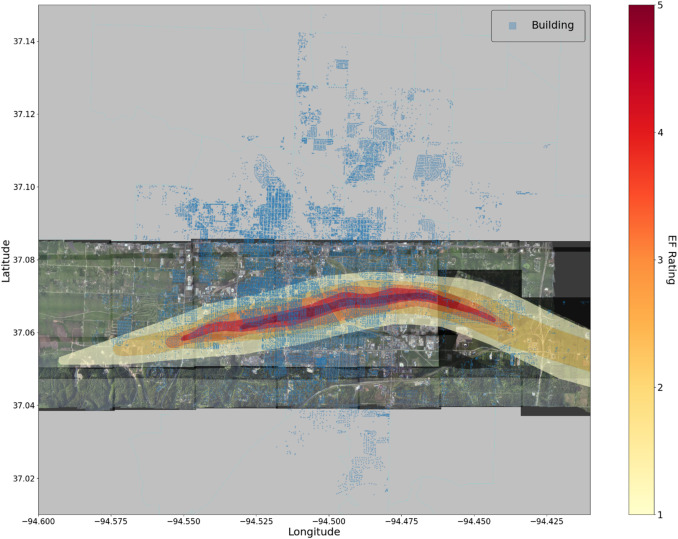
For a supply chain team, the important part is not that the map looks sophisticated. It is that building-level classification changes the first call list. A planner can separate a supplier in the likely impact corridor from one outside it. A transportation director can stop treating an entire metro area as equally uncertain. An inventory manager can see which store clusters or service depots deserve immediate replenishment attention before the normal stream of field reports catches up.
The pressure to make those calls faster is not academic. Falvey Insurance Group cited 2023 tornado damage at $1.38 billion and a 2024 single outbreak at $5.9 billion, while also reporting that 97% of organizations with active disaster plans resume operations within three days.[2] Those figures do not prove that AI shortens tornado recovery. They do show why the first operating day matters: if the plan is meant to get the business moving inside a three-day window, spending the first day waiting for confirmation is expensive.
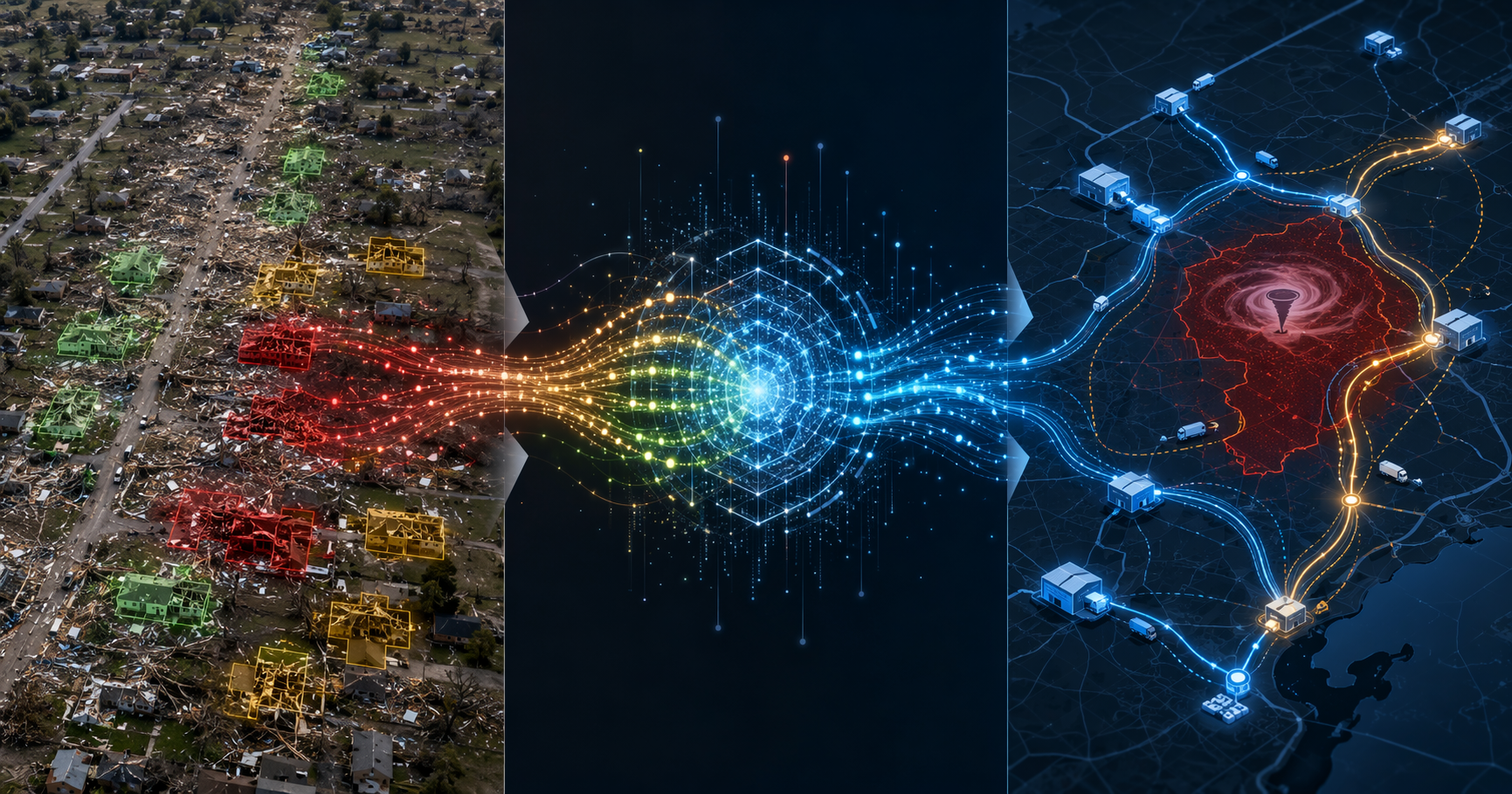
The credible operating model has three handoffs. First, AI converts post-impact imagery into a usable damage signal. Second, planning systems translate that signal into exposure across inventory, suppliers, orders, and demand. Third, a control tower recommends, and in limited cases executes, transportation and replenishment actions. Each handoff has a different evidence base. The tornado evidence is strongest at the damage-assessment stage. The supply chain and control-tower evidence is broader, drawn from extreme-weather, disaster-response, and AI operations research rather than from a clean public case study of AI-led tornado recovery.
| Recovery phase | What AI can know earlier | Action it can unlock |
|---|---|---|
| Damage signal | Which buildings and corridors show likely tornado damage, classified by severity | Prioritize site checks, carrier restrictions, supplier calls, and safety reviews |
| Supply exposure translation | Which SKUs, supplier sites, open orders, DCs, and store clusters depend on the affected area | Reposition inventory, release substitutes, protect critical demand, and call alternates sooner |
| Logistics action | Which lanes, loads, appointment windows, and replenishment plans conflict with the disruption | Recommend reroutes, rebalance loads, resequence deliveries, or escalate exceptions for human approval |
Phase 1: Damage Assessment Becomes an Operations Signal
Traditional tornado recovery starts with a badly timed information gap. The people who need to make network decisions are rarely the first people who can see the damage. Local emergency responders, utilities, facility managers, law enforcement, and carriers all see fragments. Supply chain planners receive those fragments unevenly, often after they have already made a conservative decision: hold shipments, suspend dispatch, delay replenishment, or wait for a verbal all-clear.
A deep learning damage model changes that sequence by turning imagery into a first operating layer. In the Texas A&M work, the model did not merely flag a broad disaster zone. It classified individual buildings into damage categories and inferred the tornado track from the distribution of observed damage.[1] That distinction matters. A polygon on a weather map tells a logistics team to be worried. A building-level damage layer tells it where to start.
In practical terms, the first useful output is a ranked set of assets and dependencies. A distribution center marked as major damage triggers a different workflow than a DC sitting outside the classified damage band but dependent on nearby roads or labor. A supplier facility classified as destroyed moves procurement into alternate-source mode. A store cluster surrounded by moderate or major damage may need emergency replenishment, temporary closure support, or demand suppression, depending on product category and safety conditions.
The under-one-hour assessment time is the operational hinge.[1] Manual inspection still matters; no responsible network lead would use satellite classification as a substitute for safety clearance. But the work that used to wait for confirmation can begin in parallel: freeze nonessential inbound loads to the affected node, identify trailers already en route, check appointment schedules, pull supplier exposure lists, and prepare alternate allocations for high-priority SKUs.
There is a boundary here that should stay visible. The Texas A&M model was tested on the 2011 Joplin EF-5 tornado, and broader validation across other tornado events, building types, imagery conditions, and operating regions remains a research issue.[1] That does not make the work less useful. It means the right adoption question is not “Can this model fully automate tornado recovery?” It is “Can this kind of model give the recovery team a defensible first signal sooner than field inspection alone?”
Phase 2: The Damage Map Has to Touch Inventory and Suppliers
A damage map by itself is still emergency intelligence, not supply chain recovery. The second phase begins when the organization joins that map to the boring systems that actually decide service: item-location inventory, supplier master data, open purchase orders, customer orders, transportation management, warehouse labor, and demand forecasts.
This is where predictive analytics earns its place. Once the affected buildings, corridors, or nodes are classified, the system can ask narrower questions: Which finished goods were supposed to ship from the affected DC tonight? Which raw materials depend on a supplier in the path? Which stores normally receive replenishment through a closed lane? Which substitute supplier is qualified, available, and close enough to matter? Which items will see demand rise because of cleanup, repair, medical, utility, or food needs?
That translation is not glamorous, but it is where hours saved upstream can turn into days saved downstream. If damage classification reaches planners while there is still time to redirect inbound trailers, the business may avoid sending product into a blocked node. If supplier exposure is calculated before phone confirmation arrives, procurement can prepare alternate-source calls with actual part numbers and order quantities rather than a general warning. If demand sensing sees likely spikes around impacted store clusters, inventory managers can protect scarce stock before routine replenishment logic drains it elsewhere.
The evidence for this phase is less tornado-specific. The World Certification Institute cites a Johnson & Johnson internal AI system that detected 85% of major supply disruptions an average of seven days ahead, and also cites 20% to 50% supply chain error reduction through AI early warning.[3] Those are useful signals about predictive supply chain practice, but the Johnson & Johnson figure is reported through an intermediary and should not be treated as independently verified tornado evidence.
Everstream Analytics’ 2026 weather-risk material is better used as context for exposure than as proof of tornado recovery performance. It supports the point that extreme weather is a live supply chain planning problem in 2026, but it does not by itself demonstrate that a specific company recovered from a tornado faster because of AI.[4] Resilinc’s Q3 2025 reporting that extreme-weather alerts rose 41% year over year is similar: relevant pressure on manufacturing supply chains, not a tornado-specific outcome study.[5]
A useful implementation pattern is to treat the post-tornado damage layer as a trigger, not a standalone report. When a supplier, DC, cross-dock, carrier terminal, or store cluster falls inside a classified damage zone, the planning system should automatically generate an exposure packet. That packet does not need to make the final decision. It should show open orders, inventory on hand, inventory in transit, constrained SKUs, alternate suppliers, customer priority, and the first safe decision deadline.
- For inventory: identify SKUs tied to damaged or uncertain nodes, then reserve or reposition stock before normal allocation consumes it.
- For procurement: rank alternate suppliers by qualification status, available capacity, distance, and contractual constraints.
- For customer service: flag orders likely to miss promise dates before the customer escalation queue forms.
- For finance and risk: separate likely lost capacity from temporarily inaccessible capacity, because those lead to different recovery costs.
The weakness in many resilience programs is that the first signal lands in a dashboard but not in the systems that move product. A regional map may show a tornado path clearly, while the transportation plan, supplier plan, and allocation plan continue running yesterday’s assumptions. AI only compresses recovery when the damage signal changes those assumptions fast enough for people to act.
Phase 3: Rerouting Is a Control Decision, Not Just a Map Line
Once the network knows what is damaged and what supply is exposed, the transportation problem becomes immediate. Loads are already rolling. Drivers may be approaching unsafe corridors. Carriers need instructions. DCs need revised appointment schedules. Stores need to know whether to wait, cancel, or accept partial deliveries. This is the phase where control towers and agentic AI get the most attention, and where the language often gets too clean.
A control tower can recommend reroutes, resequence deliveries, switch pickup points, rebalance inventory between DCs, and escalate exceptions when a tornado affects a logistics hub. SAP has described AI-powered control towers in terms of operating-model change and reports performance figures including 25% lead time reduction and 30% fewer unplanned outages.[6] Those figures should be read within SAP’s control-tower context, not as tornado-specific recovery proof.
Agentic AI adds another layer: systems that do not only surface exceptions, but propose actions across planning, sourcing, inventory, and logistics. ABI Research reported that 65% of supply chain professionals rate AI as important or very important for technology purchases, and that 57% of executives expect agentic AI to make proactive recommendations by 2026.[7] That shows where buying intent and expectations are moving. It does not remove the need to define which recommendations can be automated during a tornado and which ones still require approval.
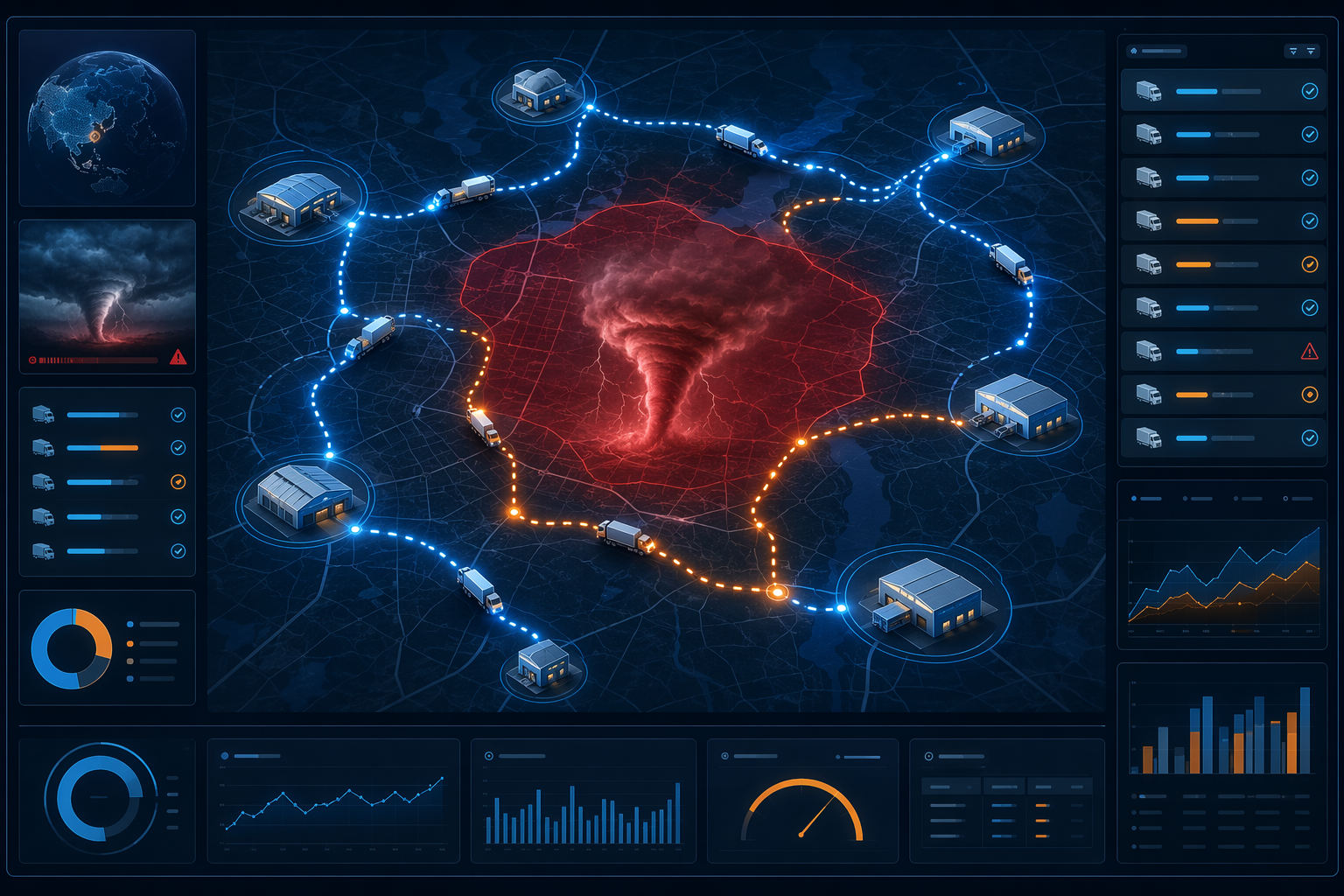
In a tornado recovery workflow, the safe automation boundary is usually narrower than the sales deck suggests. A system may automatically hold a noncritical load from dispatching into a classified damage zone. It may automatically propose a carrier lane around a closed corridor. It may automatically identify a lower-risk DC for replenishment. But decisions that affect driver safety, hazardous materials, customer allocation, contractual supplier substitution, or emergency-priority orders need governance.
The control tower also depends on data that is often weakest during disruption. If carrier GPS feeds are delayed, appointment data is stale, inventory accuracy is poor, or supplier records do not identify plant-level dependencies, the AI system may produce confident recommendations from bad inputs. The answer is not to keep humans doing everything manually. The answer is to decide in advance which data feeds are trusted, which recommendations require confirmation, and which roles have authority to approve exceptions when normal hierarchy is unavailable.
Samsara’s October 2025 State of Connected Operations reporting surveyed 1,550 emergency management professionals and found broad AI transformation across disaster operations, but its figures apply across disaster types rather than tornadoes alone.[8] The same source’s warning that 79% say frontline teams are not trained for digital tools in crises is more important for implementation than the adoption headline.[8] A rerouting recommendation that the night dispatcher, yard lead, or store operations team cannot interpret under pressure is not operational resilience. It is another queue.
Where the Three Phases Actually Compress Time
The strongest claim is not that AI turns tornado recovery into a fully autonomous process. The strongest claim is that it can shorten the blind interval between impact and coordinated supply chain action. That interval used to be filled with waiting: waiting for field inspection, waiting for supplier callbacks, waiting for road status, waiting for inventory exposure analysis, waiting for someone to reconcile competing versions of the truth.
A connected AI workflow attacks that waiting in sequence. Damage assessment reduces the time to a first location-specific view. Exposure analytics reduces the time to understand which products, orders, suppliers, and facilities are affected. Control-tower recommendations reduce the time to generate transportation and inventory options. None of those steps eliminates uncertainty. They move useful uncertainty to the surface earlier, while there is still time to choose among imperfect options.
For example, a hypothetical regional distributor with one DC near the tornado path should not wait for a complete facility inspection before doing any planning. With a building-level damage layer, the team can classify the DC as likely damaged, uncertain, or outside the main impact pattern. With inventory and order data connected, it can identify critical SKUs scheduled to leave that node. With a control tower, it can test whether nearby DCs, alternate carriers, or delayed shipments create a better service outcome. The final decision may still belong to the recovery lead, but the lead is no longer starting from a blank map and a phone tree.
That same logic applies to supplier substitution. A procurement lead does not need AI to say that a destroyed supplier facility is a problem. The value is in connecting the damage classification to the supplier’s parts, open purchase orders, approved alternates, qualification rules, customer commitments, and transportation options before the first round of calls is complete. Earlier does not mean reckless. It means the first supplier conversation can start with a part-level recovery plan instead of a general request for status.
The Evidence Is Promising, but Uneven
The tornado-specific literature is still thin. The Texas A&M damage-assessment work gives this use case its firmest footing because it addresses tornado damage directly and reports a clear time comparison against manual inspection.[1] The inventory, supplier, and rerouting phases rely more heavily on adjacent evidence from extreme-weather risk analytics, supply chain AI, control towers, and disaster operations. That synthesis is reasonable, but it should stay labeled as synthesis.
Vendor and intermediary claims can still be useful if they are kept in their lane. SAP’s control-tower figures speak to AI-enabled operations performance in that context.[6] ABI’s figures speak to market expectations around AI and agentic recommendations.[7] Resilinc and Everstream help establish that weather-related supply chain exposure is a current planning concern.[4][5] None of them proves that a company recovered from a tornado in hours because an autonomous system rerouted the entire network.
That distinction matters for investment decisions. A supply chain leader trying to justify AI for tornado recovery should not sell a single magic layer. The defensible business case is built around connected readiness: imagery access, damage models, asset geocoding, clean supplier and inventory data, transportation visibility, predefined approval rules, and trained operators. Remove any one of those, and the three-phase workflow starts to break.
What to Build Before the Sirens
The implementation work starts before tornado season, not after the warning expires. The first requirement is geocoding the network at a useful level of detail. Corporate addresses are not enough. The system needs facility coordinates, supplier plant locations where available, carrier terminals, critical cross-docks, store clusters, repair depots, and inventory nodes. If the damage model can classify buildings but the supply chain system only knows suppliers at headquarters level, the handoff fails.
The second requirement is exposure logic. The organization should define which products, customers, suppliers, and lanes become critical when a node is damaged or inaccessible. A food distributor, an automotive parts supplier, a building-materials network, and a medical-products company will not rank the same SKUs the same way. AI can surface options quickly, but it needs business rules that describe what matters when capacity is scarce.
The third requirement is an approval model for automation. Some actions can be low-risk: hold a planned shipment, alert a carrier, create an alternate route proposal, or generate a supplier exposure packet. Others need human review: diverting scarce inventory away from one customer to another, using an alternate supplier under emergency terms, sending a driver near a disputed hazard zone, or overriding a customer allocation rule. Those boundaries should be set while everyone is calm.
Training is not a side issue. During a tornado response, the people touching the system may not be the architects who bought it. Dispatchers, warehouse supervisors, procurement analysts, store operations teams, and customer service leads need to know what an AI recommendation means, what confidence it carries, and when they are allowed to override it. The recovery plan should include drills where the imagery layer, supplier exposure packet, and rerouting recommendations are used together, not demonstrated separately.
AI can compress tornado supply chain recovery when the organization connects rapid damage assessment to inventory, supplier, and transportation systems, and when people are prepared to govern the recommendations that follow. The useful ambition is not replacing the disaster recovery team. It is shortening the blind interval between impact and coordinated action.
References
- Tech Meets Tornado Recovery — Texas A&M University, May 14, 2025.
- Is Your Supply Chain Ready for the 2025 Tornado Season? — Falvey Insurance Group.
- From Reactive to Proactive: How AI-Driven Supply Chains Weather Every Storm — World Certification Institute.
- 2026 Weather Risk for Supply Chains — Everstream Analytics.
- Top 5 Manufacturing Supply Chain Disruptions in Q3 2025 — Resilinc, Q3 2025.
- Autonomous Supply Chain: Why Agentic AI Is Rewriting the Operating Model — SAP News, June 2026.
- Supply Chain Disruptions 2026: How to Build Resilience with AI and Automation — ABI Research.
- Samsara Study Reveals Majority of Businesses Vulnerable to Disasters — Samsara, October 2025.
Comments
Join the discussion with an anonymous comment.