
Blanket recalls are usually where precision goes to die. A quality team has a credible defect signal, an executive decision is made, and then distribution operations has to pull more product than anyone is sure is affected because the organization cannot prove, quickly enough, where the suspect units actually moved. The warehouse gets broad instructions. Wholesalers get broad notices. Pharmacies wait for direction. Someone starts building the audit file from emails, spreadsheets, call logs, portal exports, and screenshots.
That is the real operating problem behind AI for pharmaceutical recall supply chain management. The point is not to let a model decide a recall. The point is to use AI against trusted DSCSA serialization data so the recall team can narrow the affected universe from a broad lot, shipment lane, or customer population to the actual lot and serial-number-level product movements that need action.
The baseline is not small. A 2012–2023 FDA data analysis found about 330 drug recalls per year on average, each involving about 400,000 units, with a median recall duration of 1.3 years.[1] That duration is what matters operationally: not just the day the recall is announced, but the long tail of finding product, confirming disposition, reconciling responses, and keeping evidence defensible.
Regulated teams also have reason to keep severity on the radar. RAPS reported FDA discussion of an uptick in Class I recalls in 2025, although that context should not be overread as a drug-only trend because the discussion also involved medical-device recall pressures.[2] The safer conclusion is narrower: recall operations are under scrutiny, and a faster interface is not enough if the underlying traceability remains incomplete.
What makes a recall surgical
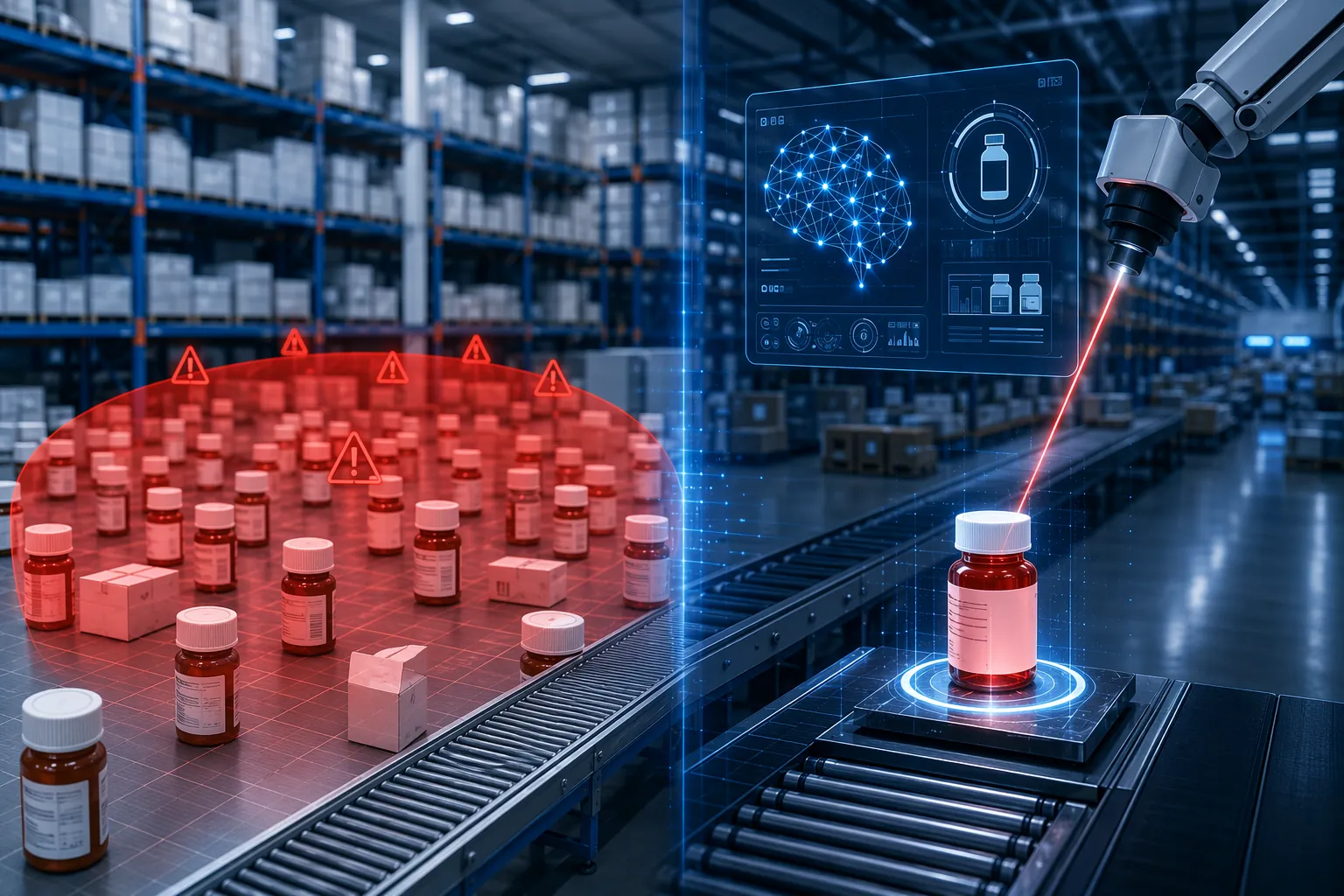
A surgical recall is not simply a smaller recall. It is a recall where the team can show why the scope is smaller: which product identifiers are implicated, where those serialized units went, which trading partners received them, which parties were notified, what responses came back, what inventory was quarantined or returned, and who approved closure.
DSCSA serialization is the substrate. AI is the accelerator. Serialization gives the system product identity and movement history. AI helps read noisy signals, match them to structured and semi-structured records, generate tasking, and keep reconciliation from turning into a manual chase. A deeper explanation of that data layer is covered in AI-Enhanced DSCSA Data Speeds Up Medication Recalls.
The difference shows up in the first hours. In a blanket process, the coordinator is still asking where suspect product might be. In a serialization-native process, the first question becomes whether the affected GTIN, lot, expiration, and serial-number population can be matched to EPCIS events and trading-partner records with enough confidence to support action.
The workflow that actually has to work
The strongest claims about AI recall speed only make sense if the workflow is already connected from signal intake through closure. LSPedia has reported up to a 90% reduction in manual recall labor from operational testing with early adopters.[3] Honeywell has described AI-assisted TrackWise Recall Management as moving recall execution from weeks to minutes.[4] Those are vendor-reported outcomes, not independent industry benchmarks. They are still worth paying attention to because they point to the same bottleneck: recall teams spend too much time assembling the affected population before they can manage it.
Signal detection starts before the recall package is clean
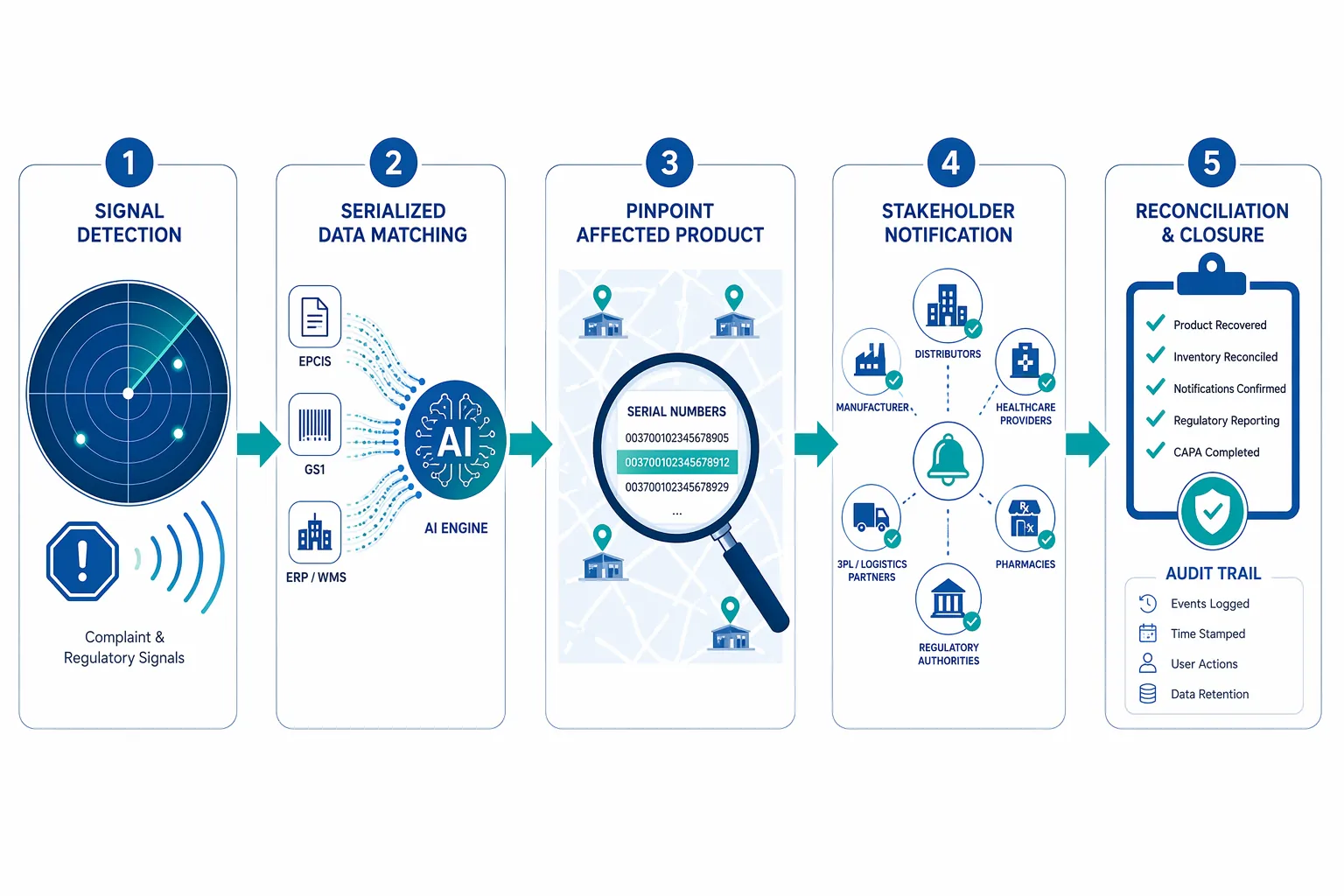
The first useful AI job is not dramatic. It is intake. Complaint narratives, field notices, regulatory alerts, internal deviation records, supplier messages, adverse quality reports, and customer emails rarely arrive in the same format. A model can classify them, extract product names, lot references, packaging levels, dates, customer names, and defect language, then route the signal for human review.
This is where teams have to resist automation theater. A complaint cluster is not automatically a recall. A regulatory alert is not automatically a finished scope. The value is that the QA lead sees the suspected product universe sooner, with source documents attached, instead of waiting for someone to manually normalize every mention of a product across inboxes and spreadsheets.
Serialized matching narrows the suspect universe
Once the signal is credible, the system has to match it against serialized data. In practice, that means using GS1 identifiers and EPCIS event history to connect the recall trigger to product master data, lot and batch records, packaging hierarchy, shipment events, receiving events, returns, saleable-return verifications, and any available trading-partner status updates.
A lot-level recall can still be broad. A serial-number-level recall can be much tighter if the defect is tied to a packaging event, a shipment condition, a partial distribution pattern, or a known subset of product movement. The system should be able to show the recall coordinator which serials are in internal inventory, which were shipped, which were received downstream, which appear to have been dispensed or otherwise removed from available inventory, and where there are gaps.
That last category matters. A mature platform should not hide uncertainty. If a wholesaler has not returned an EPCIS event, if a location record is stale, or if aggregation data is broken between case and each-level units, the workflow needs to flag that exception. Surgical recall management depends as much on visible incompleteness as on clean matches.
Pinpointing has to reach the floor, not just the dashboard
A dashboard that identifies affected serial numbers is only halfway useful. The instruction has to reach the warehouse floor, the 3PL, the wholesaler portal, the pharmacy notification path, and the audit file. The recall coordinator needs work queues: hold these units, block these shipments, notify these trading partners, confirm disposition for these locations, escalate non-response after the defined interval.
This is where AI can reduce the handwork without owning the regulated decision. It can draft notifications from approved templates, populate affected product tables, assign recipients based on serialized movement records, suggest escalation lists, and detect mismatches between the recall scope and downstream responses. Human reviewers still approve the recall strategy, message content, regulatory posture, and closure rationale.
Notification is a routing problem and an evidence problem
Good notification is not measured by how many emails went out. It is measured by whether the right party received the right instruction for the right product, whether that party had enough information to act, and whether the sponsor can prove the instruction was sent, received, acknowledged, and completed.
For a manufacturer, the recipient set may include wholesalers, specialty distributors, 3PLs, repackagers, health-system pharmacies, retail chains, and internal quality or customer-service groups. For a distributor, the same event may require customer quarantine instructions, manufacturer coordination, return authorization, and inventory blocking. AI can help assemble those paths from trading-partner and shipment data, but the system still needs role-based approvals and controlled templates because recall communication is not ordinary customer messaging.
Closure depends on reconciliation, not announcement
The recall is not operationally closed when the notice leaves the building. It closes when the affected product has been accounted for according to the approved plan, exceptions have been dispositioned, non-responders have been escalated, and QA can defend the final reconciliation.
An AI-supported workflow should track acknowledgments, returned quantities, quarantine confirmations, destruction records, replacement shipments, credit activity, and unresolved serials against the original affected population. It should also preserve the version history: when scope changed, who approved it, which notification version went to which party, and what evidence supported closure.
| Recall stage | AI can help by | Human accountability remains with |
|---|---|---|
| Signal intake | Classifying complaints, alerts, notices, and deviation language | QA and pharmacovigilance or complaint-handling owners |
| Serialized matching | Linking product signals to GTIN, lot, serial, aggregation, and EPCIS movement data | Recall coordinator, serialization lead, and quality approver |
| Scope definition | Showing affected, unaffected, and uncertain product populations | Recall committee or designated GxP decision authority |
| Notification | Drafting controlled communications and routing them to trading partners | Authorized recall communication owner |
| Reconciliation | Tracking acknowledgments, quantities, exceptions, and closure evidence | QA lead and recall owner |
Why DSCSA data quality decides the outcome
DSCSA has pushed the industry toward interoperable, electronic, serialized traceability, and that pressure is what makes targeted recall automation possible. Inmar frames DSCSA as part of a shift toward faster, more effective drug recalls, while ARVO describes smart recall management as the combination of AI and traceability rather than AI alone.[5][6]
The distinction is not academic. If EPCIS data is missing, late, duplicated, or mapped inconsistently, the model has to work around a traceability problem it cannot truly solve. It may find likely matches. It may prioritize exceptions. It may make the user interface cleaner. It cannot create a defensible serialized movement history where trading partners never exchanged one.
The organizations positioned to extract recall value first are the ones that have already made serialization operational, not just compliant on paper. They know whether aggregation holds when cases are broken. They know which partners send usable EPCIS events. They know where returns, samples, damaged goods, and 3PL handoffs fall out of the clean data path. They have people who can investigate exceptions without treating every mismatch as an IT ticket for next quarter.
That maturity also changes the business case. TraceLink’s CEO has estimated that 40% of pharma distribution cost is compliance-related and amenable to automation, while also describing targeted recalls enabled by serialized data.[7] That figure should be treated as an executive estimate from an industry platform provider, not a settled benchmark. Still, it captures why recall automation budgets increasingly sit between compliance, distribution, and network operations rather than inside quality alone.
For a more detailed cost lens, see How AI Transforms the Economics of Drug Recall Management. The short version for recall owners is simpler: automation pays off only when it reduces the manual proof burden, not merely when it produces a faster list.
Governance cannot be bolted on after the model
Every serious recall platform has to answer the same uncomfortable questions: who can change scope, who can approve notification language, who can override an AI match, who can close an exception, and how the system preserves the evidence. These are not administrative preferences. They determine whether the recall record can survive inspection.
Human-in-the-loop governance should be explicit at the decision points that carry GxP consequence. AI can recommend that a serial population is implicated; an accountable person approves the recall scope. AI can draft the stakeholder notice; an authorized reviewer approves release. AI can flag a non-response; the recall owner decides escalation. AI can propose closure readiness; QA signs off against the approved procedure.
The audit trail should capture both the model-assisted output and the human action taken on it. If a coordinator excludes a set of serials because investigation shows they never left controlled inventory, the system should retain the evidence. If the team expands scope because an EPCIS gap makes the downstream location uncertain, that should be just as visible. A surgical recall is defensible only when the reasons for precision are documented.
Change management matters most where it affects data capture and sign-off authority. If warehouse users bypass scanning because the hold process is clumsy, if a trading partner portal is not monitored, or if local teams respond outside the controlled workflow, the recall record starts to fragment again. The model may still be impressive, but the operation has returned to emails and reconciliation calls.
Where the vendor approaches differ
The vendor landscape is easier to evaluate by workflow center of gravity than by feature checklist. Most credible tools will talk about AI, automation, notifications, and dashboards. The better question is where the recall record naturally lives and how close the platform sits to serialized movement data.
| Approach | Best fit | What to validate |
|---|---|---|
| Serialization-native recall operations, such as LSPedia’s recall module | Organizations that want recall execution to start from DSCSA serial, lot, aggregation, and trading-partner traceability data | Whether partner EPCIS exchange, exception handling, and recall reconciliation are production-ready across the real network |
| Network or platform traceability, such as TraceLink’s ecosystem approach | Companies that need recall scope and communication to operate across a broad external trading-partner network | Whether targeted recall workflows are embedded enough for QA approval, field notification, and closure evidence |
| QMS-led recall management, such as Honeywell TrackWise Recall Management | Organizations whose recall governance, CAPA linkage, and quality-event records already live in QMS processes | Whether serialized product matching is deep enough, not just attached as data imported into a quality workflow |
| ERP-centric curation and assistant workflows, such as Oracle-style recall support | Companies that coordinate inventory, orders, customer records, and financial disposition primarily through ERP | Whether the tool can preserve GxP recall evidence while reaching beyond internal inventory into trading-partner traceability |
Serialization-native platforms have an obvious advantage when the core question is “which serialized units moved where?” QMS-led platforms may be stronger when the recall is tightly coupled to deviations, investigations, CAPA, and quality approvals. ERP-centric tools can be practical when the hardest work is inventory blocking, order impact, returns, and financial settlement. None of those centers of gravity is automatically wrong. The risk is choosing a system that is elegant in its home domain but weak at the handoffs where recalls fail.
Vendor-reported speed claims should be tested against a company’s own data conditions. Ask for a demonstration using imperfect partner records, partial aggregation breaks, mixed internal and 3PL inventory, and a scope change after the first notification. A clean demo dataset can make almost any recall look surgical.
What to test before trusting the speed claim
A useful pilot should follow one recall scenario all the way through. It does not need to be theatrical. It needs to prove that the system can move from signal to serialized scope to stakeholder action to reconciliation without losing control of the record.
- Start with a known product and lot, then introduce a narrower affected serial population to see whether the tool can avoid over-pulling.
- Include internal inventory, 3PL-held product, wholesaler movement, and at least one incomplete trading-partner response.
- Require the system to show affected, unaffected, and uncertain product separately.
- Route notifications through the actual approval chain, not a sandbox-only shortcut.
- Reconcile acknowledgments, quantities, exceptions, and closure evidence against the original serialized population.
- Export or review the audit trail as QA and an inspector would see it.
A historical or hypothetical contamination scenario can help users see the contrast between manual and AI-supported recall response. The key is to keep the exercise honest: if the old process would have required broad outreach because serial-level downstream data was unavailable, the AI workflow should mark that uncertainty rather than pretending the product was precisely located. For an applied example of that contrast, see How AI Tracking Would Have Changed the Cetirizine Recall.
The conditional promise
AI can make pharmaceutical recalls more surgical when DSCSA serialization data is usable, exchanged, and governed. It can reduce the time spent reading unstructured signals, matching product records, building notification lists, chasing acknowledgments, and assembling the closure file. Under the right data conditions, vendor claims about moving from weeks toward minutes are plausible for parts of the workflow, especially scope identification and communication preparation.
Without that foundation, the same tools become faster interfaces on top of incomplete traceability. They may still help organize work, but they cannot prove where affected product went, who acted, or why a narrower scope was justified. In recall management, precision is earned in the data before it appears on the screen.
References
- The continuing challenge of drug recalls: Insights from a ten-year FDA data analysis — ScienceDirect, 2024.
- MedCon: FDA sees uptick in class I recalls in 2025 — RAPS.
- Next-Generation Serialized Recall Module Launched at HDA Traceability Seminar — LSPedia.
- Honeywell AI-Assisted Recall Software — Honeywell, May 2025.
- DSCSA and the New Era of Faster, More Effective Drug Recalls — Inmar.
- Smart Recall Management: AI & Traceability in Pharma — ARVO.
- How DSCSA Compliance Is Unlocking Recall Efficiency — Pharmaceutical Commerce.
Comments
Join the discussion with an anonymous comment.