
The hardest forecast for a fast food new menu launch is usually due before the first order is ever placed. The item has cleared concept work. Marketing has a window. Procurement needs to know whether a sauce, shell, protein, topping, or packaging component should be positioned nationally or held regionally. Distribution centers need space. Operators want enough inventory to avoid a launch-week miss, but not so much that they inherit the write-off if the item underperforms.
That is where traditional demand forecasting runs out of road. A statistical model can learn seasonality, weekday patterns, store-level velocity, and price response when a SKU has history. A new menu item or limited-time offer has none. For launch planning, the useful question is not whether AI can “improve forecasting” in a general sense. It is whether AI supply chain planning for fast food new menu launch decisions can create a defensible first forecast when the POS line is still blank.
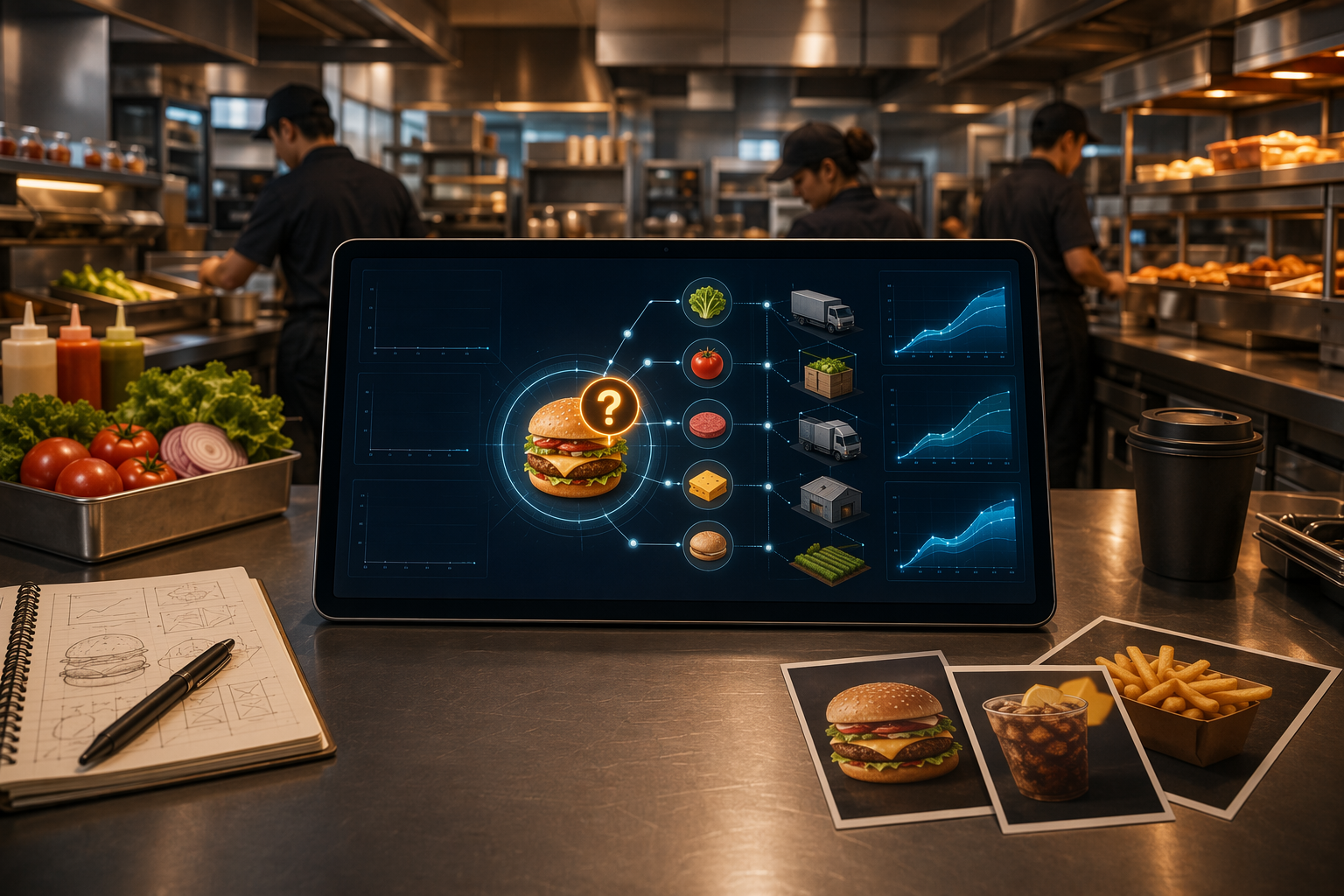
The better answer starts with attributes and analogs. Instead of asking the model to learn from sales history that does not exist, the chain describes the new item in operationally meaningful terms, compares it with similar past launches, produces a pre-launch forecast from those analogs, and then updates the forecast as early sell-through arrives. It does not make launch planning automatic. It makes the first call less blind.
Why New Menu Launches Break the Usual Forecast
A QSR launch forecast has to serve decisions that are more physical than the forecast itself. How much inventory should be committed before launch? Which restaurants need additional delivery frequency? Which distribution centers need to hold incremental cases? Which ingredients are shared with the base menu, and which ones become stranded if demand misses?
A successful item can be just as stressful as a weak one. Taco Bell’s Doritos Locos Tacos sold 100 million units in its first 10 weeks, after a three-year development cycle, and required Frito-Lay to build six dedicated production lines for the shell. That case predates current AI planning platforms, so it should not be treated as an AI example. It is useful because it shows the upstream burden a hit launch can create before the system has settled into a normal replenishment rhythm.[1]
The downside risk is not only sellout. Overbuying a unique ingredient, over-positioning a launch-only package, or tying up DC slots can create a different failure mode: the restaurants may execute the campaign, but the supply chain pays for uncertainty afterward. CPG research is an imperfect but relevant analog here. A 2021 Marketing Letters study summarized by Tremendous examined 83,719 CPG SKUs and found that about 25% of new products failed by year one and about 40% failed by year two, with supply chain misplanning identified as a major contributor. Those are CPG figures from a historical product sample, not QSR menu-launch failure rates, but they put useful pressure on the idea that launch planning is only a marketing bet.[2]
The Attribute-Based Answer to the Cold Start
Cold-start forecasting is the planning problem created when a product has no historical demand record of its own. In a fast food chain, the item still has information attached to it. It has a product family, meal occasion, price point, protein or base ingredient, flavor profile, preparation method, daypart, channel emphasis, promotional support, menu placement, regional relevance, and operational complexity.
Those attributes become the bridge between a blank SKU history and a usable launch forecast. The model is not guessing from the name of the item. It is using a structured description of the new item to find older launches that behaved similarly enough to be informative.
| Planning object | What it means in a new menu launch |
|---|---|
| Product attributes | Structured descriptors such as protein, flavor, format, price tier, daypart, prep burden, packaging, and promotional support. |
| Analog database | A history of prior launches and LTOs tagged with the same attributes, plus their actual sell-through and supply chain outcomes. |
| Pre-launch simulation | A model run that projects demand and operational impacts before the launch goes live. |
| Early sell-through learning | The forecast update that happens when first-day and first-week sales begin to reveal real demand. |
AWS published a vendor benchmark for Amazon Forecast in 2022 showing that cold-start forecasts generated with product metadata could be up to 45% more accurate than prior cold-start methods. The methodology matters: this is a vendor-run machine learning benchmark, not a QSR-specific field result, and “up to” should not be read as a guaranteed lift in restaurant launch planning. Still, the benchmark supports the central mechanism: when history is absent at the item level, attributes can carry predictive signal.[3]
The Workflow That Turns a No-History Item Into a Launch Forecast
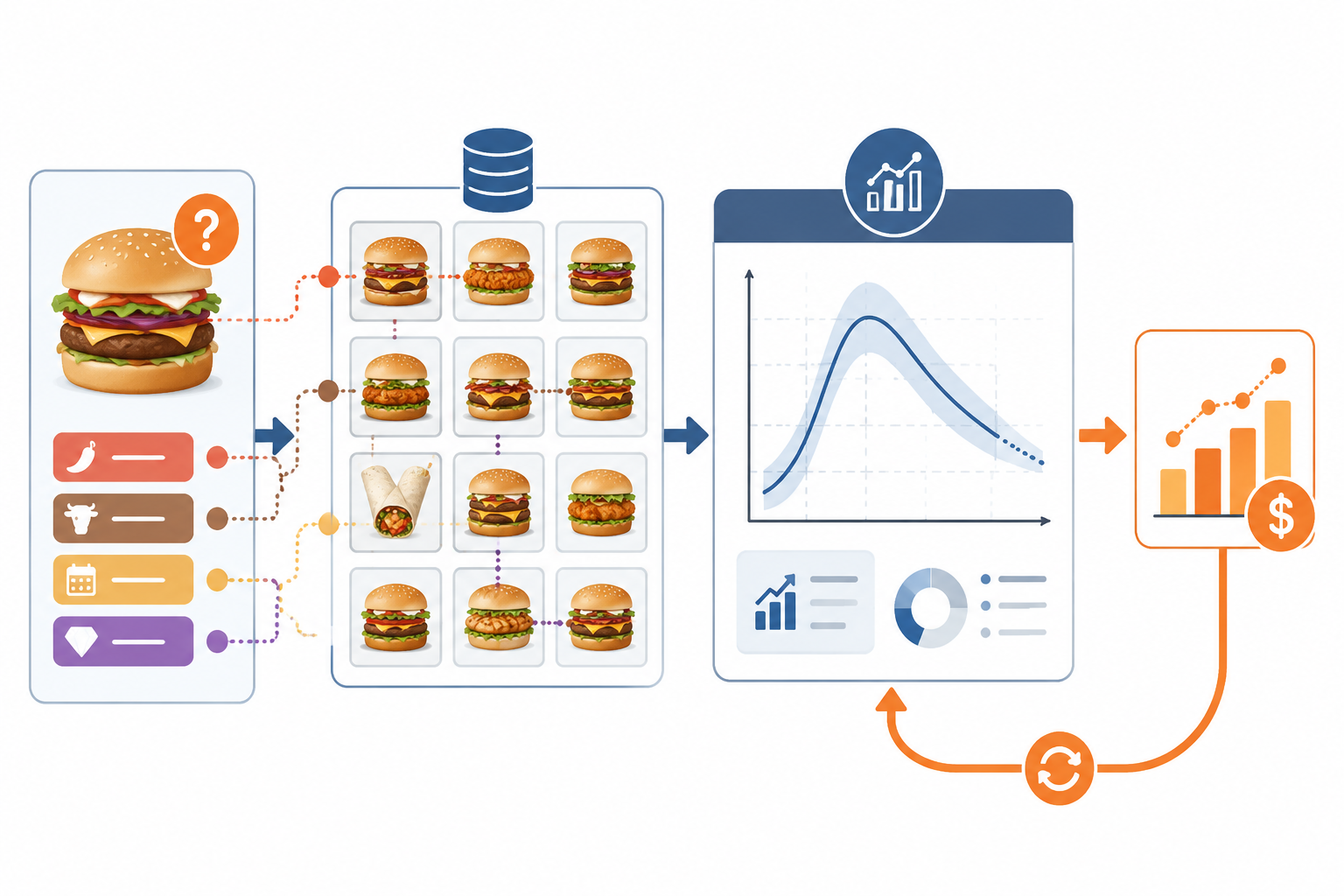
A workable attribute-based process is not just a model selection exercise. It is a planning workflow that starts with merchandising and ends in inventory, delivery, and store execution. The sequence usually looks like this:
- Create a launch attribute taxonomy that planners, culinary, marketing, supply chain, and operations can all use consistently.
- Build an analog database from prior new products, LTOs, regional tests, and comparable menu changes.
- Generate a pre-launch demand forecast by matching the new item to relevant analogs and adjusting for campaign, timing, price, and footprint.
- Translate the forecast into ingredient buys, DC positioning, production commitments, delivery plans, and restaurant-level guidance.
- Update the forecast as early sales arrive, separating genuine demand signals from launch-week noise where possible.
The first two steps decide whether the rest of the system has anything useful to learn from.
The Taxonomy Has to Match How the Chain Actually Operates
A launch taxonomy is not a product description written for the menu board. It is a planning language. “Spicy chicken sandwich” is not enough. The supply chain needs to know whether the chicken is shared with an existing item, whether the sauce is unique, whether the bun or package is new, whether prep time changes labor flow, whether the product is likely to skew toward dinner or late night, and whether marketing will push trial nationally or concentrate support in selected markets.
The same item can carry different planning risk depending on which attribute changes. A flavor extension using existing proteins and packaging is a different problem from a new platform with a unique component. A regional LTO with local media is a different problem from a national launch attached to a major campaign. The model needs those differences in structured form, not buried in meeting notes.
This is where cold-start forecasting often fails in practice. The supply chain team may own the forecast, but merchandising and marketing own much of the information that makes the forecast useful. If the launch is treated as a supply-chain-only project, the model sees a thin record. If it is treated as a cross-functional data asset, the model gets a fuller description of why one item might behave like a prior launch and unlike another.
The Analog Database Is the Hard Part
The analog database is the chain’s memory of prior launches. It should include the attributes known before launch, the forecast issued at the time, actual demand by store or market, media and promotion details, supply constraints, substitutions, stockouts, waste, and any operational notes that explain distorted sales. A launch that sold poorly because demand was weak should not be treated the same as a launch that sold poorly because a unique ingredient was short.
Depth matters more than decoration. A chain with many years of well-tagged LTOs, test-market items, limited regional offers, and national rollouts has a real base for matching. A chain with scattered launch recaps in slide decks and inconsistent SKU mappings has a cleanup project before it has an AI project.
Good analog matching does not mean finding one perfect historical twin. Most new items do not have one. The model may need to weight several prior launches: one that matches flavor intensity, another that matches price tier, another that matches campaign scale, another that matches operational complexity. The planner’s job shifts from inventing a number in a spreadsheet to reviewing whether the analog set makes operational sense.
That review is not a ceremonial override. It catches cases where the data is technically similar but commercially misleading. A past item may share attributes with the new launch but have run during an unusual promotion, a supply shortage, a different media environment, or a narrow geography. AI can surface the candidates; launch planners still need the authority to reject weak analogs and document why.
The Pre-Launch Forecast Should Produce Supply Chain Decisions, Not Just Demand Curves
A launch-day forecast that stops at projected units is unfinished. For QSR, the useful output is the translation from menu demand into component demand and operating load. If the forecast says a new item will sell at a given velocity, the system has to convert that into cases of a unique sauce, pounds of protein, packaging requirements, DC slotting pressure, delivery capacity, and restaurant-level inventory guidance.
This is why pre-launch simulation belongs close to forecasting. McDonald’s All-Day Breakfast rollout, modeled by HAVI using AnyLogic, examined more than 14,000 restaurant configurations. The case was not specifically an attribute-based AI forecasting example, but it shows the planning value of modeling how the same menu change behaves across different restaurant operating conditions.[4]
For a new fast food item, that same logic matters before the first purchase order is finalized. A forecast may look manageable at the national level while hiding stress in a subset of stores: small back rooms, higher drive-thru mix, limited freezer space, remote delivery routes, or markets where the item’s attributes are likely to over-index. The launch plan needs to know where average demand is not the real constraint.
Plan Optimus describes AI-enabled QSR planning platforms as capable of modeling product launches and projecting ingredient, distribution center, and delivery impacts before rollout. That is a vendor perspective rather than independent evidence, but it reflects the right implementation target: the forecast has to become a supply chain plan, not a dashboard that procurement still has to translate manually.[5]
The First Week Is Not the End of the Forecast
The first forecast is made from attributes and analogs. The second forecast should learn from actual sell-through. Once restaurants begin ringing sales, the model can compare early velocity against the analog-based expectation and adjust demand by store cluster, region, daypart, and channel.
This feedback loop is where fast food launches can move from “reasonable initial allocation” to better replenishment. If early sales are stronger than expected in high-drive-thru suburban stores but ordinary in dense urban units, the chain should not wait for a full campaign recap to adjust supply. If trial spikes on day one and then falls back toward the analog pattern, the system should not mistake every opening surge for sustained demand.
The practical discipline is to separate sell-through signals from execution noise. A weak first week may reflect low demand, but it may also reflect late deliveries, training issues, POS configuration problems, app merchandising, or stores rationing inventory. A strong first week may reflect media concentration, trial incentives, influencer attention, or a one-time novelty effect. Early learning is powerful only when planners can see which restaurants actually had product available and which constraints shaped the sale.
How to Pilot Without Pretending the Whole Chain Is Ready
The cleanest implementation path is phased. Start with the foundation: define the attribute taxonomy and build the analog database. Then map value in one category or launch type where the chain has enough history to learn from. Scale only after the pilot proves that the forecast can be translated into better decisions for ingredients, DC inventory, delivery planning, or store allocations. Optimization comes later, when in-season learning is mature enough to adjust the second-week and third-week plan.
Impact Analytics’ 2026 playbook says cold-start deployment can reach a first live category within one selling season. That is a vendor implementation claim, not a neutral industry benchmark, but it is a useful expectation setter: the first credible use case does not have to cover every menu category or every launch pattern at once.[6]
A narrow pilot is also easier to judge. A chicken LTO, beverage platform, breakfast item, dessert, or sauce-led promotion each has different analog quality and operational consequences. The first pilot should sit where past launch data is deep enough, attributes are stable enough, and supply chain consequences are visible enough to measure. A glamorous launch with thin analog history may be a poor first test.
The pilot should measure planning decisions, not only forecast accuracy. Did procurement buy closer to actual need? Did DC inventory sit in the right markets? Did emergency transfers decrease? Did restaurants have fewer stockouts or less leftover launch-only inventory? Did the second forecast materially improve after early sell-through arrived? A model can look better on paper and still fail to change the launch plan in time.
What Makes the System Fail
The most common failure mode is shallow analog data. If prior launches are not tagged consistently, if stockouts are not captured, if media support is missing, or if item hierarchies changed without a bridge table, the model may find mathematical neighbors that are not planning neighbors. The answer is not to add a larger model on top of weak memory. The answer is to repair the memory.
A second failure mode is late involvement from the teams that control launch facts. Marketing may know that the media plan is unusually heavy. Culinary may know that a component has production constraints. Operations may know that a build is harder than it appears. Procurement may know that a supplier has a minimum run size. If those facts arrive after the forecast is issued, the AI workflow becomes another version of the old spreadsheet scramble.
A third failure mode is treating early sales as pure demand. In QSR, availability and execution shape observed demand quickly. A restaurant that runs out at dinner teaches the model something different from a restaurant that had inventory and still sold slowly. Feedback loops need supply and execution context, or they will learn from distorted sales.
The governance question is simple: who is allowed to change the forecast, and who owns the consequence? A useful launch-planning system gives demand planning, merchandising, marketing, supply chain, and operations a shared view of the assumptions. It also records overrides so the next launch can learn whether the human adjustment improved the plan or only made everyone feel safer before launch.
The Bounded Promise
Attribute-based AI forecasting is a strong fit for fast food new menu and LTO planning when the chain has enough prior launch data, a disciplined attribute taxonomy, and cross-functional ownership of the inputs. It directly addresses the cold-start problem because it does not wait for SKU-level history to exist. It uses what the chain already knows before launch: what the item is, how it compares with prior items, where it will run, how it will be promoted, and what operational burden it creates.
The credible goal is not autonomous launch planning. The credible goal is a better first forecast before procurement commits, before DCs reserve space, and before operators inherit the launch. Then, once early sell-through arrives, the system should make the second-week forecast materially smarter than the launch-day guess.
References
- Taco Bell’s Doritos Locos Tacos: 100 million sold — Restaurant Business, 2012
- Why new product launches fail & how to avoid it — Tremendous Blog, 2021
- Generate cold start forecasts for products with no historical data using Amazon Forecast — AWS Machine Learning Blog, 2022
- McDonald’s HAVI AnyLogic simulation modeling All-Day Breakfast rollout — AnyLogic
- AI-Enabled Supply Chain & Inventory Planning in the Quick Service Restaurant Industry — Plan Optimus, 2025
- AI Forecasting for New Product Launches: 2026 Playbook — impactanalytics.ai, 2026
Comments
Join the discussion with an anonymous comment.