
The practical question is not whether an AI model can make a weather map look smarter. It is whether a monsoon forecast can arrive early enough to change a purchase order, a lane plan, or a stock position before the rain turns into expediting.

What Has Actually Been Proven
The first useful signal is not hype about AI, but a benchmark that moved. In Nature, NeuralGCM was reported to produce ensemble forecasts more accurate than ECMWF-ENS 95% of the time for 2-to-15-day forecasts, while running more than 3,500 times faster than X-SHiELD and about 100,000 times less computationally expensive, with a one-year simulation taking 8 minutes instead of 20 days. That speed matters because operational planning cycles cannot wait for a long compute queue, even when the forecast is strong [1].
For monsoon-specific planning, the more relevant result is the subseasonal one. A Caltech study published in PNAS reported that an ML model improved South Asian monsoon rainfall prediction correlation with observations by up to 70% on the 10-to-30-day horizon, which is the range where planners start deciding whether to pull inventory forward, hold back shipments, or hedge procurement earlier than usual [2].
Why Deployment Matters More Than a Demo
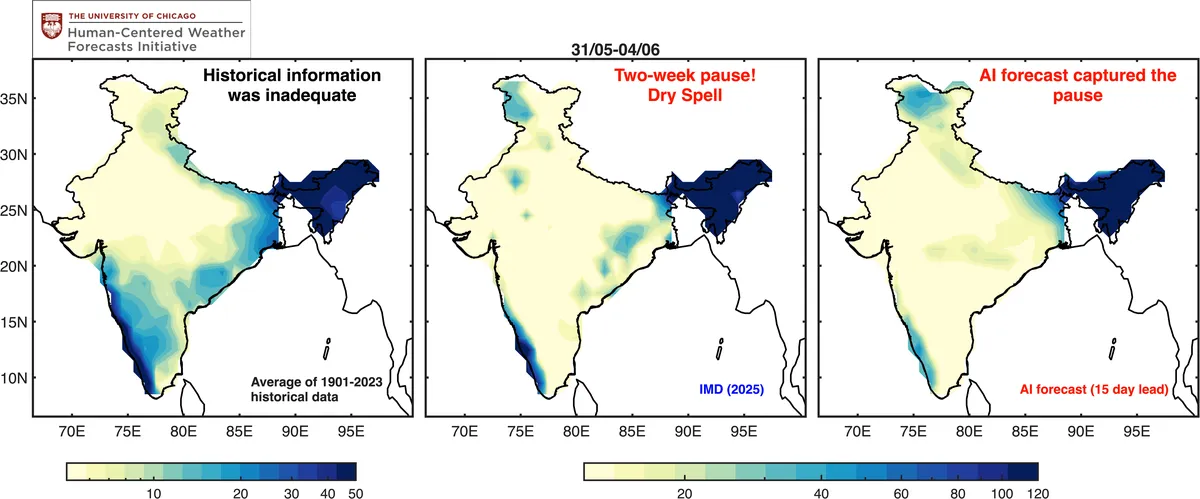
The strongest evidence that this is already operational came in India's 2025 summer growing season, when NeuralGCM was blended with ECMWF AIFS and historical data and delivered by SMS to 38 million farmers. The reporting around that rollout says advance forecasts up to one month ahead nearly doubled participating farmers' annual income. That is not a supply chain case, but it is the kind of scale that makes it hard to dismiss the capability as a lab curiosity [3].
The logistics consequence is easier to see once the weather touches roads and delivery windows. In affected regions, monsoon conditions can increase transportation time by up to 40% and costs by 15%, which means a forecast only matters if it reaches the people deciding whether to ship now, wait, reroute, or stage inventory elsewhere [4].
| Planning move | What the forecast changes |
|---|---|
| Demand planning | Adjusts expected sell-through before weather shifts buying patterns or store access |
| Inventory positioning | Moves critical stock closer to the risk zone before roads, ports, or yards slow down |
| Logistics routing | Adds buffer time or changes lanes before congestion and flooding create avoidable delays |
| Procurement hedging | Buys earlier or qualifies alternates when weather threatens harvest, supply, or delivery windows |
The Business Case Is Real, but Not Monsoon-Only
Adjacent cases help show the pattern without pretending they are identical to monsoon planning. ClimateAi says Suntory uses its platform to project 30% to 40% yield declines in specific commodity locations and to receive alerts 5 to 7 days before market awareness, but that example is about longer-term climate exposure, not a seasonal monsoon forecast. It is still useful because it shows how a weather signal can become a procurement decision rather than a slide in a risk review [5].
A separate ClimateAi case says a building materials company captured $15 million in additional sales during Hurricane Ian by pre-positioning inventory ahead of the storm. That is hurricane-specific, not monsoon-specific, but it demonstrates the commercial pattern planners care about: forecast, inventory decision, sales outcome [6].
There are also cleaner fleet and demand-planning analogs. Kearney's 2025 write-up of P&G says AI-based demand forecasting will reduce its Japan delivery truck fleet by 30%, which is a reminder that better weather and demand signals only matter when they are wired into the operating model that decides how much capacity to carry [7].
Where the Forecast Still Needs Guardrails

None of this removes the basic limit: 10-to-30-day forecasting is still probabilistic. The atmosphere does not become deterministic because a model is better than last year's baseline. The useful question is narrower and more operational: does the forecast shift expected cost enough to justify earlier buying, different stocking, or a rerouted load?
- The forecast has to land inside ERP, planning, and transportation systems, not stay in a separate dashboard.
- The signal has to map to a decision threshold, such as when to accelerate orders or hold inventory.
- Stakeholders need enough explanation to trust why the model is pushing a specific action.
- Data quality still matters; a strong weather model cannot fix weak item, lane, or site master data.
So AI monsoon forecasting for supply chain planning is real today, but it works as a planning input, not as a substitute for planning discipline. The model widens the window; the organization still has to decide what to do with it.
References
- Neural general circulation models for weather and climate - Nature
- AI improves monsoon rainfall predictions - Caltech
- How AI is helping 38 million farmers with advance weather predictions - University of Chicago
- Monsoon Madness: Navigating the Impact of India's Rainy Days - Mohawk Global
- Unlocking resilient supply chains: Suntory's ClimateAi strategy - ClimateAi
- Three ways AI can help companies de-risk supply chains and capture new opportunities during hurricane season - ClimateAi
- The role of artificial intelligence to improve demand forecasting in supply chain management - Kearney
Comments
Join the discussion with an anonymous comment.