
In defense procurement, supplier risk usually shows up after someone has already signed the paperwork. A certificate is off, a traceability chain breaks, an invoice needs to be unwound, or a part that looked compliant at award turns out to be a problem months later. The most useful AI systems in this space are the ones that change that timing. The DLA’s Business Data Analytics supplier risk model matters because it did not just produce a score; it screened 43,000 vendors, flagged more than 19,000 as potentially high-risk, and fed intelligence that contributed to a supplier’s guilty plea for providing falsely certified Turkish-made parts for U.S. weapon systems.[1]
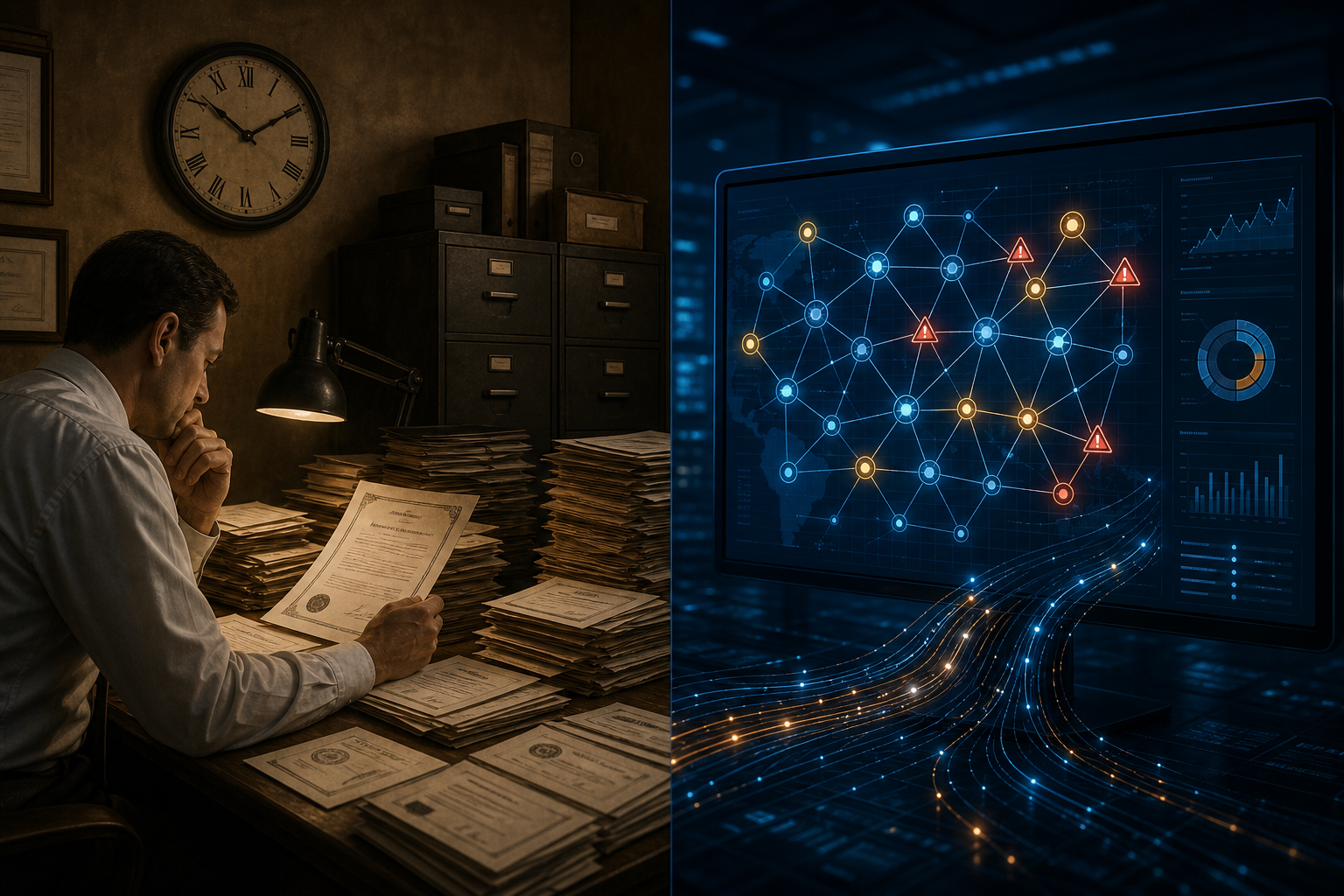
That case is worth more than a headline because it separates three things that often get blurred together: a model finding risk indicators, a human organization deciding to investigate, and a legal outcome proving misconduct. The DLA model did not prove the parts were counterfeit by itself. It surfaced enough signal for investigators to act earlier, and that is the operational change defense contractors should care about.
Why the Signal Matters
Defense supply chains are hard to police manually because the underlying data is incomplete and uneven. The DLA white paper says the Department of Defense lacks data model requirements for about 40% of strategic and critical materials, or 115 of roughly 290 materials, and that more than 90% of FY2023 shortfall materials had zero or one domestic supplier.[1] That is the kind of environment where a quarterly review packet is already behind the problem. If a contractor is waiting for a formal audit to uncover a weak supplier, the organization is usually paying for the discovery twice: once in disruption, and again in remediation.
Counterfeit parts, false certifications, sanctions exposure, and compliance gaps are not separate issues in this setting. They travel together. A supplier that looks acceptable on paper can still create quality fallout, schedule slips, or downstream disclosure work if the record set is thin. AI becomes relevant here not because it is fashionable, but because it can work across larger and messier data sets than a human reviewer can reasonably hold in view.
What AI Changes in Supplier Risk Work
The practical workflow is straightforward even when the model behind it is not. Supplier records, certifications, transaction histories, shipping documents, financial signals, and compliance data are ingested together. Pattern detection then looks for anomalies, weak links, or combinations of indicators that do not fit expected behavior. From there, the output can feed risk scores, bottleneck forecasts, demand sensing, continuous financial health monitoring, and recommendations for pre-qualified alternative suppliers.[1][3] The point is not to replace procurement judgment; it is to move the review forward in time so someone can ask the hard question before production is disrupted.
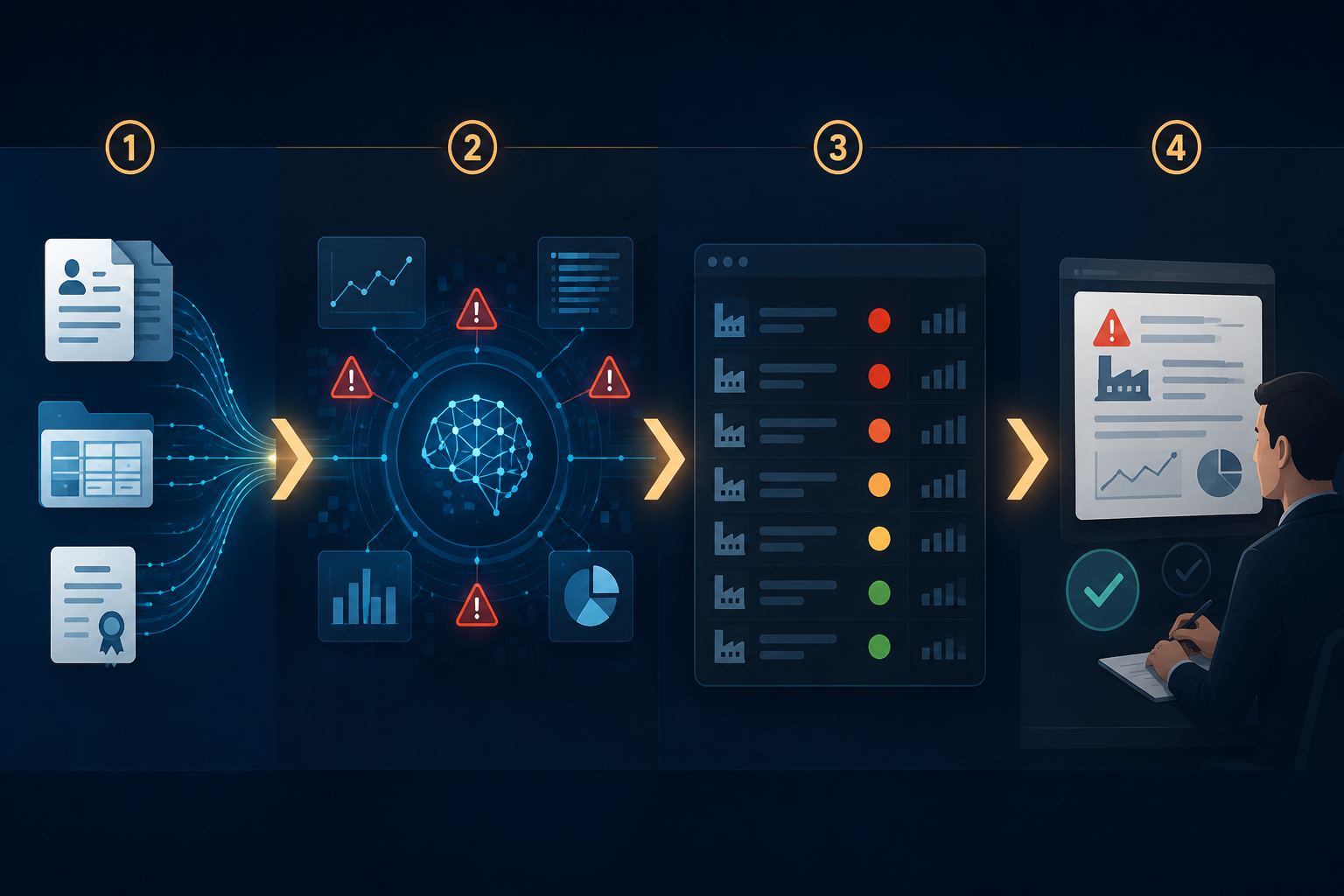
That handoff to a human reviewer is where the system either becomes useful or becomes theater. A risk flag only helps if someone can see why it appeared, decide whether it warrants escalation, and document the result. If the organization cannot explain the score later, it has not really improved supplier governance; it has just added another opaque layer.
The DLA’s own AI Center of Excellence, established in June 2024, is a sign that the agency sees this as more than a one-off analytics experiment.[2] It also shows why DLA is such a strong proof point and such a difficult benchmark. The agency has coordinated data access, governance, and safe AI integration in a way many contractors have not. A mid-tier defense supplier may still get value from the same approach, but it will not have the same starting conditions.
Implementation Requirements
For a contractor, the first implementation question is not which model to buy. It is whether supplier identities, certificates, payment data, quality records, and shipping history can actually be tied together without a cleanup project that never ends. The second question is whether the organization can explain a flag in plain terms: which data points drove it, who reviewed it, and what action followed. Without that audit trail, AI may help a team notice a pattern, but it will not help the team defend a sourcing decision after the fact.
That is also why the DLA case should be read as evidence, not a universal benchmark. Its 43,000-vendor scale is a sign of what becomes possible when data access and coordination are strong, not a promise that every contractor will see the same ratio of flags to suppliers.[1] The more realistic expectation is narrower: AI can improve screening and monitoring when the data is complete enough, the model is explainable enough, and the human process is ready to investigate rather than ignore the alert.
That expectation becomes more important, not less, as the regulatory environment shifts. Recent NDAA AI restrictions and CMMC-related uncertainty mean contractors cannot treat governance as finished work. Even if the final DoD implementation rules are still moving, the direction is clear enough: supplier-risk tooling has to fit into a compliance posture that can survive review, not just impress a dashboard audience.
The broader defense ecosystem is moving the same way. Public reporting says DCSA is using AI-enabled tools and commercial data aggregators to identify DIB risk, in coordination with the Office of the Chief Digital and AI Officer.[4] That does not disclose a particular product, but it does show the pattern. Defense organizations are using AI to widen the net, while the real test remains whether a contractor can turn the signal into a defensible operational decision.
References
- Utilization of Artificial Intelligence (AI) to Illuminate Supply Chain Risk — DLA, May 2025
- DLA Applying AI to Supply Chain Risk Management, Warfighter Readiness — DLA
- Pentagon uses AI to identify 19,000 high-risk suppliers from 43,000 vendors — TraxTech
- Pentagon using AI to protect supply chains — GovCIO Media
Comments
Join the discussion with an anonymous comment.