
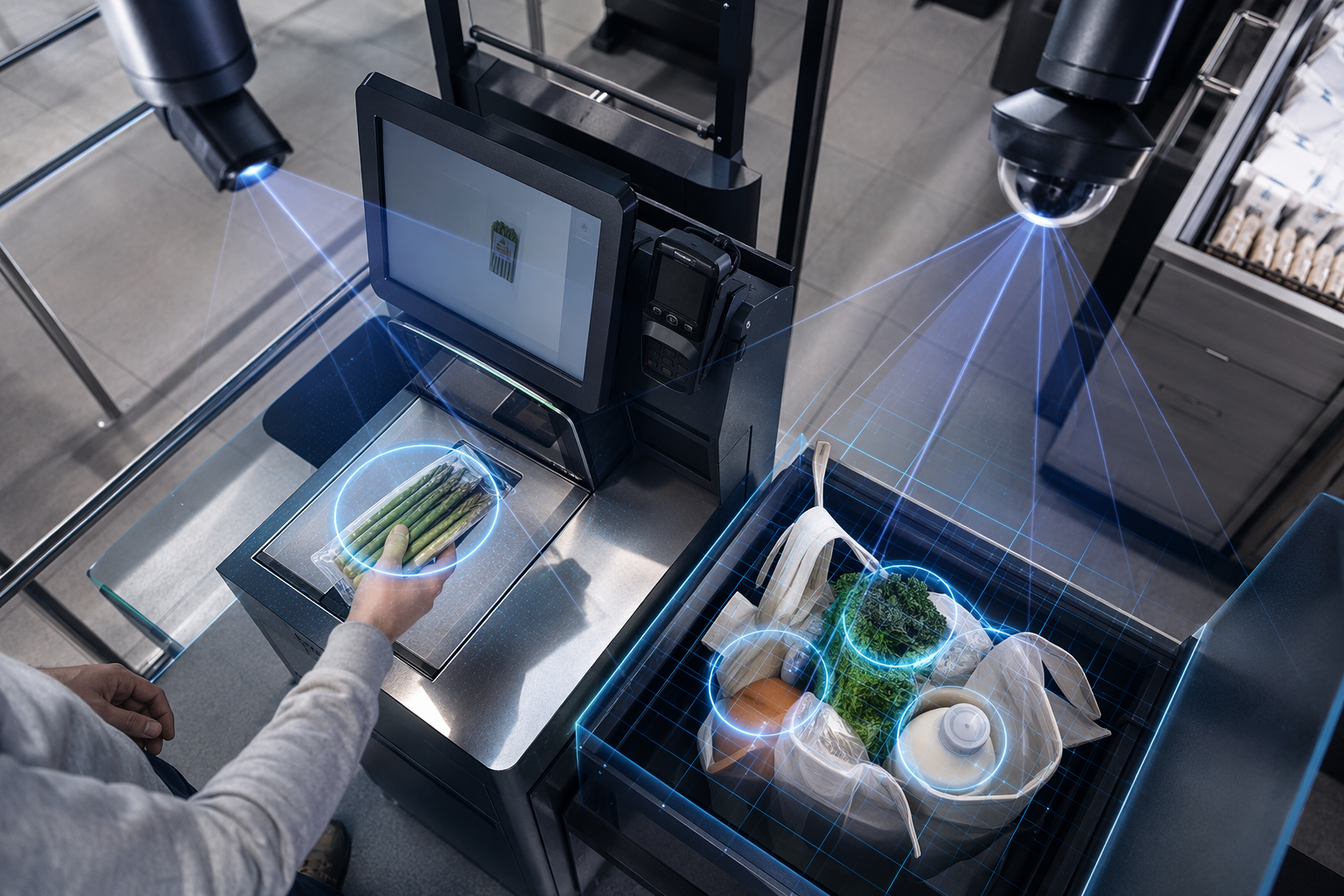
At a self-checkout lane, the useful question is not whether a camera can “see theft.” It is whether the system can compare what the customer’s hands did with what the point-of-sale system recorded, fast enough for the shopper or the attendant to fix the problem before it becomes a loss event. That is where AI for retail self-checkout theft prevention is materially different from ordinary video review: cameras observe item movement, the POS records scans and prices, and the model looks for mismatches while the transaction is still open.
The problem is large enough to deserve that operational attention, but the numbers need careful handling. ECR Retail Loss’s 2026 self-checkout report, based on 39 retailers with more than €1 trillion in combined turnover, found missed scans to be the most frequent self-checkout loss type, appearing in 1% to 4.8% of self-checkout transactions.[1] A separate retail estimate cited through Wharton puts self-checkout shrink at 3.5% to 4% of sales, compared with less than 1% for staffed lanes, but that figure is better treated as an industry estimate than as a controlled multi-retailer measurement.[2]
What the System Has to Match
A self-checkout transaction produces two very different records. The first is physical: a product is picked up, moved across the scanner, placed into a bagging area, returned to the cart, or carried away. The second is transactional: a barcode is scanned, a PLU is entered, a weight check is triggered, a payment is completed, or the session is abandoned. Computer vision becomes useful when those records are joined.
That POS integration is the line between loss-prevention theater and a workable checkout tool. A camera-only system may flag unusual motion. A POS-connected system can ask a more specific question: did the item that moved through the scan zone produce the expected scan event, at the expected time, for the expected product or product class?
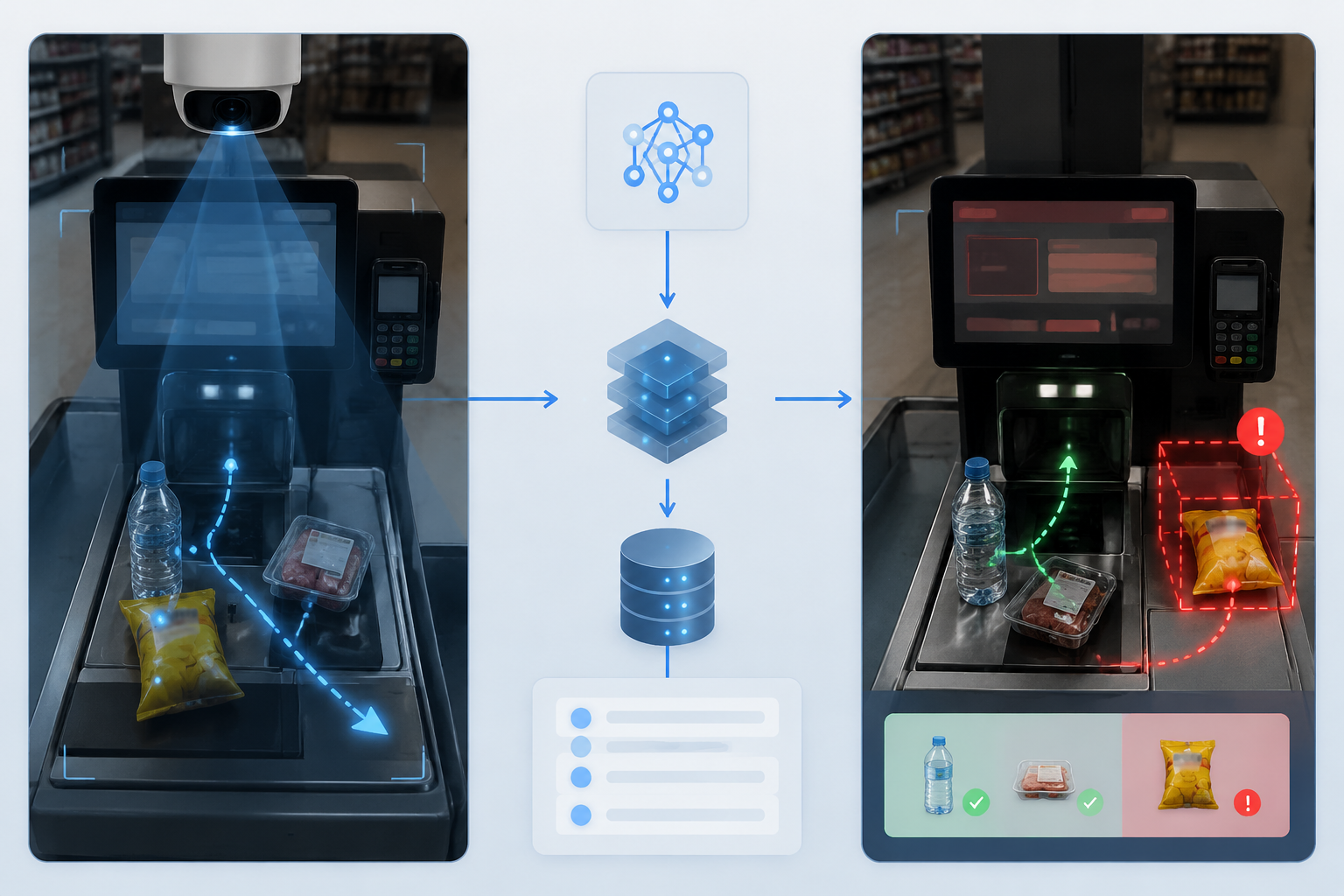
In practice, the system watches a short sequence rather than a single frame. It tracks an item entering the customer’s hand, crossing or bypassing the scan area, and landing in the bagging area or cart. It then checks the POS stream for a corresponding scan, price lookup, void, quantity change, or payment completion. If the movement and the receipt disagree, the system can prompt the customer, alert the attendant, or log the event for later review.
The Five Loss Patterns AI Is Usually Asked to Separate
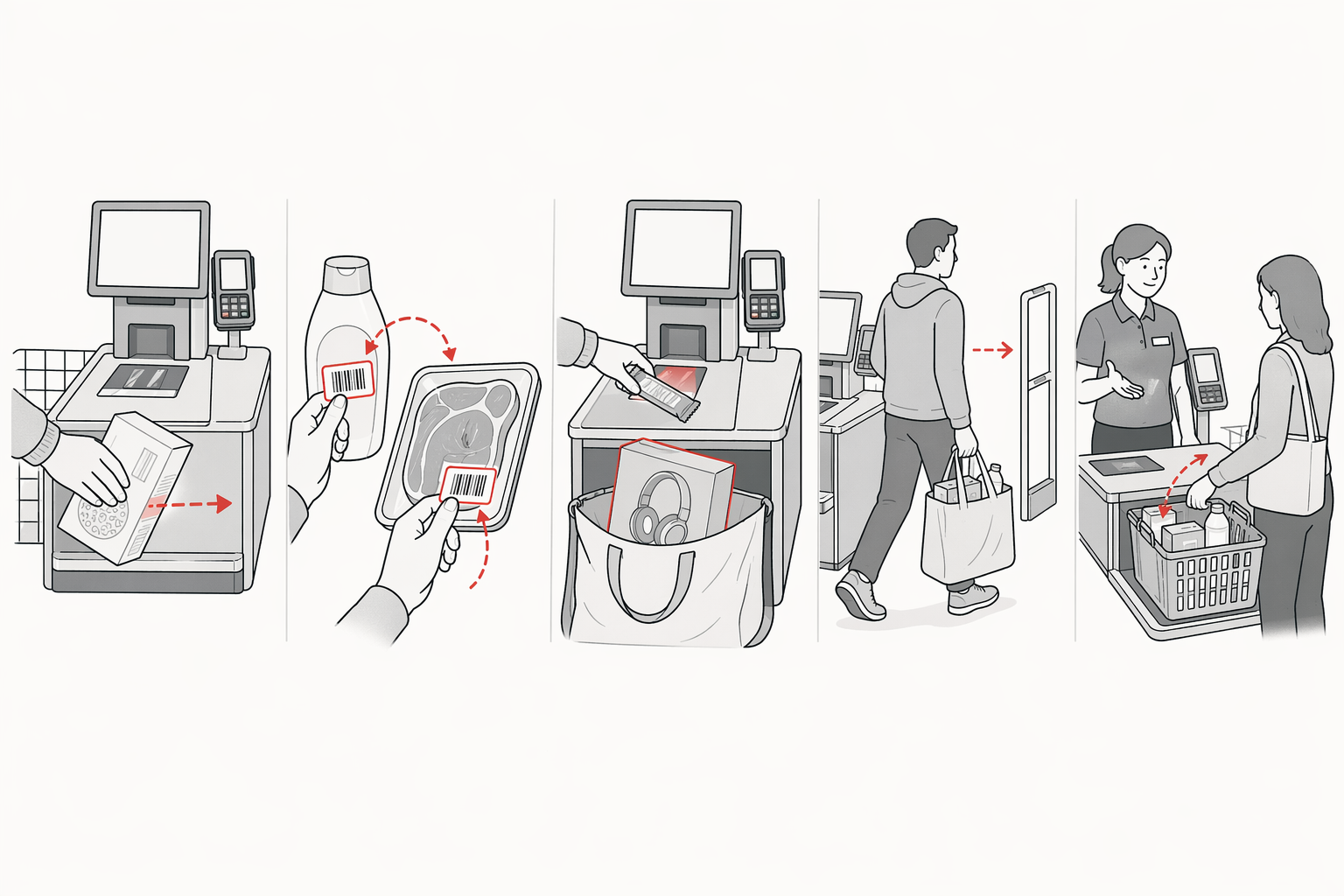
The awkward part of self-checkout loss is that the same lane has to handle mistakes, opportunistic behavior, and organized tactics without treating every customer like a suspect. The five patterns matter because each one calls for a different response.
| Loss pattern | What the AI compares | Why the distinction matters |
|---|---|---|
| Missed scan | An item moves through or around the scan zone, but no matching POS scan appears. | Often resolved with a customer prompt before staff need to intervene. |
| Barcode switching | The scanned code does not appear to match the product being handled. | Lower incident value than walkaways on average, but more deliberate and harder for attendants to spot manually. |
| Stacking or concealment | Multiple items move together, or one item hides another as the POS records only one scan. | Requires item-level visibility, not just a count of scan events. |
| Walkaway | A customer leaves or attempts to leave before paying for items in the transaction area. | High-value incidents need fast escalation because the transaction may no longer be recoverable at the lane. |
| Sweethearting | An associate-assisted or associate-controlled transaction lets items pass without proper scanning. | The issue is not only customer behavior; it can involve process design, staffing, and internal controls. |
ECR’s 2026 report gives useful scale to two of those categories: walkaways averaged €88 per incident, while barcode-switching averaged €17 per incident.[1] That does not make walkaways the only problem worth solving. It means the intervention threshold should not be identical for every alert. A suspected walkaway may need immediate staff attention; a likely missed scan may be better handled by a soft prompt on the screen.
Missed scans are the baseline test
Missed scans are where many systems prove their value because the workflow can stay low-friction. The model sees an item move into the bagging area without a matching scan. Instead of immediately calling over an attendant, the lane can display a short video replay or message asking the shopper to re-scan the item. ECR reports that soft-nudge interventions of this kind achieved 50% to 80% self-correction rates.[1]
That self-correction rate is operationally important. It means some incidents become a customer-facing checkout correction rather than a confrontation, a report, or a queue at the attendant station. It also gives the associate a cleaner signal: if the prompt is ignored, the next alert carries more context than a generic “possible theft” message.
Barcode switching and stacking need product-level context
Barcode switching is not just a non-scan. Something did scan; it was the wrong thing. The AI has to compare the visual product or packaging class with the barcode event and price recorded by the POS. Stacking and concealment create a different mismatch: one scan appears, but the visual record suggests more than one item moved into the bagging area.
Those patterns are where model accuracy and alert design start to matter more. DataIntelo’s 2026 market report states that AI computer vision systems achieve barcode recognition accuracy of 97% to 99%, and that machine-learning-based approaches reduced false-alert rates from 18% to 22% under rule-based systems to 2% to 4%.[3] Those are still not zero. In a busy front end, a 2% false-alert rate can be acceptable or exhausting depending on transaction volume, staffing, and how intrusive the prompt feels.
Walkaways and sweethearting are escalation problems
A walkaway leaves less time for gentle correction. The system has to identify that unpaid items remain associated with a customer who is leaving the lane, and it has to send the alert to someone who can act immediately. The value of the detection depends on store layout, staff line of sight, and whether the alert reaches the right associate before the customer exits.
Sweethearting is even more sensitive because it may involve an employee-controlled exception rather than an unattended customer action. A useful system does not just label the event; it preserves enough POS and video context for a supervisor or loss-prevention lead to review patterns over time. One ambiguous incident should not carry the same weight as repeated mismatches tied to the same lane, associate, or transaction type.
Where the Measured Results Are Strongest
The most defensible evidence starts with ECR because it looks across retailers rather than relying on a single vendor deployment. In controlled studies, non-scan identification technology reduced loss by up to 9%.[1] That is a more modest number than many sales claims, but it is also a more usable planning assumption for a retailer building an internal case.
ECR also reports larger business outcomes where retailers attributed savings to these systems: one retailer reported $136 million in annual savings across 2,000 stores, equivalent to a 0.13% sales lift, and another reported investment recovery of 4.5 times the initial outlay.[1] Those figures should not be read as a universal ROI multiple. They do show why front-end loss prevention has moved from pilot curiosity to boardroom-level shrink work.
The same report adds a useful warning about removing older controls too quickly. Turning off weight controls, often done to reduce customer friction, increased shrink by 20% at one retailer and increased shrink by 0.8% to 5% in five of six studies.[1] That matters because computer vision is sometimes positioned as a replacement for every existing safeguard. The evidence is better read as a case for redesigning the control mix, not simply switching off one layer and hoping the camera catches everything.
Field evidence from 27 stores
EasyFlow’s ScanWatch field study adds concrete lane-level evidence, though from a narrower setting. Across 27 stores at a European chain and 2.1 million scan events, the system detected 32,107 thefts.[4] That is useful because it shows the technology operating at transaction scale, not just in a lab. It is also limited: one European chain does not automatically represent a North American grocer, a warehouse club, or a high-SKU mass merchant.
Vendor-attributed claims belong in the case, with labels attached
SeeChange reports more than 50% shrink reduction at self-checkout from its computer vision security deployments.[5] That kind of result is worth noting, especially because it aligns directionally with the broader evidence that real-time detection and intervention can reduce loss. It should stay labeled as vendor-attributed, not converted into a guaranteed outcome for every chain.
The gap between “up to 9%” in controlled multi-retailer evidence and “50%+” in a vendor-attributed deployment claim is not a contradiction by itself. Different baselines, fraud mixes, staff workflows, alert thresholds, and store formats can produce very different results. A chain with heavy missed-scan leakage and a well-designed correction prompt may see a different outcome than one whose losses come mostly from walkaways, organized barcode switching, or poor attendant coverage.
How Value Is Created Before an Incident Escalates
The least dramatic part of AI self-checkout prevention may be the most valuable: catching a mismatch early enough that the customer can correct it. A video prompt that says, in effect, “this item may not have scanned,” moves the first response away from the attendant and back into the transaction flow. If the shopper genuinely missed the scan, the fix is simple. If the shopper was testing the lane, the prompt changes the risk calculation without requiring an accusation.
For store teams, that intervention design is not a soft detail. It determines whether AI reduces workload or creates a new alert queue. A useful deployment defines which events receive customer prompts, which go directly to attendants, which are logged for review, and which are ignored because the confidence level is too low. The model may detect the mismatch, but the workflow decides whether shrink goes down without making the front end feel hostile.
The best deployments also preserve context. An associate should not have to interpret a vague alert while supervising six lanes. The alert should show the item movement, the scan or missing scan, the lane, the transaction state, and the recommended action. If the system cannot explain why it interrupted the transaction, staff trust will erode quickly.
What to Evaluate Before Deployment
A retailer evaluating AI computer vision at self-checkout should start with its own loss profile, not the broadest vendor claim. The same system may perform differently depending on whether the chain’s main problem is missed scans, produce lookup abuse, barcode switching, unpaid walkaways, or associate-enabled loss.
- POS integration: Can the system match item movement to scan events, voids, quantities, tender status, and transaction completion in real time?
- Intervention design: Which alerts trigger customer prompts, which trigger staff response, and which are held for later review?
- False-positive handling: What is the expected alert volume per lane per hour, and how will staff challenge or dismiss incorrect alerts?
- Evidence by fraud type: Does the vendor show results separately for missed scans, switching, stacking, walkaways, and sweethearting?
- Store fit: Were the reported results generated in stores similar to the retailer’s format, basket size, staffing model, and customer flow?
- Compliance posture: How are video, face data, biometric identifiers, retention periods, and customer notices handled in each jurisdiction?
The compliance question should be raised early, not after procurement has already picked a platform. Privacy and biometric requirements vary by jurisdiction, including GDPR obligations in Europe and state-level biometric laws in the United States. A system that works operationally can still create legal exposure if retention, consent, notice, or biometric processing is handled casually.
The Evidence Is Promising, but Still Uneven
The current evidence supports AI computer vision as a growing Store Operations and Checkout use case, especially where POS-video matching is paired with soft-nudge correction and disciplined staff escalation. It does not support treating the technology as a guaranteed shrink cure.
ECR’s sample is heavily grocery-weighted, with 35 of 39 retailers in grocery, and its operator base is weighted toward the UK and US.[1] That makes the findings highly relevant to supermarket and similar self-checkout environments, but less definitive for every retail segment. ECR also notes that many intervention-efficacy studies remain small; for example, only 4 of 14 non-scan identification studies provided numeric outcome data.[1]
False positives remain the day-to-day risk. Even improved machine-learning systems can generate alerts that are technically explainable but operationally unhelpful. If associates learn that too many alerts interrupt innocent customers, they will work around the system. If customers see too many prompts for normal behavior, the lane starts to feel punitive. The shrink result depends on the whole chain: detection, POS integration, customer prompt, staff response, review process, and compliance controls.
AI can move detection earlier, make interventions less confrontational, and give loss-prevention teams better evidence than a receipt and a distant camera angle. But the retailer still has to decide what happens after the alert.
References
- Self-Checkout Loss Report 2026 — ECR Retail Loss, 2026
- Combatting Retail Shrink While Preserving CX — Elo Touch, 2026
- Self Checkout Theft Prevention Market — DataIntelo, 2026
- Self Checkout Statistics & Theft Trends — EasyFlow
- Self Checkout Security — SeeChange
Comments
Join the discussion with an anonymous comment.