
Self-checkout has reached the awkward stage of retail operations: too useful to remove, too leaky to leave alone. The labor model works. Many shoppers like the control. Store teams have built front-end routines around it. Yet the loss profile is hard to defend when self-checkout is estimated to account for 23% of total retail unknown losses in a global ECR Retail Loss Group study covering 93 retailers and €2.237 trillion in combined sales.[1] Capital One Shopping’s research puts average shrink at self-checkout at 3.75% of inventory, compared with about 0.94% at staffed lanes, or nearly four times higher.[2]
That is the business case behind AI self-checkout theft detection systems. The useful question is not whether AI can spot a suspicious motion in a video feed. The question is whether the system can see the basket, match what it sees to the transaction, correct honest errors before they become shrink, and escalate only the events that deserve an associate’s attention.
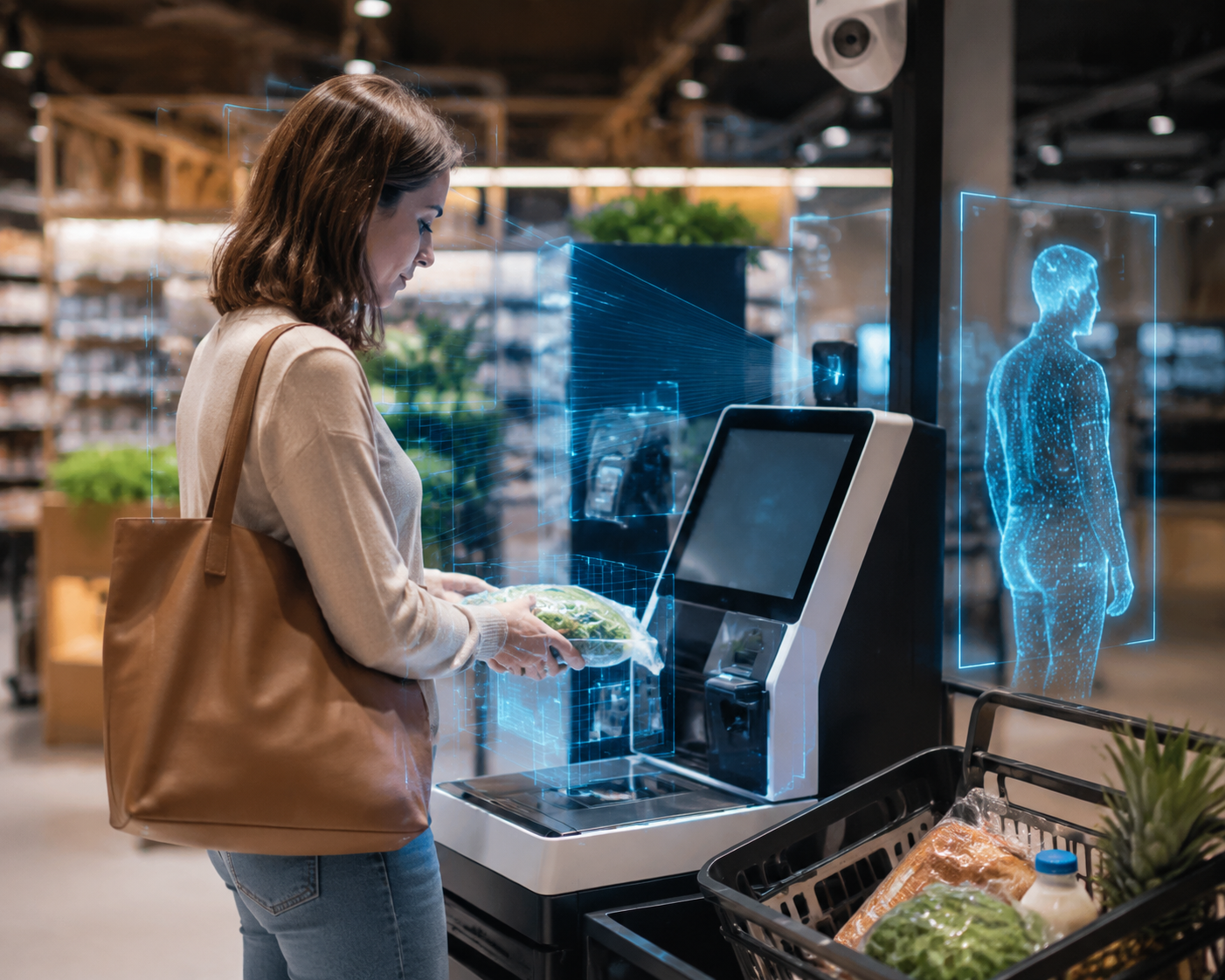
Why the old control layer runs out of patience
Weight verification did not become common by accident. It is simple to understand, it gives the system a physical check against the scan record, and loss prevention teams still put a lot of trust in it. In the ECR Retail Loss Group survey, 77% of loss prevention managers considered weight alerts the best current solution for non-scanned items.[1]
But anyone who has watched a busy front end knows the other half of that story. Bagging areas misread lightweight items. Customers shift a purse, reusable bag, or child’s snack onto the scale. Produce, multipacks, and bulky goods create exceptions. The attendant walks over, clears the alert, and does it again a minute later. The system may be technically “controlling” the lane, but operationally it is training associates to dismiss noise.
That noise matters because most stores do not want self-checkout to feel like a checkpoint. A false alert turns a normal transaction into a public interruption. A real miss, if handled badly, can become an accusation before the store has enough evidence. The better control layer has to change the sequence: detect the behavior earlier, compare it against the POS record, and give the shopper a chance to fix it quietly.
What the newer systems actually do
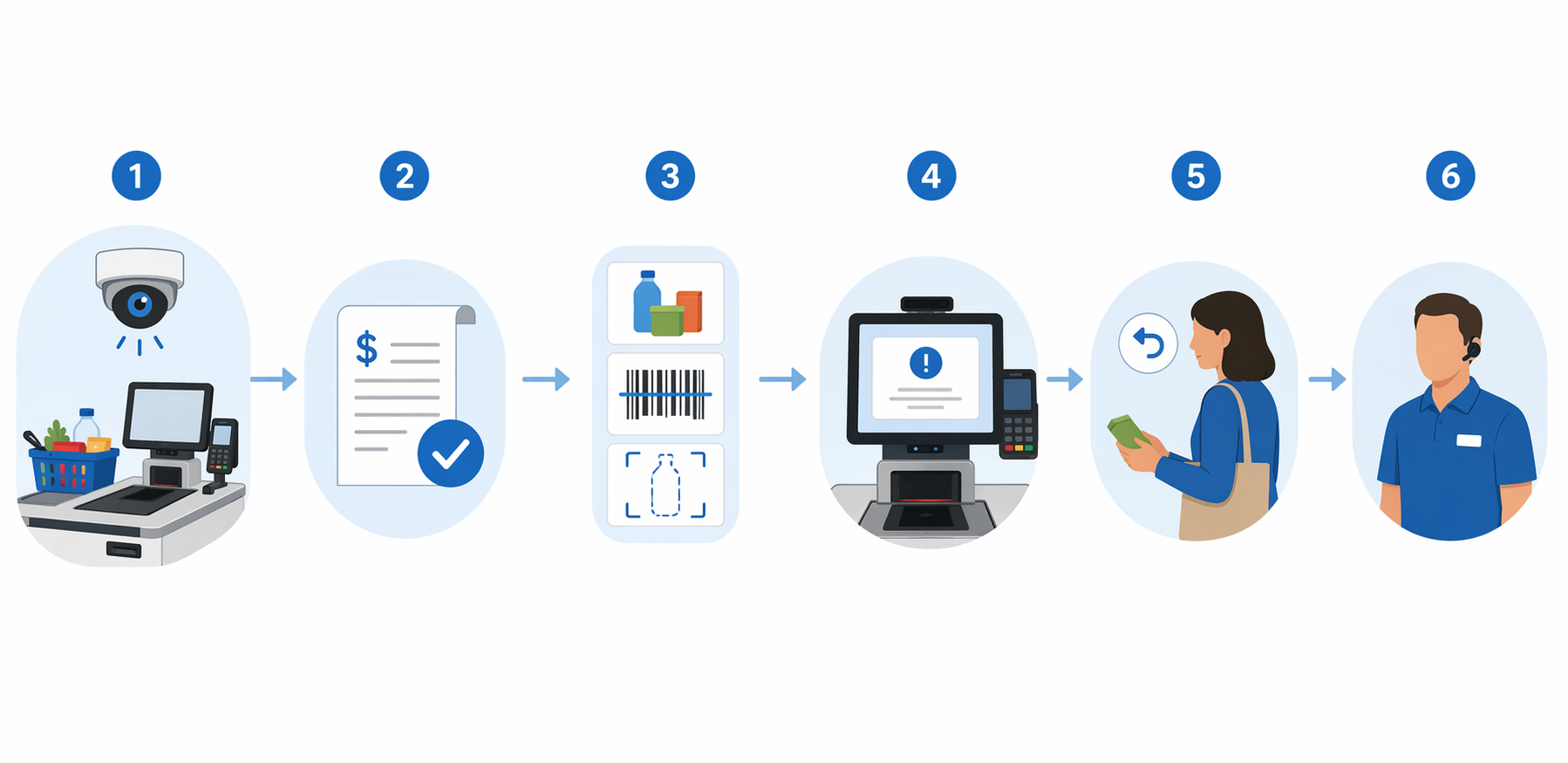
The mature version of self-checkout AI is not just camera surveillance over a lane. It is a transaction-aware workflow. A camera observes item handling. The POS reports what has actually been scanned. A model classifies the gap between the physical action and the transaction record. The kiosk prompts the customer when the event looks correctable. Staff see only the events that need human judgment.
Everseen describes its Evercheck system as detecting more than 30 distinct loss patterns in real time, including skip-scanning, barcode switching, product stacking, walkaways, and start/end anomalies.[3] That breadth matters because self-checkout loss rarely presents as one neat behavior. A shopper can miss a scan because an item is hidden under another item, because the barcode of a cheaper product is presented, because the transaction ends before all goods are recorded, or because the item movement never reaches the scanner at all.
POS reconciliation is the part that keeps the camera from becoming a clip factory. A video-only system can show that a product moved across the scanner area. It cannot, by itself, know whether the POS recorded that item, recorded a different item, accepted a produce lookup, voided an entry, or suspended the transaction. Once the video event is joined to POS data, the store can distinguish “item moved, no scan recorded” from “item moved, scan recorded late” or “item moved, cashier intervention already occurred.” That difference is where many false escalations disappear.
Edge processing is the other practical piece. Checkout is a bad place to wait on the cloud. If a customer has already paid or walked away, the system has missed the cheapest correction point. Shopic describes edge-based computer vision as processing in-store video locally to avoid cloud latency in loss prevention workflows.[4] For a front-end team, the value is not architectural elegance; it is that the prompt appears while the item is still on the customer’s mind and the bagging area is still in front of them.
| Workflow point | Operational purpose |
|---|---|
| Camera observes item movement | Captures the physical action that may not appear in the transaction log |
| POS data is matched in real time | Separates unscanned items from delayed scans, voids, and legitimate exceptions |
| Loss pattern is classified | Identifies behaviors such as skip-scanning, barcode switching, stacking, and walkaways |
| Screen prompt appears | Gives the shopper a low-conflict chance to rescan or correct the transaction |
| Customer self-corrects or continues | Resolves many incidents without an associate stepping into the lane |
| Staff escalation is reserved | Directs attendants to events where intervention is more justified |
The quiet value of the on-screen nudge
The strongest operational feature is often the least dramatic one: a prompt on the self-checkout screen. SeeChange says live deployment data shows 50% to 80% of customers self-correct after receiving a soft on-screen nudge, without staff intervention.[5] That figure should be read as a vendor-reported deployment outcome, not a universal behavioral law. Still, it points to the right mechanism.
A useful nudge does not have to decide whether a shopper intended to steal. It only has to tell the customer that an item may not have scanned and give them a clear next action. That distinction matters on the floor. A distracted parent, a shopper unfamiliar with produce lookup, and a deliberate skip-scan can all create the same immediate mismatch. The screen can correct the first two without forcing the attendant to make a public call on intent.
This is also where AI systems can reduce labor drag rather than just move it around. If every uncertain event becomes a staff alert, the store has bought a more expensive version of the weight-scale problem. If half or more of correctable events resolve at the screen, the attendant’s time shifts toward exceptions that remain unresolved after the customer has been given a chance to act.
Can the 50% shrink reduction claim hold up?
The answer is: it can, but the evidence is not all the same kind. Some of it is commissioned ROI modeling. Some of it is vendor-reported deployment data. Some of it comes from a single store or single chain. Those differences do not make the results useless. They do change how a loss prevention director should use them in a capital request.
The most boardroom-ready number comes from Forrester’s Total Economic Impact study of Everseen Evercheck, commissioned by Everseen and published in September 2024. The study reports 374% ROI over three years, payback in under six months, $88,000 in average benefit per store, and a 15% labor productivity improvement for a composite organization built from interviewed customers.[6] Those are meaningful indicators, especially because they combine shrink and labor effects. They are not the same as an independently audited, chainwide randomized test.
SeeChange reports a 50% or greater reduction in self-checkout-attributable shrink within 60 to 90 days of live operation.[5] In a named store example, Intermarché La Farlède reduced self-checkout loss from 3% of transactions to about 1.5% after deploying vision AI, according to director Laurent Hugou.[7] That is directly relevant because it describes the specific loss area buyers care about. It is also limited: the Intermarché example is a single French store, and SeeChange’s broader marketing materials do not always disclose retailer names or baseline periods.
EasyFlow’s ScanWatch.ai case adds another useful but bounded data point. The company reported 32,107 theft incidents detected across 27 stores in one European retail chain using 2023 data.[8] That supports the idea that these systems can detect loss patterns at operational scale, not just in pilots. It does not prove the same incident rate, deterrence effect, or ROI would appear in a U.S. big-box, discount, club, or convenience format.
| Evidence | What it supports | How to treat it |
|---|---|---|
| Forrester TEI study commissioned by Everseen | ROI, payback period, per-store benefit, and labor productivity indicators | Useful for business-case modeling, but vendor-commissioned and based on a composite organization |
| SeeChange deployment outcomes | 50%+ reduction in SCO-attributable shrink within 60–90 days | Relevant to live operations, but disclosure varies by retailer and baseline |
| Intermarché La Farlède example | Reduction from 3% to about 1.5% of transactions at one store | Concrete store-level case, not a broad benchmark |
| EasyFlow / ScanWatch.ai European chain case | 32,107 detected incidents across 27 stores in 2023 | Good scale signal, geographically and format limited |
Where the break-even story is strongest
A sub-six-month payback is plausible when three things happen at the same time: the baseline SCO loss is material, the system catches high-frequency behaviors in real time, and a large share of incidents are corrected without staff intervention. The Forrester TEI result points in that direction, but a retailer should still rebuild the model with its own basket mix, SCO penetration, front-end labor model, and known shrink baseline.[6]
The math weakens in stores where self-checkout volume is low, where shrink is already tightly controlled, or where the integration creates too many unresolved alerts. It also weakens if the retailer measures only detected incidents rather than net shrink movement. A system can find more events because it sees more clearly; that does not automatically mean it has reduced loss. The procurement case should separate detection volume, customer correction rate, staff intervention rate, and verified shrink reduction.
The cleanest pilot design is not complicated. Pick comparable stores, establish a pre-deployment baseline for SCO-attributable shrink, track the same categories after go-live, and review alert quality with the front-end team. If the store is seeing fewer unresolved misses, fewer unnecessary interventions, and lower SCO-attributable shrink, the system is doing more than producing impressive dashboards.
The conditions that make the 50% benchmark credible
AI self-checkout theft detection systems are no longer experimental when the deployment has the following operating conditions in place:
- Real-time camera-to-POS reconciliation, so alerts are tied to transaction facts rather than video suspicion alone.
- Edge inference or equivalent low-latency processing, so the correction happens before payment or walkaway.
- Loss-pattern coverage broad enough to include skip-scanning, barcode switching, stacking, walkaways, and transaction start/end anomalies.
- Configurable alert rules by store, daypart, lane type, and product mix, because a high-volume grocery front end does not behave like a low-volume specialty store.
- Staff training that defines when to approach, what to say, and when not to intervene.
- Privacy governance covering video retention, access controls, signage, auditability, and GDPR or CCPA obligations where applicable.
The privacy point belongs in the buying criteria, not in the legal appendix. These systems process customer behavior at a sensitive moment in the store. A retailer should know what is processed locally, what leaves the store, how long clips are retained, who can review them, and whether the vendor can support regional privacy requirements before the pilot expands.
Alert governance matters just as much. SeeChange describes an AI Rules Engine that can adjust sensitivity dynamically by conditions such as time and day.[5] The operational value of that kind of tuning is straightforward: the store can reduce alert fatigue during known noisy periods without turning the system off, then tighten rules where the data shows higher-risk patterns.
What buyers should not overclaim
There are no public, independent head-to-head benchmarks that reliably compare accuracy across major self-checkout AI vendors. Detection-rate claims are generally self-reported. A retailer comparing Everseen, SeeChange, Shopic, Fujitsu, NCR Voyix, or other providers should avoid treating vendor demos as equivalent to store-level proof.
The same caution applies to broad market momentum. A growing category can signal that retailers are taking the problem seriously, but it does not tell a buyer whether a specific system will work with their POS version, camera placement, labor rules, produce catalog, or privacy policy. The useful evidence is closer to the lane: pre- and post-deployment shrink, correction rates, escalation rates, false alert rates, and associate workload.
The strongest conclusion is therefore narrower than the sales pitch but still substantial. AI self-checkout theft detection can cut SCO-attributable shrink by 50% or more when it combines computer vision, real-time POS reconciliation, fast local processing, tuned alerts, trained staff, and clear privacy controls. Break-even inside six months is achievable in the right store base, especially where self-checkout losses and avoidable interventions are already high. It should be treated as a benchmark to validate, not a guarantee to paste into a budget deck.
References
- Self-checkout Retail Loss Global Study, ECR Retail Loss Group.
- Self-Checkout Statistics, Capital One Shopping.
- Solutions, Everseen.
- How Computer Vision is Rewriting the Rules of Retail Loss Prevention, Shopic.
- Self Checkout Security, SeeChange.
- The Total Economic Impact™ Of Everseen Evercheck, Forrester, September 2024.
- AI in Grocery Stores: Shrink at Self Checkout, SeeChange.
- Self-Checkout Statistics & Theft Trends, EasyFlow.
Comments
Join the discussion with an anonymous comment.