
Supply chain fraud usually does not announce itself as fraud. It arrives as an invoice that is close enough to the purchase order, a supplier bank change that passes a busy approval queue, a contract price that has drifted from the agreed schedule, or a bidder group that keeps taking turns with a neatness no market normally produces. By the time internal audit samples the file, payment may be gone, the vendor record may have changed, and the person left reconstructing the trail is usually in AP, procurement operations, or audit—not in a software demo.
That is why the practical question around AI for supply chain fraud detection is not whether a dashboard can look sophisticated. It is what the system can see before payment, award, or contract leakage becomes permanent. The need is not theoretical: ACFE estimates that a typical organization loses 5% of annual revenue to fraud, while PwC reported that 51% of organizations experienced fraud in the prior two years.[1][2] In manufacturing procurement specifically, FICO’s Utkarsh Kansal, cited by Autodesk, put losses at about $350 million.[3]

Manual audits still matter, but they are structurally late for this problem. They review samples, after events, against rules someone already thought to write. AI changes the timing and the field of view when it continuously compares procurement and payment behavior across invoices, purchase orders, receipts, contracts, vendor master data, payment history, bidder relationships, and workflow approvals. The useful version is less glamorous than the marketing version: it is a monitoring layer that keeps asking whether a transaction fits the commercial facts around it.
What AI Looks At That Manual Review Often Misses
The strongest fraud-detection use cases are not built around a generic “suspicious” score. They tie a fraud type to a detection mechanism. That distinction matters because a duplicate invoice, a shell supplier, and a collusive bid pattern do not leave the same kind of evidence.
| Fraud area | What AI compares | Likely detection signal |
|---|---|---|
| Contract and pricing fraud | Contract terms, price schedules, invoices, purchase orders, amendments | Invoice prices, discounts, quantities, or payment terms that do not match the governing agreement |
| Invoice and document fraud | Invoices, POs, receipts, vendor master data, bank details, tax IDs | Duplicate, altered, unsupported, or mismatched payment requests |
| Bid rigging | Bid history, bidder relationships, award patterns, timing, contact networks | Repeated rotation, shared identifiers, unusually synchronized submissions, or hidden links between bidders |
| Shell company fraud | Vendor records, ownership data, sanctions lists, registration databases, addresses, bank accounts | Vendors that appear separate in the ERP but connect through entities, people, accounts, or registration details |
| Maverick spend | Spend categories, approval paths, supplier usage, contract coverage, buyer behavior | Purchases outside preferred suppliers, catalogs, thresholds, or negotiated channels |
| Policy violations | Approval workflows, delegation limits, split purchases, exception history, user behavior | Transactions that technically clear one control but violate the pattern or intent of policy |
Contract and pricing fraud is where natural language processing earns its keep. A reviewer can check whether an invoice references the right contract. AI can go further by comparing invoice line items, price tables, service descriptions, escalation clauses, discount language, and payment terms against the underlying agreement. The fraud signal may be small: a surcharge that appears after an amendment, a rebate that is missing, or a contracted unit price that is applied correctly on some invoices and not on others. Autodesk’s discussion of AI-enabled procurement fraud detection and related FICO methodology describes this contract-versus-invoice comparison as one of the places where analytics can surface discrepancies that are hard to catch at scale.[3]
Invoice and document fraud is more mechanical, but it is also where a lot of money leaves the building. The detection problem is not only whether the invoice is a duplicate. It is whether the invoice matches a valid purchase order, whether goods or services were received, whether vendor bank details changed recently, whether the tax ID and address make sense, and whether the invoice image or document metadata conflicts with master data. Zycus describes automated cross-referencing across procurement documents as a way to reduce fraudulent documentation, and Infosys BPM similarly frames invoice checking around PO, receipt, and supplier-data comparisons.[4][5]
This is also where fraud detection overlaps with working-capital operations. The same data plumbing that supports three-way match, supplier onboarding, and payment approval also supports invoice-risk scoring. A team evaluating this use case should treat it as adjacent to AI in supply chain finance, because payment timing, invoice validation, and supplier identity controls depend on much of the same source data.
Bid rigging leaves a different trail. A rules engine can flag bids submitted after a deadline or awards above a threshold. Social network analysis looks for relationships and repeated behavior across bidders: shared addresses, common directors, linked email domains, recurring subcontractor relationships, consistent bid rotation, or submission patterns that cluster too closely. Infosys BPM identifies social network analysis as one of the approaches used to reveal hidden bidder relationships in procurement fraud detection.[4] The point is not that every tidy pattern proves collusion. It is that the same group of suppliers behaving too neatly over time deserves review before the next award, not three quarters later.
Shell company fraud is often a master-data problem wearing a supplier-management costume. A new vendor may have clean paperwork inside the ERP while sharing an address, phone number, beneficial owner, bank account, or registration detail with an employee, sanctioned entity, or existing supplier. Entity matching helps because fraudsters do not always reuse exact names. The system has to tolerate spelling variations, abbreviations, changed addresses, and layered ownership. Autodesk’s FICO-cited discussion and Infosys BPM both point to external-list and registration matching as part of shell-company detection.[3][4]
Maverick spend and policy violations are duller, and therefore dangerous. They become normal because the workflow is busy and the exceptions look individually defensible. AI is useful when it learns normal buying behavior by category, site, buyer, supplier, threshold, and approval path, then flags transactions that fall outside that pattern. This depends heavily on spend classification. If categories are messy, supplier hierarchies are duplicated, and free-text descriptions are inconsistent, anomaly detection will spend its time rediscovering data hygiene problems. For teams still building that foundation, machine learning in spend analytics is usually the upstream capability that makes policy and maverick-spend detection credible.
Why Two Model Types Are Better Than One Bigger Rulebook
Fraud teams already know rules. Block payments to sanctioned vendors. Review invoices above an approval threshold. Flag duplicate invoice numbers. Require evidence for supplier bank changes. These controls are necessary, but they mainly catch what someone already anticipated.
AI systems typically add two model families on top of those controls. Supervised models learn from labeled history: known duplicate-payment cases, confirmed false invoices, prior vendor fraud, policy breaches, or suspicious transaction records. They look for combinations of attributes that resemble past events. In procurement language, they are good at saying, “This looks like the kind of problem we have seen before.” Autodesk’s FICO-cited explanation describes supervised learning as one branch of fraud detection, trained on labeled historical fraud data.[3]
Unsupervised anomaly-detection models do not need the organization to have labeled every scheme in advance. They profile normal transactions, suppliers, agents, contracts, and payment behavior, then flag outliers. In procurement language, they are saying, “This does not behave like its peer group.” That matters because fraud changes. A new shell supplier, a new invoice-manipulation pattern, or a new buyer-supplier relationship may not match last year’s case file.
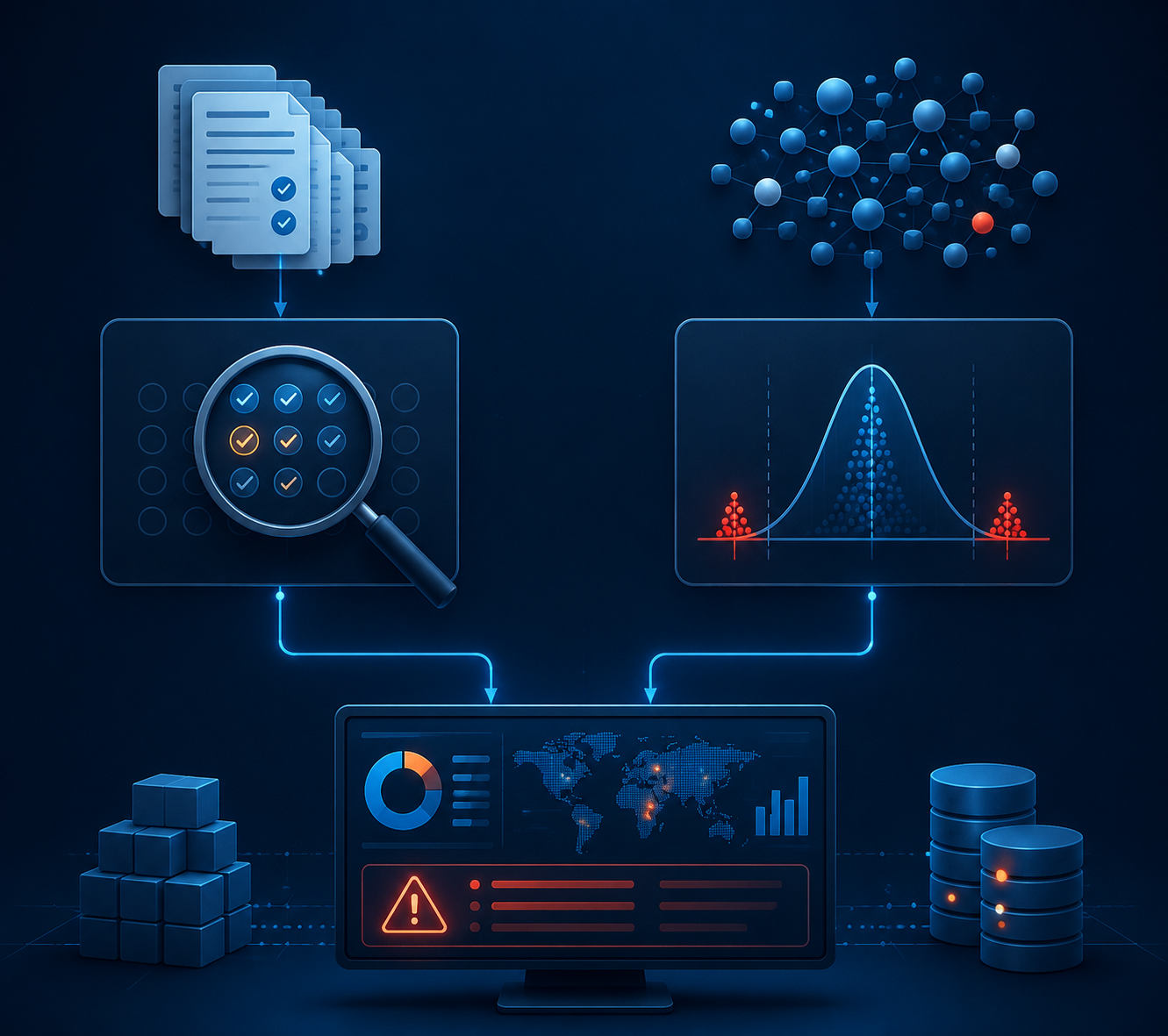
The two approaches are stronger together. A supervised model can catch a recurring invoice pattern that has already been investigated. An unsupervised model can notice that a low-value supplier suddenly receives high-frequency payments just under approval thresholds, even if no one has labeled that exact behavior as fraud. The review queue then gets a reason code: invoice mismatch, unusual buyer behavior, related-party signal, contract variance, duplicate document feature, or abnormal payment timing. Without that explanation, the AP team only receives another box of alerts.
Persona-based scoring is a useful extension because it moves the model closer to how procurement work actually happens. Buyers, category managers, plant purchasers, sourcing leads, and approvers do not behave the same way. A purchasing agent buying MRO parts for urgent plant maintenance will have a different pattern than a corporate services buyer running a quarterly sourcing event. FICO’s methodology, as summarized by Autodesk, groups purchasing agents into behavioral archetypes so the system can detect anomalous activity against an appropriate peer group rather than against a crude enterprise average.[3]
Real Time Means Intervention Moves Upstream
“Real time” should not be read as magic. In procurement controls, it means the model scores events while there is still something useful to do: before supplier approval, before a contract exception is accepted, before a purchase order is released, before an invoice is paid, before a bank-account change is activated, or before a suspicious bid event is awarded.
That changes the operating model. In a retrospective audit, the team samples completed transactions and reconstructs evidence. In continuous monitoring, the system watches the transaction stream and routes exceptions to the people who can still stop, hold, enrich, or challenge the action. AP may hold payment pending receipt verification. Procurement operations may require a supplier-master review. Sourcing may pause an award until bidder relationships are checked. Internal audit may use the alert history to decide where to test controls.
The economic value comes from this timing. A perfect post-payment explanation is still a recovery problem. A good pre-payment signal is a prevention control. The model does not have to prove criminal intent; it has to identify enough inconsistency to justify slowing the workflow and asking for evidence.
What the ROI Evidence Actually Shows
The commonly cited 30–50% improvement range should be handled carefully. It is not a neutral market average, and it is not a promise that any organization can buy. The strongest numbers in the available material come from vendor implementation data and case studies. They are useful indicators of what systematic deployment can achieve, but they depend on baseline fraud exposure, transaction volume, process maturity, model scope, and whether teams actually act on alerts.
Zycus reports a 30–40% reduction in fraud-related losses from implementation data and separately cites a 30% reduction in fraudulent documentation through automated cross-referencing.[5] Those figures are most relevant where the deployment covers core procurement documents, supplier records, and approval workflows—not where AI is bolted onto a narrow reporting layer after payment.
Brillio describes a case for a $25 billion pharmaceutical company in which AI reduced the effort required to identify suspicious transactions by 50x.[6] That is a workload metric, not the same as confirmed loss reduction. For a procurement or AP leader, it still matters because false negatives are not the only cost of fraud control. So is the analyst time spent searching large transaction populations with weak filters.
Cognizant’s bank case reports $20 million in annual savings, 50% fewer fraudulent transactions, and processing of 1,200 checks per second in under 70 milliseconds.[7] The banking context is not identical to procurement, but the case is relevant to the real-time scoring question: high-volume fraud detection has to score fast enough that controls do not become a bottleneck.
For broader ROI context across supply chain AI, fraud detection should be compared with other applications such as forecasting, routing, inventory optimization, and maintenance rather than treated as a standalone miracle case. A cross-use-case view of machine learning logistics ROI benchmarks can help separate control-value cases from productivity cases.
Adoption Is Growing, But Market Size Is Not Proof of Effectiveness
Dataintelo’s market analysis values the AI-powered procurement fraud detection market at $1.93 billion in 2025 and projects it to reach $8.92 billion by 2034, implying an 18.5% CAGR. The same analysis identifies invoice fraud as the largest application segment at 32.5% of spending, cloud deployment at 64.5% share, cloud total-cost-of-ownership reductions of 35–45% versus on-premises, and North America as the leading region at 38.2% share.[8]
Those numbers support adoption momentum. They do not prove that every implementation works. Market growth can reflect fear, regulatory pressure, vendor bundling, cloud migration, and fraud loss experience as much as measured effectiveness. A procurement leader should read the market sizing as validation that the category is real, then return to the harder questions: what data will the model see, what decisions will it influence, and who will own the alert backlog?
Representative Vendors in the Space
The vendor landscape spans fraud analytics, procurement suites, AP automation, expense monitoring, and payment platforms. Representative names in the research base include FICO Falcon, IBM Watson, SAP Fraud Management, Zycus Merlin/ANA, AppZen, Oversight, Coupa, and Tipalti.[3][4][5] They should not be treated as interchangeable. Some are stronger in payment and transaction scoring, others in procurement-suite integration, document intelligence, supplier management, or enterprise analytics.
At this stage, the better comparison is not feature-counting. It is fit to the fraud surface. A company worried about invoice manipulation needs deep AP, PO, receipt, and vendor-master integration. A company worried about bid rigging needs sourcing-event and bidder-network visibility. A company worried about shell suppliers needs entity resolution, external-data matching, and supplier onboarding controls. The same AI label can hide very different control coverage.
The Risks That Decide Whether the System Pays Off
The first risk is dirty data. Fraud models are only as useful as the transaction, vendor, contract, and workflow data they can read. Duplicate suppliers, missing receipts, inconsistent payment terms, weak contract metadata, and free-text categories all create noise. A model trained on unreliable history may learn the organization’s control failures as if they were normal behavior.
The second risk is integration. Real-time detection requires connections to ERP, procure-to-pay, sourcing, contract lifecycle management, supplier onboarding, AP automation, and sometimes external entity or sanctions data. If the model only receives a batch file after payment, the organization has bought analytics, not prevention. Teams moving from pilot to production need an implementation path closer to an AI procurement implementation roadmap than a one-off proof of concept.
The third risk is model drift. Fraud schemes change because controls change. Once suppliers, employees, or outside actors learn what slows payment, they adapt. Periodic retraining and performance monitoring are not maintenance luxuries; they are part of the control. If alert precision decays, AP and procurement teams will either ignore the queue or drown in reviews. That drift problem is not unique to fraud detection, and the same discipline used in production supply chain AI model monitoring applies here.
The fourth risk is false-positive workload. A fraud score that creates ten thousand weak alerts is not a control; it is a new backlog. The review design has to define thresholds, escalation owners, evidence requirements, override reasons, and feedback loops. Procurement operations, AP, sourcing, compliance, and internal audit should not discover after go-live that each assumed someone else would clear the queue.
The fifth risk is consortium-data complexity. Shared fraud-intelligence models can help smaller firms that lack enough internal fraud history or transaction volume, but pooled data raises privacy, confidentiality, and governance issues. The available material supports the promise of consortium approaches, not a conclusion that these concerns are fully solved for small and midsize enterprises.
AI is credible for supply chain fraud detection when it monitors the actual procurement and payment workflow: contracts against invoices, invoices against receipts and POs, vendors against entity data, bids against bidder networks, and buyer behavior against policy and peer patterns. Its ROI depends less on possessing an AI tool than on feeding, integrating, tuning, and governing the models long enough for the alerts to become operational decisions.
References
- Occupational Fraud 2024: A Report to the Nations, ACFE, 2024, link
- PwC’s Global Economic Crime and Fraud Survey 2022, PwC, 2022, link
- Fighting procurement fraud with artificial intelligence, Autodesk, link
- AI in procurement fraud detection, Infosys BPM, link
- AI in Procurement Fraud Detection, Zycus, link
- Suspicious Transaction Identification for a $25B Pharma Company, Brillio, link
- AI Fraud Detection Case Study, Cognizant, link
- AI-Powered Procurement Fraud Detection Market, Dataintelo, 2025, link
Comments
Join the discussion with an anonymous comment.