
The security problem at the 2026 World Cup starts with arithmetic, not with artificial intelligence. Sixteen venues, 104 matches, 39 days, and more than 6 million fans create a monitoring load that no operations room can honestly absorb by staring at screens. If each venue runs roughly 1,500 cameras, the tournament produces more than 11 million camera-hours of footage — much of it valuable only if someone or something detects the right few seconds before the crowd, vehicle queue, drone track, or access-control failure has already moved on. Those scale estimates come from vendor-published analysis, but the operational point does not depend on a perfect camera count: passive CCTV becomes a record of what happened, not a reliable way to decide what must happen next.[1]
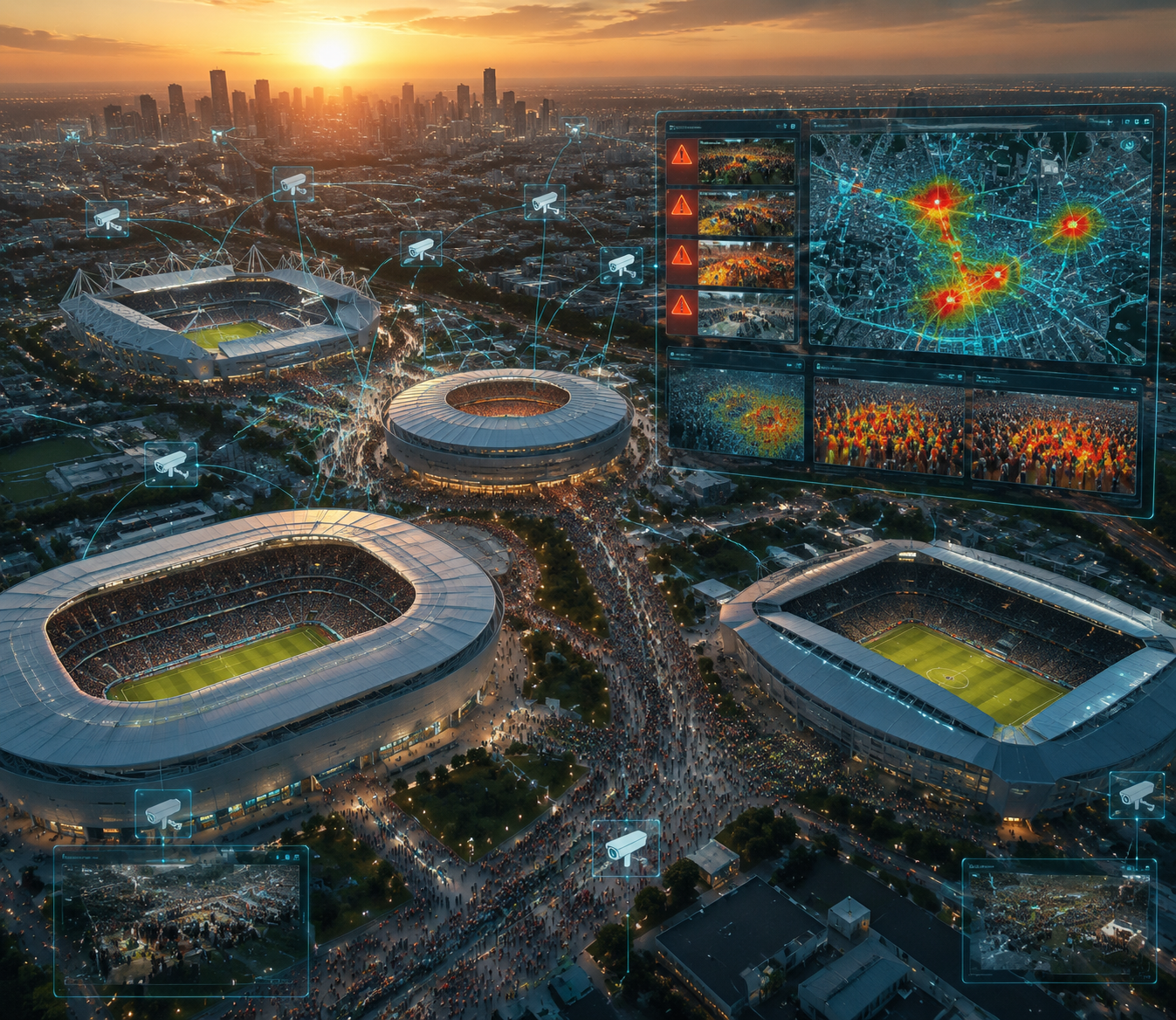
That is why AI security planning for World Cup logistics is less about buying smarter cameras than changing the tempo of the whole response chain. The useful question is not whether AI can make a stadium “safe.” No system can promise that. The useful question is whether AI can shorten the gap between detection and action: a crowd build-up at the wrong gate, a vehicle queue backing into a public road, an unauthorized drone entering restricted airspace, a cyber or public safety signal that changes the risk profile of a venue, or a warehouse gate delay that strands equipment and staff downstream.
At this scale, security planning becomes logistics planning under pressure. Fans are moving. Broadcast equipment is moving. Temporary fencing, concessions, medical teams, police units, buses, rideshare traffic, volunteers, credentials, and freight are all moving through systems built for normal days. A delayed alert is not just a missed notification; it is a handoff that arrives after the field team has lost the angle.
More Cameras Do Not Fix Alert Fatigue
Legacy surveillance fails twice at mega-event scale. First, it creates too much footage for human review. Second, it creates too much noise for human trust. IntelliSee’s World Cup security analysis reports that legacy CCTV and related detection workflows can generate roughly 98% false alerts, a figure that should be treated as vendor-originated rather than an independent universal benchmark.[1] Still, anyone who has watched a shift supervisor triage repeated nuisance alarms knows the pattern: after enough bad alerts, the next alert has to work harder to earn attention.
False alarms are not a cosmetic dashboard problem. They consume the radio channel, pull supervisors away from judgment calls, and train staff to wait for confirmation. In a stadium environment, waiting can be the whole failure. A gate begins to compress. A group climbs a barrier. A vehicle blocks a service lane. The first signal may be weak, but the cost of ignoring it rises quickly once thousands of people are already moving.
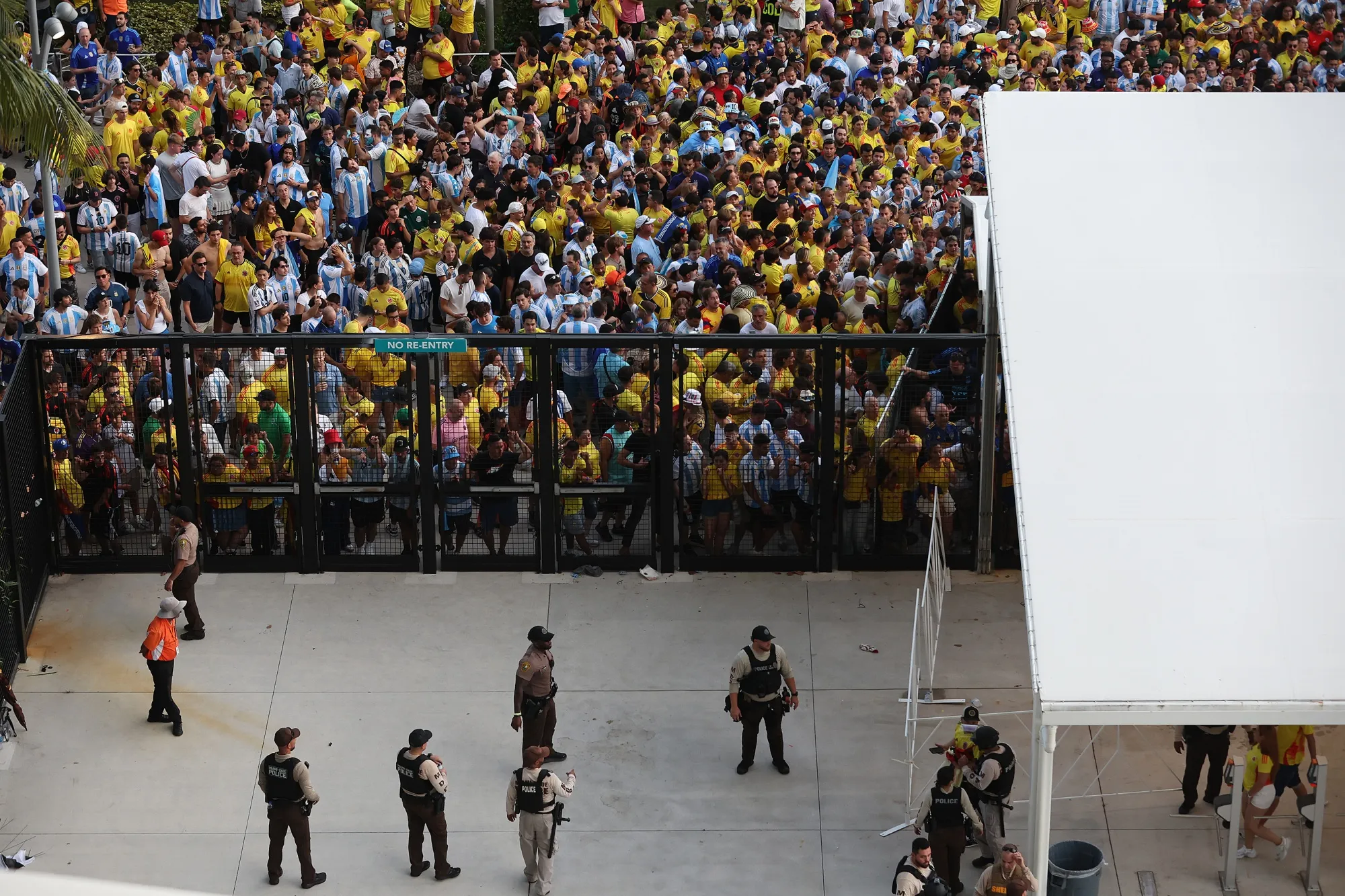
The 2024 Copa America final at Hard Rock Stadium is the blunt reminder. Ticketless fans overwhelmed security checkpoints before the Argentina-Colombia match, producing exactly the kind of crowd-control breakdown that looks obvious in replay and messy in real time.[1] The lesson is not that one product would have prevented the breach. The lesson is narrower and more useful: checkpoint failure often becomes irreversible when detection, escalation, and field coordination lag behind crowd behavior.
What Changes When Detection Becomes Triage
The practical value of AI video analytics is not that it watches every screen like a tireless guard. It is that it changes what reaches the guard. A useful system filters camera feeds for conditions that matter operationally: abnormal crowd density, movement against expected flow, people entering restricted areas, objects left where they should not be, blocked exits, vehicle queues, perimeter breaches, or behavior patterns that need a human decision. The best output is not a flashing red box; it is a prioritized task with location, confidence, camera view, and recommended routing to the team that can act.
That compression matters. A passive CCTV workflow asks someone to notice, interpret, find the right camera, call the right desk, and hope the field unit is still positioned to respond. An AI-assisted workflow can surface the anomaly, group related signals, suppress duplicate alarms, and push a more complete incident package to the supervisor. The human still decides whether the alert is a nuisance, a developing incident, or a command-level escalation. The difference is that the decision starts earlier and with less scavenger hunting.
| Legacy monitoring step | AI-assisted planning shift |
|---|---|
| Camera wall depends on a human noticing the right feed | Analytics promote unusual or high-risk conditions to the top of the queue |
| Repeated nuisance alarms compete with real incidents | Duplicate and low-confidence events can be filtered before supervisor review |
| Incident context is assembled manually across radio, video, and access-control systems | Related signals can be grouped into a single operating picture |
| Response depends on who happens to see the issue first | Alerts can be routed to the desk or field team responsible for that zone |
The control-plane layer is where this becomes more than camera analytics. Forbes reported that Booz Allen’s Sit(x) public safety AI platform was deployed in five World Cup host cities, while RapidSOS HARMONY AI was described as fusing signals from more than 723 million connected devices.[2] Those are not proof of outcome by themselves. Adoption is not effectiveness. But they show the direction of the operating model: public safety desks are trying to combine video, emergency communications, connected-device signals, and field reports into one triage environment rather than leaving each system to shout separately.
The workflow only improves if the system respects jurisdiction and handoff. A stadium command room may see a crowd-density alert at a gate, but police, private security, fire, EMS, traffic control, transit, and venue operations may all own different pieces of the response. AI can accelerate the moment when the right people see the same incident. It cannot replace the pre-agreed rule for who closes a gate, redirects a queue, opens a relief entrance, pauses vehicle entry, or declares that a public road has become unsafe.
Drones, Cyber Signals, and the Problem of Too Many Feeds
Drones make the same point in a more visible way. DroneLife reported a $221 million federal investment in counter-UAS capabilities tied to World Cup security planning, and cited recent event examples in which eight unauthorized drones were disabled at F1 Miami and 12 breached the no-fly zone at the Masters.[3] Those cases should not be inflated into a forecast of World Cup drone incidents. They do show why drone detection cannot sit in a separate corner of the operation as a specialist feed that only one team understands.
A drone alert may matter because of what is happening below it: a packed fan zone, a media compound, a VIP route, a temporary warehouse, or a traffic choke point. The useful AI layer is the one that can correlate the aerial signal with venue status, crowd density, police posture, and response options. Without that fusion, the command room gets another alarm. With it, the alert becomes a ranked operational decision.
The same applies to cyber and emergency communications. A ticketing-system disruption, a public safety call cluster, a credentialing failure, or a network issue may not look like a crowd hazard at first. During a mega-event, it can become one if it slows entry, blocks dispatch visibility, or pushes people toward the wrong gates. AI planning earns its keep when it helps operators see those dependencies before the physical queue tells the story.
The ROI Is Clearest Where Logistics Leaves a Trail
Security ROI is hard to prove when the best outcome is that something does not happen. Traffic and logistics give planners a cleaner measurement surface. Around Houston’s NRG Stadium, FullStack reported that NoTraffic’s AI traffic system produced a 15% reduction in average vehicle delay, more than 20,873 vehicle hours saved, more than 16,000 metric tons of CO₂ reduction, and more than $40 million in projected five-year economic value.[4] Those figures are bounded to a traffic-management use case, which is exactly why they are useful. They do not prove that every AI security investment pays back. They show where the ledger can be inspected.
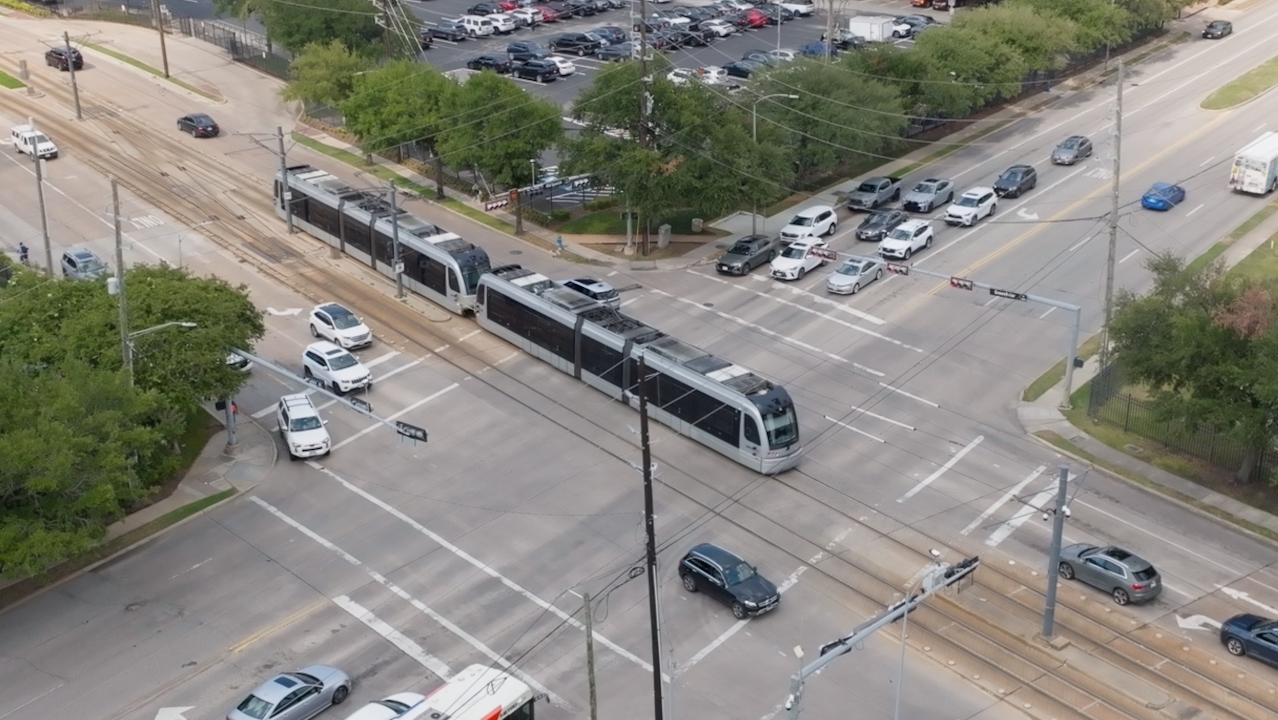
Vehicle-hours saved are not a soft benefit in World Cup operations. They affect bus reliability, police redeployment, fan arrival patterns, freight windows, emergency access, and labor hours. A signal plan that cuts delay can reduce the number of frustrated people arriving at the same checkpoint at the same time. A better prediction of post-match egress can keep rideshare, transit, and pedestrian flows from competing for the same physical space. Traffic data is security data when congestion changes crowd behavior.
The staffing contrast in Miami points to another measurable category: operational leverage. PCMag reported that Lenovo’s Technology Command Center in Miami required about 600 employees with AI support, compared with an estimated 1,800 or more that would have been needed without it.[5] That is not a license to understaff the field. It is a sign that AI can reduce the number of people needed to reconcile screens, tickets, logs, and alerts manually — if the system is good enough to make fewer humans more effective rather than merely busier.
The physical logistics burden behind the tournament is large enough to justify that attention. A Forbes Business Council post described Rock-it Cargo moving more than 1 million pounds of equipment, supported by 5,000 vehicles and 1 million square feet of warehouse space across 16 venues.[6] Because that source is council-post commentary from a vendor executive, it should be used as context rather than independent proof of AI performance. Still, the operating picture is credible: World Cup security is tied to freight timing, warehouse access, temporary infrastructure, and vehicle routing, not only to fan screening at the gate.
What a Better Detection-to-Response Loop Looks Like
A serious AI security plan starts before match day by mapping the points where slow information becomes physical risk. That usually means gates, credential checkpoints, perimeter roads, broadcast compounds, temporary warehouses, fan zones, transit interfaces, rideshare areas, emergency lanes, and drone-restricted zones. The system design should ask a plain question for each: if something begins to fail here, who needs to know within seconds, and what action can they still take?
- At a checkpoint, crowd-density analytics should alert before compression reaches the barrier, not after video shows a breach.
- At a service gate, vehicle recognition and queue monitoring should distinguish normal delivery peaks from a blockage that threatens emergency access.
- At a traffic desk, signal timing and incident data should show whether a delay is local inconvenience or a venue-wide arrival problem.
- At a public safety desk, drone, call, and camera inputs should be fused into one incident view when they describe the same risk.
- At a warehouse or dispatch console, late equipment movement should be visible early enough to reroute labor, staging, or security coverage.
The technology stack can be complicated; the operating test is not. Does the alert arrive with enough context for the supervisor to act? Does it route to the right team? Does it reduce duplicate radio traffic? Does it make the next handoff clearer? Does it preserve an audit trail for post-incident review? A system that answers yes to those questions changes operations. A system that adds another screen to an already crowded room does not.
Human review is not a compliance decoration here. Crowd behavior is contextual. A surge toward a gate may be dangerous, or it may be a predictable wave after transit arrivals. A person crossing a boundary may be an intruder, a lost worker, or someone directed there by another authority. A drone track may require escalation, monitoring, or dismissal depending on location and timing. AI can sort and accelerate the evidence. It cannot own the consequence of a bad call.
The Ceiling on the Claims
The 2026 World Cup evidence is still provisional. Several cited sources were published during the tournament window, so final post-tournament incident data, audited cost figures, and after-action findings may change the picture. The strongest false-alarm claim in the source base comes from vendor material. Some public safety and command-center examples show deployment and capacity, not independently measured prevention. The Houston traffic figures are more concrete, but they support a bounded logistics ROI case rather than a blanket security conclusion.
There are also governance questions that cannot be waved away by better analytics. Data sharing between agencies needs legal authority and retention rules. Model outputs need review for bias, drift, and false confidence. Biometric or identity-based surveillance should not be assumed without specific public documentation. Cyber resilience matters because an AI-enabled command center becomes a dependency of its own. And field teams still need training, radios, routes, authority, and rehearsal time.
The defensible case for AI-powered security planning is therefore practical rather than triumphant. At World Cup scale, legacy CCTV asks people to find urgent meaning inside millions of hours of footage and a storm of low-value alerts. AI can make the system more responsive by ranking the signal, fusing related inputs, forecasting logistics pressure, and handing supervisors a clearer decision earlier. That is the measurable gain — and the reason trained humans, governance, and field execution still belong at the center of the plan.
References
- FIFA World Cup 2026 Security: 16 Stadiums, 6 Million Fans, and the AI Gap No One’s Talking About, IntelliSee
- A New Generation Of Public Safety AI Is Helping Keep The World Cup Safe, Forbes, 2026-06-21
- Drones and AI Take Center Stage in World Cup Security Planning, DroneLife, 2025-12-19
- How World Cup Cities Are Using AI to Prep, FullStack
- Inside the Secret AI War Room Behind the 2026 World Cup, PCMag
- The 2026 FIFA World Cup And The Future Of Global Supply Chains, Forbes Business Council, 2026-02-19
Comments
Join the discussion with an anonymous comment.