
The hard decision comes before the barricades go up. A dispatcher is watching a storm cell crawl toward a low-lying corridor, a carrier is still reporting clean GPS pings, and the customer’s delivery window has not moved. If the team waits for a formal road closure, the truck may already be committed to a route that no longer exists operationally. If it diverts too early, the transportation manager owns the extra miles, fuel, and driver hours.
That is where AI for flood-threatened supply chain routing has become more than a prettier map. The useful question is not whether a model can predict heavy rain. It is whether logistics teams can turn uncertain flood intelligence into a routing decision early enough to protect delivery performance.
Flooding is now too large a disruption category to treat as an exception handled by manual escalation. Everstream Analytics reported that flooding accounted for 70% of weather-related supply chain disruptions in 2024, with 123 U.S. flood events that year and Hurricane Helene alone producing $7 billion in infrastructure damage insurance claims. Everstream also assigned climate-related flooding a 90% risk score, the highest supply chain threat score it identified for 2025–2026.[1]
The escalation is not just a U.S. story or a single hurricane story. Everstream’s 2026 disruption outlook says overall supply chain disruptions rose 38% year over year in 2024, while extreme weather events rose 119% and flood alerts rose 214%.[2] That kind of increase changes the planning threshold. Flood response can no longer sit outside the routing workflow as a late exception ticket.
What changes when routing becomes flood-aware
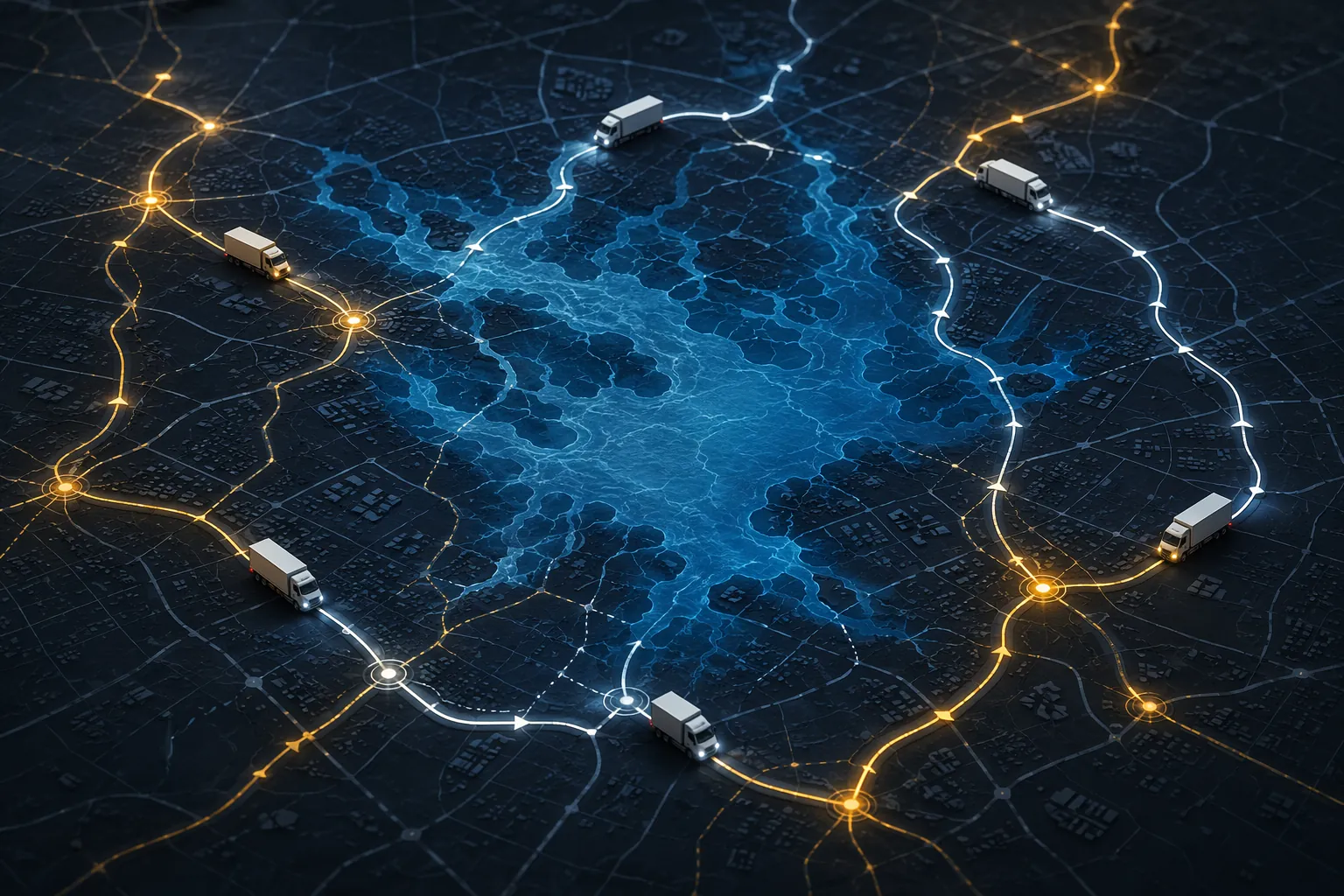
Ordinary route optimization is usually asked to reduce distance, time, fuel, or late deliveries under known constraints. Flood routing has to work with constraints that are still forming. A bridge may be passable now and unsafe in two hours. A warehouse may be reachable from the north but not the south. A driver may be close enough to turn back, while another asset is already past the last sensible diversion point.
Modern AI-driven routing systems do not make that judgment from one feed. They combine weather APIs, flood maps, satellite-derived flood extent data, GPS telemetry, historical disruption patterns, delivery-window rules, driver and asset locations, and transportation management system constraints. The output is not a single perfect answer. It is a continuously updated set of route choices, each carrying tradeoffs around risk, service, cost, and timing.
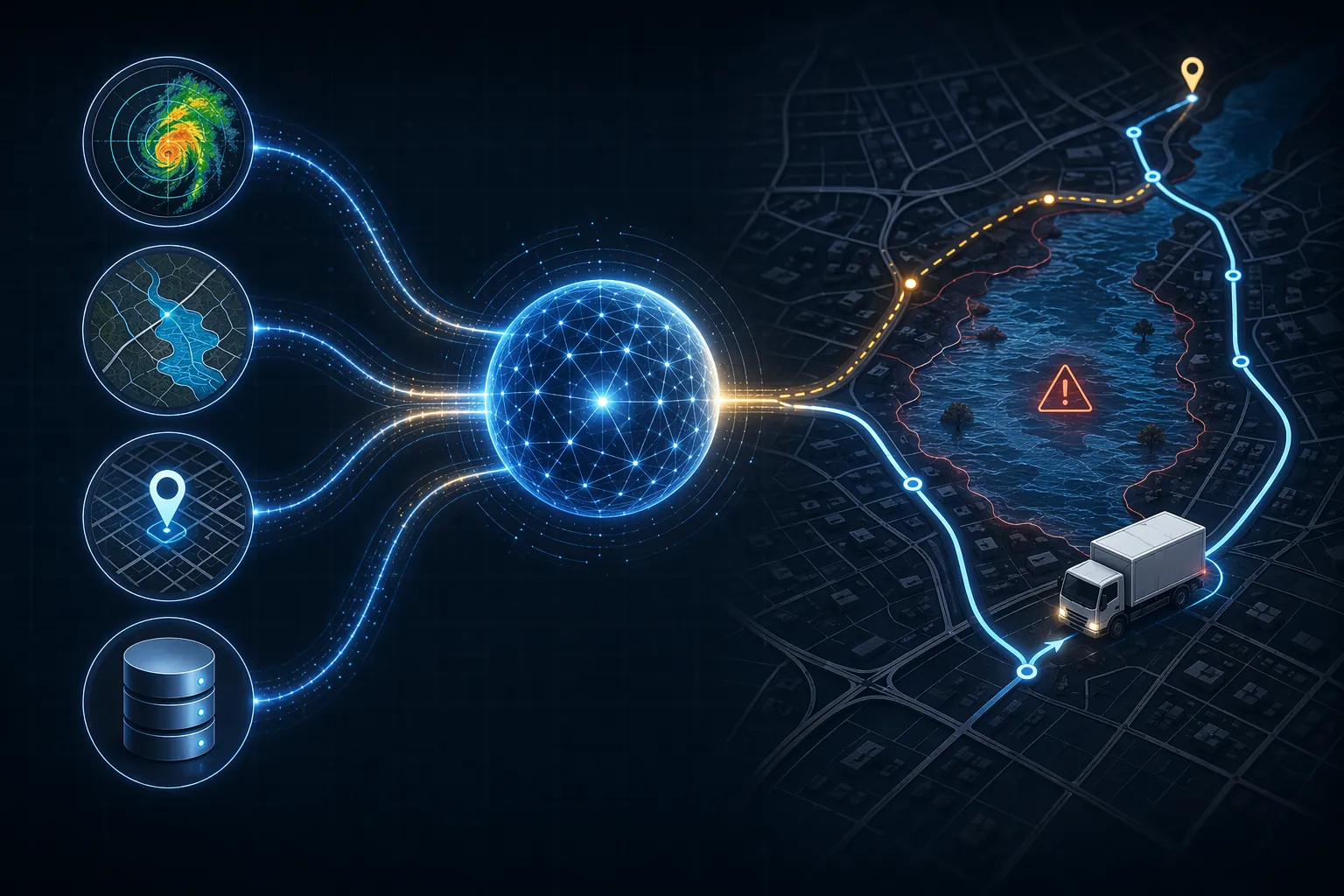
The difference matters inside the control room. A static optimizer can tell a planner which route looked best when the load was tendered. A flood-aware system keeps asking whether that route still makes sense as rainfall, road status, and asset position change. It also has to know what cannot be sacrificed: a refrigerated shipment’s dwell limit, a consignee appointment, a driver’s hours, a carrier handoff, or a customer penalty tied to a narrow delivery window.
A useful flood-routing recommendation therefore has to answer several operational questions at once:
- Which shipments are exposed to the threatened corridor, not just the visible storm area?
- Which loads can still be diverted without breaking service commitments elsewhere?
- Which alternate routes add cost but reduce the probability of a missed delivery window?
- Which decisions require human approval because the model is acting on a forecast rather than a confirmed closure?
- Which downstream nodes need new ETAs, inventory pulls, or appointment changes?
That last point is often where the software demo gets too clean. A reroute is not just a line moving around blue water on a screen. It can change labor planning at the receiving dock, carrier settlement, customer communications, detention exposure, and the next load assigned to the same tractor. If the AI cannot write its recommendation back into the transportation workflow, the dispatcher is left translating model output into operational work under pressure.
The measurable case: delay, cost, fuel, and arrival performance
The strongest argument for AI route optimization during floods is not that it is autonomous or fashionable. It is that earlier, better-informed routing decisions can reduce the operational penalty of disruption. Current deployment materials support a practical delay-reduction range of 15–35% for AI-assisted route optimization, while RTS Labs reports that AI route optimization can produce 5–20% logistics cost reduction and 20–30% inventory level reduction based on McKinsey benchmarks cited in its 2025 overview.[3]
Those figures should be treated as directional benchmarks, not as a guaranteed business case for every fleet. They do not say that any shipper can buy a platform and remove one-fifth of cost from a flood-prone network. They do say the opportunity is large enough to deserve attention from executives who previously treated route optimization as a back-office efficiency project.
RTS Labs also describes client cases where AI route optimization delivered a 15% fuel cost reduction and a 35% improvement in on-time arrivals.[3] For flood response, those two metrics belong together. A safe alternate route that preserves the appointment but burns margin may still be the right call for a high-priority load. A system that can compare service risk against fuel and mileage impact gives transportation leaders a better basis for approving that call before the route fails.
DHL’s Resilience360 case is more directly tied to disruption visibility and shipment prediction. The system ingests real-time weather data and flood maps to support dynamic rerouting, and DHL reported 90–95% accuracy in predicting shipment arrival times after AI integration, with the platform expanding to more than 13,000 users globally.[4] Those are self-reported figures, so they should not be read as independently audited proof. Still, arrival prediction accuracy is an operationally meaningful metric because it affects when teams notify customers, rebook appointments, or move inventory from another node.
| Evidence point | What it indicates | How to read it |
|---|---|---|
| 15–35% delivery delay reduction range | AI-assisted rerouting can reduce disruption impact when decisions are made early enough | Useful as a planning range, not a guaranteed result |
| 5–20% logistics cost reduction benchmark | Optimization can affect total transportation economics, not only miles | Cited through RTS Labs as a McKinsey benchmark |
| 15% fuel cost reduction and 35% on-time arrival improvement | Route optimization can improve both cost and service in reported client cases | RTS Labs client-reported outcome |
| 90–95% shipment arrival prediction accuracy | Better ETA confidence can improve exception management and customer communication | DHL self-reported Resilience360 figure |
For a VP evaluating budget, the important separation is adoption versus effectiveness. A platform with thousands of users may indicate organizational reach. It does not, by itself, prove that flood reroutes improved service. A delay-reduction or on-time metric is closer to operational effectiveness, but even then the baseline, network type, carrier mix, and disruption severity matter.
Where weather intelligence touches routing-adjacent decisions
Not every useful flood decision is a truck-level diversion. Sometimes the better move is to reposition inventory before demand shifts, reschedule inbound deliveries, or protect a supplier lane before the transportation team starts seeing late loads. ClimateAi’s FICE model is described as quantifying the timing, duration, and magnitude of weather-related demand spikes and supply disruptions, drawing on government weather services, macroeconomic indicators, and credit-card spending across more than 100 sectors.[5]
ClimateAi reports that a roofing manufacturer used its hurricane forecasting before Hurricane Ian to reposition inventory, generating $15 million in additional sales.[5] That is not a pure route-optimization case, and the figure is self-reported by the vendor. It is still relevant because flood and storm intelligence often creates value before a dispatcher touches a route: inventory must be close enough to serve the market when roads degrade.
The same boundary applies to Hitachi’s reported use of ClimateAi to map a cyclone near suppliers in Chennai and reschedule deliveries before the event.[5] The lesson is not that every shipper needs the same model. It is that routing continuity depends on upstream decisions: whether product is in the right facility, whether appointments can move, and whether planners trust a forecast before the disruption becomes visible in the TMS.
The capability categories are clearer than the vendor labels
Vendor names can be useful shorthand, but they should not obscure the operating capability being bought. DHL Resilience360 points to real-time risk visibility and dynamic rerouting. ClimateAi points to weather-driven supply and demand intelligence. RTS Labs points to custom constraint solving for complex routing problems. Everstream Analytics points to disruption databases and multi-tier risk scoring. Altana Atlas points to AI mapping of global trade flows. IBM Deep Thunder and CIMF point to hazard modeling for flood, fire, and heat. Jacobs Flood IQ points to short-range flood forecasting for infrastructure operations.
Jacobs Flood IQ is not a freight-routing product in the narrow sense, but its reported 24–72 hour forecast capability shows the kind of warning window logistics teams want when flood risk threatens service territory or infrastructure. Highways Today reported that United Utilities used Jacobs Flood IQ in a network context and achieved a 20% reduction in sewer flooding and pollution across a 78,000 km network.[6] That case should stay in its lane: it supports the value of flood intelligence for infrastructure response, not a direct claim about trucking performance.
For routing leaders, the vendor shortlist matters less than four questions that cut across all of them:
- Can the system identify exposed shipments before a formal closure appears?
- Can it combine forecast risk with live asset position and delivery constraints?
- Can it push recommendations into the TMS, carrier workflow, and customer communication process?
- Can the organization define who approves a probabilistic reroute and when?
Why the data stack decides whether the model gets trusted
Flood-aware routing depends on data that is timely enough to act on and clean enough to defend. GPS pings that arrive late, weather feeds that disagree without confidence scoring, stale road restrictions, incomplete facility geocodes, or missing delivery-window rules can turn a sophisticated model into another source of argument during an exception call.
The practical architecture usually has several layers. Weather and flood feeds describe the hazard. GPS and telematics show where assets actually are. Historical disruption data helps the model understand which corridors, facilities, or crossings tend to fail under similar conditions. Constraint solvers compare alternate routes against service commitments, equipment limits, driver rules, carrier availability, and cost impact. The TMS then has to make the recommendation executable.
| Layer | Operational job during a flood threat | Failure mode if weak |
|---|---|---|
| Weather and flood intelligence | Estimate where and when disruption may affect corridors | Teams wait for confirmed closures and lose reroute options |
| GPS and telematics | Locate trucks, trailers, and loads relative to the threatened area | Recommendations arrive after the asset has passed the last useful decision point |
| Historical disruption patterns | Identify routes and nodes that tend to fail under similar conditions | The model treats every alternate path as equally reliable |
| Constraint solving | Balance service windows, cost, driver limits, equipment, and customer priority | The system suggests routes that look good on a map but break the operation |
| TMS and workflow integration | Convert recommendations into tenders, updates, alerts, and appointment changes | Dispatchers rekey decisions manually during the disruption |
This is also why probabilistic recommendations need operating rules. A model may say a corridor has a rising flood probability inside the delivery window. Someone still has to decide whether that probability is high enough to divert freight now, hold at origin, split inventory, or notify the customer that the appointment is at risk. If leadership has not defined those thresholds before the storm, the decision falls back to the loudest escalation channel.
Human-in-the-loop does not mean humans redo the model’s work. It means the system narrows the decision fast enough that a planner or manager can approve the business tradeoff: spend more to preserve service, hold freight to avoid stranding an asset, or accept a delay because the alternate route is worse. That approval path is as important as the algorithm when flood risk is still uncertain.
A realistic investment test for flood routing AI
Gartner predicted in March 2026 that 60% of supply chain disruptions will be resolved without human intervention by 2031.[7] That is a useful signal about direction, but it should not be mistaken for proof that today’s flood-routing systems can be left alone. Flood response still involves customer commitments, safety, carrier relationships, and cost tradeoffs that many organizations are not ready to delegate completely.
The better investment test is more grounded. A logistics team is ready to extract value from AI route optimization during floods when it has clean real-time data, usable weather and flood intelligence, TMS integration, and decision rights for acting on forecasts before the route is officially broken.
If those conditions are missing, the model may still produce accurate risk signals that arrive in a workflow unable to use them. The dispatcher will see the warning, the manager will see the cost of diversion, and the organization will hesitate until the cheap option disappears. If those conditions are present, the reported gains in delay reduction, cost reduction, fuel savings, and on-time performance explain why flood-aware routing has moved from optional optimization to resilience infrastructure.
References
- Report: Floods Pose Top Threat to Supply Chains in 2025 — SupplyChainBrain
- Are You Prepared for the Supply Chain Disruptions of 2026? — Everstream
- AI Route Optimization: Everything You Need to Know (2025) — RTS Labs
- AI for Avoiding Supply Chain Disruptions – Two Use Cases — Emerj
- Climate Risk: An Essential Element of Supply Chain Risk Mapping in 2026 — ClimateAi
- The AI Flood Intelligence Reshaping Infrastructure Resilience — Highways Today
- 60% of Supply Chain Disruptions Will Be Resolved Without Human Intervention by 2031 — Gartner, March 2026
Comments
Join the discussion with an anonymous comment.