
AI energy supply chain optimization is a narrower question than the phrase sometimes suggests. This is not mainly about using AI to reduce electricity consumption in a generic supply chain. It is about using AI inside the energy industry’s own operating network: wells, offshore assets, refineries, pipelines, terminals, warehouses, maintenance programs, supplier bases, and the cash tied up between them.
That distinction matters because energy is not a clean-room benchmark category. A model that helps a retailer rebalance stock is not automatically prepared for a refinery turnaround, a critical compressor, a subsea component, a constrained port, or a supplier risk that becomes visible only after a geopolitical signal, weather event, or logistics failure. The better question is which AI use cases have already produced measured results in energy operations, and which claims are still too thin to carry an investment committee deck.

The strongest evidence starts with assets, not dashboards
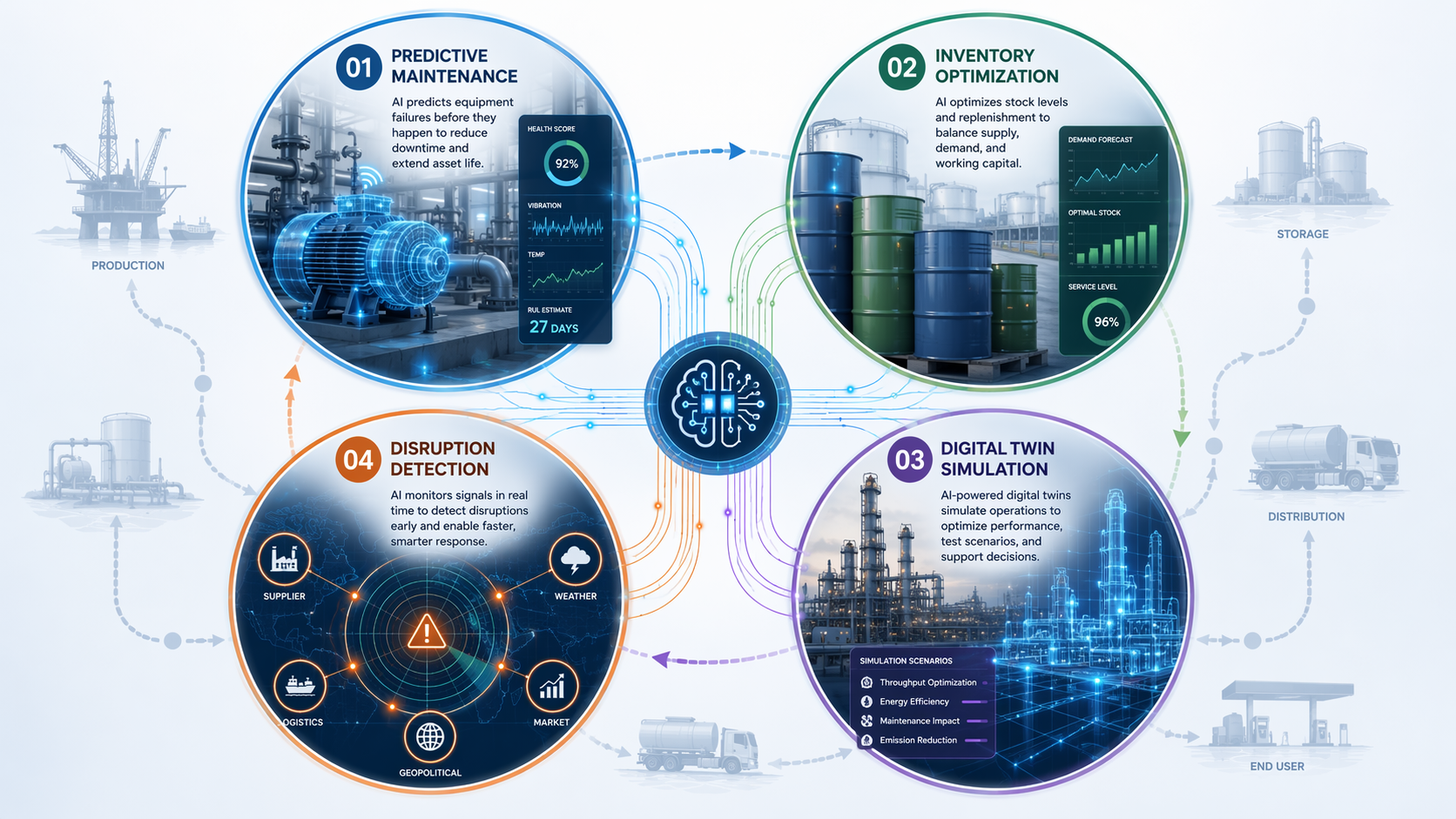
Shell’s predictive maintenance deployment is the clearest documented example because the operating mechanism is visible. Energies Media reported in April 2025 that Shell monitors more than 10,000 equipment items, processes 20 billion data rows each week, and runs more than 10,000 machine learning models that generate 15 million daily predictions. The same report attributes $50 million in annual savings and a 20% reduction in maintenance costs to the system, based on secondary reporting of Shell’s public claims.[1]
Those details make the case more useful than a generic “AI saves maintenance cost” claim. The value is not coming from a single algorithm finding a few bad bearings. It comes from scale: a large installed asset base, enough history to train models, enough sensors and operating data to detect changing conditions, and enough maintenance spend for avoided interventions and avoided outages to show up in the numbers.
For a supply chain or operations executive, the transferable lesson is not that another company should expect the same $50 million. It is that predictive maintenance can become a supply chain business case when it changes demand for spares, technician scheduling, emergency freight, shutdown planning, and inventory buffers. The model output matters because it moves work earlier, before the procurement team is paying for speed and the operations team is paying for downtime.
The attribution still deserves care. The savings figure is reported through Energies Media rather than reproduced here from Shell’s own financial filings, so it should not be treated as an independently audited benchmark. But among available examples, Shell’s case has the right ingredients for internal comparison: named company, enterprise scale, operational function, measured cost effect, and enough implementation detail to understand why the result is plausible.
bp’s inventory case speaks the language of cash
If Shell’s case is compelling because downtime is expensive, bp’s inventory optimization case is compelling because working capital is hard to ignore. Energies Media reported that bp’s AI inventory optimization reduced working capital by 22%, with cash flow projections improving by approximately $2 billion by 2027 against a 2024 baseline, based on secondary reporting of bp investor materials.[1]
That is the kind of result that travels beyond the supply chain function. Maintenance teams may care about service levels and parts availability. Finance cares that cash is not trapped in slow-moving stock, duplicated safety buffers, or materials bought early because nobody trusts the forecast. Operations cares that a leaner inventory position does not become a production risk. A credible inventory model has to satisfy all three.
The 2027 projection should be handled as a projection, not a fully realized historical outcome. The 22% working-capital reduction is the more direct operating metric; the approximately $2 billion cash flow improvement depends on the baseline, time horizon, and assumptions embedded in investor-facing materials. Used responsibly, the case supports a narrower but important claim: AI-enabled inventory optimization can release material working capital in large energy companies when it is connected to planning, maintenance demand, and procurement execution.
| Company | Use case | Measured outcome | How strong the evidence is for a business case |
|---|---|---|---|
| Shell | Predictive maintenance across equipment assets | $50 million in annual savings and 20% maintenance cost reduction reported through secondary coverage | Strongest operating detail: asset count, data volume, model count, daily predictions, and cost result |
| bp | AI inventory optimization | 22% working-capital reduction and approximately $2 billion projected cash flow improvement by 2027 versus 2024 baseline | Strong cash-flow relevance, but the larger dollar figure should be treated as a projection |
| ExxonMobil | Digital twin at Baytown facility | 30% reduction in unexpected outages | Useful operational evidence, narrower than enterprise-wide financial savings |
| Chevron | AI supplier-risk early warning | Supplier risks detected 45 days earlier than traditional methods | Promising risk lead-time evidence, with less direct cost attribution |
Digital twins and supplier warnings widen the map, but the proof is narrower
ExxonMobil’s Baytown digital twin case extends the evidence from maintenance and inventory into simulation. Energies Media reported a 30% reduction in unexpected outages at the Baytown facility, and TraxTech also noted ExxonMobil’s collaboration with Kinaxis on energy-specific supply chain solutions.[1][2]
A digital twin is valuable in energy because the physical system is expensive to interrupt. If a refinery, terminal, or production asset can test operating constraints and supply scenarios before the real network absorbs the shock, planners get a chance to move maintenance, materials, labor, and logistics decisions out of crisis mode. The Baytown figure is meaningful, but it is still an outage metric. It does not, by itself, show the full procurement, logistics, working-capital, or margin effect.
Chevron’s supplier-risk early warning system points to a different value pool. TraxTech reported that Chevron uses predictive analytics on historical data to detect supplier risks 45 days earlier than traditional methods.[2] Forty-five days is not a savings number, but it is operationally consequential. It can change whether a company expedites, dual-sources, negotiates allocations, changes shipping plans, or accepts a production risk knowingly rather than discovering it late.
This is also where the evidence gets thinner. Earlier detection is not the same as avoided loss. A supplier-risk model can create value only if the organization has playbooks, alternative sources, contracting flexibility, and decision rights ready before the alert arrives. Without those, the model becomes a better alarm attached to the same constrained response system.
What the cases have in common
The named deployments are different, but they share a practical pattern. AI is being applied where energy companies already have large cost pools, visible failure modes, and data that has been accumulating for years. Maintenance records, sensor histories, asset hierarchies, inventory movements, supplier performance, logistics events, and outage records are not glamorous, but they are the raw material that lets a model find patterns worth acting on.
- Predictive maintenance works best when equipment criticality, failure history, sensor data, and maintenance execution are connected rather than trapped in separate systems.
- Inventory optimization works best when the model sees both demand signals and the operational consequences of stockouts, not just historical consumption.
- Digital twin simulation works best when planners can test constraints across assets, logistics, and maintenance windows before the real network is disrupted.
- Supplier-risk detection works best when alerts trigger approved actions, such as alternate sourcing, expedited qualification, inventory repositioning, or contract escalation.
That is why energy deserves separate treatment from broad supply chain AI commentary. The sector’s asset intensity creates a high penalty for failure, and that penalty makes earlier prediction easier to monetize. A 20% maintenance-cost reduction, a 22% working-capital reduction, a 30% outage reduction, or a 45-day risk lead-time gain each moves a different financial lever. They should not be averaged into one artificial benchmark.
Aggregate metrics help with context, not proof
Broader benchmarks are useful once the company-level evidence is on the table. AWS for Industries and TraxTech cite McKinsey-derived metrics indicating that companies using AI in energy supply chains achieve 15% lower logistics costs, 35% reduced inventory, and 65% improved service levels.[2][3] AWS also describes agent-based model simulations in which optimized strategies deliver 15–25% supply chain efficiency gains and reduce disruption response times by 30–50%.[3]
Those figures are useful for sizing ambition, but they are not a substitute for a company’s own baseline. “Inventory down 35%” can be excellent or reckless depending on service criticality, supplier lead times, storage constraints, and outage exposure. “Service levels up 65%” needs a definition before it can be compared across a refinery, a wind fleet, an LNG terminal, and a utility spare-parts network.
Agent-based simulation is especially attractive in energy because disruption behavior is often nonlinear. A port delay, weather event, supplier failure, or unplanned maintenance issue can cascade across production, transport, and storage. But simulated efficiency gains remain simulation evidence unless they are tied to live operating decisions and measured after implementation.
The investment case should be built by function
A defensible AI business case in an energy supply chain should not start with the market category. It should start with the function where a measurable operating problem already exists. Maintenance and inventory have the strongest public evidence because they connect directly to cost, downtime, cash, and service risk. Digital twins and supplier-risk detection are credible next candidates, but their business cases often need more careful translation from operational signal to financial outcome.
| If the pressure is | Start with | Primary metric to defend | Evidence to request before scaling |
|---|---|---|---|
| High unplanned downtime or emergency maintenance | Predictive maintenance | Maintenance cost, outage rate, avoided emergency work | Asset coverage, prediction accuracy, intervention history, and cost attribution |
| Cash tied up in spares and materials | Inventory optimization | Working capital, stockout rate, service level | Baseline inventory policy, demand history, criticality rules, and realized cash release |
| Complex asset or network constraints | Digital twin simulation | Unexpected outages, scenario response time, plan adherence | Live decision use, not just model output or simulation results |
| Supplier disruption exposure | Risk detection and early warning | Lead time gained, avoided expedite cost, continuity of supply | Documented actions taken after alerts and measured outcomes |
The first screening question is whether the company can name the decision that will change. A maintenance model that does not alter work orders, inspection timing, or spare-parts planning is not yet an operating improvement. An inventory model that recommends lower stock without changing replenishment rules, approval thresholds, or service-level governance will struggle once a critical part is unavailable. A supplier-risk model that produces warnings without commercial alternatives mostly creates earlier anxiety.
The second screening question is whether the baseline is clean enough to survive finance review. Energy companies often have fragmented asset systems, inconsistent materials masters, duplicate supplier records, and planning rules that reflect old constraints. AI can still be useful in that environment, but the return should not be promised as if the data foundation were already solved.
Data foundation is a prerequisite, not an implementation footnote
Opportune’s discussion of AI and analytics in hydrocarbon supply chain optimization emphasizes industry-specific implementation considerations rather than treating supply chain AI as a plug-in layer.[4] That framing is important. In hydrocarbons, the model has to respect asset constraints, product specifications, transportation limits, safety requirements, regulatory obligations, and the operational reality that a local optimization can create a larger system cost somewhere else.
The practical data work is usually less exciting than the model demo. Equipment hierarchies need to match maintenance histories. Materials need consistent descriptions and criticality codes. Supplier records need ownership. Inventory policies need to distinguish insurance spares from routine consumables. Logistics data needs enough event history to separate normal variability from disruption. If these foundations are weak, the AI program may still produce pilots, but scaling the result across assets and regions becomes much harder.
This is also why 18–24-month ROI expectations are more credible than instant-payback claims. The research materials describe that time frame as a typical implementation horizon, with data foundation quality repeatedly appearing as a scaling condition.[4][5] Some pilots will show earlier operational wins, but enterprise value usually requires integration into planning, procurement, maintenance, and performance management routines.
Market growth is an urgency signal, not a return model
The market backdrop explains why boards and executive teams are asking about AI now. Open Sky Group cites Precedence Research figures valuing the AI in supply chain market at $9.94 billion in 2025 and projecting it to reach $236 billion by 2035, a 37.3% compound annual growth rate.[5]
That projection says vendors, investors, and buyers expect rapid growth. It does not prove that a specific energy company will earn a return. Market CAGR should support timing and competitive-awareness arguments, not replace a function-specific business case. The more useful evidence remains the named deployments: Shell for predictive maintenance at scale, bp for working-capital release, ExxonMobil for outage reduction through digital twin capability, and Chevron for earlier supplier-risk detection.
A responsible decision boundary
Energy executives have enough peer evidence to justify serious investment in AI energy supply chain optimization, especially where the target is maintenance cost, unplanned downtime, inventory, working capital, or risk lead time. The evidence is not evenly strong across every use case. Predictive maintenance and inventory optimization carry the most financially legible proof. Digital twins and supplier-risk detection are promising, but they need tighter links between model output, operating action, and measured financial consequence.
The companies most likely to make the business case hold are the ones that select use cases by operating pain, document the baseline before deployment, invest in data quality, assign decision rights, and measure outcomes by function rather than leaning on broad AI adoption statistics. A sourced, function-specific case with an 18–24-month ROI horizon is easier to defend than a neat benchmark that collapses maintenance, inventory, logistics, and risk into one promised transformation number.
References
- AI in Supply Chain Management: Real Results from Top Energy Companies in 2025, Energies Media, April 2025
- AI-Powered Supply Chain Transformation: Energy Sector Shows the Way Forward, TraxTech, 2025
- Top-performing supply chains: When AI meets energy industry experience, AWS for Industries
- Supply Chain Optimization in Hydrocarbons with AI and Analytics, Opportune
- Supply Chain AI Statistics: 18+ Statistics You Should Know for 2026, Open Sky Group
Comments
Join the discussion with an anonymous comment.