
A returned item starts losing value before anyone argues about whether reverse logistics is a cost center or a strategic capability. It waits for a label scan. It waits for a dock door. It waits for inspection. It waits for someone to decide whether it goes back to shelf, moves to a secondary channel, gets repaired, gets liquidated, or becomes another write-off in a bin that no one wants to own.
That waiting has become too expensive to treat as an administrative afterthought. McKinsey estimated that US consumers returned nearly $1 trillion in merchandise in 2024, while noting that NRF put the figure at $890 billion; the difference is a scope and methodology issue, not a reason to ignore the size of the leak. Retailers also spend about $200 billion annually on returns recovery, which means the economics are no longer hiding in the back room.[1]
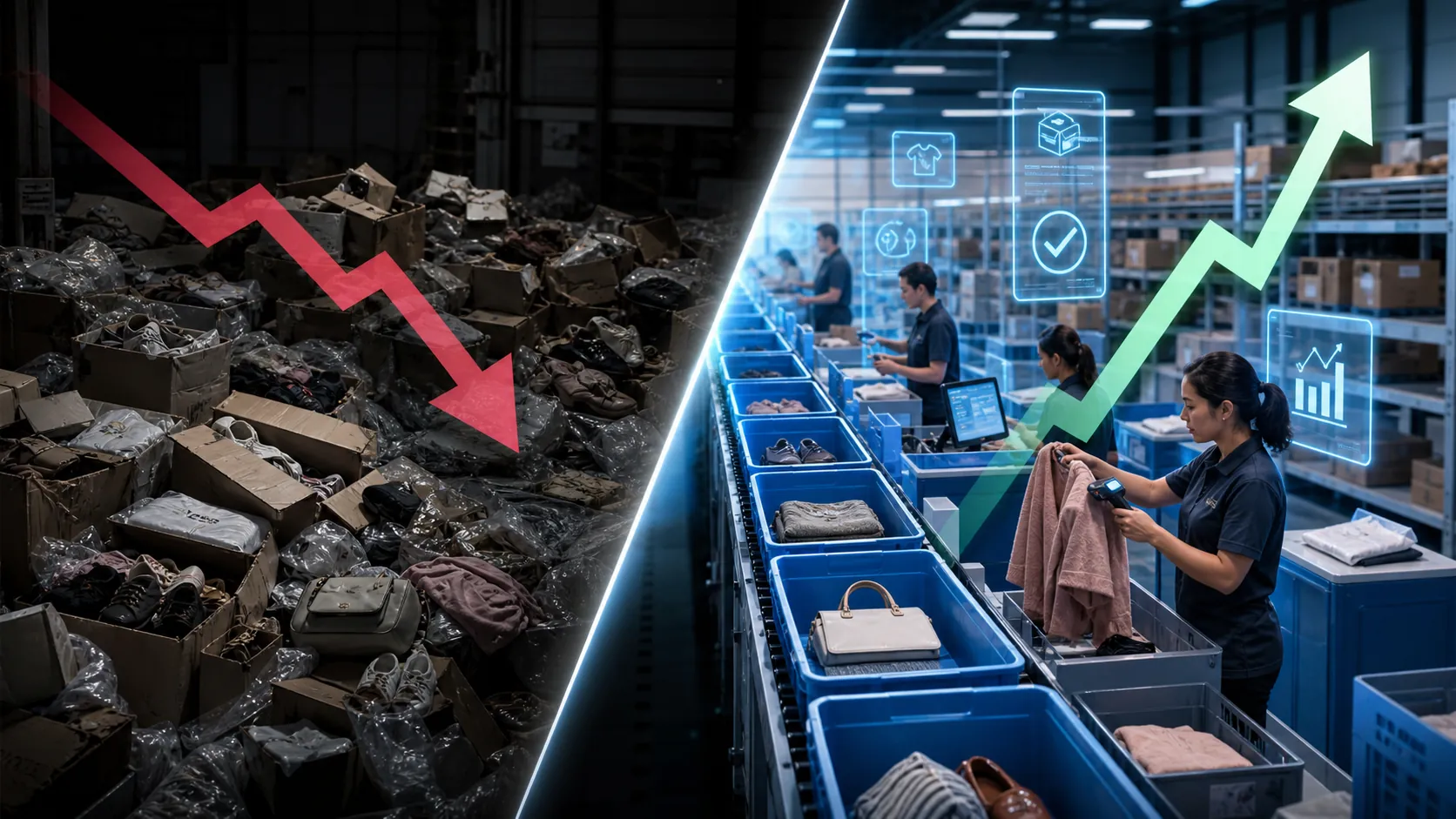
AI matters in this part of the supply chain only when it changes the next physical action. A better model is useful if it tells a return center to staff inspection differently next Tuesday, pre-builds transportation capacity before a seasonal spike, routes a carton into the right lane the first time, or prevents a sellable item from being pushed into liquidation because the system had no better choice. The same discipline applies where recall-related reverse logistics overlaps with ordinary returns: speed and traceability matter, but the operational question is still what happens to the item next.
The strongest business case is not built around a general claim that AI “transforms returns.” It is built around four decisions: what returns are likely to arrive, what condition they are in, how they should move, and where they should land before recoverable value decays.
The Reverse Flow Has To Be Predicted Before It Can Be Controlled
Most return centers feel volume before they understand it. A promotion sells through online, a fit issue shows up in apparel, a marketplace seller mislabels dimensions, a holiday category comes back late, and the reverse network absorbs the evidence after the forward network has already moved on.
Predictive return forecasting is the first useful AI intervention because it moves planning upstream. Instead of waiting for return merchandise authorizations to become dock congestion, models can combine return history, item attributes, sales patterns, policy rules, seasonality, and channel data to estimate what is likely to come back and where it will appear. That does not eliminate returns. It changes the preparation: labor scheduling, inspection capacity, trailer planning, store receiving, vendor conversations, and inventory expectations.
This is where executives should be careful with the word “forecast.” A model that predicts return volume is not the same as a model that proves a policy caused that volume. A high return rate on one SKU might reflect fit, damage in transit, misleading product content, buyer behavior, or a merchandising decision that created demand the product could not satisfy. The operational value comes from seeing the wave early enough to allocate capacity and investigate the cause, not from pretending the model has settled every commercial question.
| AI intervention | Operational decision it should change | Value at stake |
|---|---|---|
| Predictive return forecasting | Labor, dock, carrier, and inventory preparation before returns arrive | Less congestion and fewer delays before inspection |
| Computer vision inspection | Condition grade, packaging status, damage detection, and exception routing | Faster separation of sellable, repairable, resale, and non-recoverable goods |
| Dynamic routing and backhaul optimization | Which route, facility, store, or carrier movement absorbs the return | Lower pickup and transfer cost per item |
| Disposition decisioning | Restock, resale, repair, liquidation, recycle, vendor return, or hold for review | Higher recovery before item condition and demand deteriorate |
Inspection Is Where Value Recovery Becomes Visible
Inspection is the unglamorous hinge in the returns operation. Until the item is graded, every downstream choice is approximate. Is the box unopened? Is the original packaging intact? Is the product damaged or only the carton? Is a missing accessory enough to block restock? Should the item go back to a store, to e-commerce inventory, to a refurbisher, to secondary resale, or to a liquidation pallet?
Computer vision can help because condition is visual, repetitive, and time-sensitive. Cameras and models can compare packaging condition, surface defects, label integrity, tamper evidence, and visible damage against decision rules. The aim is not to remove every human from inspection. It is to stop making the same low-risk visual judgment slowly and inconsistently while higher-risk exceptions wait in the same queue.
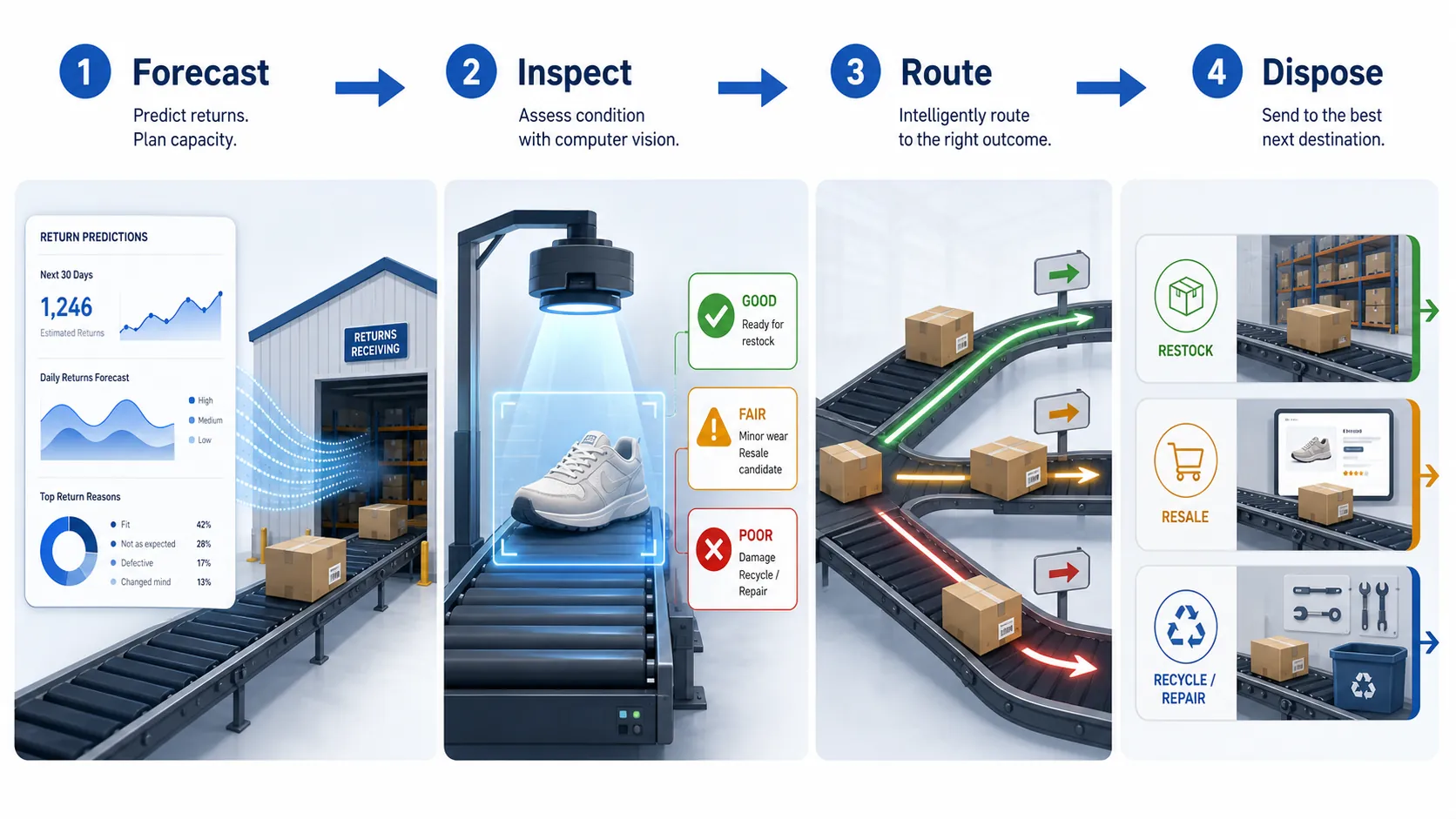
The margin consequence is direct. Optoro says products returned in original packaging can sell for up to 10 times more on secondary markets than damaged items.[4] That does not mean every unopened return deserves the same route, and it does not make secondary resale preferable to restock. It does mean that detecting packaging and condition accurately is not clerical work. It is a pricing and recovery decision at the point where the operation still has choices.
The best inspection use cases usually start with categories where condition signals are clear and the value spread between dispositions is wide. Consumer electronics, appliances, footwear, beauty, home goods, and premium apparel can all have very different economics depending on whether an item is unopened, lightly handled, incomplete, damaged, or unsafe to resell. A scan that merely says “received” does not protect that spread. A condition grade tied to an approved disposition rule can.
Disposition Needs More Than A Reason Code
Many return systems still lean on reason codes that were built for customer service, not recovery optimization. “Too small,” “changed mind,” “damaged,” and “wrong item” are useful signals, but they are not disposition decisions. The disposition engine needs to weigh condition, original selling price, current demand, markdown schedule, location, seasonality, channel restrictions, repair cost, transportation cost, vendor agreements, and compliance constraints.
That is where AI can move from classification to decision support. A returned item in original packaging with current demand near a store may be worth routing to restock. A similar item with weak demand, damaged packaging, and high transfer cost may recover more through a secondary channel. A product with uncertain safety status should be held for human review or a controlled process, even if the model sees resale value. The value of the system is not that it makes every decision automatically; it is that it brings item-level economics into the decision before the default path destroys optionality.
This is also where policy and customer experience enter without taking over the room. McKinsey found that 71% of consumers said a dynamic, AI-segmented return policy would not reduce their likelihood to shop again.[1] That supports a narrower conclusion than some teams may want: segmentation is not automatically customer-hostile. It does not prove every restrictive policy is safe, and it does not replace brand judgment. It does give operations leaders room to argue that a one-size-fits-all policy may be leaving money on the floor when risk, item value, and customer history differ.
Routing Savings Are Real, But They Are Not The Whole Prize
Transportation is usually the easiest part of the AI story to understand. If a returned item can ride an existing lane, consolidate with nearby pickups, move through a store network, or avoid a dedicated trip, the cost drops. McKinsey reports that per-item pickup costs can fall from $4 to $6 to under $1.50 through backhaul optimization.[1]
The mechanism is straightforward: better matching between return pickup demand and available capacity. Dynamic routing can assign pickups to routes that already pass nearby, decide whether a store should hold goods for consolidation, and reduce empty miles when forward and reverse flows can be paired. For enterprise retailers and 3PLs, the savings become meaningful because returns are high-frequency, fragmented movements rather than a few tidy truckloads.
Still, cheap movement is not the same as good recovery. Moving the wrong item cheaply to the wrong node can preserve a transportation KPI while sacrificing margin. Routing should therefore sit behind, or at least beside, the disposition logic. If the item is likely to go back to shelf, speed and proximity matter. If it is headed to repair or resale, consolidation and specialist capacity may matter more. If it is tied to a safety event or recall-adjacent hold, traceability outranks convenience.
For readers focused specifically on recall response, the operating pattern is related but not identical: identify affected units, isolate them, route them through controlled flows, and keep auditable records of what happened. ChainSignal has covered that narrower agentic workflow in How AI Agents Automate Recall Response Across Retail Supply Chains. In ordinary reverse logistics, the same discipline around traceability helps, but the optimization target is broader: recover value without violating safety, policy, or channel rules.
The Adoption Gap Creates The Window
The numbers are strong enough to get attention. McKinsey describes return-to-shelf cycles compressing from 8 to 12 days to 3 to 5 days, and the same evidence set points to AI reducing labor costs by about 30% and accelerating processing by 50% to 60%; Deloitte and Locus also discuss AI-enabled improvements in reverse logistics processing and labor productivity.[1][2][3]
The more important number may be the adoption gap. In McKinsey’s survey of 30 supply chain executives, only 5 used anything beyond basic data for disposition decisions.[1] That finding changes the competitive framing. This is not yet a mature software category where every large retailer has already standardized the same playbook. For companies with enough returns volume and usable data, there is still a window to improve recovery before the practice becomes table stakes.
That gap also explains why broad market-growth figures are less persuasive than operational metrics. A forecasted CAGR may help a software vendor describe category momentum, but it does not tell an operations director which lane gets less congested, which item gets inspected faster, or which pallet avoids liquidation. Locus cites Technavio’s projection that the reverse logistics AI market will grow at a 19.8% CAGR, but the investment case inside a retailer still has to be built from flow time, labor, transportation, recovery rate, and exception cost.[3]
What A Credible Implementation Looks Like
A realistic AI reverse-logistics program does not begin with a universal deployment across every category and node. It begins where the value spread is large enough to justify better decisions and the data is good enough to support them. High-volume categories with repeatable return patterns, visible condition differences, and multiple viable disposition paths usually make better starting points than rare, bespoke, or low-value returns.
- Enough returns volume to make forecasting, inspection automation, and routing optimization financially meaningful.
- Returns-history data that connects item, channel, reason code, timing, condition, disposition, and recovery outcome.
- Item-level condition signals, including images or scan data where computer vision is part of the inspection process.
- Integration into WMS, TMS, OMS, store systems, or equivalent platforms so recommendations become executable work.
- Human review for exceptions where a wrong disposition creates high financial, safety, compliance, or customer risk.
The integration point deserves more attention than it usually gets. A model that recommends “restock” but cannot trigger the WMS workflow, update inventory availability, inform transportation, or preserve an audit trail is still mostly an analytics layer. The operational leverage appears when the recommendation changes the work queue, the routing instruction, the inspection requirement, or the inventory status. For companies still preparing the underlying architecture, ChainSignal’s A Five-Phase Cloud Migration Roadmap for Supply Chain AI is the more relevant starting point than a disposition-engine demo.
Human review is not a concession that the AI failed. It is part of the control design. Low-value, low-risk, high-confidence returns can move quickly. Ambiguous damage, regulated products, fraud signals, recall-adjacent items, and expensive goods should be routed to people with the right authority. The system earns trust by knowing which decisions can be automated and which ones should be escalated.
The business case is credible when AI preserves recoverable value that the current reverse flow leaks: returns arrive with better capacity planning, inspection separates condition faster, routing uses available movement more intelligently, and disposition happens before time and handling erase the best option. That is how reverse logistics becomes a value recovery engine rather than a better-labeled cost center.
References
- From cost center to competitive advantage: Modernizing reverse logistics with AI, McKinsey, February 2026.
- Reverse Logistics With AI in Retail, Deloitte, 2025.
- How AI-Optimized Reverse Logistics Is Becoming Retail's Hidden Competitive Edge, Locus, 2026.
- How AI is Driving the Future of Retail Returns, Optoro.
Comments
Join the discussion with an anonymous comment.