
The MV Trisha Kerstin 3 did not leave only a casualty count behind. The January 2026 sinking off Basilan, Philippines killed 29 people, triggered a multi-agency rescue effort, exposed a passenger-manifest discrepancy, and led regulators to ground Aleson Shipping’s entire fleet, suspending four daily round trips that island passengers and cargo had relied on.[1]

That sequence matters for anyone evaluating AI for ferry disaster recovery logistics. A ferry disaster is not a single response problem. It becomes a chain of operational handoffs: who was actually aboard, which responders are searching which waters, what vessel capacity is still legal to use, how island supplies move after a route is suspended, and when families can trust the names they are given.
The Basilan record is also a reminder to be careful with evidence. The most detailed available account cited 359 reported passengers, later revised to 344 actual passengers, with 15 people apparently listed who never boarded.[1] It also reported 32 prior incidents involving the same operator since 2019.[1] Those details make the case operationally useful, but they still come from a single contemporary report; later official investigations may refine the record.
The useful question is therefore narrower than whether AI can “solve” ferry disasters. It is whether existing AI capabilities, already used in maritime search and rescue, humanitarian logistics, and post-crisis supply chain recovery, map to the specific breakdowns that a ferry sinking creates.
The ferry failure map
Five logistics failures stand out from the Basilan case. They overlap in time, but they are not the same job, and treating them as one emergency-response process is where software plans usually get vague.
| Failure mode | What failed operationally | AI capability that plausibly fits |
|---|---|---|
| Manifest inaccuracy | Reported passenger records did not match actual boarding reality. | Computer vision, boarding validation, and identity-verification decision support |
| Multi-agency SAR coordination | Coast Guard, Navy, Air Force, fishing boats, and commercial craft had to operate across the same search environment. | AI-driven common operating pictures and responder readiness analytics |
| Fleet redeployment delays | A whole operator fleet was grounded, removing scheduled capacity at once. | Dynamic routing and capacity-reallocation models |
| Island supply disruption | Suspended ferry round trips became a local continuity problem, not just a transport inconvenience. | Predictive demand and recovery inventory models |
| Survivor and family notification logistics | Unreliable source data slowed the path from rescue records to confirmed names. | Identity matching, record reconciliation, and exception-flagging systems |
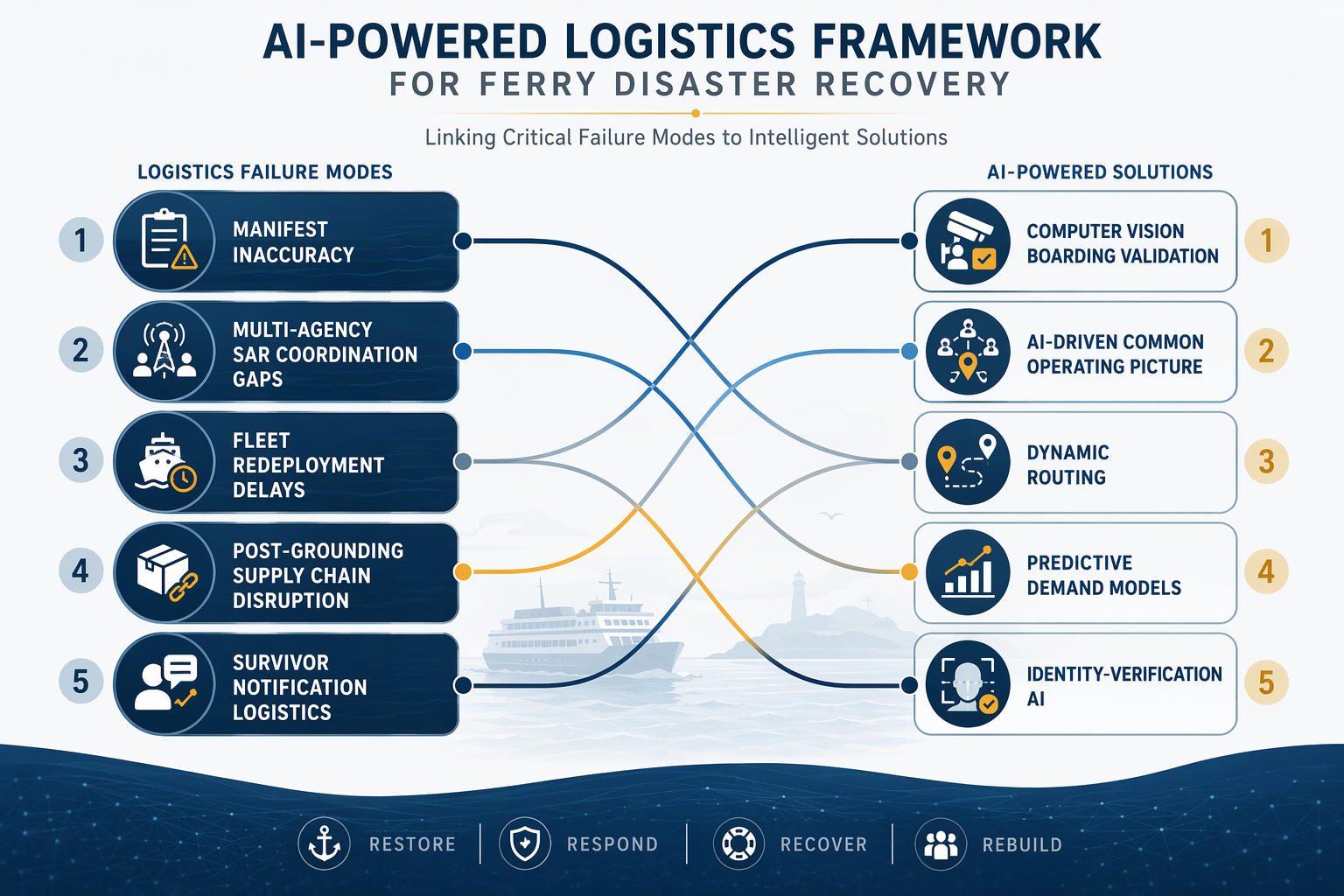
None of those matches proves ferry-specific return on investment. The stronger claim is that each failure has an adjacent operating domain where AI has already been tested or deployed, and that gives ferry operators enough basis to pilot carefully measured decision-support systems.
1. Manifest inaccuracy is not paperwork after the fact
The manifest discrepancy in the Basilan case is the detail that turns a sinking into a prolonged logistics problem. A list that says 359 people were aboard, when the later figure is 344, sends search planners, hospital coordinators, port officials, and families into different versions of the same event.[1] The 15 names reportedly listed despite not boarding are not a clerical footnote. They are potential false search targets, delayed confirmations, and family-notification errors waiting to happen.
AI can help here only if it is placed at the boarding and reconciliation points, not sprinkled onto the incident room after the vessel has gone down. Computer vision at gangways, license-plate or ticket-image recognition for roll-on/roll-off traffic, duplicate detection in passenger records, and anomaly flags for last-minute changes can all reduce the gap between the sales manifest, the boarding manifest, and the final sailing manifest.
The key design choice is exception handling. If a passenger is listed but not visually confirmed boarding, the system should not quietly “correct” the record. It should create a time-stamped exception for a gate agent or vessel officer to resolve before departure. If connectivity is poor, the system should preserve a local audit trail and synchronize later. In an archipelago, the perfect cloud workflow that fails at a small port is not a safety system.
This is also where privacy and accountability belong in the same conversation as speed. Identity-verification AI can support matching across ticketing, boarding, survivor intake, hospital transfer, and morgue records. It should not become an unreviewed authority for declaring who was on board. In disaster recovery, a false match can be almost as damaging as a missing match.
2. SAR coordination needs a shared picture before it needs autonomy
The reported Basilan response involved the Philippine Coast Guard, Navy, Air Force Black Hawks, fishing boats, and commercial craft.[1] That mix is typical of real maritime response: official assets arrive, nearby vessels assist, aircraft search wider areas, and shore-side coordinators try to keep the operating picture current while information arrives unevenly.
The AI application that fits this failure is not a robot captain. It is a common operating picture that ingests vessel locations, aircraft search patterns, weather conditions, reported sightings, survivor pickup points, hospital destinations, and asset readiness. A rescue coordinator still decides. The system reduces the time spent reconciling partial views.
There is adjacent evidence for that kind of use. A 2026 account of RNLI-related real-time analytics describes AI-enabled identification of high-risk zones and fleet readiness tracking in maritime search and rescue operations.[2] Singapore’s HTX has also described Marine Video Analytics for Rescue and Recovery at Sea, using synthetic data training with thermal and sonar inputs to improve person-in-water detection.[3]
Those examples matter because they sit close to the ferry problem. After a passenger ferry sinks, the coordinator needs to know not only where people might be in the water, but which asset can reach them, whether that asset has capacity, whether it has recovered survivors already, and which pier or hospital is ready to receive them. Detection without dispatch discipline only moves the bottleneck.
The International Maritime Rescue Federation’s warning is the right constraint here: SAR should remain human-led, with AI used as decision support rather than full automation.[4] That is not a conservative slogan. It is an operating requirement when fishermen, naval crews, helicopter pilots, port officers, and medical teams are all acting on the same evolving map.
3. Grounding a fleet turns safety action into a capacity shock
A fleet grounding is often discussed as a regulatory response, but at the dock it is also a capacity shock. In the Basilan case, Aleson Shipping’s entire fleet was grounded and four daily round trips were suspended.[1] That removes predictable transport from people, cargo, port labor, delivery schedules, and island businesses at once.
Dynamic routing models are the most relevant AI tool here. They can compare substitute vessels, berth windows, route restrictions, crew availability, cargo priorities, expected passenger demand, and emergency exemptions. The output should be ranked options for human dispatchers and regulators: which routes can be covered now, which cargo should move first, and where a temporary connection creates more congestion than relief.
This is familiar territory in transport management, but ferry recovery has sharper constraints than ordinary freight optimization. A truck can often be rerouted onto another road. A ferry route depends on seaworthiness, port compatibility, crew certification, weather, draft, cargo mix, and passenger safety rules. The model needs maritime constraints built into it, not a land-network solver wearing a nautical label.
The practical pilot is modest: simulate the loss of one operator’s vessels and measure how quickly planners can produce a regulator-approved emergency timetable, how much essential cargo capacity is restored, and how many passenger movements remain unserved. Those are ferry recovery outcomes. A generic “route optimized” dashboard is not enough.
4. Island restocking starts while the incident is still being investigated
Once scheduled ferry capacity disappears, the supply question arrives quickly. Pharmacies, fuel distributors, grocery wholesalers, construction suppliers, fish buyers, and public offices all begin asking the same question in different forms: what still moves, and when?
Predictive demand models can help ports and local authorities separate urgent replenishment from normal backlog. They can use pre-incident shipment patterns, seasonal demand, known inventory levels, public-service priorities, and substitute-route capacity to estimate where shortages are likely to emerge first. The point is not to forecast the whole island economy. It is to keep the next few days of constrained transport from being allocated by whoever calls loudest.
The evidence is adjacent but useful. A June 2026 systematic review of AI decision-support systems for disaster logistics describes AI models for humanitarian logistics, including reinforcement learning for resource allocation and predictive analytics for demand forecasting, and cites 20–30% faster disruption reaction times.[5] A 2025 study on post-crisis supply chain recovery reports 10–20% improvement in demand forecast accuracy and delivery reliability when AI is deployed.[6]
Those figures should not be copied directly into a ferry business case as if they were measured after ferry sinkings. They do, however, support the case for using AI to triage scarce recovery capacity. Ferry-dependent regions need to know which demand signals are trustworthy, which are panic distortions, and which cargo flows cannot wait for the normal schedule to resume.
5. Family notification is a logistics process with human consequences
Family notification is often handled as a communications issue. In ferry recovery, it is first a data-quality issue. A family waiting at a port office is not helped by a faster announcement if the passenger record, survivor list, hospital transfer log, and casualty identification record disagree.
AI-assisted record reconciliation can flag probable matches across messy datasets: spelling variations, duplicate names, partial IDs, ticket numbers, vehicle registrations, hospital intake notes, and rescue-vessel pickup logs. It can also identify records that should not be merged automatically. That second function is just as important as the first.
In the Basilan case, the manifest mismatch means notification could not be cleanly separated from boarding validation.[1] If the original list includes people who never boarded, every downstream process inherits that uncertainty. The best notification system in the world still depends on an accountable chain of identity evidence.
A useful ferry-disaster AI pilot would therefore measure more than message speed. It would track time to confirmed survivor identity, time to confirmed non-boarding status, number of unresolved duplicate records, number of human-reviewed exceptions, and whether families received corrected information through an auditable channel.
What the evidence can and cannot carry
The strongest evidence for AI in ferry disaster recovery logistics does not come from ferry disaster recovery itself. It comes from nearby domains: maritime SAR analytics, humanitarian logistics, post-crisis supply chain recovery, and commercial disruption response. That distinction should shape investment decisions.
The peer-reviewed and institutional material supports several narrower claims. AI decision-support systems are being studied for humanitarian logistics resource allocation and demand forecasting.[5] Post-crisis supply chain research reports improvements in forecast accuracy and delivery reliability under AI deployment.[6] Maritime SAR organizations and public-safety technology agencies are testing analytics for readiness, high-risk zone identification, and person-in-water detection.[2][3]
Vendor evidence is weaker but still directionally useful when labeled correctly. Oxmaint, a vendor source, attributes 35% faster incident resolution, 50% reduction in response resource wastage, and more than $100,000 in event savings to AI-assisted disaster response logistics.[7] Those are not independent ferry-recovery benchmarks. They are claims a planner might use to frame a pilot hypothesis, not to close a procurement argument.
Broader disaster-response commentary also supports the direction of travel without settling the ferry-specific question. RAND has described AI as changing disaster response through improved sensing, prediction, and decision support.[8] That is useful framing, but it does not answer whether a small ferry port with intermittent connectivity, manual boarding practices, and mixed public-private responders can produce the same gains.
The unresolved validation gap is not a reason to dismiss AI. It is a reason to measure the right things. Ferry operators and regulators should not ask only whether a model is accurate in a laboratory or whether a platform reduces response time in a generic disaster setting. They should ask whether it improves the specific recovery handoffs that failed: manifest closure, SAR tasking, emergency timetable approval, essential cargo restoration, and confirmed family notification.
Where pilots should start
The first pilots should sit close to existing command authority. A boarding-validation tool can support the gate agent and vessel officer. A SAR common operating picture can support the incident commander. A dynamic routing model can support port authorities and ferry dispatchers. A demand-planning model can support island emergency managers and logistics coordinators. An identity-reconciliation tool can support trained notification teams.
That placement matters because ferry disaster recovery is full of irreversible communications. A model can recommend that a route receive substitute capacity, but a regulator must approve the sailing. A model can flag a likely survivor identity, but a human process must confirm it before a family is told. A model can highlight a search zone, but a SAR commander must weigh weather, crew safety, and asset limits.
A serious pilot would run against drills, historical schedules, and controlled live operations before being used in an actual sinking. It would include offline operation at smaller ports, audit logs for every automated match or recommendation, manual override, and post-incident review. The test is not whether the interface looks modern in an emergency operations center. The test is whether it shortens the messy handoff from first report to accountable recovery action.
Ferry-dependent operators have enough adjacent-domain evidence to justify investment in manifest validation, SAR coordination, dynamic routing, and recovery demand planning. They do not yet have direct empirical proof that those tools improve ferry disaster recovery outcomes. The sensible investment posture is to pilot them as human-led decision-support systems, measure ferry-specific recovery metrics, and refuse any product claim that skips the operational handoff between rescue, transport capacity, inventory, and confirmed names.
References
- Philippines Ferry Disaster Claims 29 Lives as Entire Fleet Grounded, gCaptain, January 2026.
- How AI is Revolutionising Maritime Search and Rescue, Multitone, 2026.
- Marine Video Analytics for Rescue and Recovery at Sea, HTX Singapore, 2025.
- Charting the Future: Can AI Navigate the Complex Waters of Maritime SAR?, International Maritime Rescue Federation, 2026.
- AI-DSS for disaster logistics, ScienceDirect, June 2026.
- Post-crisis supply chain recovery AI, Supply Chain Analytics, 2025.
- AI-assisted disaster response logistics, Oxmaint, 2026.
- How AI is Changing Our Approach to Disasters, RAND, August 2025.
Comments
Join the discussion with an anonymous comment.