
The useful test for ai supply chain recall consumer communication is not whether an agent can sound calm in a message. It is whether a consumer can move from “I may own the affected product” to a completed refund or replacement without waiting in a phone queue, misreading a lot code, or having to explain the same situation twice.
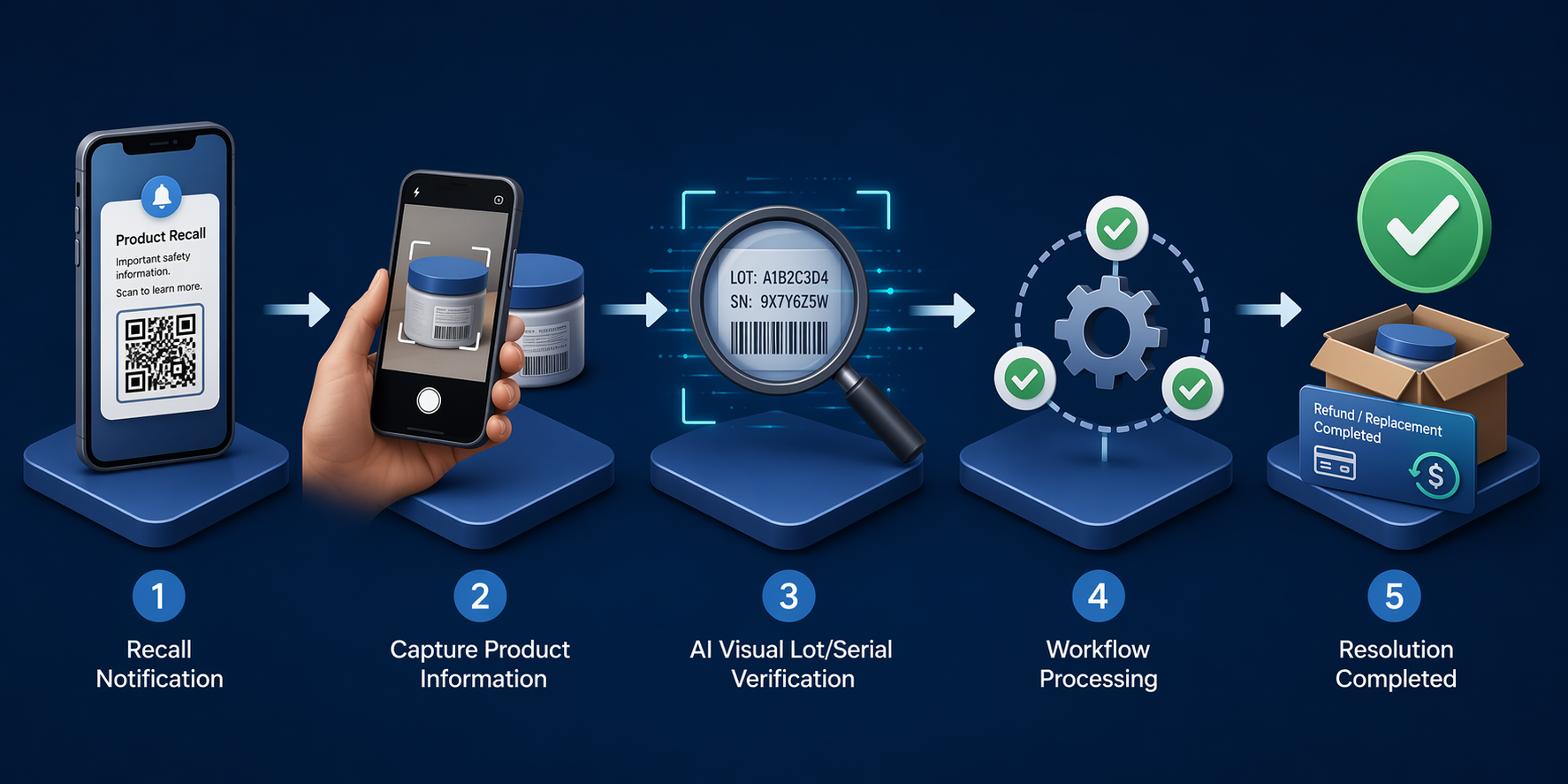
The clearest operating example so far is TechSee’s Sophie AI deployment for an unnamed major consumer goods brand. TechSee says the visual AI agent handled more than 300,000 recall interactions, was deployed in 24 hours with regulator approval, improved resolution times by 40%, and reduced recall costs by double digits. In the described flow, consumers used a secure link or QR code, uploaded product photos, had lot or serial details visually verified by AI, and received a refund or replacement in under two minutes without downloading an app.[1]

The recall journey changes when the product can be verified visually
In a conventional consumer recall, the expensive part is often not the notice itself. It is the messy middle: the consumer receives an email, letter, store alert, or public notice; tries to decide whether the product in the pantry, garage, freezer, nursery, or medicine cabinet is affected; searches for a lot, batch, model, UPC, date, or serial number; then contacts a service channel that has to validate the claim before issuing a remedy.
That is where the TechSee sequence is worth looking at closely. The consumer does not start by describing the product to an agent. The brand sends a secure link or QR code. The consumer opens the experience on a phone and photographs the product. The AI agent checks the visual evidence against the recall criteria, including the relevant lot or serial details, then routes the case into the refund or replacement workflow.[1]
| Consumer step | What the AI workflow is doing | Operational reason it matters |
|---|---|---|
| Open secure link or scan QR code | Moves the consumer into a controlled recall flow without an app download | Reduces abandonment before the product is even checked |
| Upload product photo | Captures package, label, code, or serial evidence from the consumer’s own product | Cuts down the back-and-forth that usually lands in the contact center |
| Visual verification | Compares product details against the affected recall scope | Prevents refunds or replacements from depending only on consumer interpretation |
| Automated routing | Sends verified cases into the correct remedy path | Keeps straightforward cases away from manual queues |
| Refund or replacement | Completes the remedy after validation | Turns a notice into a closed case rather than an open service interaction |
The under-two-minute figure matters because it measures the consumer-facing completion of the verification-to-resolution path, not just a faster chatbot response.[1] A recall operation is not fixed when a consumer receives an apologetic message. It is fixed when the affected unit is identified, the consumer receives the promised remedy, and the case record can withstand review.
There is still an important caveat around the proof. The brand is not named, and the improvement and cost results are reported by TechSee rather than by an independent audit.[1] That does not make the case useless. It does mean the numbers should be read as a documented vendor deployment, not as a universal benchmark for every recall category.
Why this use case has become harder to ignore
The pressure behind recall communication is not theoretical. Sedgwick reported 3,295 recalls across five U.S. industries in 2025, while defective units rose 26% to 858 million.[2] For quality and customer experience leaders, those figures translate into notices to send, products to identify, consumers to reassure, cases to document, and contact-center capacity that can disappear within hours of a public announcement.
The financial context is just as uncomfortable. Industry recall-cost studies have put the average direct cost of a single recall above $10 million, and that figure should be treated as directional rather than current because it traces back to 2019. Even so, it explains why double-digit cost reduction claims attract attention. The question is whether the savings come from a real change in the case path: fewer manual verifications, fewer repeat contacts, fewer invalid claims, faster remedy issuance, and cleaner evidence for review.
Food recalls show why the consumer side of the process can become unmanageable quickly. Grocery Trader, citing Food Standards Agency data, reported that each food recall in 2024 affected 2.5 times more products than in 2023.[3] A broader affected footprint means more consumers trying to work out whether their product is involved, more product photos and code checks, and more opportunity for confusion before a remedy is issued.
Regulators are also pushing companies toward better communication mechanics. On July 9, 2025, FDA Commissioner Marty Makary sent a letter encouraging food industry leaders to streamline and enhance recall communications, explicitly calling for the use of “cutting-edge technologies” and AI-assisted analysis.[4] That is not a blanket approval of every AI recall workflow. It is a useful signal that faster, more precise communication is not just a customer-experience preference; it is part of the regulatory conversation.
Enforcement risk adds another reason to avoid loose processes. CRC Group reported that CPSC fines exceeded $28 million in the first quarter of 2025 alone, already surpassing the full 2024 total.[5] Fines are not the same thing as consumer communication workload, but they sharpen the operating reality: a recall process has to be defensible, not merely fast.
What has to be true before an agent can take over the front line
A multimodal recall agent depends on a surprisingly ordinary foundation: product data that matches what consumers can actually photograph. If the affected lot number is printed inconsistently, hidden under a flap, smudged by condensation, or formatted differently across contract manufacturers, visual recognition becomes a handoff problem rather than an automation problem.
The same is true for image quality. A consumer may upload a dark photo, crop out the batch code, photograph the wrong panel, or send a picture of a similar but unaffected SKU. A useful workflow has to recognize when the evidence is insufficient and either prompt for a better image or route the case to a person. The worst version of automation is not the one that asks for another photo. It is the one that confidently closes or denies a case from weak evidence.
The TechSee case is strongest where the process is bounded. The consumer enters through a secure link or QR code, the product evidence is visual, the recall scope can be checked against lot or serial details, and the remedy can be issued automatically after verification.[1] Those are conditions, not decorations. Remove any one of them and the operation starts to look much more like assisted service than end-to-end automation.
Human oversight still belongs in the design. It is needed for unclear images, mismatched records, vulnerable-consumer situations, suspected fraud, legal exceptions, escalations, and cases where the consumer disputes the outcome. A recall agent should shrink the manual queue by removing clean, repeatable cases. It should not make the remaining cases harder to see.
The vendor field is forming around different pieces of the recall problem
TechSee’s Sophie AI is the most relevant example for consumer-facing visual verification because the public case includes scale, deployment time, regulator approval, app-free access, visual lot or serial recognition, and completion of refund or replacement.[1] That is a fuller operating chain than a general customer-service automation claim.
Marketpoint Recall is positioned more broadly as an AI-powered, multi-channel recall platform. Its launch materials describe support for 31 languages, QR-code self-service portals, and AI-enabled recall management across channels.[6] Grocery Trader also reports Marketpoint’s claim that its approach can reduce recall costs by up to 40%, but that is a vendor claim rather than an audited result.[3]
Cegeka’s Quality Impact Recall Agent is described as an AI-driven recall management workflow, with more emphasis on managing the recall process than on the consumer photo-verification journey.[7] Recall InfoLink’s B2C recall notification material focuses on reaching consumers through data sources such as loyalty programs and improving direct notification practices.[8] Those capabilities can matter before the verification step begins: consumers cannot resolve a recall they never hear about.
The useful distinction is not “AI vendor” versus “non-AI vendor.” It is whether the system owns notification, verification, case routing, and remedy issuance, or only one portion of that path. A platform that sends better messages may improve reach. A visual agent that verifies product identity may reduce manual review. A claims workflow may speed reimbursement. Those are related jobs, but they are not interchangeable.
Consumer trust is earned in the awkward middle of the process
A recall notice puts a consumer in an exposed position. They may have fed the product to a child, installed it in a home, given it as a gift, or stored it next to products they now do not trust. The service experience that follows can either reduce that embarrassment and uncertainty or make it worse.
GS1 US and the Institute for Supply Management reported in October 2025 that 59% of U.S. consumers would be hesitant to re-buy the same product or brand after a recall, while 85% believed recalls are effective.[9] That gap is instructive. Consumers may accept that recalls work as a safety mechanism and still punish a brand that makes the remedy confusing, slow, or humiliating.
This is where a well-built AI flow can do something more useful than “reassurance.” It can remove small frictions that feel large to the person holding the affected product: finding the right code, knowing which photo to take, avoiding a phone call, getting a clear eligibility answer, and receiving the promised refund or replacement before frustration hardens into a complaint.
Where automation is ready, and where it still needs a brake
Multimodal AI agents are ready for a specific recall-communication workload: high-volume consumer interactions where the affected product can be identified visually, the recall scope is encoded cleanly, the remedy rules are straightforward, and legal or regulatory stakeholders are comfortable with the workflow before launch. In those conditions, the TechSee case shows a credible path to faster resolution and lower cost, with the consumer completing verification and remedy in minutes rather than waiting for manual review.[1]
They are not ready to replace judgment across every recall. Messy product records, inconsistent lot placement, poor package-image coverage, unclear eligibility rules, or uncertain regulatory acceptance should push the design back toward assisted automation. The agent can collect evidence, guide the consumer, and prepare the case, but a person should still decide when the product identity or remedy path is not clear.
The practical line is simple enough to be useful: automate the cases that can be verified cleanly and resolved according to approved rules; escalate the cases where the evidence, data, or approval path is weak. That boundary matters more than the headline savings, because the point of recall communication is not to make the brand sound modern. It is to get affected products identified, consumers made whole, and the record closed without creating a second operational problem.
References
- Streamline the Chaos with AI Agents for Recalls, TechSee
- U.S. industries see more recalls and defective units in 2025, Sedgwick
- Marketpoint Recall: supermarket recalls are stuck in the past – here’s how to fix them, Grocery Trader
- FDA Encourages Food Industry Leaders to Streamline & Enhance Product Recall Communications with Public and Regulatory Partners, U.S. Food and Drug Administration, July 9, 2025
- Beyond the Label: What 2025’s Product Recall Trends Reveal About Emerging Risk, CRC Group
- Marketpoint Recall launches AI-powered platform for product recalls, Automotive Testing Technology International
- Transforming product recalls with AI, Cegeka
- B2C Recall Best Practices, Recall InfoLink
- New GS1 US Survey Finds Consumers Are Concerned About the Frequency of Food Recalls Despite High Confidence That They Are Effective, PR Newswire, October 2025
Comments
Join the discussion with an anonymous comment.