
By the time a recall is formally declared, the work is already late-stage: scope the affected products, find parts, notify customers, coordinate with regulators, brief customer service, and keep production from repeating the same mistake. AI is useful in recall management only if it moves some of that burden upstream. The practical question is not whether a model can announce “a recall is coming.” It is whether machine learning can spot a repeatable defect pattern while the evidence is still scattered across complaints, warranty notes, supplier records, and production history.
That distinction matters more as recall scope grows. In the automotive sector, Supply Chain Management Review reported that Q3 2025 saw average recall scope rise by 60%, from about 26,600 vehicles per event to about 41,900, with systemic software and electric vehicle component defects contributing to the increase.[1] A wider recall scope does not prove that every company needs a predictive model. It does make one point hard to ignore: when a defect signal is systemic, slow recognition becomes expensive very quickly.

The strongest proof is not prediction. It is containment.
The cleanest example is General Motors. In a case described by Supply Chain Digital, drawing on SSA & Company, GM used data mining across car parts tracking and supplier manufacturing records to narrow a potential recall from an entire model line to exactly four specific vehicles.[2] That is the kind of result quality and procurement teams can actually use. It changes the operating problem from “Which population might be exposed?” to “Which units can we identify, inspect, and fix?”

The important mechanism in the GM case is traceability under pressure. Parts records alone would not be enough if they could not be tied to specific vehicles. Supplier manufacturing records alone would not be enough if they could not be connected back to vehicle build history. The value came from crossing those data sets until the suspect population stopped being a product family and became a small set of identifiable assets.
That is also why this kind of AI work belongs in recall prevention, not just recall execution. Once the defect is public and the recall campaign is underway, the organization still needs automation for notification, workflow, documentation, and customer handling. Those downstream activities are a different problem from early detection. The upstream problem is harder to see because the signal usually starts as a few oddly similar claims, a phrase that keeps appearing in call notes, a supplier lot that looks slightly worse than neighboring lots, or a condition log that only becomes suspicious when matched against field failures.
GM’s case does not prove that every manufacturer can reduce a potential recall to four units. It shows a narrower, more useful lesson: when product, part, supplier, and manufacturing records are linked tightly enough, analytics can shrink uncertainty before the recall machine consumes the whole organization.
Where the early signal usually hides
A formal defect investigation rarely begins with perfect evidence. It often begins with language: “burning smell,” “door won’t latch,” “metal fragment,” “screen freezes,” “strange taste,” “intermittent shutoff.” Those phrases may sit in consumer complaints, warranty claims, dealer notes, customer service transcripts, social media posts, NHTSA filings, or food customer feedback lines. None of those sources is complete. Together, they can become persuasive.
| Signal source | What it can reveal | Why it is hard to use |
|---|---|---|
| Consumer complaints | Repeated descriptions of the same failure mode | Messy language, duplicates, emotion, and inconsistent product identifiers |
| Warranty claims | Repair frequency, replacement patterns, and cost concentration | Lag between failure, service visit, coding, and analysis |
| Call center logs | Early customer language before a formal failure code exists | Unstructured notes and uneven agent terminology |
| NHTSA filings | External complaint patterns for vehicle safety issues | Incomplete context and reporting bias |
| Supplier quality data | Lot, batch, process, or component patterns | Data-sharing limits and inconsistent supplier systems |
| Temperature or condition logs | Exposure patterns that may explain product deterioration | Useful only when tied to product identity and movement history |
Natural language processing helps because many early defect signals do not arrive in clean codes. A call center analyst may know that customers are describing the same issue, but the system may classify those calls under different categories. NLP can group similar wording, identify emerging complaint clusters, and connect informal descriptions to known components or quality parameters. It is not magic; it is a way of making weak, scattered text easier to compare.
Kroger is a useful comparison outside automotive. Food Logistics, in an article attributed to RTS Labs, describes Kroger mining feedback from its 1-800 “Customer Connect” line to predict quality control parameters such as taste, appearance, and foreign materials, with the aim of improving process control before recalls are needed.[3] That source trail matters: this is vendor-attributed reporting, not an independent audit of recall reduction. Still, the operating idea is credible. Ordinary customer language can become a quality signal if the company has enough volume, enough history, and a way to route the signal back to the people who can investigate production.
From messy complaints to a defensible defect signal
The model’s job is not to replace the quality investigation. It is to raise a pattern earlier than the normal reporting chain would. Three techniques tend to carry the work.
- NLP clusters unstructured descriptions so that similar complaints are not missed just because customers, agents, dealers, or technicians use different words.
- Anomaly detection watches quality streams for behavior that departs from the expected baseline, such as a supplier lot, process window, or condition profile that begins to stand out.
- Pattern recognition across production lots connects field symptoms back to build dates, supplier batches, component versions, software releases, or distribution conditions.
The useful output is not simply a risk score. A quality engineer needs to know what the model believes is connected: which symptom, which product population, which part, which supplier lot, which plant, which period, which customer geography, which storage condition, or which repair action. A vague alert that “complaints are rising” is a dashboard. A defensible alert says, in effect, “These complaints are semantically similar, they involve this component family, they are concentrated in this build window, and the affected units share this supplier or production attribute.”
The academic evidence points in the same direction. Supply Chain Management Review cites Das et al. 2023 as showing that automotive OEMs using machine learning on NHTSA consumer complaint data can forecast which components show systemic failure signs before a formal recall declaration, giving companies the chance to pre-order replacement parts.[1] That is not the same as claiming the model prevents every recall. It means complaint data can be structured early enough to support operational preparation before the public recall process catches up.
There is a quiet but important procurement implication here. If supplier quality data is separate from field complaints, procurement gets pulled in late, after the pattern has hardened into a crisis. If supplier lots, process deviations, inspection results, and component genealogy are connected to complaint and warranty data, supplier quality managers can test a narrower hypothesis sooner. That does not make blame fairer by itself, but it makes the discussion less dependent on memory, escalation politics, and whichever function happens to own the loudest system.
The data architecture has to be built before the alarm
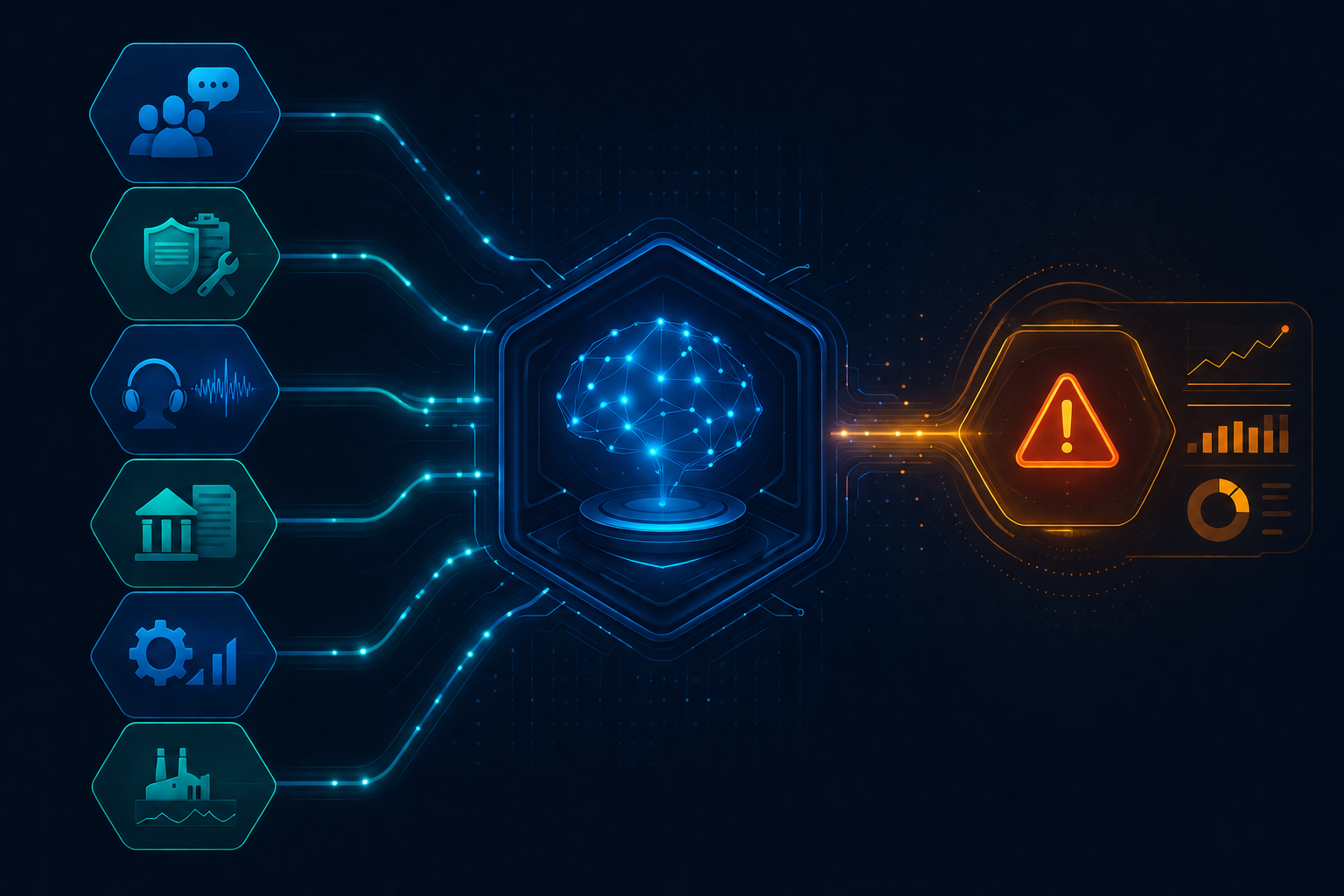
Predictive recall detection depends less on a glamorous model than on whether the organization can connect evidence that was never designed to live together. The model needs product identity, component identity, supplier identity, manufacturing history, field behavior, and customer language to be linkable at the right level of detail.
Digital thread traceability is the foundation. If a company cannot trace a finished product back through components, lots, manufacturing steps, and supplier records, the model may detect a symptom cluster but fail to define the exposed population. That is where recall prevention becomes practical supply chain work rather than an analytics experiment.
Integrated quality and ERP systems matter for the same reason. Complaint records, warranty claims, nonconformance reports, purchase orders, receiving inspection results, supplier corrective actions, and production records all describe different pieces of the same object. If those systems cannot exchange identifiers reliably, a model may find correlation without enough context to support an investigation.
Supplier data sharing is usually the uncomfortable part. The signal may depend on information outside the manufacturer’s four walls: lot history, process parameters, inspection escapes, material substitutions, or corrective actions. Tools listed in The 2026 AI Supplier Risk Monitoring Vendor Directory can help surface supplier-side risk signals, but software does not settle the governance question. Contracts, data standards, access rights, and escalation rules decide whether supplier signals arrive early enough to matter.
False positives are not a tuning footnote
Early-warning systems create work. Some alerts will point to real defects. Some will point to noise, seasonal patterns, usage changes, customer misunderstanding, duplicate complaints, media effects, or normal variation. Treating false positives as a minor model-calibration issue is a good way to lose the people who have to investigate them.
Before alerts start flying, the organization needs an escalation design. A first-level signal may deserve monitoring only. A stronger signal may require a quality engineer to review sample records. A repeated signal tied to a supplier lot may trigger containment, supplier notification, or additional inspection. A safety-related pattern may need legal and regulatory review sooner. Product law commentary on AI and product safety emphasizes that companies using AI in this area still have to navigate recall, regulatory, and legal obligations rather than treating AI output as a substitute for judgment.[4]
The investigation process should also protect against alert theater. If every weak anomaly becomes a meeting, teams will tune out the system. If the threshold is too high, the model becomes another lagging report. The useful middle ground is a documented triage path: who reviews the alert, what evidence must be attached, what time window is used, what comparison population is relevant, and what action is allowed before formal defect confirmation.
Where predictive recall detection is weakest
The case for AI gets weaker when the data is thin. Low-volume products may not generate enough complaints, claims, or service events for a model to separate a real pattern from random variation. New products may lack the historical baseline needed to identify what “abnormal” looks like. In many deployments, models need at least 12 months of usable complaint or quality history before the organization should expect reliable signal detection.
Sparse data does not make early detection impossible, but it changes the method. A company may rely more heavily on engineering judgment, supplier process monitoring, inspection data, or physics-of-failure reasoning until field data accumulates. That is still better than pretending that a model trained on limited history can provide the same confidence it would have in a high-volume environment.
The evidence base is also not as mature as the sales language around it. The GM and Kroger examples are useful, but they come through consultancy- or vendor-attributed sources rather than broad independent audits.[2][3] The academic work cited on NHTSA complaints gives the field methodological support, but it does not eliminate the need for company-specific validation.[1] No comprehensive cross-industry study measuring predictive recall detection ROI was identified in the supplied research.
What “AI predicts recalls” should mean in practice
A responsible claim is narrower than the headline version. AI can help forecast systemic defect patterns before formal recall declaration when enough related data exists, when product and supplier traceability are strong, and when the organization is willing to investigate imperfect early warnings. It is most credible in high-volume environments where complaints, warranty claims, production history, supplier quality records, and condition logs can be connected.
The best systems do not merely predict. They reduce the unknowns that make recalls expand: which products are exposed, which components are implicated, which supplier lots are suspect, which customers need action, and which teams should move first. That is why the GM containment example carries more weight than a generic promise about predictive analytics. Four vehicles is not a slogan. It is a smaller search area, fewer unnecessary disruptions, and a clearer path for investigation.
Predictive recall detection is therefore credible, but conditional. It becomes operationally valuable only when the company treats early signals as work to be governed, not noise to be admired on a dashboard. Waiting for certainty is often how small defects become expensive recalls; acting on uncertainty requires traceability, discipline, and a process that can absorb false alarms without punishing the people who raised them.
References
- Turning Vehicle Recalls into a Test of Supply Chain Resilience: Lessons from 2025 — Supply Chain Management Review
- Data Analytics: Changing the Face of Recall Execution and Prevention — Supply Chain Digital
- How AI Helps 3PLs Manage Product Recalls — Food Logistics / RTS Labs
- How AI Is Revolutionizing Product Safety: Essential Insights for Navigating Risks, Recalls, and Regulations — Product Law Perspective
Comments
Join the discussion with an anonymous comment.