
The answer depends on whether “holds the most” means the largest number of visible filings or the strongest concentration of active, commercially useful patents. In the targeted Patsnap supply chain AI patent datasets, India shows roughly 30-plus filings, mostly pending applications from academic institutions, while the United States shows roughly 15-plus filings, mostly active corporate patents from companies such as Dell, Kinaxis, Walmart Apollo, Target Brands, Siemens, SAP, and Honeywell.[1]
That split is the most important starting point for reading AI patent trends for supply chain technology in Q3 2026. A raw filing leaderboard makes India look like the clear volume leader. A commercial defensibility screen points more directly toward the United States, because active, maintained corporate patents are more likely to map to product architecture, licensing leverage, or acquisition diligence than pending university filings. The Patsnap records are still a targeted snapshot of innovation signals within the dataset, not a complete global census, so the count should be read as directional rather than definitive.[1]

Raw Volume Points to India; Maintained Corporate IP Points to the US
India’s lead in the targeted dataset is real, but it is a particular kind of lead. The filings are concentrated among academic institutions, including Lovely Professional University, Nitte Meenakshi Institute of Technology, and SR University, and are predominantly pending rather than granted and maintained corporate assets.[1] That makes the activity meaningful as a signal of research energy and jurisdictional momentum. It does not automatically mean that an enterprise buyer will encounter those inventions in a deployed planning, replenishment, logistics, or procurement platform.
The US side is smaller by count in this targeted view, but more directly connected to commercial software and operating architectures. Dell Products L.P., Kinaxis Inc., Walmart Apollo, Target Brands, Strong Force VCN, Siemens, SAP, and Honeywell appear as corporate assignees in the Patsnap supply chain AI landscapes, with many of the US records described as active.[1] For a CFO, corporate development team, or procurement leader, that distinction matters because an active corporate patent can become a diligence item. A pending academic application usually becomes an ecosystem signal first.
| Lens | What the targeted patent data shows | What it can support |
|---|---|---|
| Raw filing volume | India shows roughly 30-plus filings, mostly academic and pending | Evidence of research activity and jurisdictional momentum |
| Active corporate concentration | The US shows roughly 15-plus filings, mostly active and corporate-owned | Stronger evidence for near-term vendor defensibility |
| Technology specificity | Some filings map to forecasting, lead-time prediction, delivery-date generation, graph-based digital twins, and stochastic replenishment simulation | A more useful screen than patent count alone |
Asia-Pacific also deserves a place in the conversation because it is identified as the fastest-growing filing jurisdiction in the dataset.[1] But “fastest-growing” is not the same as “commercially strongest,” and it is not the same as “most deployed.” Patent data can show where claims are being staked. It cannot, by itself, show whether those claims are being used in production software, renewed over time, or defended against competitors.
The Broader AI Patent Race Is Much Larger Than Supply Chain
The supply chain patent landscape sits inside a much larger AI intellectual property race. Harrity & Harrity’s 2026 AI Patent 100 reported 16,832 granted AI patents among the top 100 organizations in 2025, with Samsung ranked first at 1,082 granted AI patents and Alphabet second at 1,057.[2] Toyota ranked sixth with 502, Dell eighth with 414, SAP thirty-fifth with 131, and Walmart sixty-fifth with 79.[2]
Those rankings are useful scale-setting, not a supply-chain-specific leaderboard. Harrity’s list covers overall AI patents across domains, so it should not be treated as proof that Samsung, Alphabet, Toyota, Dell, SAP, or Walmart lead specifically in supply chain technology. The more careful reading is narrower: some supply-chain-relevant assignees are also competing in the broader AI patent race, and a few of them have identifiable supply chain AI claims in targeted patent landscapes.
The investment backdrop is similarly useful but secondary. Stanford HAI’s 2026 AI Index reported US private AI investment of $285.9 billion in 2025 versus China’s $12.4 billion, and 1,953 newly funded AI companies in the US, about ten times the next closest country.[3] The same report also notes that the US-China model performance gap has effectively closed and that South Korea leads the world in AI patents per capita.[3] Those facts explain why AI patenting is intense across sectors; they do not identify who has defensible supply chain software.
What the Corporate Patent Clusters Actually Cover
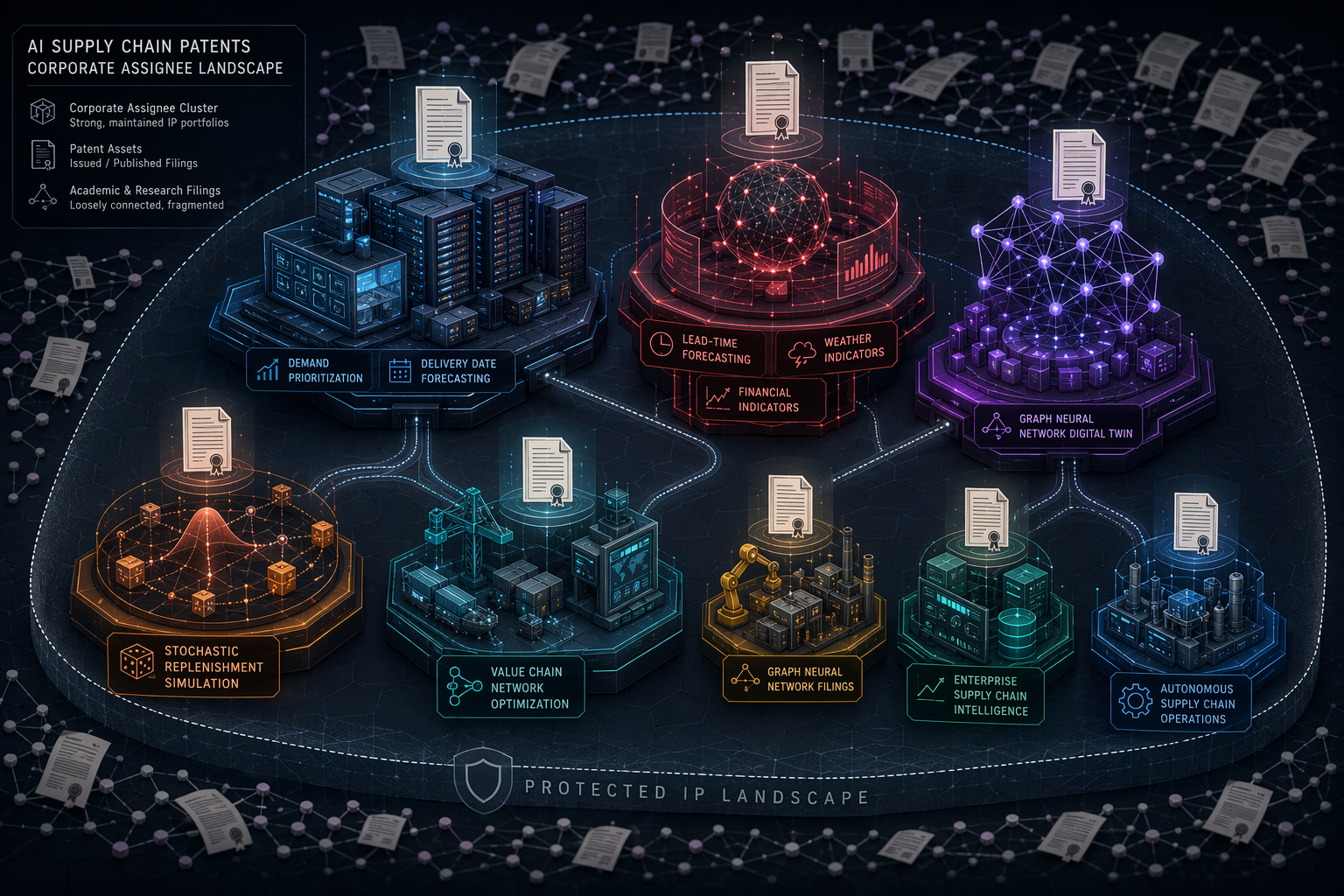
The corporate assignee map is where the patent data becomes more useful. A patent count says little until it is connected to what the claims protect. In supply chain AI, the more commercially relevant clusters are not all generic “forecasting.” They point to different operational problems: demand prioritization, temporal supply forecasting, lead-time estimation, delivery-date generation, graph-based digital twins, and replenishment simulation.
Dell: a repeated cluster around forecasting and delivery commitments
Dell Products L.P. appears as the most prolific single corporate assignee in the targeted AI supply chain forecasting patent records, with more than five active US patents covering demand prioritization, temporal supply forecasting, and delivery-date generation, with the latest active status noted as of January 2026.[1] That cluster is more interesting than a one-off filing because the protected ideas sit near a recurring commercial problem: deciding which demand gets served, when supply will be available, and what delivery promise can be made.
For evaluators, the important point is not that Dell has “AI patents.” It is that the claims appear to cover adjacent steps in an operating loop. Demand prioritization influences allocation. Temporal supply forecasting influences feasibility. Delivery-date generation influences the promise made to a customer or channel. When a patent cluster follows the same operational chain, it deserves more attention than a scattered set of unrelated AI filings.
Kinaxis: lead-time forecasting close to a known planning platform
Kinaxis Inc. holds more than four active US patents on machine-learning-based lead-time forecasting that incorporate features such as weather and financial indicators, and the research brief connects those patents to the company’s commercially deployed RapidResponse platform.[1] That connection matters. A patent tied to a known planning platform is easier to evaluate than a patent that floats above the product catalog with no obvious buyer-facing surface.
Lead-time prediction is also a narrower and more defensible area than broad demand forecasting language. In planning systems, lead time is not merely an input. It determines feasible supply plans, customer promise dates, safety stock logic, exception severity, and the credibility of scenario planning. If the patented method changes how a planning system estimates that variable, it can sit close to a buyer’s daily workflow.
Walmart Apollo and Target Brands: retailers staking architectural ground
Walmart Apollo’s 2025 graph neural network digital twin patent and Target Brands’ 2023/2024 stochastic replenishment simulation filings stand out because they point toward more distinctive architectural territory in the targeted dataset.[1] A graph neural network digital twin suggests a model of relationships across entities, locations, products, constraints, or flows. Stochastic replenishment simulation points toward testing inventory decisions under uncertainty rather than only producing a point forecast.
These filings should not be overread as proof that retailers are turning into general-purpose supply chain software vendors. They may protect internal operating systems, future commercialization options, defensive positions, or partner leverage. Still, they are notable because retail supply chains generate the kind of messy, high-frequency replenishment problems that can reveal whether an AI architecture survives contact with operating constraints.
Strong Force VCN, Siemens, SAP, and Honeywell round out the map
The remaining corporate landscape is not empty. Strong Force VCN appears with more than four patents, Siemens with three graph neural network filings, and SAP and Honeywell also appear among the corporate assignees in the targeted Patsnap data.[1] The correct inference is not that each has the same commercial exposure or the same product relevance. It is that the supply chain AI patent field is already distributed across enterprise technology vendors, industrial companies, retailers, and specialized assignees.
This is where a vendor directory becomes more useful than a patent leaderboard. Readers comparing patent holders with deployed platforms can use the AI supply chain vendor directory by functional category to separate platform vendors, retailers, industrial technology firms, and narrower solution providers before treating any patent cluster as a moat.
Forecasting Is Not One Patent Category
Supply chain AI patent analysis becomes sloppy when every claim is flattened into “forecasting.” A demand forecast estimates expected need. A lead-time forecast estimates how long supply or movement will take. Temporal supply forecasting tries to model supply availability over time. Delivery-date generation translates supply, capacity, logistics, and rules into a commitment. Replenishment simulation tests the consequences of ordering or allocation choices under uncertainty.
Those differences matter because they touch different buyers and different operational consequences. A demand planning team may care most about forecast bias and granularity. A customer promise team cares about delivery reliability. A supply planner cares about feasible supply and exception handling. A replenishment leader cares about stockouts, overstocks, and service levels. A patent that protects a method near one of those decisions has a clearer commercial reading than a patent that merely says AI improves prediction.
| Protected area | Operational question | Why evaluators should read it differently |
|---|---|---|
| Demand prioritization | Which demand should be served first when supply is constrained? | Can affect allocation logic and customer treatment |
| Temporal supply forecasting | When will supply become available? | Can affect feasible plans and exception timing |
| Lead-time forecasting | How long will production, procurement, or movement take? | Can affect planning parameters, promise dates, and inventory buffers |
| Delivery-date generation | What date can the company credibly promise? | Can affect order capture, customer communication, and service performance |
| Graph-based digital twins | How are supply chain entities and dependencies represented? | Can indicate a more distinctive data architecture |
| Stochastic replenishment simulation | What happens to inventory decisions under uncertainty? | Can support testing policies before operational rollout |
Graph-based and simulation-based filings deserve particular scrutiny because they can imply a protected way of representing the supply chain, not just a protected way of predicting one variable. That does not make every such patent valuable. It does make the claims worth reading before a buyer dismisses them as yet another AI forecasting asset.
How to Use Patent Data in Vendor Diligence
A patent screen belongs in diligence, but it should not be allowed to masquerade as product validation. The first question is whether the patent is active and maintained. The second is who owns it. The third is where it is filed. The fourth is whether the claim maps to a workflow the buyer can actually evaluate in the product. Only after those checks does the count become useful.
- Treat pending academic filings as innovation pipeline signals, not proof of current commercial defensibility.
- Give more weight to active corporate patents when they connect to a known platform, module, or operating architecture.
- Read the claim area before comparing counts; lead-time prediction, delivery-date generation, and graph digital twins are not interchangeable.
- Check jurisdiction and maintenance status before using patents in a board deck or acquisition memo.
- Ask product teams to show where the protected method appears in workflow, data model, optimization logic, or decision automation.
For a fuller diligence process, patents should sit beside product evidence, deployment references, integration depth, and measurable workflow impact. The domain-specific checklist for evaluating supply chain AI vendors is a better place to operationalize that work than a simple ranking table.
Market Growth Explains the Rush, Not the Winner
The market backdrop helps explain why patenting has accelerated. MarketsandMarkets, cited in the site’s existing market coverage, valued AI in supply chain at $13.93 billion in 2025 and projected it to reach $50.41 billion by 2032.[4] Market-size estimates vary by methodology, so this should be read as directional atmosphere rather than a precise measure of patent value.
A growing market attracts filings from several directions at once: universities trying to protect research output, enterprise software vendors protecting product architecture, retailers protecting internal systems, and industrial companies protecting operational methods. That is why the patent map looks multi-polar rather than cleanly vendor-led.
So Who Holds the Most?
By raw filing volume in the targeted Patsnap supply chain AI datasets, India leads, with roughly 30-plus filings that are mostly academic and pending.[1] By concentration of active corporate supply chain AI patents, the United States is the more commercially consequential jurisdiction in the same dataset, with roughly 15-plus filings from assignees including Dell, Kinaxis, Walmart Apollo, Target Brands, Siemens, SAP, and Honeywell.[1]
At the assignee level, Dell appears strongest by visible corporate count in AI supply chain forecasting, while Kinaxis has a notable lead-time forecasting cluster close to a known planning platform.[1] Walmart Apollo and Target Brands are especially interesting for architectural specificity because their filings point toward graph neural network digital twins and stochastic replenishment simulation rather than generic prediction language.[1]
That is as far as the evidence should be pushed. Raw filings indicate innovation activity. Stronger evidence of defensibility depends on active status, corporate ownership, jurisdiction, claim relevance, and connection to deployable technology. In Q3 2026, the useful answer is not a universal winner; it is a ranked interpretation of what each kind of patent evidence can actually prove.
References
- Patsnap AI demand forecasting patent landscape 2026, Patsnap, 2026, link
- 2026 AI Patent 100, Harrity & Harrity, 2026, link
- 2026 AI Index Report, Stanford HAI, 2026, link
- AI in Supply Chain Market, MarketsandMarkets, link
Comments
Join the discussion with an anonymous comment.