
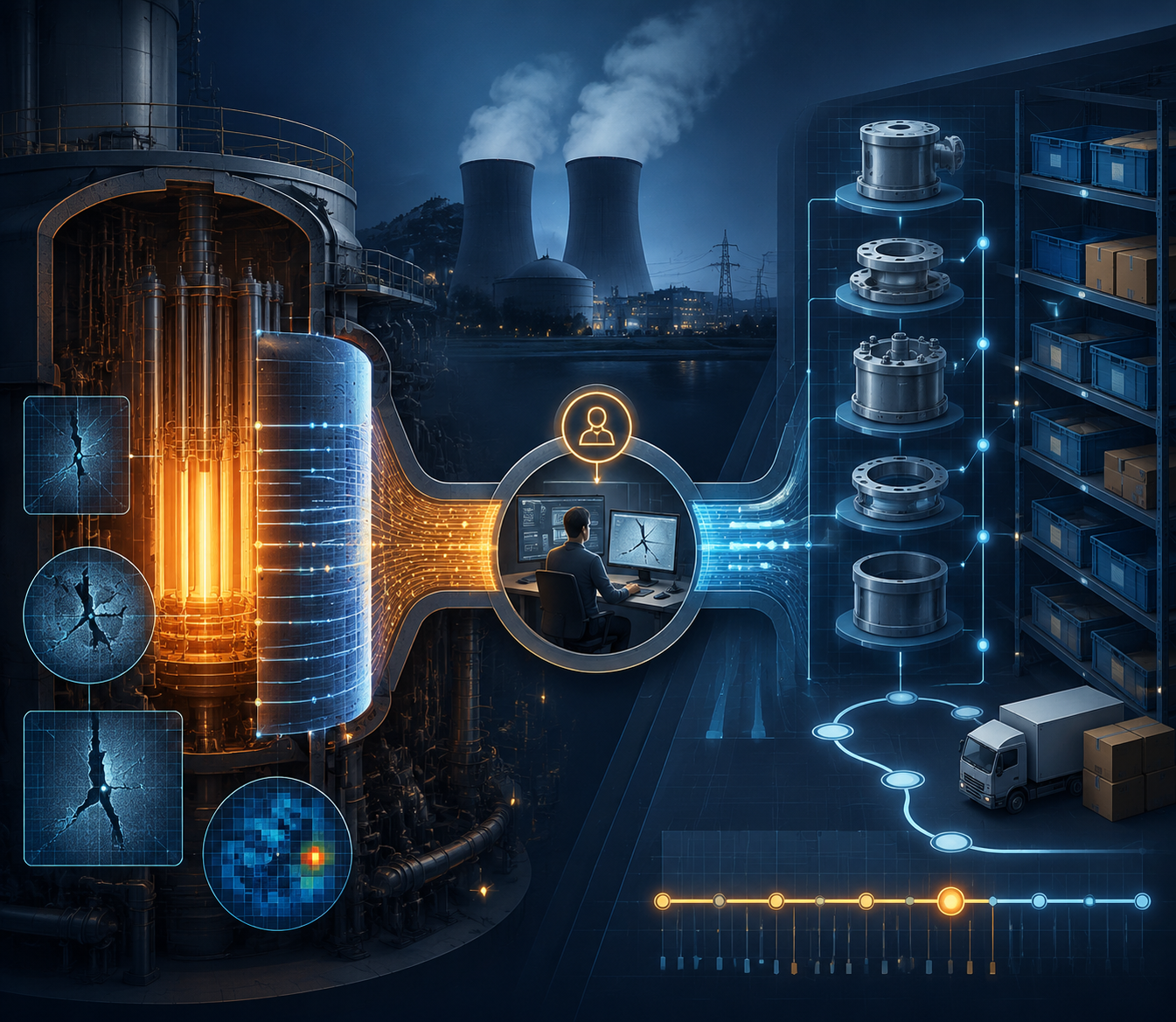
The weak point in AI for nuclear plant damage assessment supply chain work is not the first detection. It is the handoff after detection: an inspection result has to become a classified maintenance need, then a qualified material requirement, then a sourcing or inventory action that fits the outage schedule and the plant’s compliance record. That is a harder problem than drawing a box around a crack.
The pieces are no longer science projects. Oak Ridge National Laboratory and NVIDIA reported in 2018 that a convolutional neural network trained on more than 60,000 transmission electron microscopy images detected about 86% of radiation-induced dislocation damage in reactor materials, compared with about 80% by human analysts.[1] That is an older benchmark, and it should not be treated as the ceiling for current model performance. It is more useful as a conservative floor: even several years ago, AI could perform a narrow nuclear materials damage-recognition task at a level that deserved operational attention.
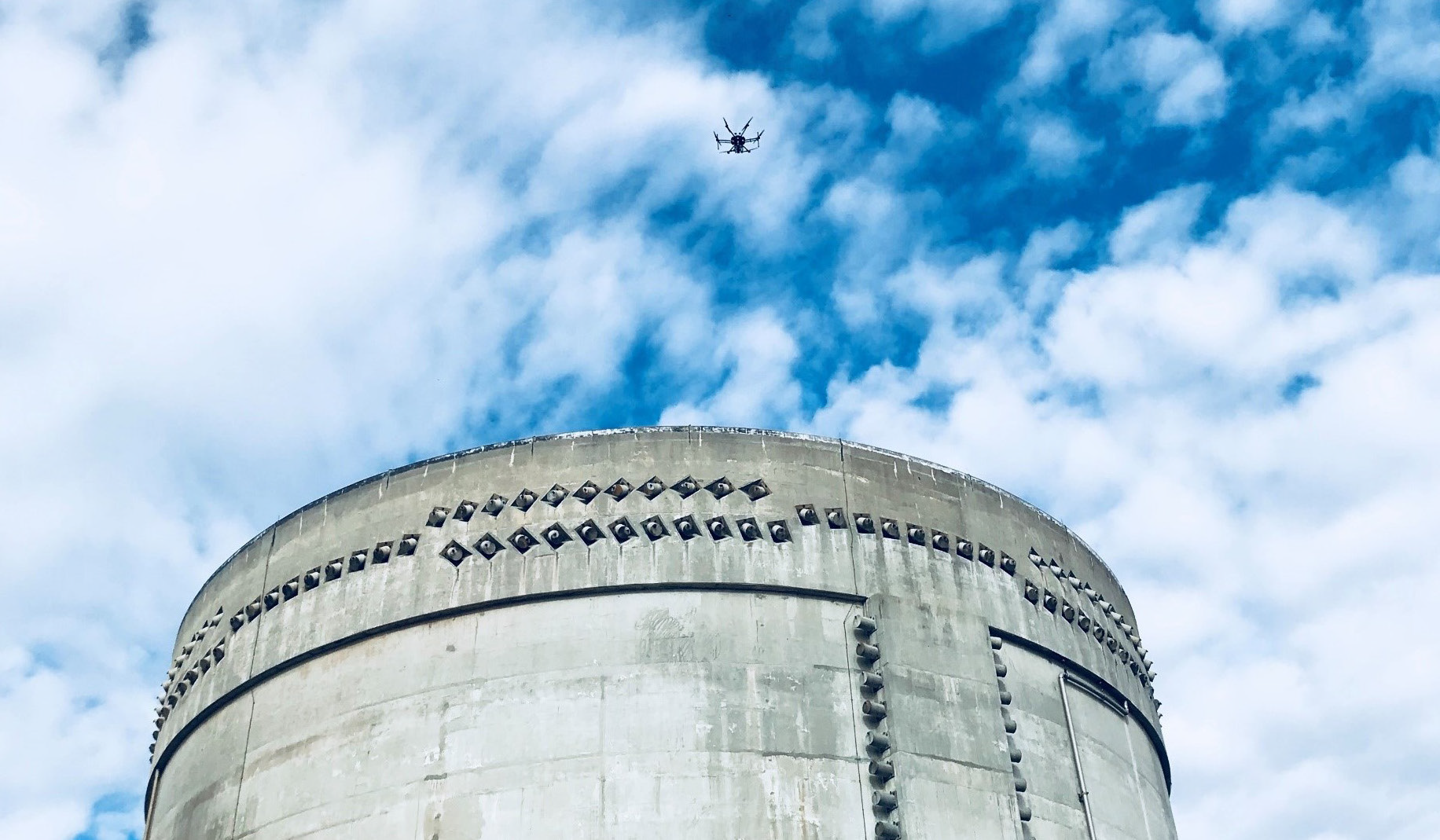
EPRI’s drone-and-AI containment inspection work moves the conversation closer to the plant. In that demonstration, drones collected images of containment buildings and an AI model identified defects with accuracy comparable to traditional manual methods, using only 2,500 training images.[2] That does not prove an autonomous maintenance workflow. It does show that computer vision can work against nuclear inspection problems outside a clean laboratory setup, where lighting, access, geometry, and plant conditions are part of the job.
The Missing Product Is the Inspection-To-Procurement Loop
No cited source in the current public record shows a single production-proven nuclear product that takes an inspection finding, validates the material requirement, checks qualified inventory, selects an approved supplier path, and generates a compliant purchasing action against an outage schedule. That distinction matters. A utility should not buy a demo of defect detection and assume the procurement problem has been solved.
But the absence of a packaged end-to-end product is not the same as absence of feasibility. The useful question is whether each work package in the chain can be made machine-readable without breaking nuclear controls.
| Workflow point | What AI can help do | What cannot be skipped |
|---|---|---|
| Inspection output | Identify and classify damage from images or other inspection records | Engineering review of finding significance |
| Maintenance context | Relate the finding to work-order history, equipment records, and prior corrective actions | Plant-specific configuration and licensing basis checks |
| Material requirement | Suggest likely part families, repair materials, or consumables tied to the work scope | Qualification logic, substitute controls, and engineering disposition |
| Inventory and sourcing | Check on-hand stock, historical demand, and supplier options | Approved supplier status, traceability, chain of custody, and quality documentation |
| Outage timing | Flag lead-time conflicts and sequence procurement against the schedule | Planner, buyer, engineering, and quality hold points |
That table is where most of the value sits. A model that sees damage faster is helpful. A model that turns a finding into a procurement-relevant need, while preserving the review path, changes the amount of time experts spend translating notes into action.
Damage Classification Has To Mean Something to Maintenance
Inspection AI becomes more useful when its output is structured for downstream work. “Defect detected” is not enough for a planner or buyer. The practical output needs location, apparent type, severity band, confidence level, inspection method, asset identifier, and a pointer to the engineering basis for deciding whether work is required.
That is not asking the model to make the repair decision. In a nuclear setting, the model’s job should be to reduce the clerical drag between the inspection record and the maintenance package. It can pre-fill structured fields, group similar findings, compare the current observation with historical work, and route the package to the right reviewer. The engineer still owns the judgment that determines whether the condition is acceptable, monitor-only, repair-now, or repair-at-next-window.
This is why the 2018 ORNL/NVIDIA result is important but incomplete. Detecting radiation-induced damage in images proves that a model can read a difficult signal.[1] It does not, by itself, prove that the model understands whether a spare part, consumable, repair procedure, or engineering evaluation is needed. The next layer has to connect visual classification to plant records.
EPRI’s 3DM Work Is the Hinge
EPRI’s Data-Driven Decision-Making program, known as 3DM, is the strongest public evidence for the bridge between maintenance history and inventory action. The program applied AI to maintenance work-order histories to support inventory optimization decisions in the nuclear power industry.[3] That is not the same as live AI procurement triggered by a fresh inspection finding. It is still the closest published step toward the workflow that supply chain teams actually need.
The significance is in the data relationship. Work orders carry the memory of what failed, what was inspected, what was repaired, what material was consumed, and how often the plant repeated the pattern. If AI can read those histories well enough to inform inventory decisions, then the bridge from inspection output to supply planning is not imaginary. The utility already has much of the raw material; the problem is that it is scattered across inspection systems, maintenance records, inventory files, procurement systems, quality records, and outage schedules.
A practical 3DM-style bridge would not start by asking AI to issue purchase orders. It would start by asking better questions earlier in the work package:
- Has this component, location, or damage mode appeared in prior work orders?
- Which parts, kits, repair materials, or services were actually used the last time?
- Were substitutions, engineering evaluations, or quality holds required?
- Did the repair wait on material, documentation, vendor availability, or outage sequencing?
- Is existing inventory qualified for the same application, or only superficially similar?
Those questions sound plain because they are the real work. They also explain why a generic industrial spare-parts recommender is not enough. In nuclear MRO, the hard part is not recognizing that two parts look alike in a catalog. The hard part is knowing whether the plant can use that item for that function, under that quality requirement, with that documentation trail, at that point in the schedule.
Procurement Timing Is a Schedule Problem Before It Is a Buying Problem
A faster sourcing recommendation can still be useless if it arrives after the repair window is already constrained. Outage work is sequenced. Scaffolding, access, radiation protection, craft availability, engineering holds, inspections, and turnover all compete for time. The buyer may be the person placing the order, but the schedule is often the thing that decides whether the order is early enough to matter.
Knowledge Relay’s AI project-controls framework is relevant for that reason. It describes AI-supported project controls across planning and scheduling, resource and asset management, budgets and costs, and contract and risk domains.[4] Read through a nuclear maintenance lens, those domains are the rails that keep procurement from becoming a disconnected speed exercise.
The useful workflow would tie each procurement suggestion to schedule logic. If an inspection finding is likely to require a long-lead qualified component, the system should not merely notify purchasing. It should flag the planner, show the lead-time risk, identify whether on-hand inventory is usable, expose documentation gaps, and place the decision in front of engineering and quality before the outage path narrows.
This is where AI can save real time without pretending to replace accountability. It can monitor the relationships humans struggle to keep current: inspection date, engineering review status, work-order priority, material availability, supplier qualification, promised delivery date, receiving inspection, and installation window. When one of those moves, the procurement risk changes.
The Procurement Half Is Starting To Productize
Nuclearn’s Parts AI announcement is worth watching because it points directly at the procurement side of the bridge. The company announced a Q1 2026 launch of a nuclear supply chain AI platform intended to codify veteran buyer expertise and target more than a 30% reduction in nuclear procurement cycles.[5]
That number needs careful handling. It is a target from a product announcement, not a validated industry result at the time of writing. It should not be repeated as proof that nuclear buyers are already cutting cycles by that amount. Still, the announcement is a market signal: nuclear-specific procurement AI is moving from slideware language into named product development, and vendors are beginning to recognize that the buyer’s expertise is not generic purchasing knowledge.
Codifying veteran buyer expertise matters because many procurement delays are not caused by typing speed. They come from knowing which supplier path is acceptable, which documentation must accompany the item, whether a historical substitute is still defensible, and when engineering or quality has to be pulled in before the order goes any further. A useful AI tool in this space has to preserve those decision branches, not flatten them into a lowest-price recommendation.
What the End-To-End Workflow Could Look Like
A realistic near-term workflow would be semi-automated and auditable. It would look less like touchless buying and more like disciplined package assembly.
- Inspection AI identifies a potential defect and attaches confidence, location, asset, and inspection context.
- The system compares the finding with prior work orders, corrective actions, and maintenance history.
- Engineering reviews the classification and determines whether the condition creates a work scope.
- AI suggests likely material requirements based on approved histories, bills of material, and prior repairs.
- Inventory is checked for availability, qualification, shelf-life or storage constraints, and documentation completeness.
- If inventory is not usable, the system identifies qualified supplier paths and flags approval or documentation gaps.
- Project controls compare lead time and receiving requirements with the outage or maintenance schedule.
- A human buyer, engineer, planner, or quality reviewer approves the next action, with the AI trail retained.
The important design choice is that each handoff creates a record. If the model recommends a part family, the record should show why. If it excludes an on-hand item, the record should show whether the issue was qualification, documentation, condition, location, reservation, or schedule. If a buyer overrides the recommendation, that override becomes training material and audit material.
That audit trail is not paperwork decoration. It is the difference between a productivity tool and a compliance liability. In ordinary industrial MRO, an AI match that gets a buyer 80% of the way there may be welcomed. In nuclear, an 80% match can create work if the missing 20% is traceability, safety classification, supplier qualification, or engineering acceptability.
The Business Case Is Translation Time, Not Just Automation
ScottMadden’s nuclear AI business case gives a useful scale for the value of removing expert rework. In one nuclear plant example, AI-assisted engineering was documented as saving 330 to 405 engineering hours per year and producing up to $8.8 million in net present value.[6] That is not a procurement-specific inspection-to-purchase-order result. It is better used as a signal that expert time inside nuclear workflows has measurable economic value when AI reduces repetitive engineering effort.
For supply chain leaders, the narrower business case should be built around avoidable translations. How many inspection findings require manual rekeying into work management? How often does procurement wait for clarification on part identity or quality requirements? How many material holds are discovered late because documentation was not checked when the repair scope first appeared? How much inventory is carried because demand signals from maintenance history are too late or too noisy?
Those measures are less glamorous than claiming autonomous procurement. They are also easier to defend. A utility does not need to prove that AI can replace a buyer to justify a system that gives the buyer a cleaner package three days earlier, with engineering context already attached and schedule risk visible.
Where Autonomy Should Stop
Nuclear constraints reduce the amount of autonomy that is safe, useful, or realistic. That is not a reason to avoid AI. It is a reason to put the tool in the correct part of the workflow.
The system can draft, compare, classify, alert, and assemble evidence. It should be much more restricted when a decision changes plant configuration, accepts a substitute, bypasses an approved supplier path, or commits the utility to material whose quality record is not complete. Those are control points, not inefficiencies to be optimized away.
The cleanest implementation pattern is human-in-the-loop by design:
- AI may classify inspection evidence, but engineering accepts or rejects the maintenance significance.
- AI may recommend likely parts, but configuration and quality rules determine what is usable.
- AI may rank supplier paths, but approved supplier and documentation controls remain binding.
- AI may flag schedule risk, but outage planners decide sequencing and priority tradeoffs.
- AI may prepare purchase documentation, but buyer approval and audit retention stay explicit.
This kind of boundary keeps the tool useful. It also makes adoption easier because the first deployment does not have to win an argument about fully autonomous procurement. It only has to show that the same people can make better decisions with less hunting, retyping, and late discovery.
How a Utility Can Start Without Waiting for a Full Suite
The practical starting point is not a plantwide AI overhaul. It is one damage mode, one asset class, or one recurring outage work package where the handoffs are visible and the data is good enough to test.
Containment inspection findings are a reasonable candidate where image records, defect classification, engineering review, and work planning already have an inspection rhythm. Rotating equipment, valves, coatings, or recurring corrective maintenance packages may also work if the plant can connect inspection evidence to work orders and material history without excessive cleanup. The selection criterion is simple: choose a workflow where late material clarification has caused real planning friction, but where the qualification rules are understood well enough to encode.
A phased build can stay modest:
- Structure inspection outputs so findings can be tied to asset IDs, locations, and work-order references.
- Map historical work orders to actual material usage, supplier paths, quality holds, and schedule impacts.
- Train or configure AI to suggest procurement-relevant classifications, not final purchasing decisions.
- Integrate inventory and approved supplier checks before the purchase request stage.
- Add project-controls logic so lead-time risk appears while the outage plan can still move.
- Measure cycle time, rework, late clarifications, material holds, and inventory exposure against the prior process.
The data work will decide the result. If part masters are inconsistent, work-order text is vague, supplier qualification data sits outside the procurement system, or inspection findings cannot be tied to equipment records, the AI layer will expose the disorder before it fixes anything. That is still useful, provided the pilot is judged as a workflow test rather than a magic procurement button.
The Realistic Prize
AI can do more than detect nuclear plant damage. The evidence supports a feasible bridge from detection to procurement action: computer vision can identify difficult nuclear damage signals, inspection AI has been demonstrated in closer-to-plant conditions, maintenance-history analytics can inform inventory decisions, project-controls AI can connect material needs to schedule risk, and nuclear-specific procurement AI is beginning to productize.
What the evidence does not support is a claim that fully autonomous, end-to-end nuclear damage assessment to purchase order execution is already production-proven. The near-term prize is narrower and more valuable than the slogan: fewer manual translations, earlier parts visibility, cleaner qualified-part decisions, better outage readiness, and a documented path from detected damage to compliant procurement action.
References
- Using AI to Detect Damage in Nuclear Reactors, NVIDIA Technical Blog, 2018
- Flying Inspectors at Nuclear Plants, EPRI Journal
- Data-Driven Decisions Benefit the Nuclear Power Industry, EPRI Journal
- From Crisis to Clarity: AI-Driven Project Controls for the Nuclear Energy Sector, Knowledge Relay
- Nuclearn Expands AI-Powered Product Suite with Parts AI and Addition of Anubis Team to Strengthen the Nuclear Supply Chain, PRNewswire, 2026
- AI Business Case for Nuclear Operations Efficiency, ScottMadden
Comments
Join the discussion with an anonymous comment.