
The useful answer to “can AI supply chain optimization prevent store closures?” starts with the closure count, then moves quickly away from the drama of it. U.S. retailers closed 8,270 stores in 2025, well below Coresight Research’s earlier 15,000-store projection, but still large enough to make every weak four-wall P&L look newly exposed. The same tracker points to pressure from private-equity leverage, tariff shocks, and channel shift in many of the chains that closed locations.[1]
AI cannot refinance a balance sheet, renegotiate every bad lease, or make customers return to a format they have already left. But closures are not only real estate decisions. Before a store appears on a closure list, there is often a quieter sequence: the shelf is empty while the system says inventory exists, the forecast misses demand, the promotion is rescued with expedited freight, and the overstocks that arrive too late get cleared through markdowns. Those are supply chain failures, and they are closer to the ground where AI can matter.
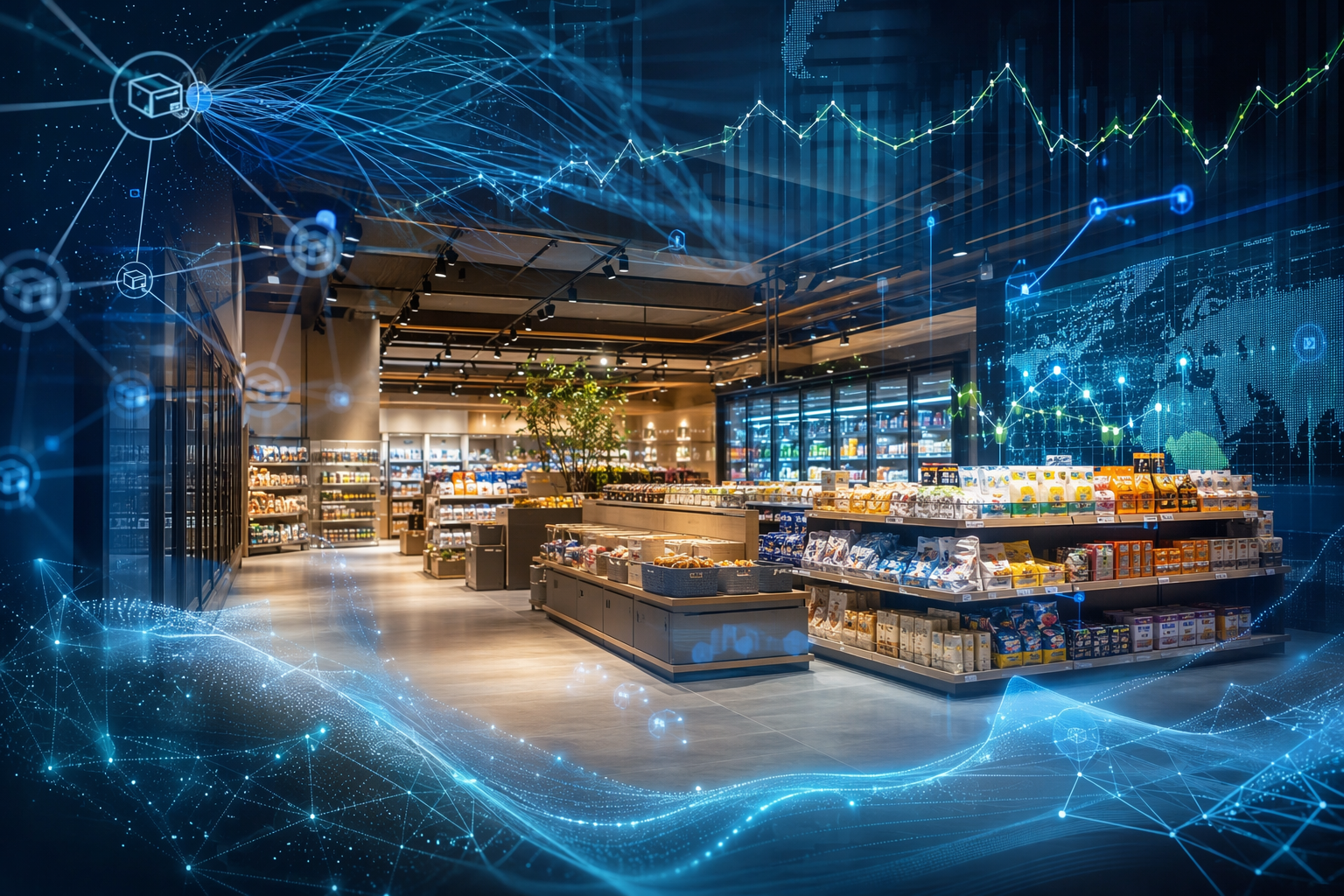
The Closure Risk AI Can Actually Touch
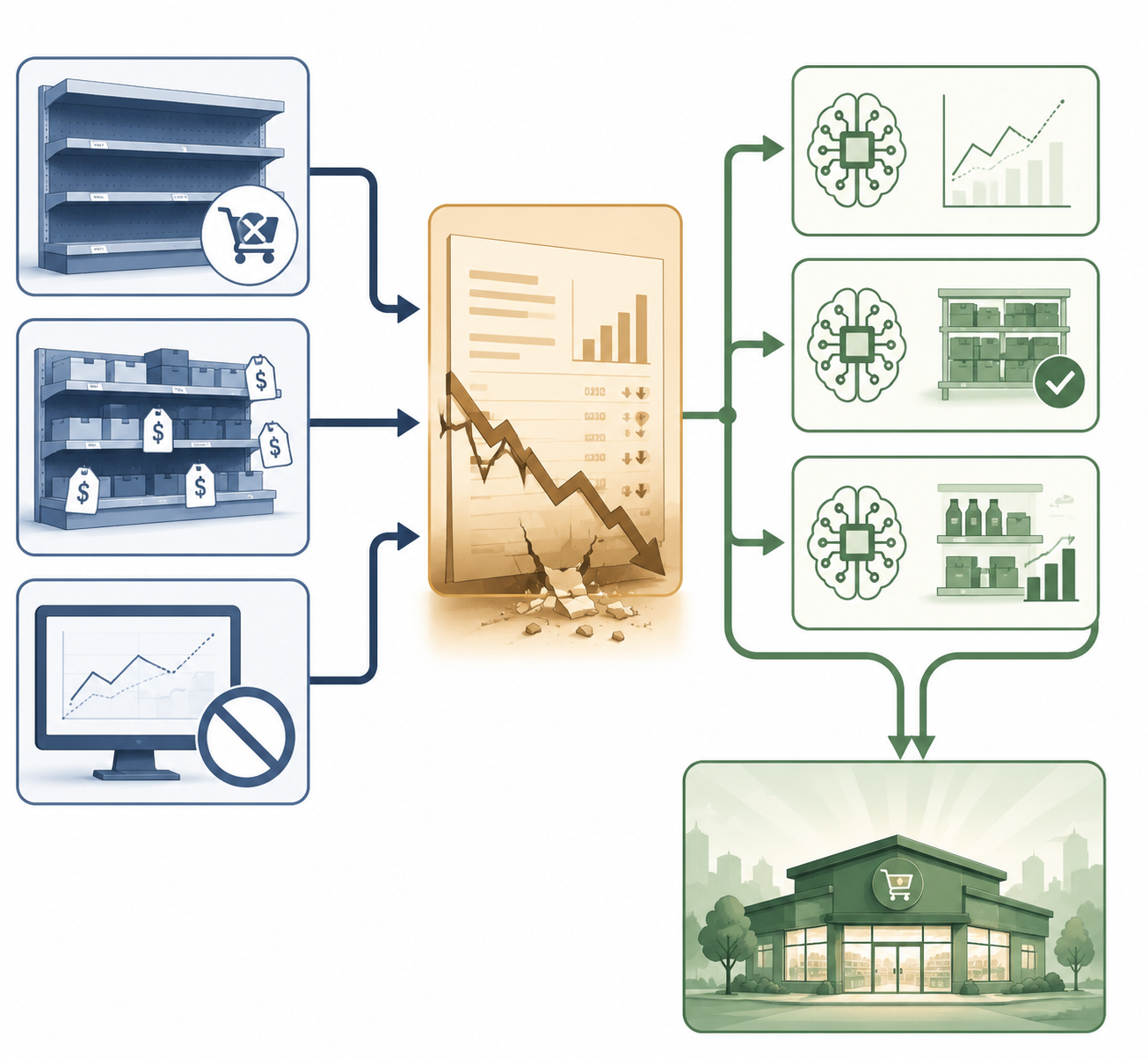
A store does not need to be disastrously run to become a closure candidate. It only needs to lose enough margin, often enough, that corporate finance stops believing the recovery story. Supply chain errors feed that erosion in several practical ways.
- Stockouts convert demand into lost sales, then make the store look weaker than local demand really is.
- Overstock ties up working capital, crowds receiving rooms, and ends in markdowns that make gross margin look worse.
- Forecast error pushes planners into late orders, rushed replenishment, and poor labor planning.
- Shelf execution gaps create the worst kind of fiction: inventory is recorded as available, but the customer cannot buy it.
- Logistics and labor inefficiency can erase the economics of a promotion even when top-line sales look acceptable.
That is the addressable zone. AI supply chain optimization is relevant when the store’s economics are being pulled down by correctable operating distortion, not when the store has no viable customer base or is trapped in a capital structure that operating improvements cannot outrun.
The scale of the operating leak is not small. A 2025 Coresight Research and Simbe survey estimated that U.S. retailers in grocery, mass merchandise, DIY, and drugstore lose 5.5% of gross sales, or $162.7 billion annually, to in-store inefficiencies including stockouts, price errors, and planogram non-compliance.[2] That figure should not be stretched across all retail, and it does not prove that AI prevents closures. It does show that the closure conversation often starts too late. By the time the lease review reaches the board deck, the margin may have been leaking through replenishment and shelf execution for years.
Invisible Stockouts Are the Cleanest Test Case
Stockouts are easy to underestimate because the system can be confidently wrong. If the enterprise resource planning record says a product is in the store, replenishment may not trigger, allocation may move on, and the store manager is left explaining an empty shelf that finance cannot see.
Target’s Inventory Ledger is the most concrete example in the available evidence because it addresses this exact hidden failure. Target found that 50% of its out-of-stocks were invisible to legacy systems: the product existed in the inventory record but was not available to customers on the shelf. Its ensemble AI model, Inventory Ledger, now covers more than 40% of the assortment and has produced sustained on-shelf availability improvements over more than four years.[3][4]
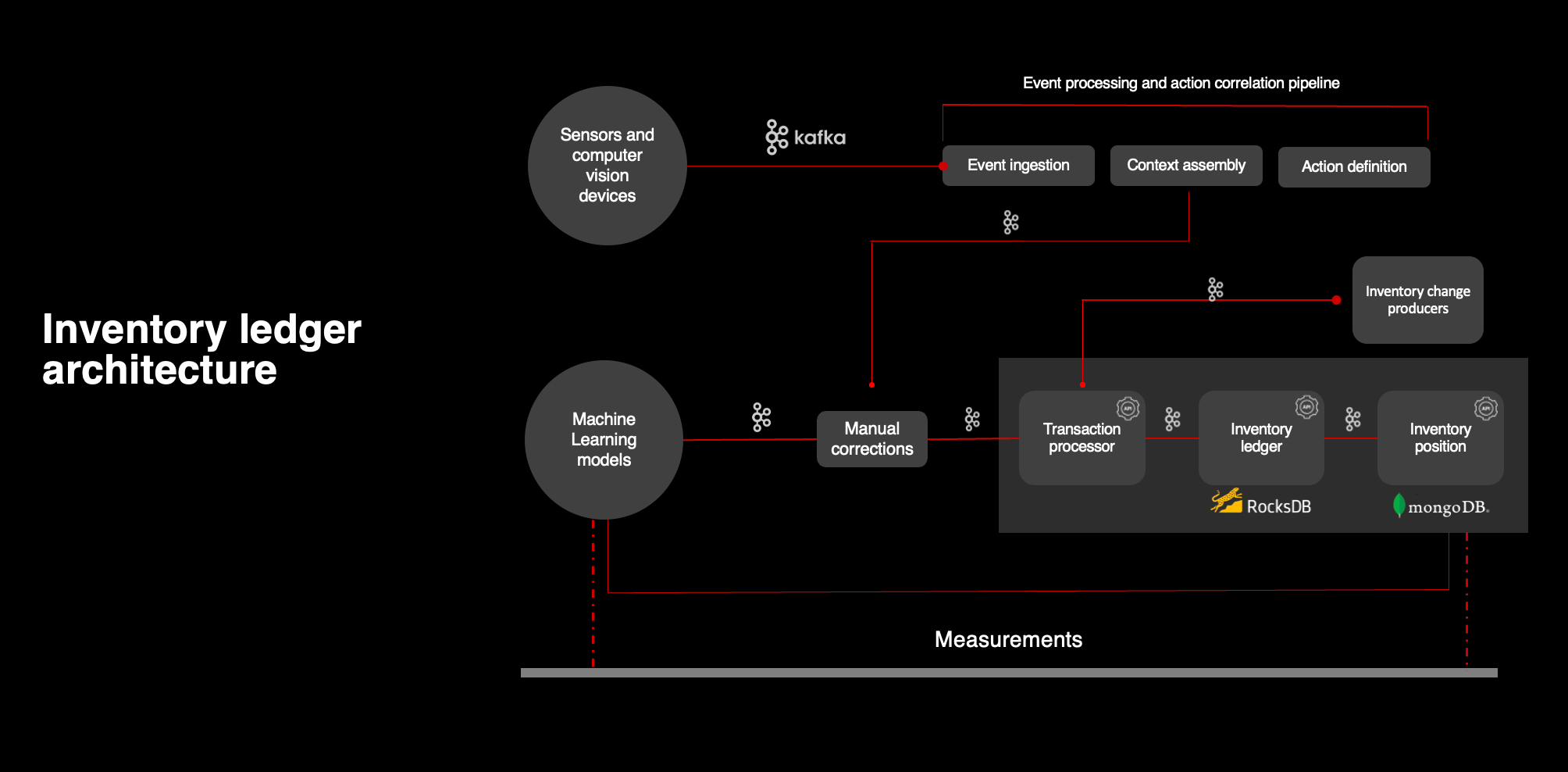
That mechanism matters more than the label “AI.” A system that identifies likely phantom availability changes the work queue. It tells teams where the recorded position cannot be trusted, where a shelf check is worth sending, and where replenishment logic should stop assuming the customer can find the item. For a store already close to the closure line, the difference between a real in-stock position and a fictional one is not cosmetic. It changes sales capture, labor priorities, and the credibility of the store’s demand signal.
This is also where the best AI use cases look least futuristic. Nobody needs a grand theory of autonomous retail to see the value of correcting the record before the next order cycle. If the system sees what the store team already suspects, the store stops being punished twice: once by the missed sale and again by the data trail that says the inventory was there.
Forecasting and Inventory Optimization Reduce the Pressure Before It Reaches the Shelf
Shelf intelligence catches execution failures late in the chain. Demand forecasting and inventory optimization work earlier, where mistakes are cheaper to prevent. The practical question is whether the system can place inventory closer to real demand without simply creating new overstocks somewhere else.
| Closure Driver | Supply Chain Failure | AI Optimization Pathway | Store-Level Consequence |
|---|---|---|---|
| Lost revenue | Products customers want are unavailable | Demand sensing, replenishment adjustment, shelf intelligence | More demand is converted into sales |
| Markdown pressure | Inventory arrives in the wrong quantity, store, or timing | Inventory optimization and allocation modeling | Less capital trapped in slow-moving stock |
| Promotion margin erosion | Forecast misses create late freight and poor labor coverage | Forecasting and labor/inbound planning | Fewer expensive rescues of planned sales events |
| False weak-store signal | System records do not match shelf reality | Computer vision, ledger correction, exception workflows | Finance sees cleaner demand and availability data |
Walmart’s AI-enabled Trend-to-Product work shows the same logic from another angle: use demand signals to reposition inventory at a more local level, especially during seasonal peaks when timing mistakes become expensive quickly.[5] This is not proof that a given Walmart location stayed open because of AI. It is evidence that large retailers are using AI to make allocation more sensitive to local demand, which is one of the operating levers that can protect store economics.
The older benchmark numbers are still useful if handled carefully. A McKinsey Global Institute analysis originally published in 2019, later cited in a 2026 Forbes Tech Council article, reported that AI-enabled supply chain management could reduce logistics costs by 15%, improve inventory levels by 35%, and reduce demand forecasting errors by up to 50%.[6] Those are directional benchmarks, not current guarantees. They do, however, name the right financial levers: logistics cost, inventory level, and forecast error. Those are the places where store-level P&L damage often begins.
A forecast error rarely stays in the forecast file. It becomes too much stock in one district, too little in another, a late truck, a frustrated department manager, or a markdown plan that finance calls “disciplined” because the alternative is worse. AI forecasting helps when it reduces the number of these forced tradeoffs. It does not need to be perfect. It needs to be better enough, early enough, to keep the store from paying for preventable uncertainty.
Labor and Logistics Matter When the Margin Is Already Thin
The store closure debate tends to over-index on sales per square foot and undercount the cost of making those sales possible. A promotion that arrives late, requires rushed handling, and then misses shelf timing can show up as activity without much profit. Store teams feel this immediately; finance usually sees it after the fact.
Albertsons has been cited for using AI labor allocation matched to predicted inbound volumes to move product from dock to shelf 15% faster.[7] That is a narrower claim than “AI fixed store profitability,” and it should stay narrow. Faster dock-to-shelf flow matters because inventory that sits in the back room is not available to the shopper, while labor spent hunting, reworking, and recovering from bad inbound timing is labor not spent on the selling floor.
For stores near the viability threshold, these operational savings compound. Better inbound prediction supports better scheduling. Better scheduling improves shelf recovery. Better shelf recovery makes replenishment data more trustworthy. The chain is not glamorous, but it is how a store’s P&L stops absorbing costs that never belonged there.
Adoption Signals Seriousness, Not Outcomes
Retailers are no longer treating AI supply chain tools as side experiments. MIT CTL’s 2026 Omnichannel Report found that 63% of companies were using AI for demand forecasting, 60% for inventory management, and 61% for warehouse operations; the report characterized AI as “not optional anymore” for omnichannel supply chains.[8]
Spending intentions point in the same direction. Fortune reported that 82% of companies planned to increase AI supply chain spending, while the Coresight and Simbe work found that 58% of retailers were allocating six-to-nine-figure budgets to in-store intelligence.[7][2] That validates urgency and budget commitment. It does not validate effectiveness by itself.
This distinction matters for executives building the investment case. Adoption tells you peers are taking the problem seriously. Outcomes require a tighter question: which store-level loss mechanism will the AI system change, how will that change be measured, and who owns the operating response when the model flags an exception?
Where the Business Case Should Start
The wrong starting point is a broad mandate to “use AI to prevent closures.” That turns a hard operating problem into a procurement slogan. The better starting point is a closure-risk diagnostic by store cluster.
- If the store is losing sales while customer traffic remains plausible, examine stockouts, phantom inventory, and on-shelf availability first.
- If gross margin is deteriorating, trace overstock, late allocation, and markdown dependency before blaming local demand alone.
- If promotions lift sales but not profit, measure expedited freight, labor disruption, and forecast error around event execution.
- If the store’s reported inventory accuracy is high but shelves look poor, test whether the accuracy metric is masking shelf-level unavailability.
From there, the AI use case becomes easier to select. Demand forecasting belongs where the planning signal is unstable. Inventory optimization belongs where capital is trapped in the wrong places. Shelf intelligence belongs where system records and shopper reality diverge. Labor and inbound optimization belong where product flow is late, uneven, or too expensive.
Readers comparing supply chain AI investments across functions may want the broader ROI map in AI Use Cases in Supply Chain by Function: Where the ROI Is Real in 2026. Teams already leaning toward inventory optimization should pressure-test the data layer with the Data Readiness Assessment for AI Inventory Optimization before assuming the model can produce reliable exceptions.
The Practical Answer
AI supply chain optimization can help prevent store closures when the store is being pushed below viability by margin erosion that the supply chain can correct: stockouts, overstock, forecast error, shelf execution failures, logistics cost, and labor misallocation. The evidence supports those intermediate improvements more strongly than it supports any direct claim that AI, by itself, saved specific stores from closing.
That boundary is important. AI cannot rescue a format customers have abandoned, a location with fundamentally broken economics, or a retailer whose leverage leaves no room for operational recovery. But when the closure risk is being worsened by inventory distortion and preventable operating cost, AI is not a vague transformation bet. It is a way to find the leak before the closure model treats the store as the problem.
References
- The Great American Store Closure Tracker: 2026 Edition, MMCG Invest, link
- Coresight Report 2025, Simbe Robotics, link
- Solving Product Availability with AI, Target Tech, link
- Walmart, Target use AI to prevent inventory shortages, Business Insider, June 2025, link
- Walmart’s AI-Powered Inventory System Brightens the Holidays, Walmart Global Tech, link
- Supply Chain Optimization Through AI, Forbes Councils, February 2026, link
- Walmart, Amazon AI supply chain retail, Fortune, July 23, 2025, link
- AI “Not Optional Anymore” for Omnichannel Supply Chains, New MIT CTL Research Finds, MIT Center for Transportation & Logistics, link
Comments
Join the discussion with an anonymous comment.