
The hard part of ai supply chain optimization for boeing 737 maintenance is not teaching a model that a part was issued last month. It is teaching it that a 737 Classic, a 737NG, and a 737 MAX may look like one family on a fleet slide while behaving like three different supply chains in the stores room.
The 737 problem starts with fragmentation. Classic aircraft use CFM56-3 engines, NG aircraft use CFM56-7B engines, and MAX aircraft use LEAP-1B engines. Those differences split rotable, repairable, consumable, and engine-related demand into pools that cannot be safely treated as interchangeable. At fleet scale, the issue becomes more than catalog neatness: the NG fleet alone exceeds 7,000 delivered aircraft, the MAX fleet exceeds 1,600 delivered aircraft, and each 737 contains roughly 3 million parts, according to OxMaint's 2026 aviation MRO spare parts forecasting guide.[1]
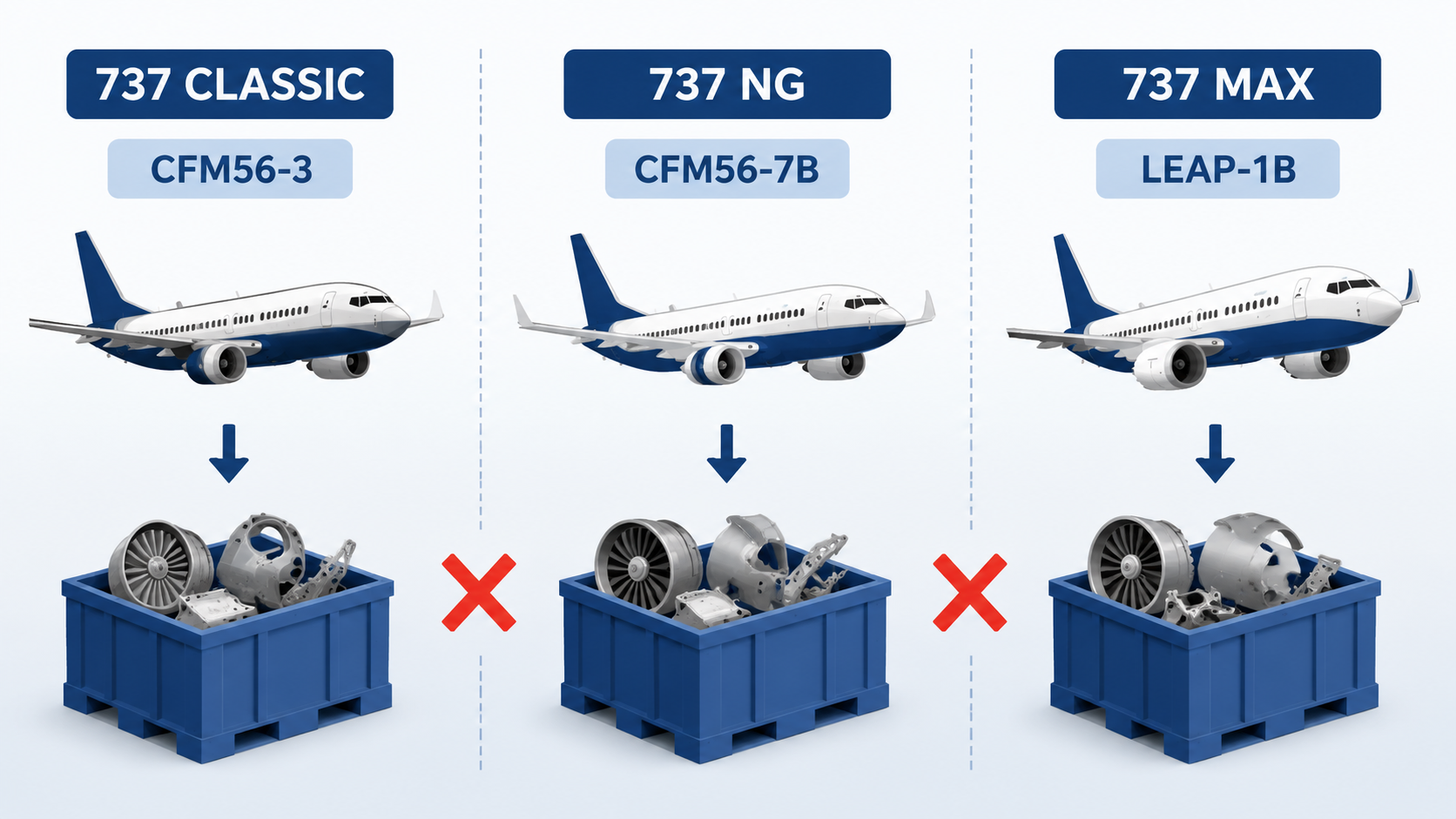
That is why a single min/max setting can look responsible in the ERP and still fail the operation. A reorder point built on last year's average may overbuy a slow-moving Classic component, understate removals on an aging NG subfleet, and miss a MAX-specific lead-time change because the model never understood that the pools had separated in the first place.
The cost pressure is not academic. OxMaint puts excess stock at 23% of MRO budget, emergency parts at a 4.8x pricing premium, and AOG cost exposure at $10,000 to $150,000 per hour, depending on route, utilization, and cost-allocation assumptions.[1] The high end of that range is not a warehouse penalty. It is an aircraft out of service when the schedule expected it to earn revenue.
Why 737 parts demand breaks traditional forecasting
Traditional forecasting methods usually assume that the past arrives in a usable rhythm. That assumption is weak for aircraft parts. Demand may sit at zero for months, then appear twice in one week. A scheduled check may pull demand forward. A reliability issue may cluster removals around a subfleet. A supplier delay may turn a normal replenishment into an AOG desk problem.
For the 737, the signal is further distorted by generation. A part that is slow moving across the whole family may be critical inside one operator's NG-heavy network. A MAX part may have too little mature history to behave like an old consumable. A Classic part may show declining total demand while becoming harder to source at the moment it is needed.
OxMaint's vendor-published benchmark puts traditional min/max and moving-average approaches at 55–65% accuracy for intermittent aviation parts demand, while AI models trained on multiple signals reach 85–94% accuracy.[1] That should not be read as an independently verified industry average. It is still a useful benchmark because the size of the gap matches what planners already know from the floor: the old logic is often blind to the reasons demand appears when it does.
| Forecasting approach | What it mainly sees | Where it struggles in 737 MRO | Reported accuracy |
|---|---|---|---|
| Min/max replenishment | Stock position and fixed reorder thresholds | Cannot distinguish demand shifts by generation, utilization, check timing, or supplier volatility | 55–65% in OxMaint vendor benchmarks |
| Moving average | Historical issue rates over a selected period | Smooths out intermittent removals and may hide emerging subfleet-specific demand | 55–65% in OxMaint vendor benchmarks |
| AI demand forecasting | Consumption, utilization, maintenance schedules, fleet age, and lead-time variability | Requires clean history, integration, and planner governance before recommendations become buys | 85–94% in OxMaint vendor benchmarks |
The improvement is not magic from the label "AI." Gradient Boosting, LSTM, and XGBoost models matter here because they can absorb several uneven signals at once: part consumption, aircraft utilization, fleet age, scheduled C- and D-check calendars, and supplier lead-time variability. For a 737 operator, that means the forecast can separate a part that is genuinely becoming obsolete from a part that is quiet today because the aircraft that consumes it has not yet entered the next maintenance window.
This is also where the MAX creates a different kind of uncertainty. Aviation Week reported in February 2026 that Southwest had concerns over a potential CFM LEAP parts crunch, a reminder that newer-generation fleets can carry supply and durability questions before long-run consumption patterns stabilize.[2] A moving average waits for that history to accumulate. A better forecasting setup at least has a chance to combine early consumption, utilization, maintenance plans, and supplier signals before the shortage becomes visible only as an expedite.
The useful forecast is the one that changes the buy
Forecast accuracy is only valuable if it changes a decision early enough. In 737 MRO inventory, the practical target is usually a rolling 90- to 180-day view: far enough ahead to procure at normal rates, close enough that maintenance planning and utilization data still mean something. OxMaint describes AI forecasting as using 12–36 months of consumption history, fleet age and utilization data, scheduled maintenance calendars, and supplier lead-time variability to create that rolling demand picture.[1]

The workflow is not complicated on paper. It is difficult because each handoff has to be trusted:
- Consumption history identifies what was issued, repaired, scrapped, borrowed, returned, or substituted.
- Fleet utilization shows which tails are flying enough to consume parts faster than the average aircraft.
- Maintenance calendars show when scheduled checks will create planned demand spikes.
- Supplier lead-time data shows which shortages need action before the due date looks urgent.
- Planner review decides whether the recommendation becomes a purchase order, a repair acceleration, a stock transfer, or no action.
That last step is not a courtesy. A model can rank risk, but it does not know every maintenance-control workaround, cannibalization decision, loan agreement, or engineering restriction unless the operation has captured it. Planner-in-the-loop governance is what prevents a forecast engine from becoming an expensive generator of recommendations nobody will release.
When the chain works, the value is not simply "less inventory." The better result is better-positioned inventory: fewer units sitting stale against the wrong generation, fewer Friday-night premium buys, and fewer explanations after an aircraft is already grounded. OxMaint's vendor guide reports a 31% reduction in excess inventory and a 20–22% cut in total parts spend from AI-based spare parts forecasting.[1] Those figures are credible enough to take seriously, but only under the operating conditions the guide itself implies: clean consumption data, maintenance-schedule integration, lead-time awareness, and human review.
What changes inside the planning cycle
A traditional replenishment cycle often notices a problem when stock crosses a threshold. In a 737 operation, that can be too late because the threshold may not reflect the next check package, the next utilization peak, or a supplier that is no longer delivering at the old cadence. AI forecasting moves the trigger earlier by asking a different question: which parts are likely to be needed during the next planning window, by which generation, and with what supply risk attached?
A practical planning cycle starts with exception review, not bulk approval. The planner looks at high-risk recommendations first: parts with predicted demand inside the 90- to 180-day window, long or unstable lead times, low available stock, limited interchangeability, and AOG exposure. The model's job is to narrow the review queue. The planner's job is to challenge the recommendation before money moves.
| Planning question | Traditional answer | AI-assisted answer |
|---|---|---|
| Should we buy? | Buy when stock reaches the reorder point. | Buy when forecast demand, utilization, check timing, and lead time indicate risk before the reorder point is breached. |
| Where should stock sit? | Place stock based on historical issue locations or standard base allocation. | Pre-position stock where upcoming aircraft activity and maintenance events create the strongest need. |
| What should be reduced? | Cut items with low recent turns. | Separate truly stale inventory from quiet parts tied to future checks or aging subfleets. |
| Who decides? | Planner adjusts parameters after shortages or excess become visible. | Planner reviews ranked recommendations before purchase, transfer, or repair action. |
This matters most for parts that are expensive enough to hurt if overbought and critical enough to ground an aircraft if missing. Nobody needs advanced modeling to replenish a cheap, stable consumable with predictable usage. The leverage appears in the awkward middle: intermittent demand, long lead time, high unit cost, and limited substitution across 737 generations.
Evidence from aviation deployments, with the labels kept on
The strongest 737-specific argument is structural: fragmented parts pools, uneven fleet age, intermittent removals, and expensive AOG exposure. The deployment evidence from adjacent aviation MRO cases supports the pattern, but it should not be blended into one universal performance promise.
ePlaneAI reports an inventory AI case with 95% forecast accuracy, 65% labor efficiency, and identification of 37% of stale inventory.[3] The stale-inventory point is particularly relevant to 737 planning because overstock is rarely just "too many parts." It is often too many of the wrong parts for the subfleet that will actually fly, age, and enter checks over the next few months.
AIONOS describes an Asia-Pacific carrier case in which predictive maintenance and scheduling analytics reduced unplanned events by 28%, saved $6.5 million in avoidable part replacement, and improved on-time performance from 82% to 91%.[4] That is not a pure 737 spare parts forecasting benchmark, but it supports the operational link that matters: better prediction changes maintenance and supply decisions before disruption reaches the schedule.
Porsche Consulting's Lufthansa example sits closer to planning productivity than inventory optimization. It reports 30% more aircraft per maintenance planner and 15% more planning synergies from AI-supported maintenance planning.[5] For spare parts forecasting, that planner-capacity gain matters because recommendations still need review. If AI increases the number of alerts without improving prioritization, it merely moves the bottleneck from the spreadsheet to the planner's queue.
The data conditions are not optional
The operators most likely to benefit are not necessarily the ones with the largest fleets. They are the ones that can feed the model enough clean operational history and connect the recommendation to the systems where work actually happens. A 737 operator with 12–36 months of reliable issue, removal, repair, scrap, and return data has a different starting point from one whose part history is polluted by miscoded transactions, manual workarounds, and unrecorded cannibalization.
Integration also decides whether the forecast becomes useful. If the model sits outside AMOS, TRAX, SAP, Quantum, or the operator's equivalent MRO and ERP environment, planners have to reconcile recommendations by hand. That usually means the model will be consulted when there is time and ignored when the desk is under pressure, which is exactly when the better signal is needed.
The minimum useful setup for a 737 spare parts forecasting program is fairly concrete:
- 12–36 months of clean consumption history, including issues, returns, repairs, scrappage, substitutions, and removals.
- Fleet attributes by generation, tail, age, utilization, and operating pattern.
- Scheduled maintenance calendars, especially upcoming heavy checks and component programs.
- Supplier lead-time history that reflects variability, not just contracted lead time.
- MRO-system integration so recommendations can be reviewed against open work, stock, repairs, purchase orders, and alternates.
- Planner-in-the-loop approval with clear override reasons and accountability.
Override tracking is easy to underestimate. If planners reject recommendations and nobody captures why, the model loses a valuable correction signal. If planners accept recommendations automatically, the company loses the operational judgment that keeps a forecast from becoming a purchase-order machine. The better design records the reason: engineering constraint, known supplier issue, planned aircraft retirement, alternate part available, one-time campaign, or bad source data.
Where the 737 business case is strongest
The strongest business case is not across every SKU. It is in the slice of inventory where uncertainty, cost, and operational consequence overlap. For a mixed 737 fleet, that often means generation-specific components, long-lead repairables, engine-related material, parts tied to upcoming checks, and items with enough historical movement to model but not enough regularity for simple averaging.
Aging NG aircraft deserve special attention because the fleet is large and old enough for utilization and removal behavior to diverge. NG average age is roughly 10–19 years, which is a wide band with real planning consequences. Two NG subfleets with the same part catalog can consume differently if one is flying harder, entering heavier maintenance, or carrying a different reliability history.
MAX planning has a different profile. The delivered fleet is younger, but LEAP-1B supply and durability uncertainty means planners may need to watch early warning signals before the historical demand record is deep enough to feel comfortable. In that environment, AI forecasting should be treated less as a certainty engine and more as an early-risk ranking tool.
Classic aircraft create the opposite problem. Demand may decline, but sourcing can become more awkward. A naive reduction program may cut slow-moving inventory that is difficult to replace later. A useful model helps distinguish dead stock from low-frequency protection stock, and that distinction is where planners earn their keep.
What a realistic implementation should measure
Accuracy alone is too thin a scorecard. A model can look accurate on high-volume parts while still missing the low-frequency items that ground aircraft. For 737 MRO, performance should be measured against the decisions the forecast is supposed to improve.
| Metric | Why it matters |
|---|---|
| Forecast accuracy by part class and 737 generation | Prevents strong aggregate performance from hiding poor results on NG, MAX, or Classic-specific pools. |
| Emergency purchase count and premium spend | Shows whether forecasted risk is being converted into planned procurement. |
| AOG events linked to material shortage | Measures the operational consequence, not just the inventory balance. |
| Excess and stale inventory value | Shows whether stock reduction is removing the right material rather than weakening coverage. |
| Planner acceptance and override rate | Reveals whether recommendations are trusted, challenged, and improved over time. |
| Lead-time prediction error | Captures supplier volatility, which is often where the procurement plan breaks. |
The first pilot should be narrow enough to inspect. A sensible starting point is not "all 737 inventory." It is a defined population: for example, selected high-value rotables or repairables across one 737 generation, with known lead-time pain and enough transaction history to evaluate. The pilot should compare AI recommendations against the current planning method over the same period, then review where the model was right, where the planner was right, and where the source data was wrong.
The uncomfortable findings are usually the useful ones. If the model keeps recommending parts that planners reject because aircraft are scheduled for retirement, the integration is missing fleet-plan data. If it misses demand tied to a check package, the maintenance calendar feed is weak. If it predicts demand correctly but procurement still expedites, supplier lead-time variability is not being handled early enough.
The threshold judgment
For Boeing 737 operators with clean historical consumption data, fleet-utilization signals, maintenance-calendar integration, supplier lead-time history, and planner-in-the-loop governance, AI spare parts forecasting is one of the highest-leverage MRO applications available. The reason is specific: the 737 family has enough scale to make inventory mistakes expensive and enough generation fragmentation to make traditional averages unreliable.
For operators without those conditions, the same technology can become a more sophisticated way to produce untrusted recommendations. The model may be advanced, but if it is trained on dirty transactions, disconnected from AMOS, TRAX, SAP, Quantum, or equivalent planning systems, and allowed to trigger purchases without accountable review, the result is not optimization. It is another argument between inventory, maintenance control, and procurement after the aircraft is already waiting.
References
- AI-Powered Spare Parts Demand Forecasting for Aviation MRO (2026 Guide) — OxMaint
- Southwest Concerned Over Potential CFM Leap Parts Crunch — Aviation Week, February 2026
- Inventory AI. Predict Every Aviation Part Need. — ePlaneAI
- AI and Predictive Analytics in Airline Maintenance and Scheduling — AIONOS
- Lufthansa Optimizes Aircraft Maintenance with AI — Porsche Consulting
Comments
Join the discussion with an anonymous comment.