
AI logistics route planning for tropical storm preparedness matters most in the hours and days before a storm turns from forecast track into blocked roads, missed appointments, and carrier capacity that has already been claimed. The practical question is not whether a model can draw a shorter route on a calm day. It is whether the system can give a transportation team more usable time: time to move inventory ahead of landfall, hold a load that would otherwise be stranded, divert around a likely closure, or escalate a low-confidence recommendation before a dispatcher has to own the failure.
That distinction is why tropical storm routing should be treated as its own use case inside logistics optimization. A hurricane cone changes. Rainfall risk shifts inland. Ports slow or close. Drivers run out of hours. A route that looked reasonable at 7 a.m. can be the wrong decision by midafternoon, not because the planning team was careless, but because the operating facts changed faster than the manual workflow could absorb.

The pressure is no longer occasional. Weather conditions account for 23% of all U.S. roadway non-recurring delays, with an estimated annual cost to trucking of $2 billion to $3.5 billion.[1] Resilinc reported that global supply chain disruptions rose 38% year over year in 2024, while extreme-weather disruptions rose 119%; floods were up 214%, and hurricanes and typhoons were up 101%.[2] Everstream has also described a compressed disaster cadence in the U.S., with billion-dollar weather disasters now occurring about every three weeks rather than every four months four decades ago.[3]
Those numbers do not prove that AI routing will pay back in every fleet. They do explain why waiting for confirmed disruption is increasingly expensive. By the time a closure is official, the best alternate carrier may be gone, the better dock appointment may be unavailable, and the inventory that should have moved inland may still be sitting in the wrong facility.
What Storm Routing Has To Integrate
A credible AI storm-routing workflow is not just a weather layer pasted on top of a transportation management system. It has to join several streams of evidence that usually live in different places, then decide whether a recommended change is strong enough to act on or uncertain enough to send to a human planner.
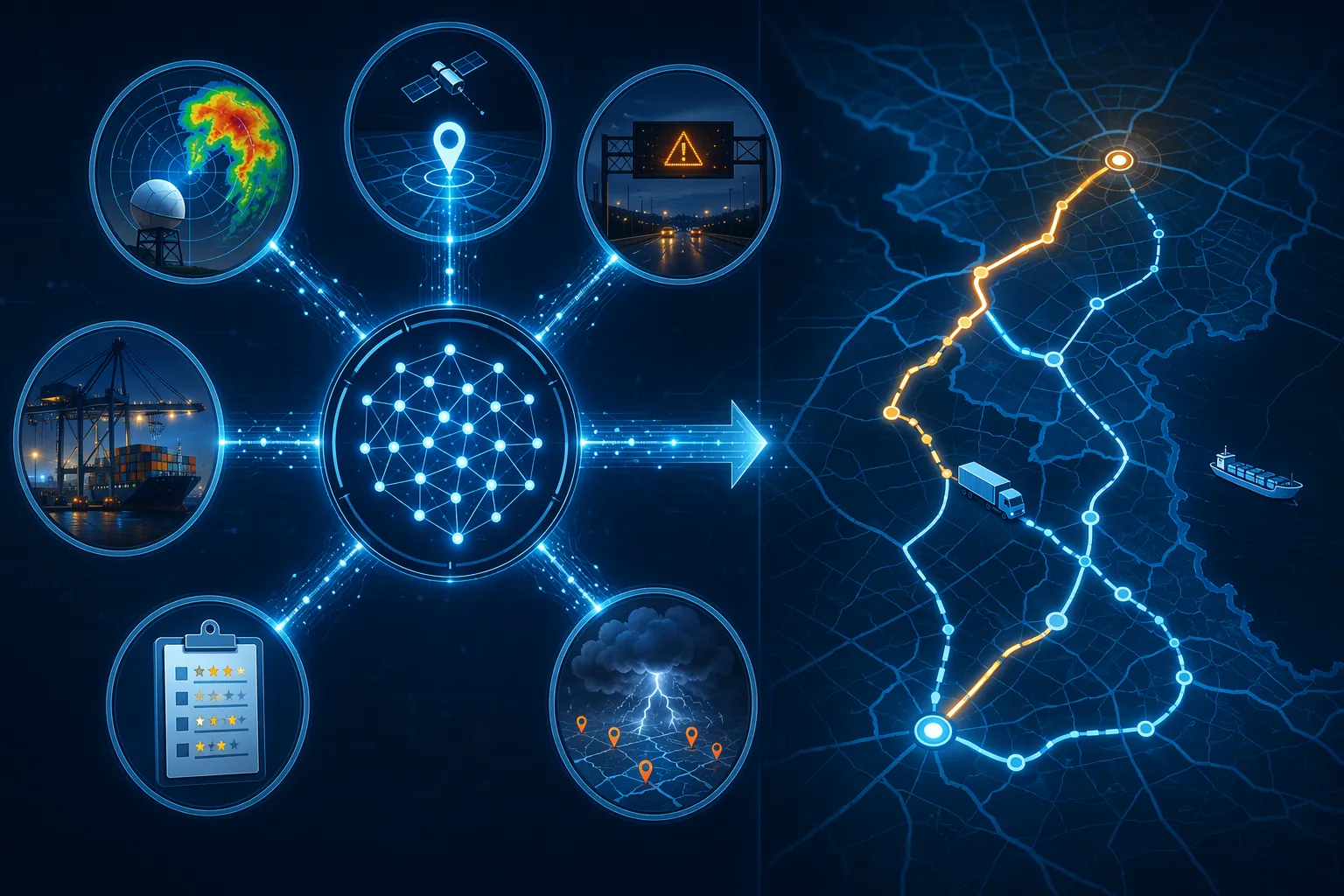
| Input | What It Changes In The Routing Decision |
|---|---|
| Hyperlocal weather forecasts | Moves planning from broad regional alerts to route-, facility-, and corridor-level risk. |
| Real-time GPS and ELD telemetry | Shows where tractors, trailers, and drivers actually are, including hours-of-service constraints. |
| Road, traffic, and closure feeds | Separates a theoretically available alternate route from one that can carry the load today. |
| Port and terminal congestion signals | Identifies whether rerouting to a port, cross-dock, or inland node only shifts the bottleneck. |
| Carrier performance history | Helps rank which carriers are likely to execute under storm conditions, not just quote capacity. |
| Historical storm-impact data | Connects forecasted wind, surge, rainfall, and flooding patterns to past disruptions in similar lanes. |
The best implementations use these inputs as a decision sequence. First, the system watches the forecast envelope and flags lanes, facilities, ports, and delivery windows that may be exposed. Next, it compares that risk with current shipment positions, appointment times, driver availability, and carrier options. Then it generates route, mode, timing, or inventory-positioning alternatives. Finally, it attaches confidence and consequence: what happens if the team moves now, what happens if it waits, and which assumptions are driving the recommendation.
That last step is where storm routing differs from ordinary optimization. A normal routing engine can optimize distance, fuel, appointment windows, and asset utilization. Tropical storm preparedness adds a moving hazard, tightening capacity, infrastructure uncertainty, and a shorter escalation clock. A model that cannot show why it prefers an early diversion over a hold-at-origin decision is asking the dispatcher to take blame without giving her enough operational evidence.
Before, During, And After The Storm
Before landfall, the value is optionality. Predictive monitoring can flag shipment risks 24 to 72 hours before impact, and some systems can detect risks as much as 7 to 14 days ahead, depending on the risk type, data coverage, and forecast confidence. At that stage, the action may not be a dramatic reroute. It may be advancing a load by one day, pre-positioning inventory outside a vulnerable coastal zone, shifting from a congested port to an inland transfer point, or reserving capacity before the market tightens.
During the storm window, the routing problem becomes narrower and more consequential. The system must update around closures, unsafe corridors, facility shutdowns, and driver constraints. Automated recommendations are useful when the confidence is high and the operational impact is clear. When confidence is weaker, the workflow should push the decision to a planner with the relevant evidence already assembled, rather than burying the uncertainty in a green check mark.
After the storm, the question changes again. Recovery routing has to account for reopened-but-congested corridors, changed demand patterns, damaged facilities, backlogged ports, and customers whose priority level has shifted. A model trained only on pre-storm planning may miss the practical recovery problem: everyone is trying to move at once, and the first open route is not always the route that restores service fastest.
The Evidence Is Strongest When It Is Kept In Bounds
There is now enough evidence to treat AI storm routing as more than a lab idea, but not enough to treat every ROI claim as portable. McKinsey’s 2025 supply chain work cites Johnson & Johnson’s AI system identifying 85% of major supply chain disruptions an average of seven days in advance, giving teams time to act before disruption materializes.[4] Separate 2026 logistics benchmarks cited by Digital Applied describe AI-powered dynamic routing outcomes including 10% to 15% fuel cost reductions, 15% to 20% faster deliveries, 30% fewer late shipments, and on-time delivery improvements from 82% to 88% up to 94% to 97%.[5]
Those are meaningful figures, but they should be read carefully. The Johnson & Johnson example is about early disruption identification and proactive response, not a blanket claim that all storm routes can be automated a week out. The dynamic-routing metrics combine broader logistics optimization evidence with AI-enabled routing performance; they are useful benchmarks, not guaranteed hurricane-season results for a network with incomplete telemetry or inconsistent carrier data.
The ClimateAi roofing manufacturer case is memorable for a different reason. In a 2023 case study, a roofing materials producer used ClimateAi’s probabilistic hurricane impact forecasts ahead of Hurricane Ian to pre-position inventory and capture $15 million in incremental sales that the company said would otherwise have been lost to disrupted supply.[6] That is a concrete example of storm-informed pre-positioning creating commercial value. It is also a single-event case from 2023, not a typical ROI benchmark for every shipper.
Taken together, the evidence points to a practical pattern: AI adds the most value when it shifts the decision earlier. It is less persuasive when it is sold as a last-minute miracle after roads are closed and capacity has disappeared.
Where Vendors Fit In The Workflow
The vendor market is better understood by role than by a single “storm routing platform” label. Weather intelligence providers such as The Weather Company, Tomorrow.io, DTN, and ClimateAi focus on forecast precision, probabilistic risk, and weather-driven operational alerts. The Weather Company describes predictive analytics and real-time insight workflows for managing supply chain weather risk, while Tomorrow.io positions weather intelligence around logistics efficiency and safety.[7][8]
Visibility platforms such as FourKites and project44 help transportation teams see where shipments, assets, and exceptions are as the storm picture changes. FourKites’ hurricane-season guidance emphasizes shipment visibility, communication, and exception management during severe weather events.[9] Risk-monitoring providers such as Everstream Analytics and Resilinc add supplier, facility, lane, and disruption intelligence across the broader supply chain. Routing and optimization engines such as Optym, LogiNext, and Wise Systems then help translate those signals into load-level routing, sequencing, and dispatch decisions.
In a mature deployment, these tools do not operate as isolated dashboards. The weather alert has to touch the shipment. The shipment has to touch the carrier plan. The carrier plan has to touch appointment windows, driver hours, customer priority, and cost. If those handoffs stay manual, the organization may still gain awareness, but it has not yet built AI logistics route planning for tropical storm preparedness in the operational sense.
A Practical Storm-Routing Operating Pattern
A useful implementation does not begin with full automation. It begins by deciding which decisions the model is allowed to influence and under what confidence threshold. For example, a high-confidence flood-risk alert on a non-urgent load may trigger an automatic reroute proposal inside the TMS. A lower-confidence storm-track scenario affecting a strategic customer may require human approval, with the model showing the alternate route, incremental cost, likely service impact, and assumptions behind the alert.
- Identify exposed lanes, facilities, ports, and customer commitments as soon as the forecast envelope overlaps the network.
- Rank shipments by consequence, including safety, customer priority, perishability, production dependency, and recovery difficulty.
- Generate alternatives that include moving early, holding at origin, diverting, changing mode, pre-positioning inventory, or resequencing deliveries.
- Attach confidence and tradeoffs so planners can see cost, service, safety, and capacity implications before approving the change.
- Track execution after the decision, because a reroute that is not accepted by the carrier or cannot make the appointment is only a planning artifact.
The operating discipline matters because storm routing decisions are rarely clean. A distributor may have enough warning to pull freight out of a Gulf Coast warehouse, but not enough capacity to move every customer order. A manufacturer may have two alternate ports, one with better weather exposure and one with worse congestion. A dispatcher may know from experience that a carrier accepts storm loads but fails to provide reliable updates once conditions deteriorate. Those details belong in the model if the organization expects the recommendation to survive contact with the control room.
The Adoption Barrier Is Not Only Technical
Data completeness is the first constraint. Real-time GPS and ELD telemetry, hyperlocal weather forecasts, and carrier performance history are not optional inputs if the goal is storm routing rather than generic alerting. Missing telemetry leaves the system guessing where freight and drivers are. Weak weather granularity turns route-level decisions into regional warnings. Thin carrier history makes it harder to judge whether a proposed alternate plan is executable under stress.
Forecast uncertainty is the second constraint. AI is becoming more important in hurricane forecasting, but it does not remove the need for meteorological judgment. NOAA has emphasized that AI augments rather than replaces human meteorologists, and no model can perfectly predict storm tracks.[10] For logistics teams, the implication is direct: the routing workflow should have confidence-threshold escalation, not silent automation at every risk level.
Dispatcher trust is the third constraint, and it is often treated too lightly. Veteran dispatchers have lived through bad forecasts, overconfident dashboards, and customers who remember only the missed delivery. If the model recommends a diversion that adds miles while the sky still looks clear, the planner needs more than a colored risk score. She needs to see the hazard, the affected corridor, the lead time, the service tradeoff, and the reason the system believes waiting will reduce options.
That trust is built through calibration. Teams should review storm-season decisions after the fact: which alerts were early and useful, which were noisy, which reroutes executed, which carriers failed, and which customer commitments were protected. Without that loop, the system may keep producing recommendations, but the control room will quietly route around the tool.
What Makes The Use Case Mature Enough
As of Q3 2026, the strongest case for AI storm routing is not that every logistics network can automate hurricane decisions. It is that the building blocks are now mature enough to influence real transportation choices before disruption materializes. Hyperlocal weather intelligence is available. Visibility platforms can connect risk to live shipments. Routing engines can evaluate alternatives faster than manual planners can rebuild a network plan under pressure. Documented deployments show earlier disruption detection, measurable delivery and cost improvements, and at least one commercially significant hurricane-linked inventory-positioning result.[4][5][6]
The use case becomes credible when the organization is honest about what the model knows and what it does not. A system with incomplete shipment visibility, weak carrier data, and no human escalation path may still produce attractive route maps, but it is not ready to carry high-consequence storm decisions. A system that integrates weather, telemetry, infrastructure conditions, port signals, carrier history, and storm-impact memory can make the decision window larger and the tradeoff clearer. That is where the ROI claims begin to deserve attention.
References
- How Truckers Use Tech to Keep Moving During Hurricanes, FreightWaves, 2022 update.
- Global Supply Chains See Nearly 40% Annual Increase in Disruptions, Resilinc, Jan 2025.
- Weather-Proof Your Logistics Operations, Everstream Analytics, 2025.
- Beyond Automation: How Gen AI Is Reshaping Supply Chains, McKinsey, Apr 2025.
- AI in Logistics: Route, Ship, and Bill Autonomously, Digital Applied, 2026.
- Accurate Hurricane Forecasting Helps Roofing Materials Producer Come Out on Top, ClimateAi, Mar 2023.
- Managing Supply Chain Weather Risks with Predictive Analytics, The Weather Company / IBM, Sep 2025.
- Weather Intelligence for Logistics: Improve Efficiency & Safety, Tomorrow.io, 2026.
- Tips for Keeping Your Supply Chain Running During Hurricane Season, FourKites, 2024.
- Hurricane Season 2026: AI Changing Future of Forecasting, Orlando Sentinel, May 2026.
Comments
Join the discussion with an anonymous comment.