
K-pop album export logistics has become a useful test case for AI supply chain execution because the market is growing in a way that ordinary warehouse assumptions do not like. Export value has climbed from $40 million in 2017 to $301.7 million in 2025, crossing $300 million for the first time, while export weight fell 24.2% in 2025 as platform albums and card-type formats reduced the physical mass moving through the network.[1] Then the first half of 2026 reached $257.48 million, up 125% year over year, a surge tied partly to major release events rather than a clean baseline trend.[2]
That combination matters on a fulfillment floor. A lighter carton does not mean an easier order if it contains multiple album versions, retailer-specific preorder benefits, fan club instructions, and order keywords that do not match the stock record cleanly. Weight-based planning can look calm while the pick face becomes noisy.
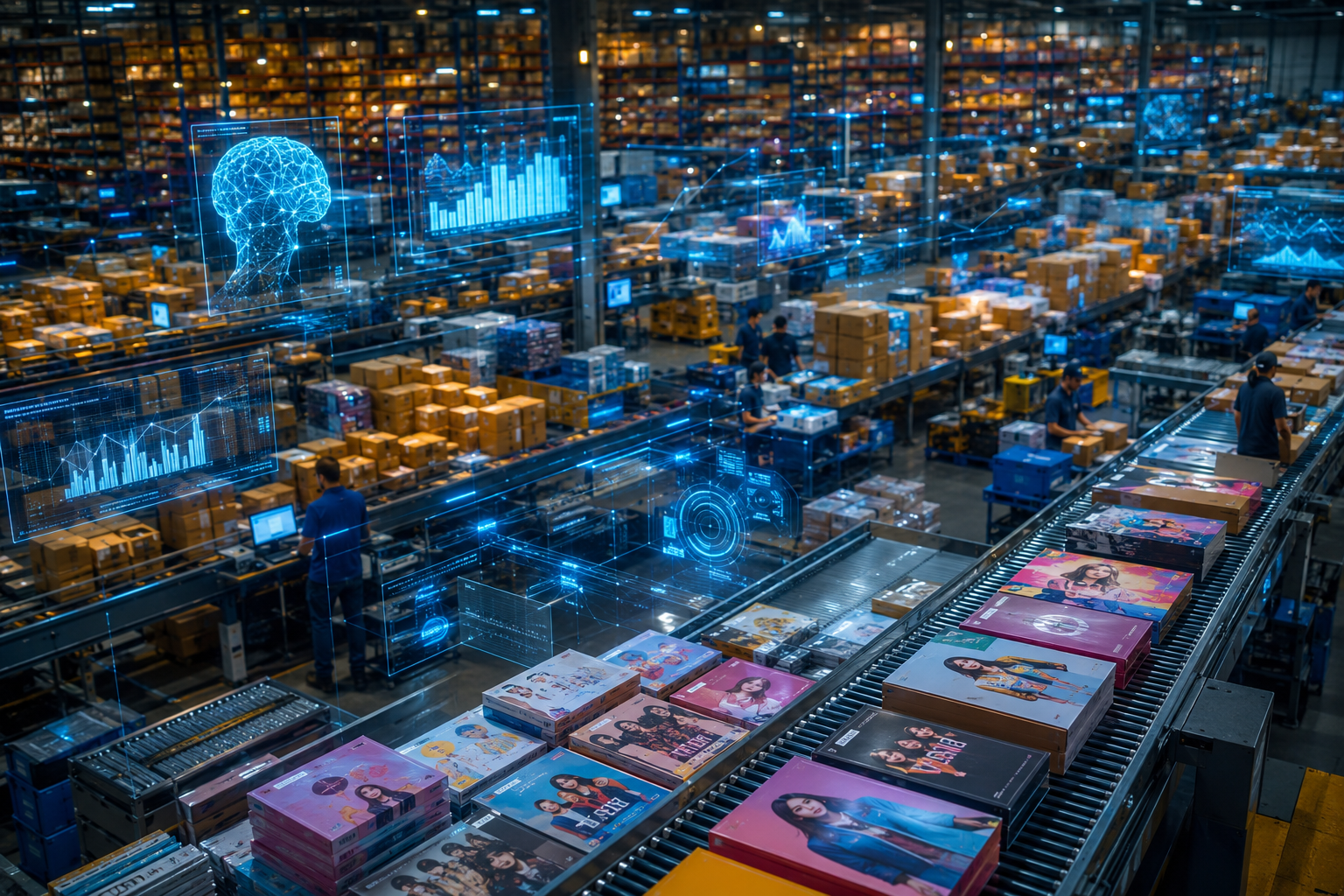
The pressure is not only annual growth. BTS's 2026 “Arirang” release reportedly drew 4.06 million preorders in its first week, and demand around such events can multiply within days.[3] For an export fulfillment operation, that is when yesterday's replenishment logic, carton plan, labor allocation, and outbound schedule start colliding with today's promotion calendar.
Why K-pop Albums Break Ordinary Fulfillment Models
A standard album catalog expands by artist, title, and edition. K-pop adds another layer: photobook versions, digipacks, jewel cases, platform albums, card-type products, member-specific covers, retailer preorder benefits, and region-specific bundles. Available data identifies more than seven physical formats, before counting retailer-specific POB variants. That is not simple SKU growth; it is SKU growth tied to fandom behavior.

The awkward part is that much of the complexity is created upstream from the warehouse. Labels create multiple versions. Retailers attach different benefits. Fandom platforms stimulate preorder waves. Group order organizers consolidate demand, then split it back into individual fan-level expectations. By the time cartons arrive at a fulfillment center, workers are not managing a music product; they are managing promises made by several systems that may not share the same vocabulary.
Fan group orders are especially hard on conventional export logistics. They create a secondary consolidation layer, where many buyers coordinate through one organizer or order structure, often to lower shipping cost or secure benefits. Colosseum's CEO has described this as a distinctive operational issue in K-pop logistics, not merely a sales channel quirk.[4] In warehouse terms, the question becomes: does the system understand the commercial intent behind the order, or does it hand the ambiguity to a supervisor?
| K-pop export feature | Operational consequence |
|---|---|
| Preorder spikes around major releases | Pick waves, labor plans, and replenishment priorities can become obsolete within days |
| Multiple physical formats | Storage, slotting, and packaging rules cannot rely on one album profile |
| Retailer-specific POB versions | Similar-looking orders may require different inserts or benefit matching |
| Platform and card-type albums | Export value may rise while weight falls, weakening weight-based planning signals |
| Fan group orders | One commercial order may hide many downstream fan-level fulfillment expectations |
This is where AI supply chain work in K-pop album export logistics becomes a practical question. The useful AI is not the one that announces a demand spike after everyone can see it. It is the system that reduces the number of judgment calls between order intake and outbound shipment while the spike is happening.
The COLO AI Case: What Changed at the Fulfillment Layer
Colosseum's COLO AI deployment is the clearest documented case in the available material. At one Los Angeles fulfillment center, the company reported a 249% productivity increase, a 93% reduction in error rates, and a 141% expansion in stored SKU volume after deploying COLO AI.[5] Those numbers are vendor-reported and not independently audited, so they should be read as case evidence rather than market proof. Still, they are specific enough to ask the right operational question: what work moved out of manual interpretation?
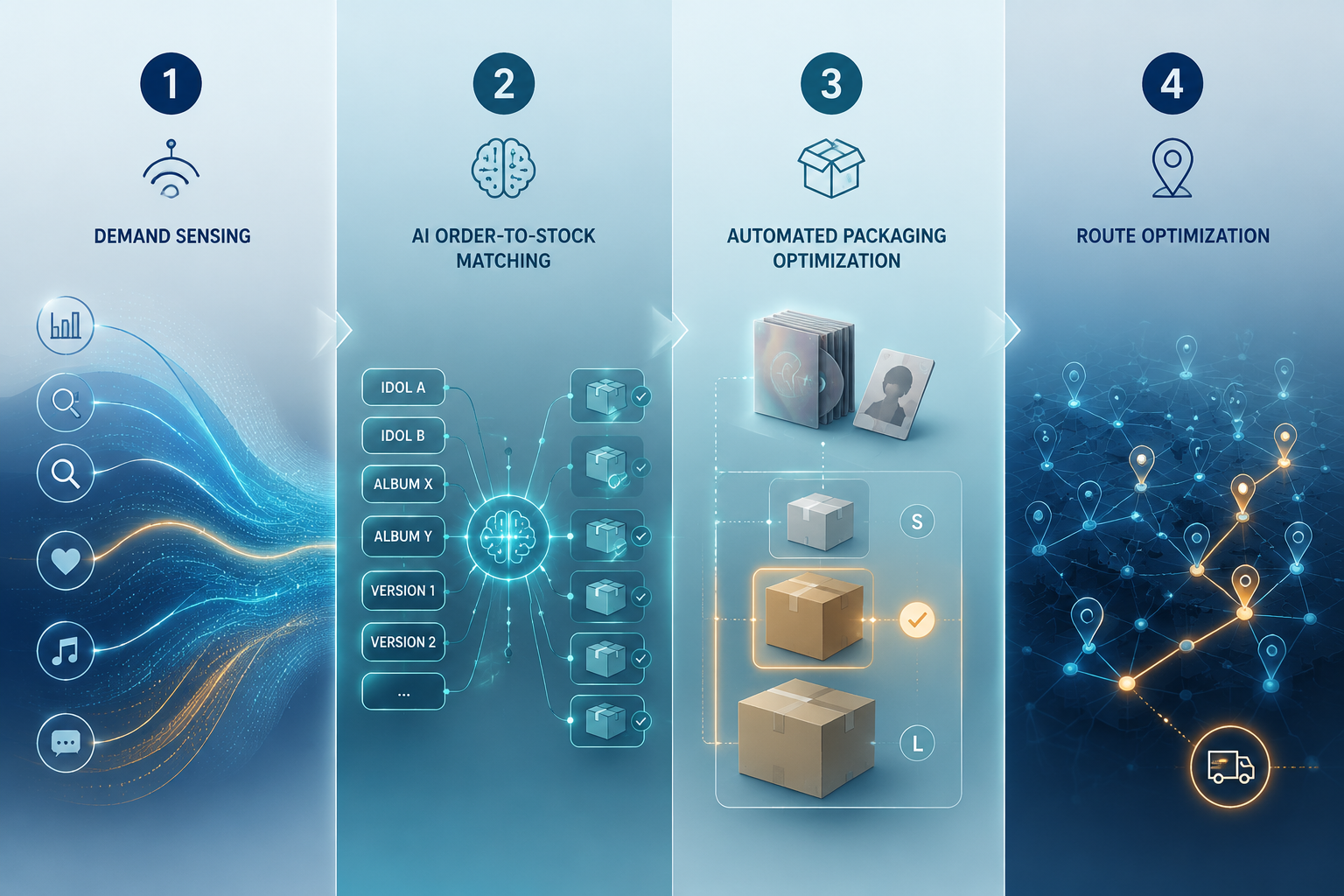
The answer appears to be less about a single forecasting model and more about a connected automation layer. Colosseum says COLO AI automates 26 core logistics processes, including AI Order Mapping, AI Packaging Mapping, and AI-driven route optimization.[5] DongA's 2025 coverage also described the system as part of a broader AI logistics operation, with attention to warehouse usability rather than only dashboard analytics.[6]
Demand Sensing Is Only the First Gate
In a K-pop album release cycle, useful demand sensing has to watch more than sales history. Preorder velocity, comeback announcements, fandom purchasing behavior, retailer campaign timing, and group order activity can all change fulfillment load before cartons move. A conventional forecast can be technically correct at the weekly level and still leave the floor short-handed on the wrong day.
The BTS “Arirang” case shows why. A first-week preorder count of 4.06 million is not just a commercial headline; it is a warning that receiving, storage, picking, packaging, labeling, customs documentation, and export handoff may all be compressed into a release-driven window.[3] The supply chain problem is not only how much demand exists, but how quickly decisions have to be re-sequenced.
Order Mapping Handles the Messiest Middle
AI Order Mapping is the part of the COLO AI case that deserves close attention. Colosseum describes it as keyword-based order-to-stock matching, a function aimed at connecting customer order language with the correct inventory record.[5] In K-pop exports, that can mean distinguishing album version, format, retailer benefit, bundle rule, and promotional insert even when the order data arrives with inconsistent naming.
That is not glamorous automation, but it is where errors are born. If “random version,” “set,” “member version,” “platform,” and a retailer POB code are interpreted differently by the commerce system, warehouse management system, and picker, the mistake may not appear until packing or customer complaint. A mapping layer that narrows those choices before the pick wave can remove a large amount of floor-level improvisation.
Packaging Mapping Matters More as Albums Get Lighter
The 24.2% drop in export weight in 2025, even as value rose, is a warning against treating albums as one physical profile.[1] A photobook album, card-type platform album, digipack, and benefit bundle may carry very different protection needs. Packaging too loosely wastes freight and material; packaging too aggressively can damage corners, bend cards, or force repacks when inserts are added late.
COLO AI's AI Packaging Mapping is described as material optimization.[5] The interesting part is not the generic promise of lower packaging cost. In this vertical, the packaging decision also has to preserve version integrity and benefit accuracy while keeping outbound flow moving. A system that proposes the right mailer, box, or dunnage pattern can take one more recurring decision away from packers during a surge.
Route Optimization Is the Back End of the Same Promise
Route optimization is often discussed as transportation math, but in export album logistics it is also a promise-management problem. A delayed export handoff can turn into thousands of fans asking the same retailer or group order organizer where their package is. COLO AI includes AI-driven route optimization among its automated processes.[5] The available material does not provide lane-level performance data, so the safe conclusion is narrow: route logic is part of the same automation stack, but the documented outcome metrics are reported at the fulfillment-center level.
Human-Facing Design Is Not a Cosmetic Detail
One of the more credible details in the Colosseum material is not a model name. DongA reported that the company developed an icon-based multilingual warehouse interface after identifying literacy barriers among U.S. warehouse workers.[6] That kind of design choice rarely appears in broad AI logistics claims, but it matters. If the system's recommendation cannot be understood quickly by the picker, packer, or exception handler, the ambiguity returns to the floor.
A hybrid human-AI model is not a soft compromise here. In a release spike, people still receive cartons, resolve damaged goods, handle missing inserts, verify exceptions, and explain late changes. The useful system is the one that makes the ordinary decision obvious and reserves human attention for the genuinely abnormal case.
That is also how the reported error-rate reduction should be interpreted. A 93% decline sounds dramatic, but without the baseline definition, order mix, audit method, and time window, it is not possible to compare it cleanly with another facility.[5] It does, however, point to the process area worth investigating: where did order interpretation, packaging selection, and exception handling become less dependent on individual worker memory?
Vendor Scale Provides Context, Not Proof
Colosseum is not a small lab project. The company has reported a 180% compound annual growth rate over five years, cumulative revenue of KRW 100 billion, roughly $72 million, by year six, a $20.8 million Series B in 2025, and service coverage for more than 10,000 brands across more than 53 centers in seven countries.[7] Those figures help explain why its K-pop fulfillment work can operate across markets, but they do not independently validate the LA productivity or error-rate results.
The Miljip partnership around BTS “Arirang” is more directly relevant because it connects Colosseum to event-driven fandom SCM and real-time tracking for a major release.[8] Even there, the evidence should be kept in proportion. It shows that the company is being used in a high-pressure K-pop distribution context; it does not prove that every future release will generate the same operating gains.
The timing of 2026 also complicates any simple growth story. The first-half export surge was partly linked to BTS's first comeback in nearly four years and BLACKPINK's new release, while 2025 full-year growth over 2024 was only 3.4%.[2] For logistics buyers, that distinction matters. A network built for release spikes is valuable, but a spike year should not be mistaken for a smooth permanent demand curve.
Vault Is Worth Watching, but Not Yet Evidence
Colosseum launched its Vault Physical AI platform in July 2026, with the stated goal of compressing automation proposal cycles from months to two days.[9] That is potentially useful in a category where release calendars and product formats change quickly. But the available material does not include published performance data for Vault, so it belongs in the watchlist rather than the evidence file.
If Vault can turn facility constraints, product profiles, and automation options into a practical deployment plan faster than a traditional consulting cycle, it may help operators prepare for volatile album programs. Until measured outcomes are available, the stronger case remains COLO AI's reported fulfillment-center results and the process architecture behind them.
What to Look For Before Applying This Pattern Elsewhere
K-pop album export logistics makes AI look useful because the pain is specific. Demand moves in bursts. The product mix fragments. Naming conventions drift. Packaging profiles diverge. Workers must execute quickly even when commercial instructions arrive from several upstream actors. An AI-native logistics platform is better suited to that environment when it changes the work sequence, not merely when it improves a forecast chart.
- Look for process-level automation that covers order mapping, packaging mapping, routing, and exception flow rather than a standalone demand model.
- Check whether the system can map inconsistent order keywords to inventory records without pushing routine interpretation to supervisors.
- Evaluate packaging logic against the real product mix, especially when lighter formats and premium inserts travel together.
- Inspect the warehouse interface, including multilingual or icon-based workflows, because adoption depends on front-line clarity.
- Ask for attributed outcome data with baselines, time windows, order mix, and audit methods before comparing performance claims.
The Colosseum case supports a qualified conclusion: AI-native logistics platforms appear better matched to K-pop album export volatility and SKU complexity than conventional systems built around steadier catalog assumptions. The evidence is strongest where it is closest to the floor: COLO AI's 26-process automation layer, its order-to-stock and packaging mapping functions, the icon-based warehouse interface, and the reported LA fulfillment-center improvements.[5][6] It is weakest where the claims broaden into general market inevitability.
For another demand-volatile category, the lesson is not to copy the K-pop story wholesale. The better test is whether the platform removes ambiguity at the points where volatility becomes physical work: receiving, slotting, picking, packing, exception handling, and export handoff.
References
- K-pop album exports top $300 million for first time, Korea.net, Jan 2026.
- K-pop album exports jump 125 pct in H1, Yonhap News Agency, Jul 2026.
- BTS 'Arirang' pre-orders reach 4.06 million in first week, Maeil Business Newspaper, 2026.
- Interview with Colosseum CEO on K-pop group order logistics, Maeil Business Newspaper.
- Colosseum COLO AI LA fulfillment center performance announcement, PRNewswire, Dec 2025.
- Colosseum automates logistics with AI and expands global fulfillment operations, DongA Ilbo, Aug 2025.
- Colosseum raises Series B and reports growth metrics, KED Global, 2025.
- Colosseum partners with Miljip for BTS 'Arirang' fandom SCM, Maeil Business Newspaper, Feb/Apr 2026.
- Colosseum launches Vault Physical AI platform, Maeil Business Newspaper, Jul 2026.
Comments
Join the discussion with an anonymous comment.