
Ahead of Hurricane Ian, a roofing materials producer had a decision that looks simple only after the fact: put Florida-code-compliant shingles inside the Florida market before landfall, and send non-Florida-code shingles somewhere else. ClimateAi’s case study says that choice helped the company capture an additional $15 million in sales that would not have been available under a reactive model.[1]
The useful part of that story is not that an AI model saw a storm. A planner still had to turn a probabilistic signal into product, location, and quantity decisions while the forecast was uncertain and the finance conversation was still uncomfortable. The better question for AI inventory management in flood risk work is: what exactly changes in the inventory plan when the model says a market is becoming exposed?

That is where most flood-risk programs either become operational or remain decorative. A risk score has to become a changed purchase order, a transfer order, an allocation rule, or a reserved truck. If it cannot cross that line, it may still be interesting to a risk committee, but it has not yet helped the person who will be blamed for the stockout or the excess.
The Hurricane Ian Lesson Was SKU Discipline, Not Blanket Stockpiling
The roofing case matters because the inventory decision was differentiated. Florida-code-compliant shingles were staged where post-storm demand and code requirements would make them sellable. Non-Florida-code inventory was not simply pushed into the same constrained market because “more stock” sounded safer.[1]
That distinction is the difference between pre-positioning and panic buying. In a flood or hurricane window, several signals arrive at once: expected physical disruption, possible demand surge, blocked inbound lanes, supplier exposure, customer urgency, and local compliance requirements. A generic surge buffer treats those signals as one problem. An inventory staging model separates them.
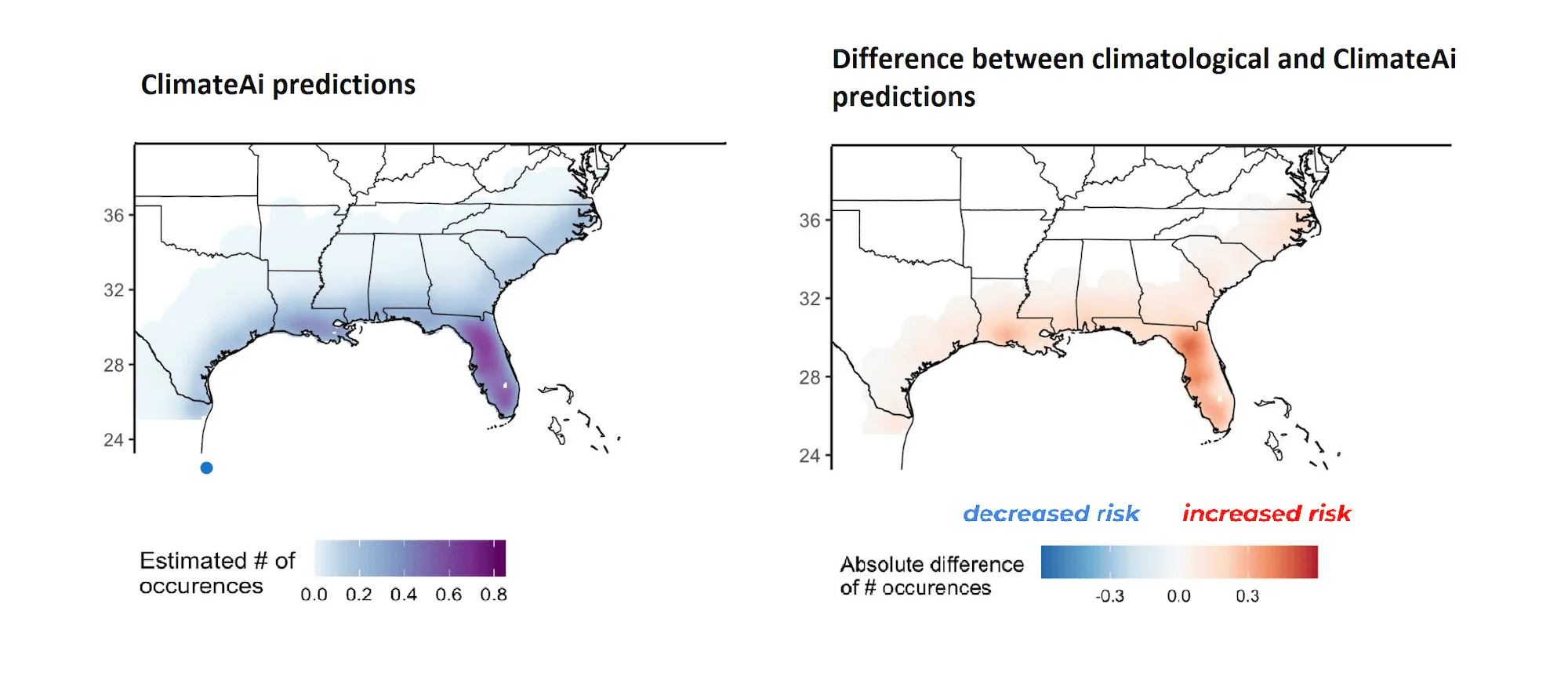
ClimateAi later described its forecast as identifying 30% to 50% higher hurricane risk in Florida weeks before Hurricane Ian made landfall.[2] Weeks are valuable only if the organization is allowed to act inside them. If every transfer above a normal replenishment threshold requires a new executive debate, the forecast lead time evaporates in approvals.
The pressure to build this capability is no longer theoretical. Resilinc reported that flood-related supply chain disruption alerts surged 214% year over year in 2024, while extreme weather events were up 119%.[3] Those numbers do not prove that every company needs the same tool or that every flood alert should trigger inventory movement. They do explain why waiting for a named storm to become an obvious operational emergency is becoming an expensive habit.
Start By Separating Three Decisions
Flood-risk inventory planning often gets discussed as if there is one decision: “Should we build stock?” In practice, three decisions need to be made separately, and mixing them creates bad plans.
| Decision | Planning question | Bad shortcut |
|---|---|---|
| What inventory matters | Which SKUs, components, or finished goods are exposed to disruption or likely to see demand surge? | Increase all safety stock in the region |
| Where inventory should sit | Which nodes are threatened, which nodes are safer, and which lanes are likely to remain usable? | Move everything closer to the forecast cone |
| How much buffer is justified | What staging cost is acceptable against expected stockout, lost-sales, or recovery-delay cost? | Fill available warehouse space because uncertainty feels dangerous |
The first decision is about item relevance. A retailer may care about bottled water, generators, batteries, and cleanup supplies. A manufacturer may care less about finished goods and more about a component made at one sub-tier site in the storm path. The same forecast can therefore produce opposite moves: stage one SKU into a market, pull another SKU away, expedite one component, and leave a slow-moving item alone.
The second decision is about node logic. “Near the customer” and “inside the risk zone” are not always the same answer. A distribution center close to demand may be useful before landfall and unusable after flooding. A safer inland node may be a better staging point if outbound lanes can be reserved and replenishment lead time is short enough.
The third decision is the one that usually exposes whether the company has a real operating model. Under uncertainty, the model will recommend some moves that later look unnecessary. That is not a failure by itself. The failure is pretending the organization can make probabilistic decisions while judging every false positive as waste after the storm misses.
How A Forecast Becomes An Inventory Target
A usable workflow does not begin with the ERP. It begins with probabilistic flood or hurricane intelligence: likelihood, timing, path, intensity, and affected geography. The forecast does not need to be certain. It needs to arrive early enough and in a format that can be mapped to products, facilities, suppliers, lanes, and customers.
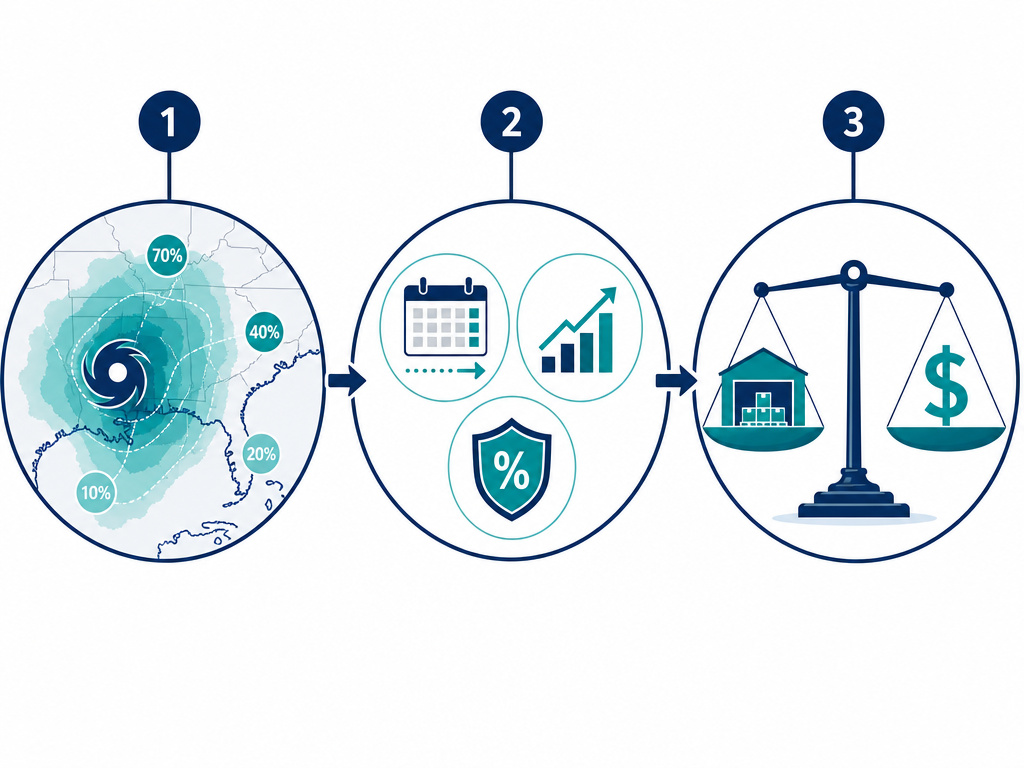
The translation layer is where AI inventory management for flood risk earns its keep. A weather probability has to become inventory language: affected SKUs, exposed supply locations, expected lead-time change, demand surge probability, transport constraints, warehouse capacity, and the time left before normal replenishment becomes unreliable.
- Forecast input: probability, timing, severity, and geography of flood or hurricane exposure.
- Inventory mapping: SKUs, components, suppliers, plants, distribution centers, stores, and customer regions connected to that geography.
- Operational variables: lead-time impact, expected demand change, available capacity, lane risk, service priority, and substitution rules.
- Optimization output: recommended quantities, staging nodes, pull-forward orders, allocation holds, and transport reservations.
For finished goods, the model may compare staging cost against expected lost sales if the market becomes unreachable. For production materials, the same logic may compare buffer cost against line-down risk. Z2Data describes an AI agent that identifies every part manufactured in a storm’s path while the storm is still forming and estimates lead-time impact, including an example of a six-week increase on identified parts.[4] That kind of BOM-level exposure matters because floods do not only interrupt demand. They also interrupt the parts that make the next production run possible.
The optimizer should not simply maximize inventory near danger. It should make trade-offs visible. A planner needs to see why the model recommends 12 days of buffer for one item, three days for another, and no move for a third. The explanation may be service level, margin, contractual penalty, customer priority, expiration risk, cube, weight, or the lack of a viable lane. Without that visibility, the recommendation becomes another black-box forecast competing with the planner’s judgment.
Do Not Confuse Demand Surge With Supply Exposure
The roofing example had a visible demand-side logic: after storm damage, Florida-code-compliant shingles were likely to be needed in Florida. But many flood-risk decisions are less obvious. A supplier in the path of a storm may produce a low-cost component that holds up a high-value assembly. A warehouse may be outside the worst rainfall zone but dependent on inbound lanes that run through it. A customer region may be safe but served by a threatened node.
That is why the item list should be built from both demand and supply exposure. Demand-side candidates include emergency-response goods, repair materials, consumables, replacement parts, and region-specific products. Supply-side candidates include sole-source components, long-lead parts, items with poor substitutability, and materials tied to facilities or suppliers inside the risk geography.
Once those lists are separated, the actions can differ. A demand-surge SKU may be staged forward into or near the affected market. A supply-exposed component may be pulled ahead into a plant far from the storm. A finished good with low regional relevance may be diverted away from a constrained warehouse to preserve dock doors, labor, and trailer slots for the items that matter.
The Quantity Decision Has To Price Uncertainty
The hardest inventory argument before a flood is rarely whether the event could happen. It is how much money the business is willing to place behind a probability. Too little buffer leaves sales, service commitments, or production continuity exposed. Too much buffer ties up cash, uses scarce space, and may strand the wrong product in the wrong region.
A practical optimization model should compare scenarios rather than produce a single heroic answer. For example, a moderate-risk scenario might justify moving only high-priority SKUs into a safer forward node. A higher-risk scenario might add pull-forward supplier orders, temporary allocation controls, or reservations for expedited freight. The point is not to eliminate judgment. It is to make the cost of each judgment explicit before the emergency call starts.
| Model input | Why it matters to the buffer |
|---|---|
| Flood probability and timing | Defines how soon normal replenishment may fail and how long inventory must cover demand. |
| Demand surge probability | Identifies items likely to sell faster because of preparation, damage, or recovery activity. |
| Lead-time impact | Shows whether replenishment can recover quickly or whether stock must cover a longer gap. |
| Margin, penalty, or service priority | Prevents low-consequence items from consuming scarce staging capacity. |
| Handling, shelf-life, and storage cost | Keeps expensive or perishable buffers from being treated like simple safety stock. |
| Transport and node capacity | Tests whether the recommendation can actually move before the window closes. |
False positives need to be priced into this logic. If a company stages inventory for a storm that shifts away, it may pay extra freight, handling, detention, or carrying cost. That cost should not surprise anyone after the fact. It is the premium the company agreed to pay for acting before certainty arrived.
Response Platforms Help, But They Do Not Grant Authority
There is a useful ecosystem shift toward earlier detection and coordinated response. Resilinc reported WarRoom activations on 59% of 22,522 disruption alerts in 2024, showing how many alerts moved into some form of collaborative response workflow.[3] That is different from proving that every alert created a better inventory move. Collaboration platforms can shorten the distance between detection and action, but they do not decide who is allowed to move stock, override allocation, or spend on premium freight.
This distinction matters during a flood window. A planner may see a strong staging recommendation on Tuesday and still lose two days because procurement wants a purchase-order justification, sales wants to protect a different customer, transportation has not reserved capacity, and finance wants to know whether the move is an exception or an approved operating mode.
The model can rank options. It cannot create authority in the middle of the storm. If pre-positioning has not been approved as a legitimate mode of operation, the organization will keep treating each early move as a special request. By the time everyone is comfortable, the lanes may be gone.
What Must Be Ready Before The Forecast Arrives
The readiness work is not glamorous, but it is what allows AI flood risk intelligence to change inventory placement instead of producing another dashboard. The company needs a contingency playbook that has already answered the questions people otherwise fight over during the event.
- Approval rights: who can authorize transfer orders, pull-forward purchasing, allocation holds, emergency substitutions, and premium freight.
- Cost thresholds: what carrying cost, expedite cost, and false-positive cost the business will tolerate at different risk levels.
- Product rules: which SKUs or components qualify for pre-positioning because of margin, customer priority, compliance requirements, lead time, or substitutability.
- Node rules: which facilities can serve as threatened-market staging points, safer inland buffers, overflow sites, or supplier-protection buffers.
- Logistics capacity: which carriers, lanes, trailers, containers, and warehouse labor options are reserved or pre-negotiated before demand spikes.
- Data readiness: whether item masters, supplier locations, BOMs, inventory balances, open orders, and lane data are accurate enough for the model to act on.
Master data deserves special suspicion. A forecast can be precise and still produce a bad staging plan if supplier locations are stale, BOM exposure is incomplete, inventory is recorded at the wrong node, or a region-specific compliance attribute is missing from the item master. In the roofing case, the Florida-code distinction was not a detail. It was the operational hinge.
The same is true for logistics. A model may recommend moving inventory before landfall, but transportation markets tighten as the event becomes visible. If carriers have not been contracted, alternative lanes have not been tested, and receiving sites have not planned labor, the recommendation becomes a late wish list.
A Practical Standard For Flood-Risk Inventory Programs
A mature program is not the one with the most dramatic risk map. It is the one where a forecast can trigger a controlled sequence of inventory decisions before the event is certain. The sequence should be boring enough to repeat: identify exposed or surge-relevant items, map threatened and safer nodes, calculate justified buffers, reserve logistics capacity, and document the cost trade-off before the move is made.
The ClimateAi roofing case is useful proof that forecast-driven staging can create value when the product-region logic is specific and the company acts early.[1] It should not be read as a universal $15 million promise. The transferable lesson is narrower and more useful: AI flood risk intelligence can lengthen the decision window, but only a prepared operating model can turn that window into the right stock in the right place.
Before trusting the next model output, ask whether the organization has already agreed who can approve the move, which costs are acceptable, which logistics options are available, and how it will tolerate a forecast that was reasonable but did not materialize. If those answers are not in place, the company is not yet ready to stage inventory before certainty arrives.
Comments
Join the discussion with an anonymous comment.