
After a drone attack interrupts a port, airport cargo terminal, border crossing, or shipping corridor, the first operational question is usually simple: when can freight move again? The second question arrives almost immediately from finance: what is this already costing, what can be proved, and what can be recovered? For companies carrying cargo through exposed gateways, AI is not an abstract technology category. It is a recovery problem measured in documents assembled under pressure, reroute quotes that expire, carrier deposits due before insurance responds, and policy language that may or may not treat the event as recoverable.
The pressure is not theoretical. Supply chain disruptions cost an average of $16 million per organization per year in direct procurement impacts, and McKinsey Global Institute estimates cited by Conexiom put the long-run effect of disruptions at roughly 45% of one year’s EBITDA over a decade for the average company.[1] Resilinc reported a 38% year-over-year increase in disruption notifications in 2025 and warned that 2026 was accelerating further.[2] A drone strike is only one form of disruption, but it concentrates the same financial problem into a shorter window: proof has to be collected while operations are still unstable.

The Claim Starts Before the Full Loss Is Known
A clean recovery diagram usually starts with damage and ends with settlement. Real incidents do not behave that neatly. The logistics team may know that a terminal gate is closed before it knows whether containers were damaged. Procurement may have a spot quote for alternate transport before legal has confirmed which policies apply. Finance may be asked to approve emergency spend before anyone can separate insured cargo damage from uninsured delay, increased cost, or war-risk exposure.
This is where AI-enabled claims handling has a practical role. It does not make the attack insurable. It does not remove the need for adjusters, brokers, lawyers, or underwriters. It can, however, shorten the handoffs between incident intake, evidence collection, claim classification, disruption costing, specialist review, and payment or escalation. In a recovery phase, that compression can matter as much as the eventual claim amount because cash decisions are being made while the situation is still moving. ChainSignal’s broader view of how AI maps to supply chain disaster preparedness phases is useful here: claims acceleration sits in recovery, but it depends on data discipline established before the event.
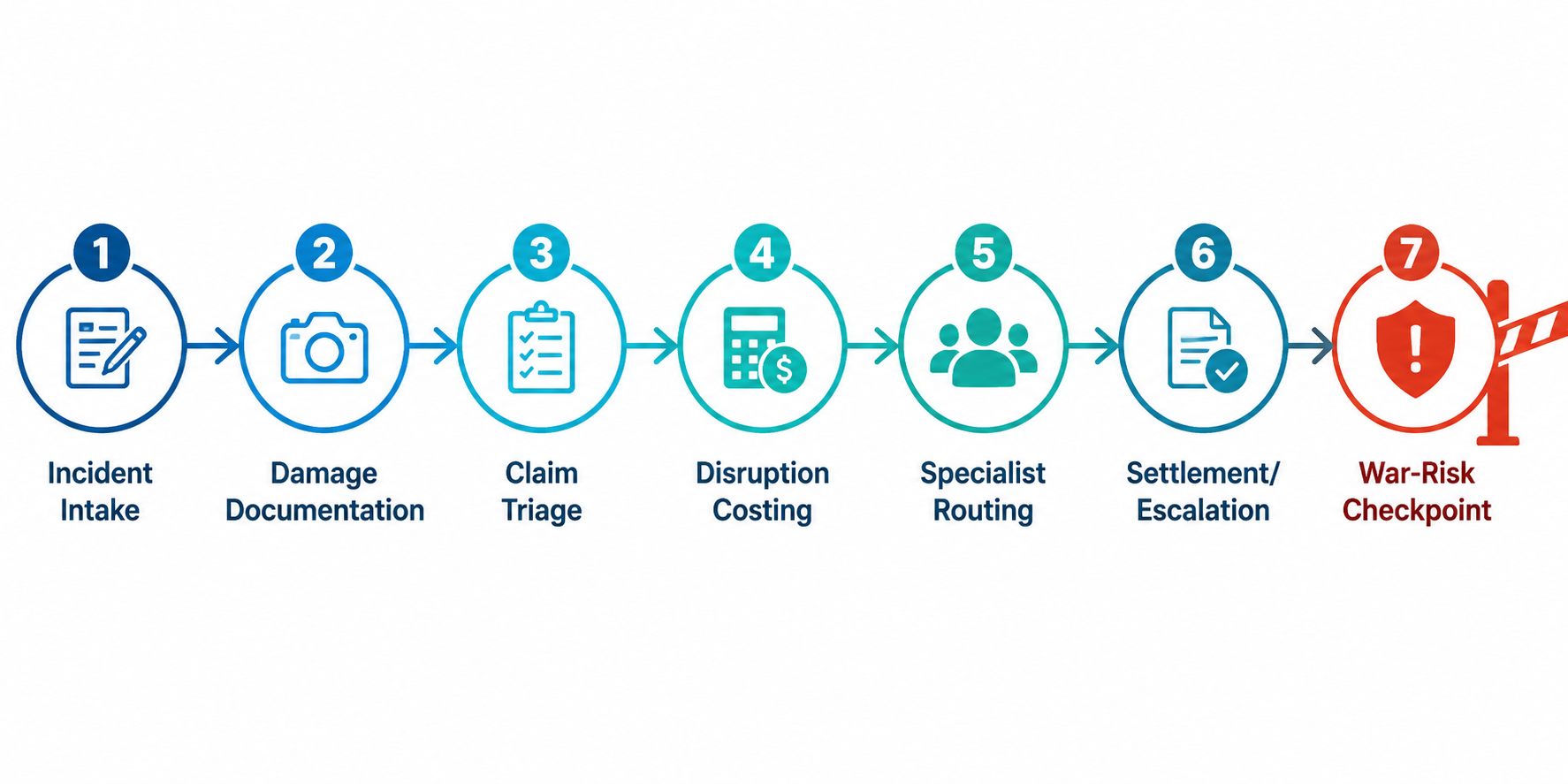
Where AI Shortens the Recovery Workflow
The useful way to evaluate AI in this setting is not to ask whether it can “handle a drone attack.” The better question is where it removes waiting from the claim file.
| Recovery point | What AI can compress | What still needs judgment |
|---|---|---|
| Incident intake | Capture initial reports, timestamps, location data, photos, shipment references, and policy identifiers | Whether the event should be treated as cargo damage, business interruption, political violence, terrorism, war-risk, or another category |
| Damage documentation | Check whether required documents are present and match the shipment, facility, or carrier record | Whether evidence is sufficient for contested causation or exclusion issues |
| Claim triage | Classify routine claims and flag missing or anomalous information | Whether a complex claim should move directly to specialists |
| Disruption costing | Update estimates as dwell time, reroute cost, substitute sourcing, and carrier charges change | Which costs are recoverable under the policy |
| Settlement or escalation | Move routine claims toward payment and package complex files for review | Coverage disputes, war-risk exclusions, and negotiated settlement positions |
The time savings become most credible in routine claims. SDCExec reports that AI-enabled systems can process routine cargo damage claims in hours instead of days, and it cites an American insurtech that automated 55% of claims end to end, with some claims settled in seconds.[3] Those examples should not be stretched into proof that drone-attack claims will settle in seconds. A strike on logistics infrastructure can involve damaged cargo, inaccessible facilities, delayed vessels, rerouting costs, sanctions concerns, and war-risk language. Still, the evidence shows what happens when the routine portion of the file no longer waits in a queue.
The practical gain is that ordinary claim work moves in parallel with operational recovery. An AI intake tool can read the first loss notice, match it to shipment records, request missing photos or invoices, and identify the policy and deductible. A document model can compare bills of lading, warehouse receipts, inspection reports, and carrier notices for mismatches. A triage model can separate a low-complexity cargo damage claim from a file that mentions restricted routes, military action, or loss of access to a port. A voice-enabled or agentic system can route the latter to a specialist rather than letting it sit behind simpler claims.
Aon describes AI as improving claims management across the lifecycle, from intake through payment, with efficiency gains coming from better routing, document handling, analytics, and decision support rather than from one isolated automation step.[4] That lifecycle framing matters after an attack because no single document tells the whole story. The first report says what happened. The transport management system shows what was supposed to move. The warehouse system shows what is physically held. Procurement systems show replacement cost and supplier alternatives. Finance systems show the cash impact. Claims recovery depends on connecting those records fast enough that the claim is not reconstructed weeks later from stale assumptions.
Disruption Costing Is the Hard Middle
Damage documentation is visible. A container is burned, a pallet is contaminated, a facility is inaccessible, a vessel is delayed. Disruption costing is harder because it changes while the recovery team is still making decisions. A reroute quote may only be valid briefly. A substitute supplier may require a deposit. A carrier may add security surcharges. A customer may assess penalties if the order misses a delivery window. The company needs a running estimate of the loss, not a polished postmortem.
AI helps when it turns operational movement into a claim-ready financial trail. The system can compare the planned route with the emergency route, tag incremental freight charges, pull revised estimated arrival times, and update dwell or storage exposure as conditions change. It can also preserve the sequence of decisions: when the gateway was impaired, when the alternate quote was obtained, when the carrier confirmed capacity, when procurement approved replacement supply, and when the customer was notified. That sequence is often the difference between a defensible mitigation cost and a general complaint that the disruption was expensive.
The same pattern appears in adjacent disruption-recovery settings. ChainSignal’s analysis of AI-enabled airline disruption recovery and spare parts supply chains covers AI-driven cost reduction patterns in disrupted operations. The relevant comparison is not that airline recovery and drone-hit logistics hubs are the same. It is that financial recovery improves when the organization can connect operational exceptions to cost consequences while decisions are still being made.
For claims teams, the quality of that evidence affects both speed and negotiation posture. A file that arrives with matched shipment IDs, invoices, inspection records, photos, route changes, replacement quotes, and a dated mitigation log is easier to triage than a file assembled from emails after month-end. AI does not remove the adjuster’s review, but it can reduce the number of basic questions that keep a claim from reaching the reviewer who can actually decide it.
The Routine Claim and the Complex Claim Should Not Travel Together
After a drone attack, one mistake is to let every related loss become one swollen claim file. Some elements may be routine: damaged inventory with clear custody records, repairable handling equipment, or documented temperature excursion after a power interruption. Other elements may be disputed: business interruption, loss of market, denial of access, political violence, terrorism, or war-risk exposure. AI triage is valuable when it keeps routine recoveries from waiting behind the hardest coverage question.
That split also protects the company’s internal cash discussion. Finance can see which recoveries are likely to move quickly, which are pending specialist review, and which may depend on policy interpretation. Operations can decide whether to keep paying for a reroute or shift to another mitigation path. Procurement can avoid treating a possible insurance recovery as cash already in hand.
Flexible Insurance Models Help, but They Still Need an Insurable Event
AI is also changing the shape of supply chain insurance products. SDCExec describes emerging models including pay-per-mile insurance, real-time risk assessment, and proactive theft or fraud prevention.[3] These models fit logistics better than annual, static assumptions because exposure changes by route, cargo type, carrier, season, and geopolitical context. A shipment moving through a stable inland corridor does not carry the same risk as cargo moving near a conflict-sensitive maritime chokepoint.
For drone-vulnerable logistics infrastructure, real-time risk assessment can support better decisions before and during a disruption. It can help identify cargo sitting in a high-risk node, flag routes with deteriorating conditions, or update insurance needs as a shipment deviates from plan. Pay-per-mile or usage-based structures can align premium with actual movement rather than broad averages. Proactive theft and fraud prevention can also reduce noise in the claim file by distinguishing suspicious documentation from disruption-driven anomalies.
The limit is that product flexibility is not the same as coverage availability. A better risk score can help an underwriter price exposure, and a cleaner claim file can help an adjuster move faster. Neither one forces the market to offer war-risk cover on terms the buyer can use.
The War-Risk Checkpoint Is Where the Workflow Can Stop
The hardest boundary sits between ordinary cargo or logistics claims and war-risk exposure. Crane Worldwide Logistics reported Hormuz war-risk premiums ranging from 3.5% to 10% of hull value per voyage, with quotes valid for only 12 hours, in operational updates covering the April to July 2026 period.[5] That data reflects a broader kinetic conflict environment involving maritime risk, not a clean drone-only dataset. As a proxy for drone-threatened corridors, though, it shows the part of the system that claims technology cannot repair.
A 12-hour quote window is not a software inconvenience. It is a procurement and finance constraint. A logistics team may find vessel capacity. A broker may obtain a war-risk quote. Finance may still need approval before committing to a premium that could consume a large share of the voyage economics. If the quote expires before approval, the decision resets under new market conditions. AI can surface the exposure, assemble the documentation, and model the cost of delay. It cannot create underwriting appetite.
This is where some AI narratives become too smooth. They describe faster claims as if the main problem is administrative friction. After a drone attack near a conflict-sensitive corridor, the main problem may be that the relevant loss sits inside an exclusion, a sublimit, a political violence wording dispute, or a war-risk layer that was never purchased. ChainSignal’s coverage of AI scenario planning for Middle East commodity and route shocks belongs upstream of this moment because route choices and coverage decisions have to be tested before the market hardens.

Adoption Is Growing, but the Evidence Is Still Indirect
The market is moving, but it is still early. Research and Markets data cited by SDCExec valued the AI in insurance claims processing market at $0.53 billion in 2026 and projected it to reach $0.97 billion by 2030, a 16.2% compound annual growth rate.[3] That growth supports the case that insurers, brokers, and claims administrators are investing in the tools. It does not mean most supply chain organizations already have AI-ready claim evidence, integrated policy data, or automated disruption-costing workflows.
There is also a specific evidence gap. The public claims-speed examples available here come from general supply chain insurance and claims operations, not from documented drone-attack insurance recoveries. The transferable lesson is about workflow compression: routine claims can move faster when intake, documentation checks, classification, routing, and payment workflows are automated. The unproven leap would be to say that those same systems have already solved drone-strike recovery at ports, airports, or maritime chokepoints.
That distinction matters for procurement and risk teams. Buying an AI claims platform or working with an AI-enabled insurer may improve recovery speed for well-documented, covered losses. It may also improve internal visibility into mitigation costs while the incident is active. But the organization still has to test policy wordings, exclusions, notification obligations, evidence standards, and war-risk purchasing procedures before the attack. The best claim engine is still downstream of the insurance contract.
What to Put in Place Before the Strike
The practical preparation is less glamorous than the technology pitch. Companies need shipment, carrier, facility, procurement, and finance data that can be connected quickly. They need claim-notification playbooks that name who opens the file, who approves emergency spend, who talks to the broker, and who decides whether a loss is routine or specialist-led. They need policy mapping that separates cargo damage, delay, business interruption, terrorism, political violence, marine war-risk, and contingent coverage rather than discovering those boundaries during the outage.
- Maintain current policy schedules, deductibles, exclusions, notice periods, and broker contacts in a format the recovery team can access during an incident.
- Predefine the evidence package for likely losses: photos, inspection reports, bills of lading, invoices, route records, carrier notices, repair estimates, replacement quotes, and mitigation approvals.
- Connect disruption costing to live operating data so reroute, dwell, storage, substitution, and penalty estimates update as the situation changes.
- Create triage rules that let routine cargo claims proceed while complex war-risk or political violence questions move to specialists.
- Set approval procedures for short-validity war-risk quotes so finance is not making its first decision after the market has already moved.
AI can support each of those tasks, but it should not be asked to compensate for missing decisions. If the policy does not respond, a faster file only proves the loss sooner. If the evidence is incomplete, automation will find the gaps faster, not erase them. If war-risk cover is unavailable or unaffordable, real-time costing may clarify the tradeoff between moving and waiting, but it will not turn an uninsured exposure into a recoverable claim.
The Procurement and Finance Judgment
AI is becoming a valuable recovery layer after drone attacks on logistics infrastructure. Its strongest role is in the middle of the recovery workflow: capturing incident data, checking documents, classifying claims, updating disruption costs, routing complex files, and allowing routine recoveries to move without waiting for every disputed issue to be solved. In the best cases, that can shift parts of the evidence-to-payment cycle from days to hours, and for highly automated routine claims, sometimes much faster.
The decisive question still comes earlier. Before the drone strike, has the organization bought the right coverage, tested the exclusions, prepared the evidence trail, and created authority to act when war-risk pricing is volatile? If the answer is yes, AI can help keep a logistics incident from becoming a liquidity argument. If the answer is no, the software may only deliver a faster view of an exposure the company cannot recover.
References
- Supply Chain Disruption Stats: 20 Costs (2026), Conexiom.
- Supply chain disruption is accelerating and why 2026 demands a new response, Resilinc.
- How AI Implementation Transforms Supply Chain Insurance, SDCExec.
- 5 Ways Artificial Intelligence Can Boost Claims Management, Aon, 2025.
- Middle East Logistics Operations Update, Crane Worldwide Logistics, April-July 2026.
Comments
Join the discussion with an anonymous comment.