
The hardest supply-chain question for an indoor farm is often asked before the crop is ready to answer it. A retailer wants dependable volume six to eight weeks out. The farm has trays, vines, climate recipes, labor plans, packaging slots, and a sales team that would rather not say “maybe.” If the commitment is too high, the farm buys itself a short shipment, a substitution fight, or a penalty conversation. If the commitment is too low, it leaves demand uncovered and may end the week with product that has no profitable home.
That is where AI work in the indoor farming supply chain becomes commercially useful. The valuable use case is not a general claim that algorithms make indoor farming work. It is narrower: AI yield forecasting and harvest scheduling can make a forward supply commitment more defensible when the model is tied to real production data, harvest strategy, and the commercial calendar.
The Contract Problem Comes Before the Model
Indoor farms control more variables than field agriculture, but they do not control the calendar after a purchase order is signed. Retail replenishment has fixed rhythms. Category managers need promotional windows, assortment plans, shelf-space assumptions, and DC inbound expectations. The grower has biological uncertainty: growth rate, grade, harvestable weight, labor timing, and whether a given batch will land in the right pack spec.
A crop plan can say what should happen. A contract asks what the farm will stand behind. Those are different documents. Static crop calendars are useful for capacity planning, but they are blunt instruments once commercial teams start negotiating weekly volume by SKU. They usually cannot see the current crop’s live response to climate, plant load, stress, or harvest strategy. They also do not price the consequence of being wrong.
The planner’s useful question is therefore not whether AI can produce a nicer yield curve. It is whether the forecast changes the commitment decision: how much volume can be promised, when it can be packed, how much buffer is needed, and where the risk window sits.
Why the 3-4 Week Horizon Carries So Much Weight
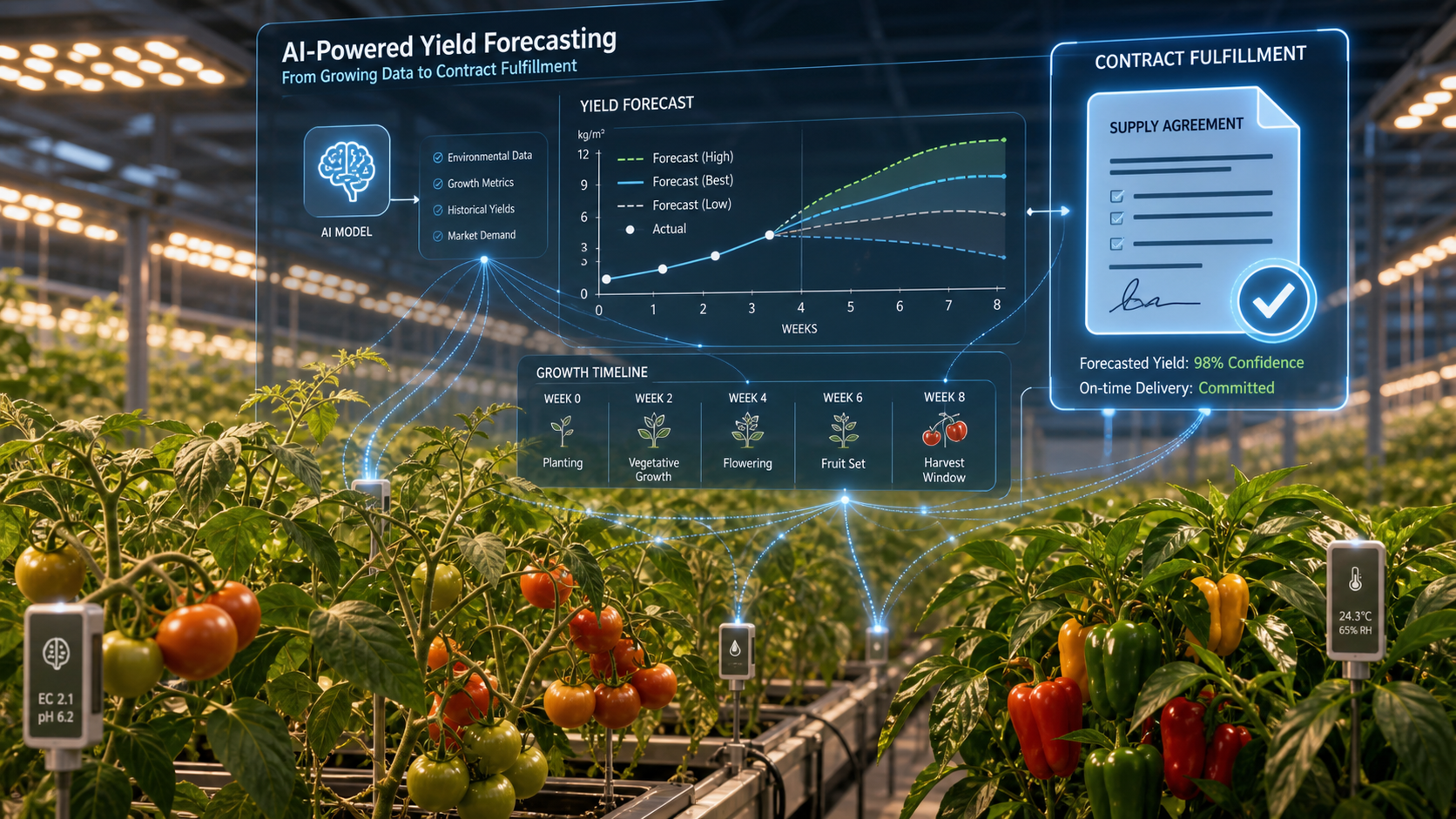
Source.ag’s Harvest Forecast is one of the cleaner public examples because it describes the planning horizon and the error reduction in operational terms. The company says the product reduces forecast error by over 40% at the critical 3-4 week horizon and can produce forecasts up to 8 weeks ahead using climate data, harvest strategy parameters, and real-time sensor data.[1]
That 3-4 week window matters because it is late enough for the crop to be sending meaningful signals, but early enough for a supply planner to still act. At that point, a farm may still be able to adjust harvest cadence, labor allocation, pack priorities, customer allocation, and sales expectations. It may still have time to warn a retailer, rebalance between accounts, or avoid taking on incremental demand that would make the base contract fragile.
The 6-8 week view does a different job. It is less about tomorrow’s picking list and more about whether a commercial promise should be made at all. A forecast extending up to 8 weeks ahead gives the seller and planner a shared starting point for retail negotiations: expected volume, timing, and the confidence band around the offer. The value is not that the eighth week becomes certain. The value is that uncertainty is visible before it is converted into a committed line item.
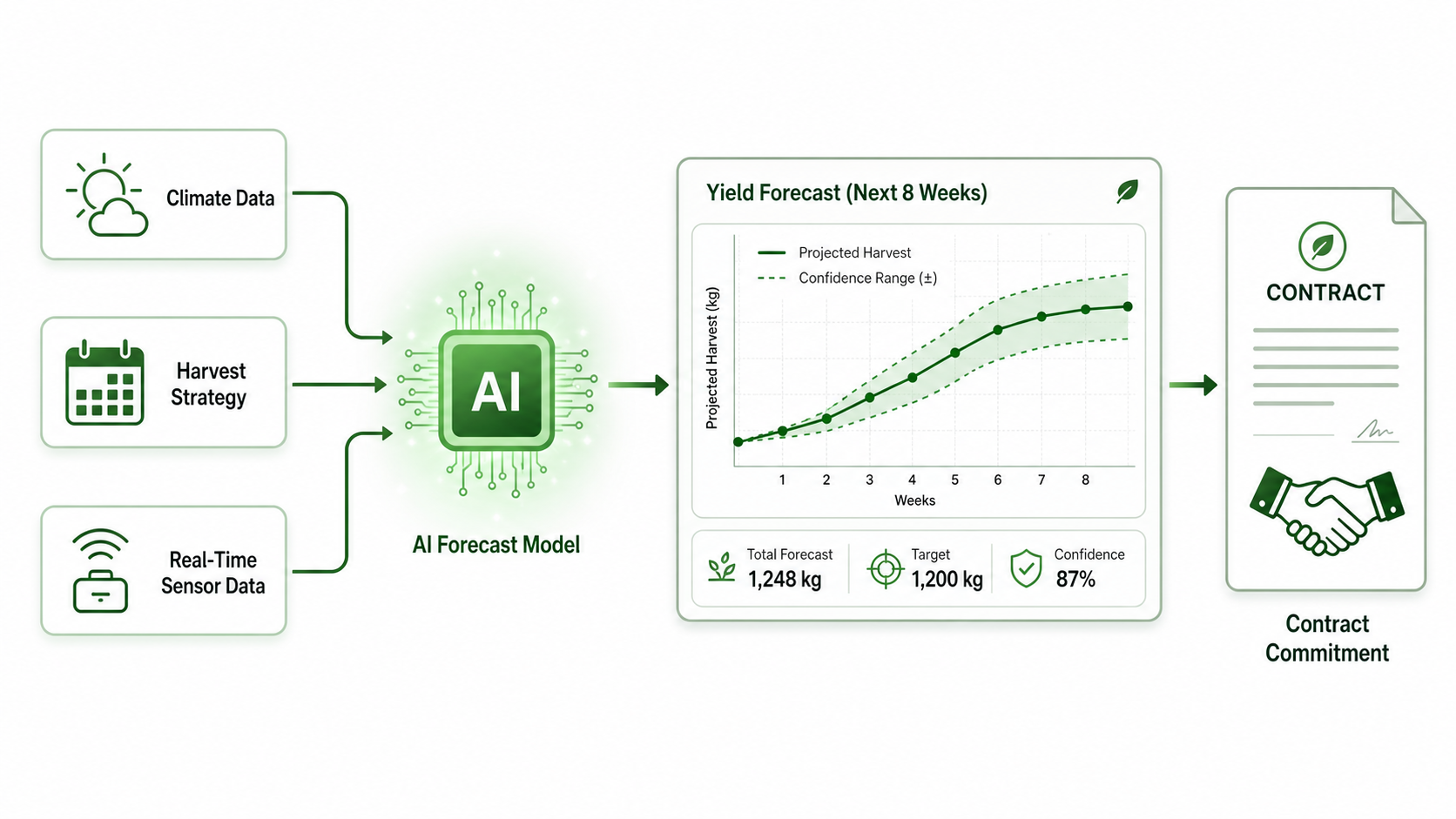
The input mix is also important. Climate data shows the environment the crop actually experienced. Harvest strategy parameters show how the operator intends to take fruit or greens off the system. Real-time sensor data reduces dependence on a generic calendar. Together, those inputs can support a rolling forecast that follows the crop rather than a static assumption that waits to be corrected at harvest.
The boundary around the evidence matters. Source.ag’s public validation context is greenhouse peppers and tomatoes, not a blanket proof point for every vertical farm, leafy green, herb, strawberry, or proprietary growing system.[1] A supply planner can still learn from the pattern, but the number should not be lifted into a different crop or facility without local validation.
What the Forecast Has to Change in the Weekly Plan
A forecast earns its place in the supply chain when it changes the operating decision. For an indoor farm selling into retail, that usually means four decisions become less improvised:
- Commit volume: the quantity the farm is willing to put into a retail supply agreement for a future delivery week.
- Holdback: the amount kept uncommitted because the risk band is still too wide.
- Allocation: the choice of which customers receive constrained volume if harvest falls below plan.
- Disposition: the plan for product that arrives above demand, below grade, or outside the agreed timing.
Without a credible forecast, these decisions drift toward either optimism or excessive buffers. Optimism shows up as overcommitment: sales takes the order, operations hopes the crop fills out, and replenishment inherits the shortage. Excessive buffering shows up as under-selling: the farm protects itself from penalties but gives up revenue and may still create waste if the harvest lands better than expected.
The better use of AI forecasting is not to remove the buffer. It is to size the buffer against current production evidence. A narrow confidence window can support a stronger commitment. A widening window can trigger earlier commercial caution. A known timing shift can move labor, packaging, or customer allocation before the truck is due.
| Planning question | What AI forecasting needs to provide | Commercial consequence |
|---|---|---|
| Can we sign the requested weekly volume? | Expected harvest volume with a risk window for the delivery period | More disciplined commitment instead of hope-based selling |
| Do we need to warn the buyer? | Early signal that harvest timing or grade is moving away from plan | Earlier substitution, allocation, or order adjustment |
| How much product should remain uncommitted? | Confidence range tied to live crop conditions | Lower buffer inventory when risk is genuinely lower |
| Where does surplus go? | Forward view of likely excess by timing and pack type | Earlier secondary-channel or processing decisions |
From Forecast Accuracy to Cost Exposure
The supply-chain economics are easy to overstate and too important to ignore. A 2025 WJAETS study reported that AI-driven demand forecasting in agricultural supply chains reduces inventory costs by 15-25% and post-harvest losses by up to 30%.[2] Those figures come from broader agricultural supply chains, so they should not be treated as indoor-farm-specific guarantees. They do show why forecast accuracy has a financial path: less inventory held against uncertainty and less product lost after harvest.
For indoor farms, the same cost categories appear in more compressed form. Product is perishable. Shelf-life expectations are tight. Premium positioning can make a downgraded or late product harder to place. If the farm harvests more than the committed channel can absorb, the planner has to find a buyer quickly or accept margin erosion. If it harvests less than promised, the cost may appear as expedited freight, retail penalties, lost promotional trust, or a buyer who reduces future allocation.
Inventory cost reduction, in this context, is not only about pallets sitting in a warehouse. It includes safety stock decisions, excess packaging runs, labor scheduled against the wrong harvest volume, and product held for a demand signal that should have been challenged earlier. Post-harvest loss is not only a disposal bin. It can be discounting, short-code product, repacking, or a scramble into a weaker sales channel.
This is why harvest forecasting and demand forecasting need to meet in the same planning workflow. A crop model that predicts biological output but does not connect to customer commitments leaves the sales planner to translate risk manually. A demand forecast that sees retail pull but not harvest probability can still create impossible promises. The useful system sits between them: what the crop is likely to produce, what the market has asked for, and what the farm should commit.
Why Surviving Operators Treated AI as Infrastructure
The 2023-2024 indoor-farming shakeout made reliability a less glamorous but more serious topic. Industry reporting and public analysis have pointed to Gotham Greens, Bowery, and Plenty as operators that continued to invest in AI-enabled or proprietary systems while much of the sector faced restructuring pressure.[3][4] That does not prove profitability, and private-company economics should not be read as audited evidence. It does show the strategic direction: the more serious operators did not treat forecasting as a dashboard accessory.
BoweryOS is often discussed as an example of platform-level integration: a system intended to connect crop monitoring, automation, and operating decisions rather than leave data trapped in isolated growing-room tools.[5] Plenty has also been described in industry coverage as using proprietary systems to manage production and planning decisions inside its controlled-environment model.[6] The relevant point for supply contracts is not whose software is more advanced. It is that these systems aim to make growing data usable for repeatable operations.
That distinction matters after a sector shakeout. Retail buyers do not only want local production, LED-lit consistency, or a compelling sustainability story. They want the case to arrive. If an indoor farm cannot translate controlled production into dependable replenishment, the technology advantage weakens at the loading dock.
Current operating status should always be checked before using any private operator as a live benchmark, especially for companies that navigated restructuring or financing stress during the 2023-2024 period. The safer lesson is operational rather than promotional: AI matters when it is embedded in production planning, harvest scheduling, sales allocation, and customer commitment routines.
Where the Claim Holds, and Where It Does Not
AI yield forecasting is strongest when the farm has enough consistent production history, disciplined sensor data, and a planning process that will actually use the forecast. A model trained on noisy records, inconsistent harvest definitions, or changing crop recipes will struggle to support a contractual promise. The same is true when commercial teams keep selling from a spreadsheet while the forecast sits in a separate technical system.
The crop also matters. Evidence from greenhouse tomatoes and peppers should not be casually transferred to every vertical-farm crop. Leafy greens, herbs, vine crops, berries, and mixed-SKU systems have different growth signals, harvest rules, grade constraints, and loss patterns. A planner should ask for crop-specific validation, facility-specific back-testing, and evidence that the forecast has been compared with actual harvests at the same decision horizon used for contracting.
The most useful implementation questions are practical:
- At what horizon is forecast error measured: 8 weeks, 6 weeks, 3-4 weeks, or harvest week?
- Does the forecast predict total biological yield, saleable yield, packable grade, or customer-ready cases?
- Can planners see confidence ranges, or only a single expected number?
- Does the system incorporate harvest strategy, or does it assume the crop will be picked the same way every cycle?
- Who is authorized to change a retail commitment when the forecast moves?
Those questions keep the use case grounded. A biological forecast does not become a supply-chain tool until it changes a PO, a production schedule, a customer allocation, or a disposal-avoidance decision. The buyer does not need to know every sensor input. The buyer needs confidence that the promised volume has been tested against the crop’s actual condition and the farm’s operating plan.
The Practical Threshold
AI yield forecasting can make 6-8 week indoor-farm supply commitments more defensible when three pieces are connected: real production data, harvest strategy, and commercial planning workflows. The public Source.ag evidence is valuable because it ties forecast improvement to a specific decision horizon, with over 40% forecast error reduction at 3-4 weeks and forecasts extending up to 8 weeks ahead in its greenhouse context.[1]
That is enough to support a serious supply-chain use case. It is not enough to claim that AI guarantees profitability, eliminates crop risk, or automatically transfers broad agricultural benchmarks to every indoor farm. The right standard is more disciplined than that: can the farm commit this much volume, for this delivery window, with this visible risk, and can the planner act before the crop proves the forecast wrong?
References
- Harvest Forecast, Source.ag
- WJAETS-2025-0925, WJAETS, 2025
- The Economics of Vertical Farming, Food Lore
- WEF/UMSL analysis on vertical farming, World Economic Forum / UMSL
- Montel blog coverage of BoweryOS, Montel
- Vertical Farming Show coverage of Plenty proprietary systems, Vertical Farming Show
Comments
Join the discussion with an anonymous comment.