
Cruise food safety starts before anyone plates a meal. It starts when provisions come off a truck at a port, when a receiving clerk has minutes to match documents to pallets, when chilled product waits for space in a walk-in, and when a galley team inherits whatever the supplier, broker, port agent, and previous shift recorded correctly. That is the practical problem behind AI for food supply chain safety in cruise operations: not whether an algorithm sounds impressive, but whether it can catch a temperature drift, a missing supplier certificate, or a sanitation pattern while the ship still has a usable decision to make.
The stakes are unusually compressed at sea. Cruise ships source provisions through fragmented global supplier networks, operate with limited resupply once underway, and serve dense dining populations in an environment where illness can spread quickly. Under the CDC Vessel Sanitation Program, ships are inspected twice yearly and must score at least 86 on a 100-point scale or face re-inspection.[1] That threshold is not the whole food safety story, but it is a useful reminder: the record has to be ready, the controls have to be visible, and the risk has to be managed before an inspector or an outbreak investigation reconstructs what happened.
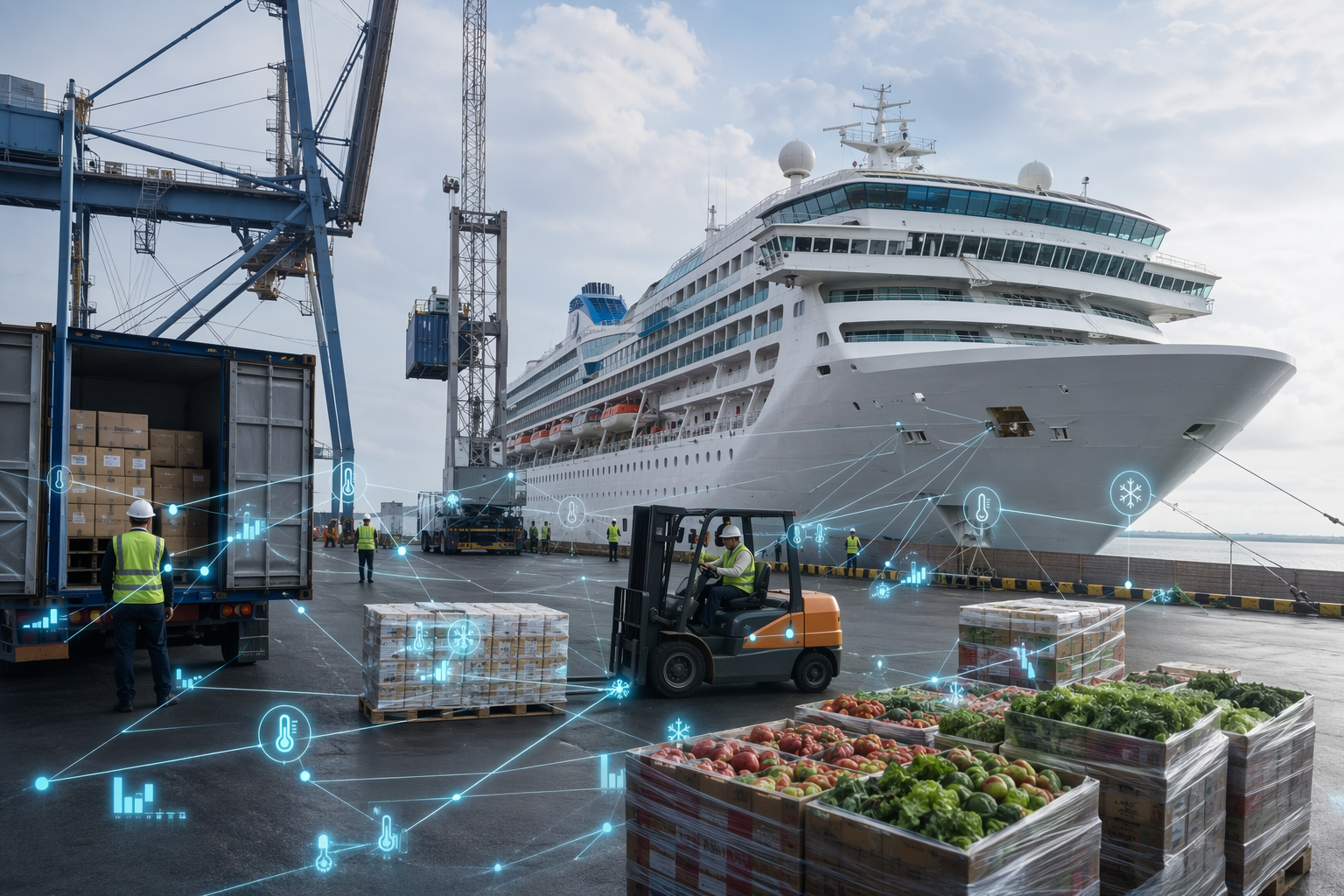
AI is useful in this setting for a plain reason: the risks are continuous, while many controls are still periodic. A refrigerator does not wait for the next log entry to warm up. A supplier certificate does not become more trustworthy because it is filed neatly after receiving. A sanitation gap that repeats across zones and shifts may be obvious to software long before it is obvious to a manager flipping through checklists at the end of the week.
But cruise operators also have to start with an uncomfortable fact. The industry may want AI, but its supply chain data is often not ready for it. At Seatrade Cruise Global, MSC Cruises procurement and logistics leader Paolo Raia described a “data gap,” saying AI needs qualitative data while cruise supply chains still rely on handwritten checklists and disconnected systems.[2] Carnival Corporation pointed to “accuracy in the data infrastructure” as the key enabler for downstream supply chain AI, with harmonization needed across 8 brands that do not all buy, record, or manage data the same way.[2]
That is the central tension. Cruise food safety is a strong AI use case because the operation produces constant risk signals. It is also a hard AI use case because too many of those signals still live in paper logs, local spreadsheets, supplier portals, email attachments, and brand-specific purchasing practices.
Where AI Fits Between Receiving and Service
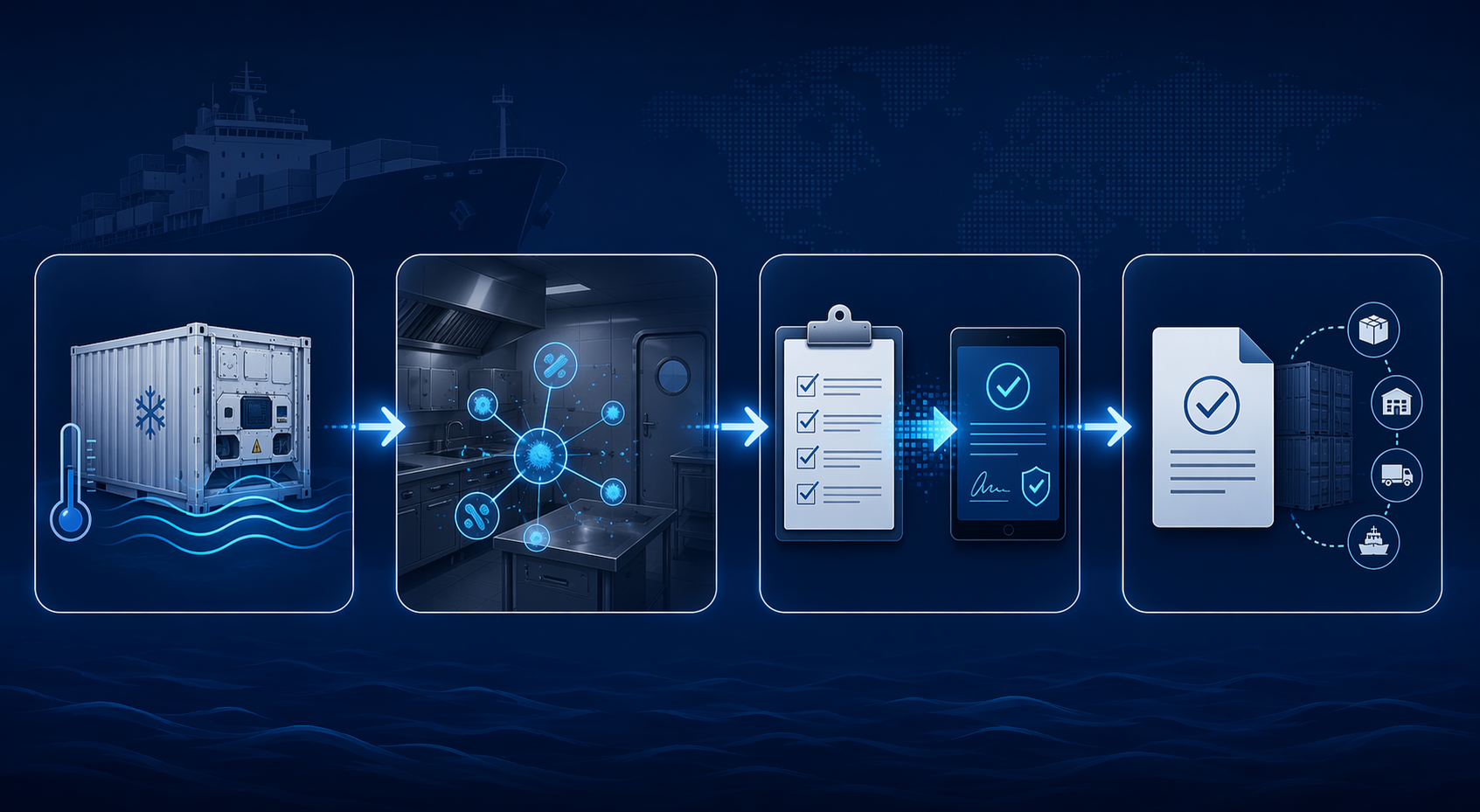
The better way to look at AI food safety on a ship is not as one system that “automates compliance.” It is an operating chain. Each link catches a different kind of risk at a different moment: temperature before spoilage, environmental patterns before contamination spreads, process deviations before records have to be rebuilt, and supplier document anomalies before goods reach the galley.
| Operating point | AI-assisted signal | Decision it should support |
|---|---|---|
| Cold storage and transport | Temperature drift patterns from sensors and historical data | Move product, investigate equipment, or reject product before spoilage risk rises |
| Galley and food production zones | Environmental monitoring patterns across shifts, surfaces, and locations | Clean, test, isolate, or retrain before a recurring risk becomes normalized |
| HACCP and process control | Digitized SOPs, task records, corrective actions, and audit trails | Show what happened without rebuilding records after the fact |
| Supplier intake | COA checks against requirements and supplier history | Hold, accept, escalate, or reject incoming goods before they enter production |
Those decisions matter because the ship has less room for correction than a land-based hotel. A restaurant can often replace a supplier shipment the same day. A ship that has already sailed may be choosing between constrained inventory, alternate menu plans, quarantine of suspect product, or accepting risk that should have been stopped at receiving.
Cold-chain monitoring becomes more valuable when it predicts drift
Manual temperature checks have a basic weakness: they sample a condition that changes continuously. A walk-in cooler can run warm between checks. A refrigerated container can be exposed during unloading. A freezer door can be held open through a busy provisioning window. If the only record is a handwritten line at fixed intervals, the food safety manager sees a few points, not the curve.
AI-powered cold-chain monitoring changes the value of temperature data by turning it into a live pattern. Smart Food Safe describes AI cold-chain monitoring as a shift from periodic manual checks to continuous predictive signals, with alerts that allow intervention before spoilage occurs.[1] That claim is vendor-authored, so it should not be treated as independent evidence that cruise outbreak rates have fallen. Still, the workflow logic is sound: a predictive alert is useful if it reaches someone while product can still be moved, equipment can still be serviced, or a receiving decision can still be reversed.
The important unit is not the dashboard. It is the action window. A cooler trending out of range during embarkation day creates one kind of response. A container showing repeated deviations across ports creates another. A supplier lane that repeatedly arrives near the edge of tolerance becomes a procurement issue, not just a galley issue. AI earns its place when it shortens the gap between signal and intervention.
Environmental monitoring can reveal patterns that shift reviews miss
Food safety failures in galleys are rarely dramatic at first. They often look like small misses: one zone cleaned late, one recurring surface result, one handoff where the next shift assumes the last shift finished the corrective action. Manual review can catch these issues, but usually after records are collected, organized, and interpreted.
AI-assisted environmental monitoring is meant to connect observations across zones and shifts. Smart Food Safe gives the example of pathogen-risk pattern detection, including Listeria risk patterns, that manual review cycles may miss.[1] Again, that is a vendor source, not a cruise-specific independent outcomes study. The narrower and more defensible point is that pattern recognition can make environmental monitoring more operational: it can point managers toward the zone, shift, product flow, or cleaning sequence that deserves attention before the next audit packet is assembled.
This is especially relevant on ships because spaces are dense and work is continuous. A galley may not have the luxury of shutting down a whole area for extended investigation. If software can show that risk indicators cluster around a certain preparation area, late-night cleaning window, or equipment group, the food safety team can target the intervention instead of treating the whole operation as equally suspect.
Digital HACCP is less glamorous than prediction, and often more necessary
The phrase “digital HACCP” does not sound like the exciting part of AI. On a ship, it may be the part that decides whether any higher-level AI can be trusted. HACCP records describe what the operation intended to control, what it actually checked, who corrected a deviation, and whether the correction happened in time. If those records are late, incomplete, or handwritten in formats that differ by vessel or brand, the AI layer has very little clean material to work with.
IONI AI says digital HACCP systems can reduce pre-audit preparation from weeks to days by auto-generating plans from existing SOPs and process documents.[3] That is a vendor-reported benefit, not an independent cruise benchmark. Even so, the operational value is easy to recognize. The best compliance record is not the one rebuilt beautifully before an inspection. It is the one created as the work happened, with deviations and corrective actions attached to the right product, process, person, and time.
For cruise operators, digital HACCP also creates a common language across ships. One vessel may be strong on receiving checks but weak on corrective-action documentation. Another may have disciplined galley logs but inconsistent supplier attachments. Once the records are digital and structured, managers can compare practice across vessels without waiting for a pre-audit scramble to expose the differences.
Supplier COA automation moves verification closer to the dock
Supplier documentation is one of the places where cruise food safety can look controlled from a distance and messy up close. Certificates of Analysis arrive in different formats. Supplier histories may sit in procurement systems that food safety teams do not use daily. A port substitution may come with acceptable paperwork in theory but incomplete context in practice.
IONI AI describes AI-driven supplier COA automation as a way to cross-check incoming provision documentation against supplier history and flag anomalies before goods reach the galley.[3] That is the right timing. A missing or suspicious document discovered after product is stored, prepped, or served creates a record problem and a food safety problem. The useful alert is the one that stops the item at receiving or pushes it into a hold-and-review lane before the galley builds the menu around it.
This is also where AI can support procurement rather than merely police operations. If the same supplier, route, category, or port repeatedly generates documentation exceptions, the pattern belongs in supplier acceptance decisions. The food safety manager should not have to rediscover the same weakness at every receiving dock.
The Data Gap Is Not a Side Issue
Most AI food safety proposals sound clean when the input data is clean. Cruise operations are not usually that clean. They involve multiple brands, ships, ports, suppliers, purchasing teams, onboard managers, and inspection expectations. The same control may be recorded in different formats. The same supplier may appear under slightly different names. Corrective actions may be written in free text. Temperature logs may be split between sensors, clipboards, and local files.
That is why the Seatrade comments from MSC and Carnival matter more than broad market enthusiasm. MSC’s point about qualitative data and handwritten checklists goes directly to model reliability. Carnival’s emphasis on infrastructure accuracy and harmonization across 8 brands shows that the barrier is organizational as much as technical.[2] A model trained on inconsistent purchasing and compliance data will not become reliable just because it is deployed fleetwide.
Bad data creates two kinds of food safety risk. The first is missed detection: a model cannot flag a supplier trend, temperature pattern, or corrective-action gap if the underlying events were never captured in a usable form. The second is alert noise: if records are inconsistent, the system may generate enough questionable alerts that crews learn to work around them. In food safety, a tool that trains people to ignore warnings is worse than a tool with a limited scope.
This is where cruise operators should be careful with the word “scale.” Scaling AI is not the same as buying licenses for every ship. It means harmonizing item masters, supplier identifiers, receiving requirements, temperature data, HACCP task structures, corrective-action categories, and audit evidence. Without that groundwork, each vessel becomes a local exception, and the fleet view becomes a polished guess.
Regulatory Alignment Helps, but It Does Not Replace Operations
Frameworks such as FDA FSMA 204, SQF, and BRCGS give cruise operators useful alignment pressure around traceability, supplier assurance, and audit discipline.[3] They also create a reason to standardize records before a crisis. But alignment is not the same as control. A system can be mapped to a framework and still fail to catch a warming cooler, an incomplete COA, or an unresolved corrective action in time.
The same caution applies to the broader food industry conversation around AI. The Institute of Food Technologists frames AI as part of a shift from reactive to predictive food safety, with data and food safety culture playing central roles.[4] That is a useful direction, but cruise operators have to translate it into the places where the work happens: receiving docks, cold rooms, production zones, sanitation schedules, supplier approvals, and audit trails.
Market sizing should be treated as context, not proof of maturity. BCC Research has placed the AI in food safety market at $2.7 billion in 2024, with a projection to $13.7 billion by 2030 and a 30.9% CAGR, though year-range variations should be verified before relying on the figure in investment materials.[5] Growth expectations do not show that cruise-specific AI deployments have independently reduced outbreaks, inspection violations, or supplier rejection errors. The evidence base is still thinner than the sales language.
A Practical Adoption Path for Cruise Operators
The strongest starting point is usually not a fleetwide AI layer. It is a bounded pilot where the data is already close to operational reality and the intervention window is clear. Cold-chain monitoring is a natural candidate because temperature signals are continuous, objective, and tied to immediate actions. Compliance digitization is another because HACCP, receiving, corrective-action, and audit records become the foundation for every more advanced model.
- Start with a high-risk category, route, or vessel group where cold-chain deviations would have immediate consequences.
- Digitize the records that crews already use instead of creating parallel forms that will be completed after the shift.
- Connect supplier COAs, receiving decisions, temperature records, and corrective actions under consistent item and supplier identifiers.
- Measure whether alerts change decisions: product moved, shipment held, equipment checked, zone cleaned, supplier escalated.
- Expand only after the pilot shows that crews trust the alerts and managers can audit the underlying records.
That last point is easy to underweight. A food safety AI pilot should not be judged only by dashboard adoption or the number of alerts generated. It should be judged by whether it changes the timing of control. Did the receiving team reject or hold a shipment earlier than it would have before? Did engineering inspect a refrigeration unit before product was lost? Did sanitation correct a recurring zone issue before the next verification failure? Did procurement see supplier exceptions in time to change acceptance terms?
Cruise lines also need governance that keeps AI in its proper role. The system can prioritize, compare, and flag. It can make weak records visible. It can reduce the time between a signal and a review. It should not replace food safety accountability, supplier approval discipline, or onboard judgment. When a vessel is underway and the food safety manager has to decide whether to use, hold, discard, or substitute product, the model is an input to responsibility, not a substitute for it.
The Narrow Answer
AI can secure cruise food supply chains when it is attached to digitized temperature records, environmental observations, HACCP workflows, and supplier documentation. Its value is strongest when it catches risk early enough for someone to move product, clean a zone, hold a shipment, question a supplier, or prepare audit evidence from records that were created as the work happened.
It cannot compensate for missing, handwritten, or inconsistent operational data. A cruise operator that has not harmonized supplier systems, purchasing practices, temperature records, and compliance workflows should treat AI food safety as an emerging, high-potential use case, not as a ready fleetwide automation layer. The right first move is narrower: digitize the controls closest to receiving, cold storage, HACCP execution, and supplier verification, then let AI prove that it improves detection speed, intervention timing, audit readiness, and acceptance decisions.
References
- Food Safety at Sea: Preventing Foodborne Illness Outbreaks on Cruise Ships, Smart Food Safe, July 2026
- Cruise lines playing catchup with AI to help supply chain needs, Seatrade Cruise News
- How AI Is Transforming Food Safety in 2026: Compliance, Supplier COA, and Audit Readiness, IONI AI
- How AI Is Reshaping Food Safety, Institute of Food Technologists
- AI in Food Safety, BCC Research
Comments
Join the discussion with an anonymous comment.